Key Takeaways
- Revolut works in Nigeria in a limited way. So when you ask can I use Revolut in Nigeria? The answer is yes, but only if you opened an account in a supported country;
- While card payments and ATM withdrawals work in Nigeria, you can’t use Revolut as full local NGN account;
- If Nigeria is your main corridor, it’s better to use an alternative that’s fully available locally. Top-tier suggestions include Ogvio and Opay.
If you’ve been using money transfer apps, the name Revolut must be familiar to you. But does Revolut work in Nigeria? Technically, yes. But it’s limited, and it doesn’t operate as a full local finance system in the country.
Because so many core features are restricted, relying on Revolut alone can feel clunky if Nigeria is your main corridor. That’s why alternatives like Ogvio, Opay, and others can make more sense for everyday use and regular transfers.
If you want to know what Revolut can actually do in Nigeria and when it’s best to choose something else, keep reading.

Did you know?
Subscribe - We publish new crypto explainer videos every week!
5 Best Crypto Portfolio Diversification Strategies (Animated Explanation)


Table of Contents
- 1. Is Revolut Available in Nigeria?
- 2. What’s Possible for Revolut in Nigeria
- 2.1. Use Existing Account in Nigeria
- 2.2. Use the Revolut Card
- 2.3. Send Money to Nigeria
- 3. What’s Restricted for Revolut in Nigeria
- 3.1. Create a Revolut Account in Nigeria
- 3.2. Create a Revolut Card
- 3.3. Convert or Hold Nigerian Naira (NGN)
- 4. Revolut Alternatives That Work in Nigeria
- 4.1. Ogvio
- 4.2. Opay
- 4.3. PalmPay
- 4.4. Kuda Bank
- 5. Choosing the Best Revolut Alternative for Nigeria
- 6. Conclusions
Is Revolut Available in Nigeria?
Short answer: yes, Revolut works in Nigeria, but with clear limits. You can use an existing Revolut account in Nigeria for card payments and ATM withdrawals, as long as the terminal or ATM accepts Visa or Mastercard.
Latest Changelly Coupon Found:I looked for a clear, official reason why Revolut is limited in Nigeria, but there isn’t one spelled out publicly. The likely reason is regulating and licensing, which might be similar to what happened with Wise in Turkey.
At the moment of writing, Revolut supports sign-ups in the UK, most EU/EEA countries, the US, Australia, Singapore, and a few others. Nigeria is not on the sign-up list.
So, in short: Revolut is usable in Nigeria for card spending and ATM withdrawals, but sign-ups and local banking features are restricted. I’ll cover exactly what’s possible and what’s restricted in the next chapter.
Looking for more in-depth information on related topics? We have gathered similar articles for you to spare your time. Take a look!



What’s Possible for Revolut in Nigeria
Even though Revolut doesn’t fully operate in Nigeria, several features still work there. Regarding Revolut Nigeria availability, the app is mainly usable for people who already have an account in one of the supported countries.
So, instead of thinking about what Revolut can’t do in Nigeria, it’s more useful to look at what it can do in practice. Here’s what that looks like.
Use Existing Account in Nigeria
First things first: can I use Revolut in Nigeria? You can, as long as you already have an account. Like previously said, Revolut works in Nigeria for existing users who signed up in supported countries.
In simple terms, if you created your Revolut account in places like the UK, EU, US, or other supported regions, you can still open the app and use your account while you’re in Nigeria. The app doesn’t stop working just because you changed locations or traveled there.
This means you can still check your balance, manage your money, receive funds, and use your card like you normally would. The main limitation is that you’re using Revolut as a foreign account, not as a locally supported Nigerian app.
Overall, Revolut works in Nigeria if you already have an account. You just won’t get access to local sign-up or Nigeria-specific banking features.
Use the Revolut Card
The Revolut card is one of the most practical features you can use in Nigeria. You can pay with your card at merchants that accept Visa or Mastercard and withdraw cash from supported ATMs.
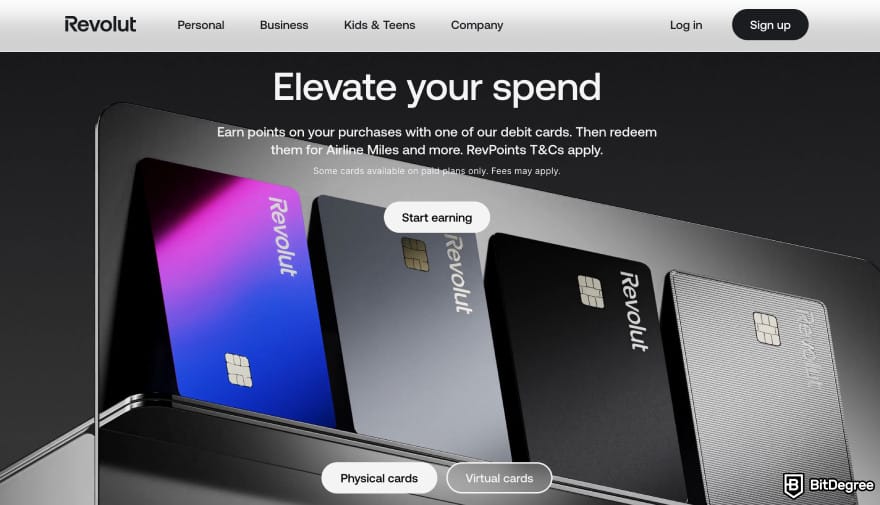
So if you’re wondering, “can you use Revolut in Nigeria along with its card?,” the answer is yes, as long as you already have a card issued from a supported country. You can use your Revolut card to pay for hotels, food, transport, or shopping in Nigeria.
Plus, when you pay in Nigerian Naira (NGN), Revolut automatically converts from your main balance, so you don’t need to manually exchange currencies in advance.
Aside from NGN, your Revolut card can handle 150+ currencies. Simply order a physical card or use a virtual card to start spending immediately.
You can also use the card for ATM withdrawals, although availability and fees depend on the ATM provider and location. Some machines may decline foreign cards, so it’s not guaranteed to work everywhere.
In short, the Revolut card works for spending and cash access in Nigeria, but you should expect occasional limitations depending on where you use it.
Send Money to Nigeria
The next part to answer is, “Can Revolut send money to Nigeria?” It can. Revolut supports sending money to Nigerian bank accounts, but again, only from supported countries.
You can send money from your Revolut account in places like the US, UK, or the EU to recipients in Nigeria. Transfer speed depends on the method used and the local banking rails involved. Some transfers can be relatively fast, while others may take longer to process.
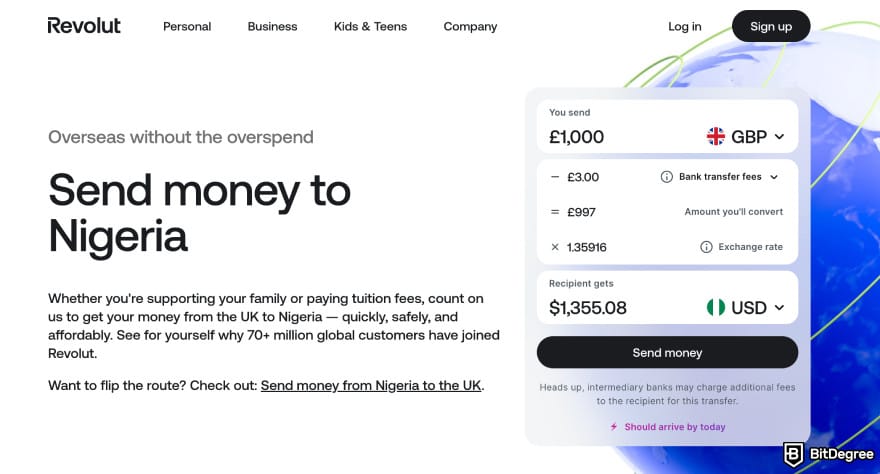
One of the main upsides is cost. Revolut typically uses its own exchange rate, which is closer to the real market rate compared to many traditional banks. Fees are usually shown upfront in the app, so you can see the total cost before confirming the transfer.
There are a few sending options, like bank transfer, card transfer, and mobile wallet transfer.
This option is mostly useful for people living abroad who want to send money to family, friends, or businesses in Nigeria. You can also use it for cross-border payments.
What’s Restricted for Revolut in Nigeria
Even though some Revolut features work in Nigeria, quite a few core functions remain limited. So if you’re wondering, can you use Revolut in Nigeria? The answer is yes, but only in a partial way. Now let’s look at what’s actually restricted and where the limitations start to show.
Create a Revolut Account in Nigeria
If you’re asking how to open a Revolut account in Nigeria, the short answer is that you can’t. Revolut doesn’t support account sign-ups for Nigerian residents, which means you can’t create a new account using a Nigerian address or local documents.
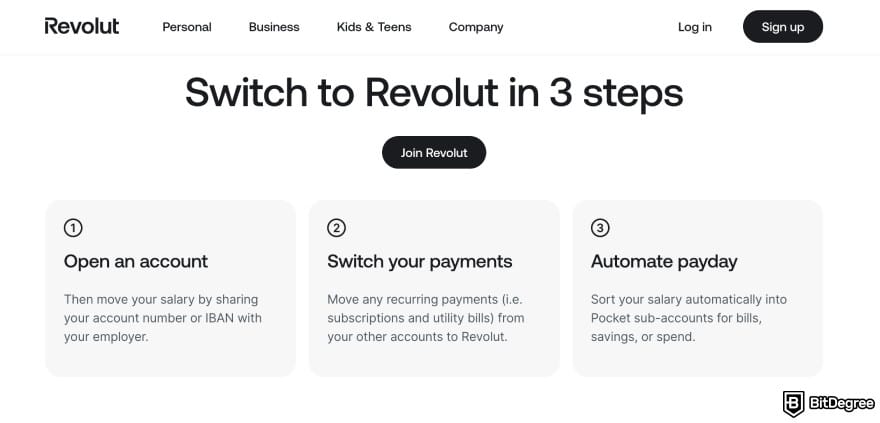
This is usually tied to how Revolut operates country by country. To allow local sign-ups, fintech apps need to meet local regulatory and licensing requirements, set up compliance processes, and often work with local banking partners.
So if you don’t already have a Revolut account from a supported country, you won’t be able to create one while living in Nigeria.
Did you know?
Subscribe - We publish new crypto explainer videos every week!
Crypto Mining Explained: How to Earn From Mining Bitcoin? (Animated)

Create a Revolut Card
Creating a new Revolut card doesn’t work in Nigeria. Since Revolut doesn’t support account sign-ups for Nigerian residents, you also can’t order a physical Revolut card or issue a new virtual card while you’re in Nigeria.
On top of that, card top-ups for your Revolut account aren’t available while you’re in the country. So before you travel, make sure your account is already funded, since you won’t be able to top up by card once you’re there.
Convert or Hold Nigerian Naira (NGN)
The next restricted thing for Revolut in Nigeria is holding or converting Nigerian Naira (NGN) directly inside the Revolut app. Revolut doesn’t offer NGN as a supported balance you can keep, top up, or manage like EUR, GBP, or USD.
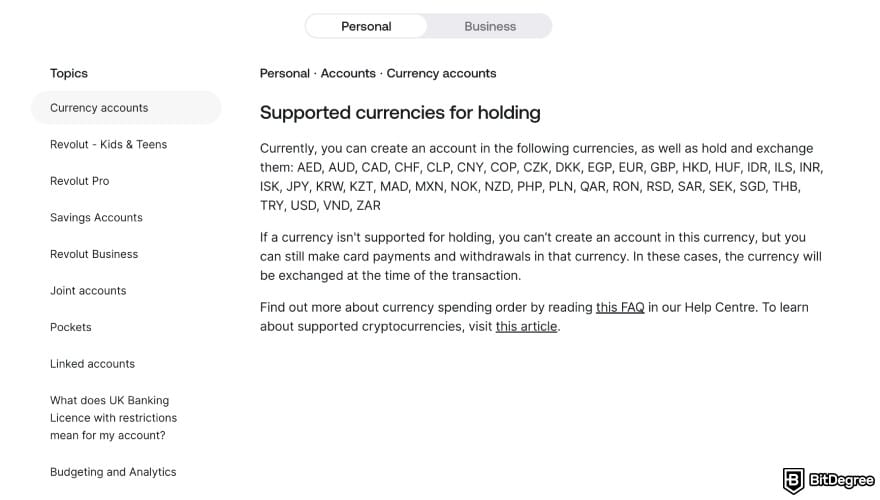
If NGN were supported, you’d normally be able to open an NGN balance in the app, exchange money into NGN in advance, and then use that balance for local spending or transfers. Since NGN isn’t available, Revolut instead converts your main balance automatically when you pay in Nigeria.
Revolut Alternatives That Work in Nigeria
Because of Revolut’s limits in Nigeria, it makes sense to look at alternatives that work fully for this corridor. If you live in Nigeria or regularly send money to and from Nigeria, it’s smart to look for a service that’s not limited to local sign-up or NGN balances.
This is where fintech apps and mobile money agents step in. Many of them use technology to close gaps in financial inclusion by lowering costs and making digital payments easier to access across Nigeria.[1]
Now, let’s go through some solid alternatives that work better in practice, starting with Ogvio.
Ogvio
Ogvio is a digital money app that lets you send, receive, and manage money across borders. It’s built to make international transfers feel more like local payments, without relying on traditional bank rails.
Among other key corridors, sending money to Nigeria is one of Ogvio's top priorities.
One of the main reasons Ogvio works well as a Revolut alternative in Nigeria is how it handles fees and FX. Transfers are designed to be low-cost, with little to zero fees in many cases, and rates are shown clearly before you confirm.
Ogvio also runs on blockchain infrastructure and supports crypto. This means you can move value using stablecoins or other supported crypto assets, which can be useful when traditional banking routes are slow or expensive. The good thing is that crypto adoption in Nigeria is widespread and isn't hard to track. It's become practical for daily use.[2]
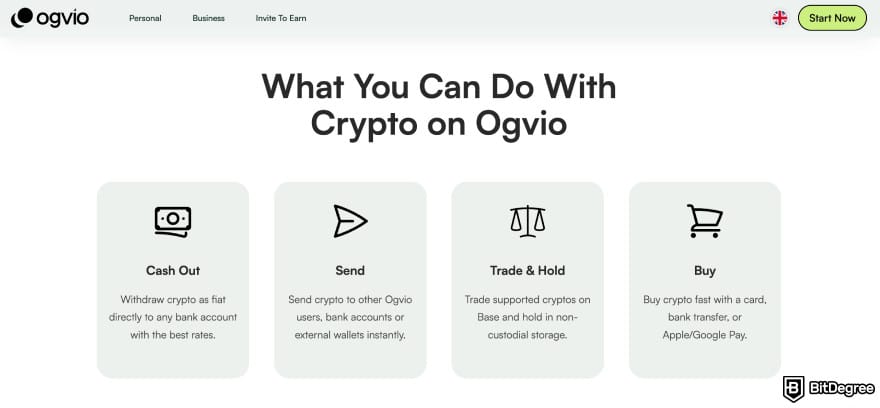
In terms of coverage, Ogvio supports a wider range of countries for onboarding and usage compared to Revolut’s limited setup in Nigeria. While Revolut works in Nigeria mainly for spending and withdrawals, Ogvio works for sending and receiving money in corridors involving Nigeria.
 |  | |
|---|---|---|
UK Germany Germany France France+160 more |  Australia Australia US USUK +38 more | |
| EN ID CN +6 more | EN ES IT +27 more | |
 USD USD EUR EUR CAD CAD+40 more |  AUD EUR USD AUD EUR USD+23 more | |
 USDC USDC BTC BTC ETH ETH+ 7 more | BTC ETH SOL SOL+220 more | |
| Visit site Read review | Visit site Read review |
Table: Comparing the country coverage between Ogvio and Revolut
On top of transfers, Ogvio also has a simple earning feature that lets you earn on your balance. This can be useful if you don’t want your money sitting idle between transfers. Simply go to the Earn menu when you’re on the Ogvio app.
When it comes to speed and limits, Ogvio is built for cross-border transfers, including to and from Nigeria. Transfer times depend on the route and method used, but in many cases, transfers are instant or faster than traditional bank wires.
If this sounds like a better fit for your case, here’s how to get started with Ogvio.
How to Use Ogvio
In this section, I’ll walk you through the basics of using Ogvio, from signing up and activating your account to funding it so you can start sending money. Let's go through the steps.
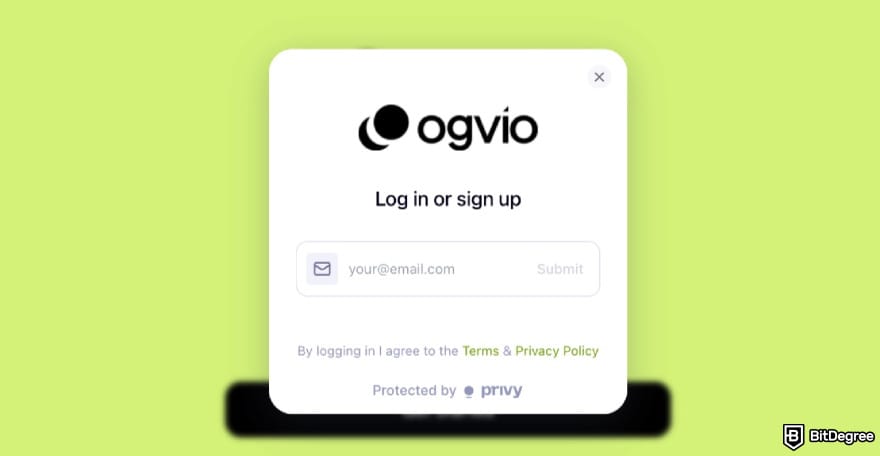
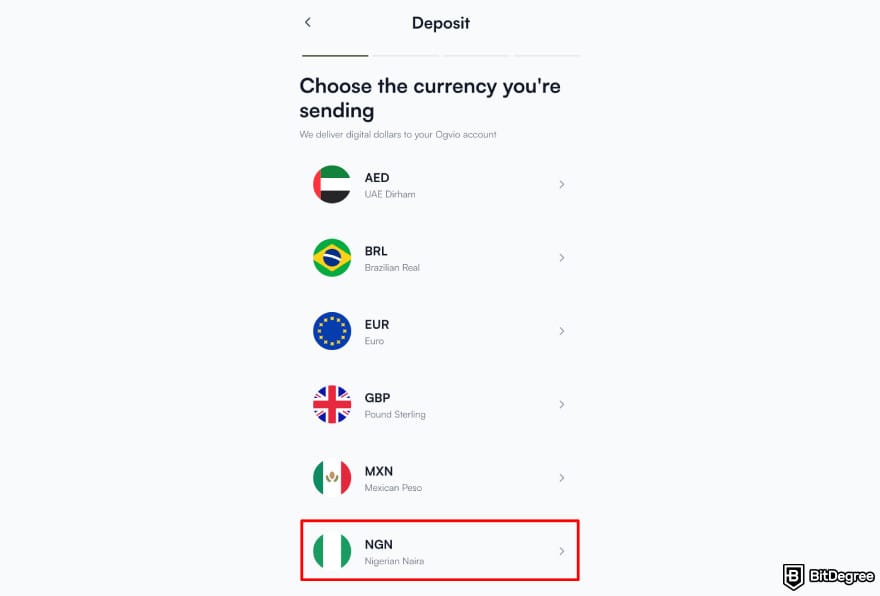
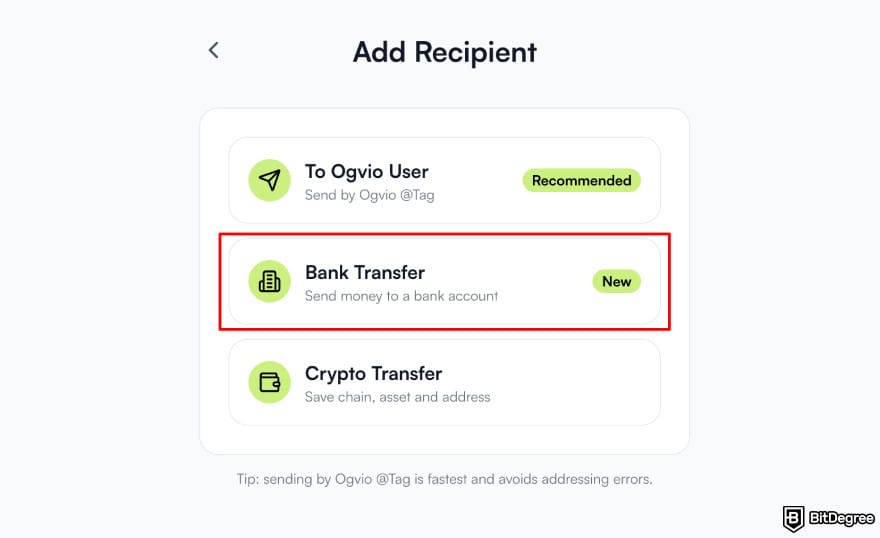
Once that’s done, all that’s left is to track your transfer in the app and wait for it to arrive. It’s a pretty straightforward flow once you’ve gone through it once, and the process gets quicker with repeat use.
📚 Read More: Ogvio Review
Opay
Opay is a popular mobile money app in Nigeria that lets you send and receive money, pay bills, and manage everyday payments from your phone. It works more like a local digital wallet and payments app than an international fintech like Revolut.
One of Opay’s biggest strengths is how easy it is to use for daily transactions. You can send money to other Opay users, transfer to Nigerian bank accounts, pay utility bills, buy airtime and data, and make merchant payments.
Transfers within Opay are usually fast, and fees are often low compared to traditional bank transfers for small, everyday payments.
Opay offers both personal and business accounts. Personal accounts are made for everyday users who want a simple way to manage money and pay for things. Business accounts are designed for merchants and small businesses.
Opay also provides debit cards that you can use for ATM withdrawals and card payments in Nigeria. This makes it easier to move between your Opay balance and cash or to pay at merchants that accept cards (without relying only on bank-issued debit cards).
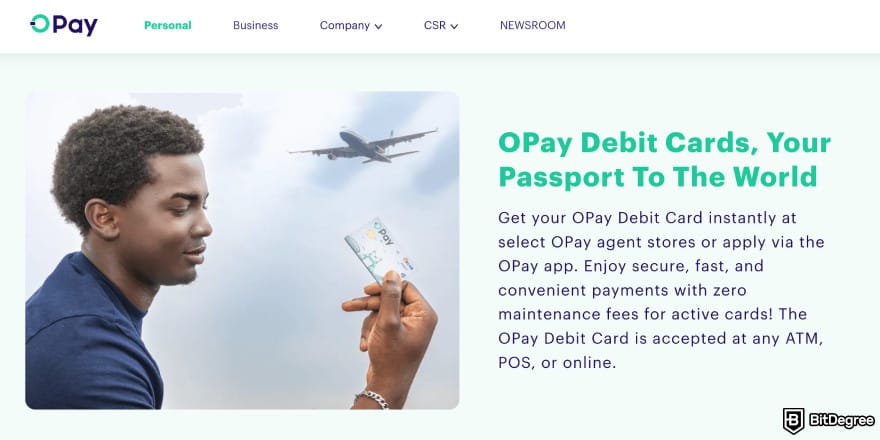
OWealth is Opay’s savings and earning feature. It lets users earn returns on idle balances, so your money isn’t just sitting there doing nothing. For many users in Nigeria, this works as a simple way to keep funds accessible while still getting some yield on their balance.
How to Use Opay
Now, we’ll go through the basics of using Opay. Once you’re set up, you can also explore features like topping up your balance, paying bills, and using your Opay card. Here’s the general flow to get started:
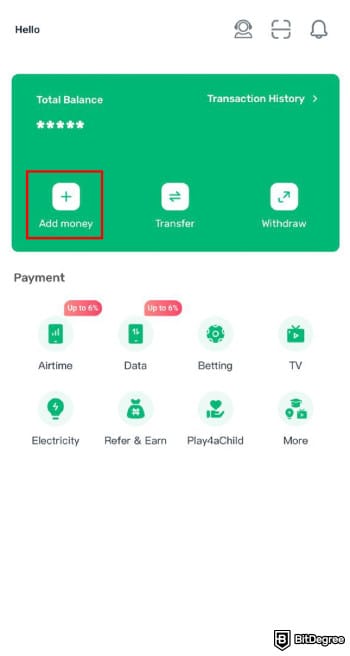
Once all is done, you can order and activate an Opay debit card if you want to use your balance for ATM withdrawals or card payments.
PalmPay
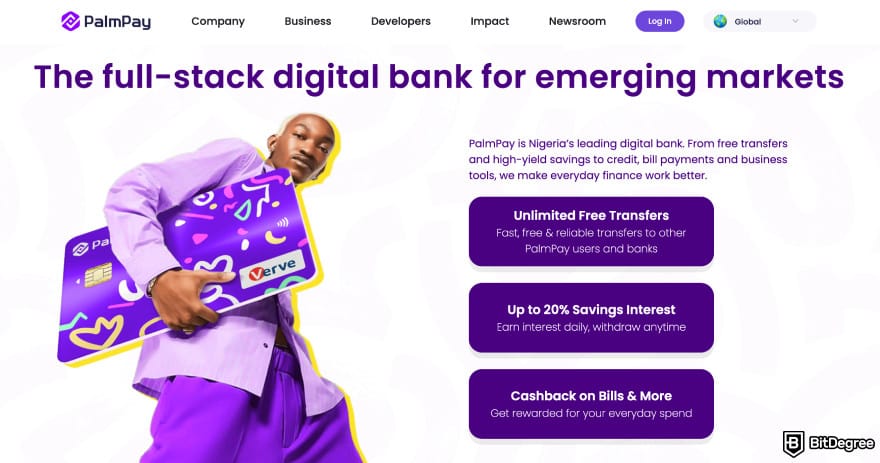
PalmPay is a Nigeria-focused digital wallet that makes everyday payments easy right from your phone. It’s built mainly for local use, letting you handle things like peer-to-peer transfers, bills, airtime, and merchant payments without needing a traditional bank first.
In short, PalmPay is often seen as a local cash-plus wallet rather than an international fintech service like Revolut.
One standout feature that makes PalmPay different from many other wallets is Cashbox. It lets users create a separate sub-wallet or savings pot inside their account. You can use it to set money aside for goals, divide expenses, or keep funds earmarked for specific purposes.
Compared to Revolut, PalmPay is built for Nigeria first. You can sign up locally, hold Nigerian Naira (NGN) right inside the app, and use features like QR payments that aren’t available on Revolut in Nigeria.
When it comes to transfer speed and limits, PalmPay generally moves money quickly within its own network. Sending to other PalmPay users is almost instant, and transfers to Nigerian banks are usually fast as well.
Your limits depend on how well your account is verified. Fully verified accounts get higher transfer caps than basic ones.
All in all, wallets like PalmPay offer advantages that international apps don’t. This is especially true with features like Cashbox that help you manage and organize your money.
How to Use PalmPay
If you’re new to PalmPay, this is the quick setup flow. I’ll go through what it takes to create an account, unlock the main features, and fund your wallet so you can start using it right away.
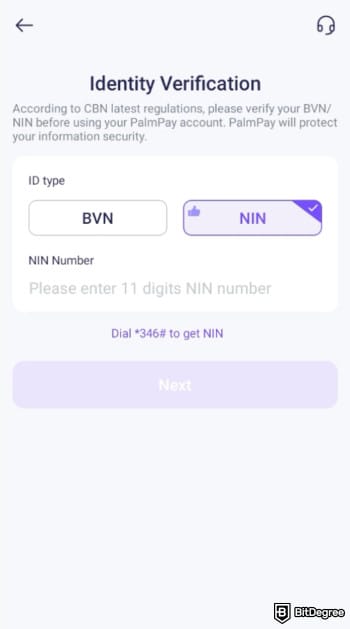
Alternatively, you can use the USSD code *861# to make transactions, check balances, or buy airtime without data.
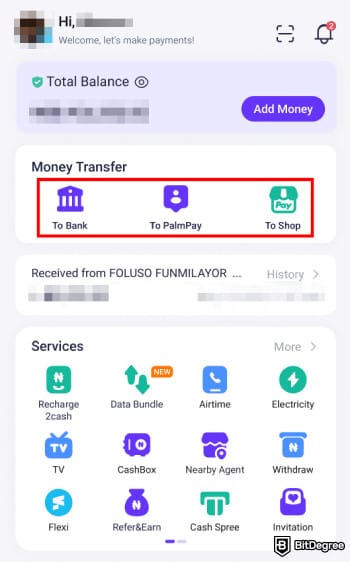
Now you can explore extra features like Cashbox to organize your money, or use QR payments and in-app promos if they’re available.
Kuda Bank
Kuda Bank is a Nigeria-based digital bank that offers full banking services through a mobile app. It’s licensed by the Central Bank of Nigeria as a microfinance bank, so it functions as a regulated local bank, not just a wallet for quick transfers.
With Kuda Bank, you get a Nigerian bank account, local transfers, bill payments, airtime and data purchases (much like Opay and PalmPay). It’s built for managing your main money flow in Nigeria, not just quick P2P payments.
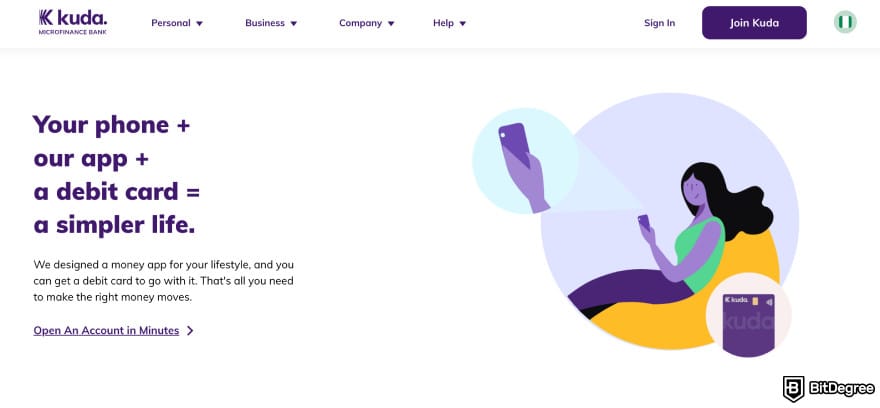
The big difference between Kuda Bank and Revolut is that Kuda is designed for Nigeria from the ground up. You can open an account locally, hold NGN, and use it as your primary bank account.
Transfer speed on Kuda is usually fast for local payments. Transfers to other Kuda users are often instant, and transfers to other Nigerian banks are typically quick as well. Limits depend on your verification level, but Kuda allows up to 25 million NGN.
Fees are one of Kuda’s selling points. Many everyday actions, like certain local transfers, are either free or cheaper than traditional banks. Some services still come with fees or fair-use limits, but costs are usually shown clearly in the app so you can see what you’re paying before confirming.
How to Use Kuda Bank
Let’s now go through the steps of getting started with Kuda Bank. Similar to the previous chapters, I’ll show you how to sign up and get your account ready to make your first transactions. Here’s the general flow:
Note that you need to complete identity verification to activate your account and unlock higher limits and full banking features.
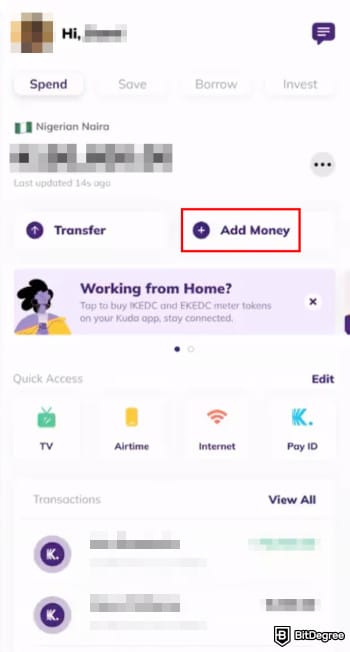
If you want, you can also order and activate a Kuda debit card if you want to withdraw cash or pay at merchants with a physical card.
Choosing the Best Revolut Alternative for Nigeria
If you’re comparing Revolut to these alternatives and asking does Revolut work in Nigeria the same way, the short answer is no. Out of the four options mentioned here, there isn’t one single best pick for everyone.
The right choice depends on how you actually use money in Nigeria, so here’s what to look at when choosing a Revolut alternative:
- Your use case. Think about what you’ll use the app for most. Daily payments and bills work best with local apps, while sending money abroad works best with something built for that.
- NGN deposit. If Nigeria is home base, being able to hold or top up with NGN is a big plus. It makes everyday money management way easier.

- Fees and transfer limits. Small fees add up over time. Check the rates and how much you can send before hitting limits.
- Local acceptance and payouts. Not every app plays nicely with Nigerian banks, ATMs, or merchants. This matters if you don’t want to deal with failed transfers.
- Global-ready platform. If your money moves between countries, you’ll feel the difference with a platform built for cross-border use, like Ogvio. It’s just less friction, and the money arrives instantly.
- Security. Always check the app’s security and that it’s regulated with proper protections in place.
At the end of the day, we can’t shake the fact that local apps work best for everyday use in Nigeria. But if you want an app that does more while letting you earn money, it’s best to go with global-friendly platforms like Ogvio.
Browse our collection of the most thorough Crypto Exchange related articles, guides & tutorials. Always be in the know & make informed decisions!



Conclusions
So, does Revolut work in Nigeria? Yes, but only in a limited, practical sense. In Nigeria, it works more as a travel and cross-border tool than a full local finance app for everyday use in Nigeria.
What’s possible is using your existing Revolut account to spend in NGN, among a few others. What’s restricted is opening a Revolut account in Nigeria. If you live in the country or need a proper setup, Revolut alone won’t cover everything.
Among Revolut alternatives for Nigeria, Ogvio stands out with its cross-border transfers to and from Nigeria with low fees. Sign up and try the app to see if it fits your case.
Scientific References
1. Ozili P.: ‘Women Digital Financial Inclusion and Economic Growth in Nigeria’;
2. Onyishi O.: ‘Digital Finance Reform in Nigeria: Opportunities, Risks, and the Road Ahead for Crypto Regulators and Businesses’.
Send Money Worldwide
Check out the best ways to send money to other countries quickly, safely, and with minimal fees.













About Article's Experts & Analysts