Key Takeaways
- A savings account is a type of bank account that lets you earn interest on the funds you deposit into it;
- There are four main ways to withdraw money from a savings account: ATMs, over-the-counter cash withdrawals, bank transfers, and withdrawals to money transfer platforms;
- Before you withdraw, make sure to plan ahead and weigh the potential earnings against losses.

A lot of people have discovered that one of the best ways to save money in the long run is to stash it away in a savings account, where it generates passive income instead of just sitting there idly and losing value with inflation. It's often not until they try to access those savings that they realize they've no idea where to start. How to withdraw money from a savings account without running into penalties or other obstacles?
Whether you need to tap into your savings because the dreaded "rainy day" is finally here, or simply want to shave off some extra cash for any other reason, I'll try to answer all your questions in this 101 guide. You'll find out all the possible ways of getting money from your savings account, and what limits or other rules apply.
I'll wrap up by showcasing the whole process from start to finish with the help of two leading money transfer services, Ogvio and Wise. If you've never used an MTS before, I recommend picking Ogvio as your gateway to money transfer services: this app offers everything you need to get started with cheap and easy transfers from any of the 160+ supported countries and regions.

Did you know?
Subscribe - We publish new crypto explainer videos every week!
Best Crypto Analysis Indicators Explained (Beginner-Friendly Animation)


Table of Contents
- 1. Understanding Your Savings Account
- 1.1. Types of Savings Accounts
- 2. Can You Withdraw from a Savings Account? Rules & Regulations
- 3. Four Ways to Withdraw Money from a Savings Account
- 3.1. Online Banking
- 3.2. Money Transfer Services
- 3.3. ATM Withdrawal
- 3.4. Over-the-Counter (OTC) Withdrawal
- 4. How to Withdraw Money from a Savings Account to Ogvio
- 5. How to Withdraw Money from a Savings Account to Wise
- 6. Key Considerations & Tips
- 7. Conclusions
Understanding Your Savings Account
While most people learning how to withdraw money from a savings account have at least some rudimentary knowledge of how this type of account works, let's review the basics just in case.
Latest Changelly Coupon Found:In a nutshell, a savings account is a specific type of bank account that allows you to save money for emergencies or other savings goals. Banks typically use these accounts as a source of funds for lending, which is why virtually every major bank offers a savings account. And, naturally, they need some incentive to offer their potential customers.
This is where interest comes into play. Most savings accounts literally pay you to keep your money in them. Interest rates vary depending on the type of savings account, market conditions, and any promotional campaigns from the bank. For example, the bank might offer a more generous introductory interest rate when you first open an account, and then downgrade it to a lower rate.
![How to withdraw money from savings account: a pen and a slip of paper with the words [Interest rate: increase/decrease].](https://assets.bitdegree.org/images/how-to-withdraw-money-from-savings-account-increase-decrease.jpg "How to withdraw money from savings account: a pen and a slip of paper with the words [Interest rate: increase/decrease].")
Unless your account contract has specifically assigned a fixed interest rate for a certain period of time, the bank reserves the right to change it at any time. As a general rule, the more competitive the rate, the more likely it is to fluctuate.
Just like checking accounts, savings accounts in most US banks are insured by the FDIC up to $250,000.
Types of Savings Accounts
There are many types of savings accounts out there. Depending on how far you're willing to stretch the definition, the whole list could include as many as eight variations. I'll touch on them below, but for now, let's focus on the two main types you likely had to choose between when looking to open one: traditional versus high-yield.
Traditional Savings Account
A traditional savings account is, as the name implies, the basic "vanilla" option offered by most banks and credit unions. Which, in itself, is one of its major selling points: given the choice, most people prefer keeping all their accounts in one institution for the most seamless and convenient transfers.
Being issued and managed by a traditional (physical) bank comes with some obvious perks. Traditional savings accounts are the go-to option for users who prefer cash deposits and withdrawals instead of online banking. In addition, they usually take a flexible approach to moving the money in or out, with few constraints. Some banks charge an account opening and/or maintenance fee of $5-$12, while others offer it free of charge.

As you might have guessed, however, their number one con is comparatively low interest rates. According to the latest data from Bankrate, the national average savings account yield in the US is only 0.62% APY. With this rate, a savings account with $10,000 in it would only generate a measly ~$62.04 per year.
High-Yield Savings Account (HYSA)
Is learning how to transfer money from a savings account even worth it when there's barely any profit to withdraw? If that's your take, you're probably in the high-yield savings account camp. Its selling point is in the name. HYSA's interest rates of up to 4% make traditional savings accounts look positively anemic.
HYSAs are usually offered by online banks - which is what explains these generous interest rates.
Unlike their traditional counterparts, online banks aren't burdened with the expenses of keeping brick-and-mortar branches, so they can afford to channel those savings into offering more competitive interest rates.
On the flip side, being limited to an online-only presence has its drawbacks, too. A lot of online banks don't offer physical debit cards, for example. Their customer support is usually more limited, as well.
Other
I won't go too much into detail about these other types of savings accounts, but for the sake of reference, here's an overview of the other most popular options in the US:
Description | Typical APY | Liquidity | FDIC insurance | Monthly fees | |
|---|---|---|---|---|---|
Student savings account | Designed for current or prospective students (18-24 year old) | Up to 4.20% | High (daily access) | ✓ | Usually $0 |
Certificate of deposit (CDs) | A fixed-term savings account contract at a fixed interest rate | Up to 4.25% | Low (early withdrawal penalty) | ✓ | Usually $0 |
Money market account (MMA) | A hybrid savings/checking account (includes check-writing capabilities or a debit card) | Up to 4.25% | High (daily access) | ✓ | Varies ($0-$15) |
Cash management account | Offered by brokerages and combines checking, savings, and investment account features | Around 4% | High (daily access) | Often via partner banks | Usually $0 |
Health savings account (HSA) | Tax-advantaged savings account for medical expenses (requires enrollment in HDHP) | Depends on investments | High (for medical bills only) | Varies by provider | Varies ($0-$5) |
Flexible savings account | Tax-advantaged savings account offered by an employer and funded by a percent of income | Usually between 3.7% and 5.15% | Low (only allowed for medical expenses) | Varies by provider | Usually $0 |
Individual retirement account (IRA) | Tax-advantaged investment account designed for retirement savings. | Depends on investments | Low (early withdrawal penalty) | Varies by holdings | Varies by custodian |
Table: Overview of savings account types in the US
As you can see, when it comes to the question of how to get money from a savings account, the relevant feature you should look into is liquidity. Some types of savings accounts are meant to be more of a revolving door, with money constantly moving in or out as needed, while others function like long-term vaults with a much higher barrier and stricter rules for withdrawals.
Looking for more in-depth information on related topics? We have gathered similar articles for you to spare your time. Take a look!



Can You Withdraw from a Savings Account? Rules & Regulations
As you'll find out in the next chapter, learning how to withdraw money from a savings account isn't too dissimilar from withdrawing from a checking account. The one key difference is that, depending on its type, a savings account will likely have some restrictions.
Can you take money out of a savings account whenever you want? In the United States, the answer is - that depends. Until recently, certain types of withdrawals from savings accounts were constrained by Regulation D by the Federal Reserve, which imposed a limit of no more than six monthly withdrawals. However, this rule only applied to the following types of transfers:
- Online bank transfers;
- Transfers initiated over the phone;
- Transactions made by check or debit card;
- Automatic or preauthorized transfers, such as recurring (scheduled) withdrawals.
As you can see, there's one type of transfer that doesn't fall under any of these - and that's cash transfers. In short, if your go-to method of tapping into your savings is withdrawing some money from an ATM, you're good to go.
And for those who prefer online banking, here's another bit of (potential) good news: in response to the Covid-19 pandemic, the Federal Reserve has lifted this requirement, leaving it up to individual banks to decide whether or not to keep this limit in place or do away with it. As a result, many banks shifted a huge portion of savings account balances into the checking category[1] to simplify reporting.
A lot of online banks and credit unions have taken the opportunity to cut their customers some slack and eliminate the six-withdrawals-per-month limit. This includes Ally, Marcus by Goldman Sachs, American Express, Capital One, and many others.
On the other hand, most traditional banks chose to hold on to it. If you have a savings account at Wells Fargo, Bank of America, Chase, or Truist, tough luck - you're still stuck with this federal limit. If you exceed it, your bank might charge a penalty of $3 to $5 per transaction or even freeze your account after repeat attempts to withdraw beyond the limit.

Then again, some banks are more lenient than others. The only way to know for sure is to read up on your own bank's policy. Don't trust any blanket statements and find out the details of how your bank handles withdrawals from a savings account so you don't get in trouble.
Finally, let me stress that the withdrawal process and rules don't look identical for all types of savings accounts. For example, the process of how to withdraw money from education savings account requires contacting your provider and submitting a withdrawal request. Meanwhile, IRAs don't allow penalty-free withdrawals before the age of 59 1/2.
Four Ways to Withdraw Money from a Savings Account
Now that you have an idea of how a savings account works and the limitations that come with having one, let's get on with our question at hand: how to withdraw money from a savings account. You have four main options to choose from.
Online Banking
If you're familiar with the process of moving your money from one bank account to another on your online banking platform, learning how to transfer money from a savings account will be a breeze.
Especially if your savings account belongs to the same account as your checking account, in which case, you can take advantage of internal bank transfers, which are usually free and instant. Most online banking platforms let you seamlessly switch between all your bank accounts, and they're already linked to each other, so you won't need to set up a connection manually.

In contrast, transferring to a checking account in another bank will require a domestic ACH transfer. You'll be asked to enter your bank details during the first transfer, but after that, you can simply add this bank account to your whitelist and carry out any subsequent transfers in just a couple of clicks.
ACH transfers usually take from 1 to 3 business days, but some banks offer Same-Day ACH for a higher fee. While traditional ACH transfers are batched through the day and then processed and sent during an overnight cycle, Same-Day ACH runs three separate processing windows:
- Morning window: Submit by 10:30 AM ET, funds available by 1:30 PM;
- Afternoon window: Submit by 2:45 PM ET, funds available by 5:00 PM;
- Late window: Submit by 4:45 PM ET, funds available by 5:00 PM the next day.
As you can see, it's all about the timing. Making a Same-Day ACH transfer too late in the day would postpone it to the next day, so if you really need an urgent transfer, make sure not to put it off. Also, Same-Day ACH isn't available on weekends or federal holidays, so factor this into your timing, as well.

The same holds true for regular ACH transfers. If you initiate one later in the day, it might not be included in the earliest batch, adding another day to the processing time.
ACH transfer fees vary by bank, but they're relatively cheap (compared to card transfers or international wire transfers, for instance). The fee typically ranges from $0.20 to $1.50 per transaction. Same-day ACH transfers can cost up to $5 per transaction.
As for the transfer limits - once again, your mileage may vary. Bank of America sets the ceiling pretty low at only $1,000 per transfer for personal accounts, while most Chase accounts get up to $25,000. Some banks, like SoFi, offer an even more generous limit of $100,000.
Other than speed, withdrawing from a savings account through an online bank transfer has just one flaw: the six-withdrawals-per-month limit I covered earlier (which may or may not be applicable to you, depending on your bank).
Money Transfer Services
Let's say you're looking at how to withdraw money from a savings account without a debit card. A lot of people these days forgo a traditional checking account in favor of a neobank or money transfer service, and are wondering if their platform is up for the job.
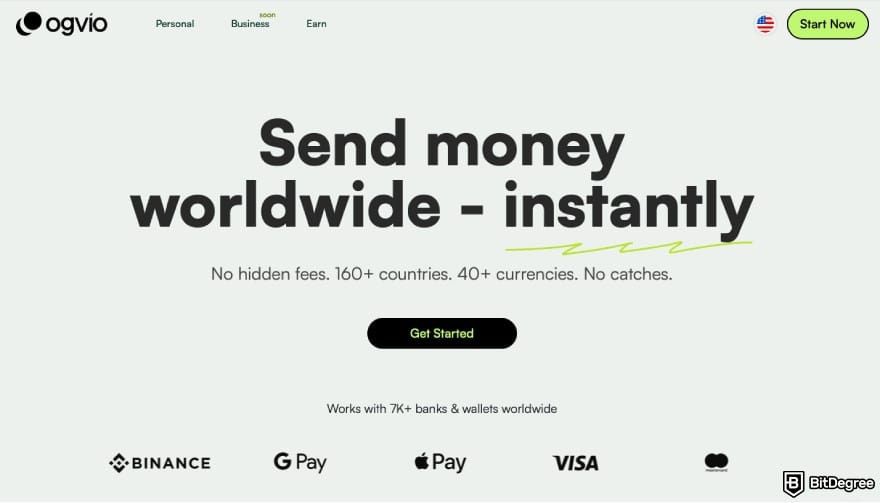
Luckily, you'll have nothing to worry about in this regard. The process of moving money from a savings account to an MTS like Ogvio or Wise is just as simple and easy as making a transfer from one bank to another, if not more. Since most of these platforms are mobile-first, they tend to offer a much better user experience for the small screen than your average traditional bank, as well as an easy connection to mobile wallets.
There's just one main difference. Unless your savings account provider offers a direct integration to the money transfer platform of your choice, you'll be doing it in the reverse direction. What I mean by that is: instead of initiating a withdrawal from your savings account, you'll have to make a deposit into your money transfer platform.
Which also means that, for the most part, you'll be dealing with the fees and limits imposed by the MTS. The good news is that some of those platforms actually have more generous fees and limits than what you'll find at most banks (I'll cover them in more detail in the relevant sections below).
 |  | |
|---|---|---|
|
| |
| Per-transaction | Per-transaction | |
| | | |
| A global money transfer service with an additional volatile currency rate pegging to USD or EUR. | A trusted digital remittance service with upfront fees and great rates, but limited options for cash delivery. | |
| Visit site Read review | Visit site Read review |
Table: Comparison of Ogvio and Wise
That said, keep in mind that transfers to neobanks or MTSs still fall under the category of "online transfers" and are subject to limits imposed by Regulation D (if relevant to your bank).
ATM Withdrawal
Can you take money out of a savings account in the form of cash, the same way you could out of a checking account? Of course! In most cases, the only requirement is having a debit card. If the provider of your savings account is a traditional bank, this won't be a problem, and even most neobanks these days offer both virtual and physical debit cards.
Besides, if you need a way how to withdraw money from a savings account without a debit card, some banks offer cardless ATMs that use NFC or QR codes to authorize a withdrawal.
If anything else, it's one of the few ways to "cheat" the above-mentioned Regulation D limit. When it comes to ATM withdrawals, the only bottleneck will be your own balance and the limits imposed by your banking provider (and, of course, the actual amount of cash available in that particular ATM, if we're being pedantic).
Once again, you'll need to read up on your bank's policies, but what most of them have in common is zero-fee withdrawals from their own (in-network) ATMs. On the other hand, withdrawals from ATMs that belong to other banking providers come with a surcharge fee.
I'll save you some time with this quick overview of the ATM withdrawal fees and limits at the most popular US banks:
Non-Network ATM Withdrawal Fees | ATM Withdrawal Limits | |
|---|---|---|
Bank of America | Domestic: $5 Foreign (non-partner): $5 + 3% for currency conversion | $1,000 per day |
JPMorgan Chase | Domestic: $5 Foreign: $5 + 3% for. currency conversion | $3,000 per day |
Wells Fargo Bank | Domestic: $3 Foreign: $5 | Depends on the branch |
Citibank | Domestic: $2.5 Foreign: 3% | $1,500 |
Truist | Domestic: $3 Foreign: $5 + 3% for currency conversion | $500 per day |
Table: Overview of ATM withdrawal fees and limits at US banks.
For clarification, those are the fees and limits for the standard (basic) account. Many banks offer a tiered account system with various fee discounts alongside higher spending and withdrawal limits.
Did you know?
Subscribe - We publish new crypto explainer videos every week!
ICO vs IDO vs IEO: Which One's the Best? (Easily Explained)

Over-the-Counter (OTC) Withdrawal
Is there a way how to withdraw money from a flexible savings account (or any other type of savings account) without online banking, money transfer services, or ATMs? Surprisingly, yes. OTC desk withdrawals (also called in-person or point-of-sale withdrawals) aren't nearly as mainstream as the other three options, but they can be an invaluable alternative for certain niche cases.
An OTC withdrawal is an in-person withdrawal, where you ask the bank teller to personally handle your transaction for you.
If you're wondering why you could possibly want to make a trip to your branch just to withdraw some money, the answer is simple: OTC withdrawals have a much higher limit than ATM withdrawals. Most banks allow taking out as much as $20,000 over the counter, although some require notifying them at least a day in advance. As you probably guessed, this type of withdrawal isn't subject to the Regulation D limit, either.
The process itself is pretty straightforward. All you have to do after showing up is give the bank teller your account details (including your card's PIN number), show some form of official ID, and fill out a withdrawal form. Some banks also ask for an SSN (Social Security Number), at least for withdrawals over a certain amount.
Some banks offer free OTC withdrawals, while others charge a small fee.
How to Withdraw Money from a Savings Account to Ogvio
One of the newest players in the money transfer scene, Ogvio has entered the stage with a bang, offering a well-rounded package of attractive features. It allows making online payments to 160+ countries and regions with some of the most competitive fees in the market. What's more, P2P transfers to other Ogvio users are 100% free and instant.
Ogvio comes with an extensive selection of top-up methods: from credit/debit card transfers and bank transfers to mobile wallets, direct payment requests from other Ogvio users and even crypto deposits. In our case, however, only two will be relevant here: card and bank transfer top-ups.
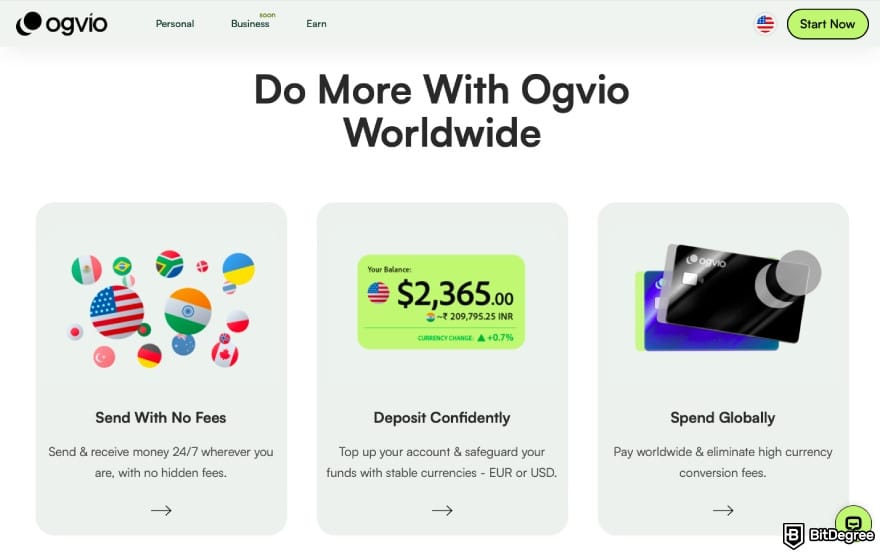
If you're looking for the cheapest option, topping up your account with a bank transfer will be your best bet: Ogvio doesn't charge any fees for bank transfer deposits. In the United States, Ogvio supports ACH, wire, and FedNow transfers.
Meanwhile, depositing money from a credit or debit card costs 1% of the transaction amount. Ogvio has no explicit limits for either, so you'll only be constrained by the ceiling set by the provider of your savings account.
There's just one slightly inconvenient hurdle I should warn you about. Ogvio requires you to pass KYC verification before you can make any bank transfers. However, as of writing this, it's not available to taxpaying US residents (only to US citizens who live abroad and pay taxes in one of the other supported countries). For now, their only options are card, crypto, and user-to-user top-ups and transfers.
| | |
|---|---|
| |
| |
| |
| Visit site Read review |
Table: Ogvio features
That's it for the theoretical know-how. Let me show you how to withdraw money from a savings account to Ogvio with this step-by-step tutorial:
![How to withdraw money from savings account: click [Get Started] on Ogvio.](https://assets.bitdegree.org/images/how-to-withdraw-money-from-savings-account-ogvio-get-started.jpg "How to withdraw money from savings account: click [Get Started] on Ogvio.")
![How to withdraw from savings account: click [Add Money] on Ogvio.](https://assets.bitdegree.org/images/how-to-withdraw-money-from-savings-account-ogvio-add-money.jpg "How to withdraw from savings account: click [Add Money] on Ogvio.")
![How to withdraw from savings account: click [Bank Transfer] on Ogvio.](https://assets.bitdegree.org/images/how-to-withdraw-money-from-savings-account-ogvio-bank-transfer.jpg "How to withdraw from savings account: click [Bank Transfer] on Ogvio.")
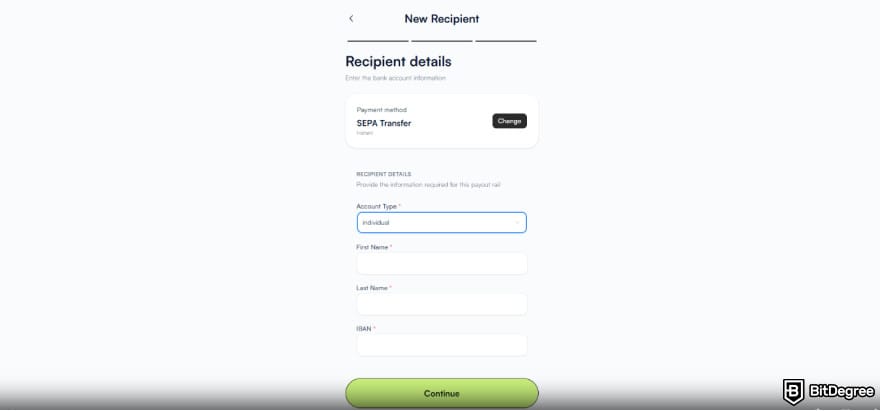
All done! If you want to make a card top-up instead, choose [Card Payment] on the "Add money" panel, enter your card details, click [Continue], and confirm the deposit.
How to Withdraw Money from a Savings Account to Wise
Wise is one of the household names in the industry of online transfer services, and for a good reason. This app offers excellent support for international payments, letting users top up their accounts or make payments in any of the 40+ supported currencies. Wise works in more than 160 countries and includes a few other neat features, such as the option to "freeze" the currency exchange rate.
Residents of the United States, the United Kingdom, and Canada can take advantage of Wise's integration with a number of local banks. On top of a speedier transfer workflow, connected bank transfers come with a guaranteed exchange rate that's secured the moment the payment is authorized (in contrast to regular bank transfers, whose rate is secured when Wise receives the money for your transfer).
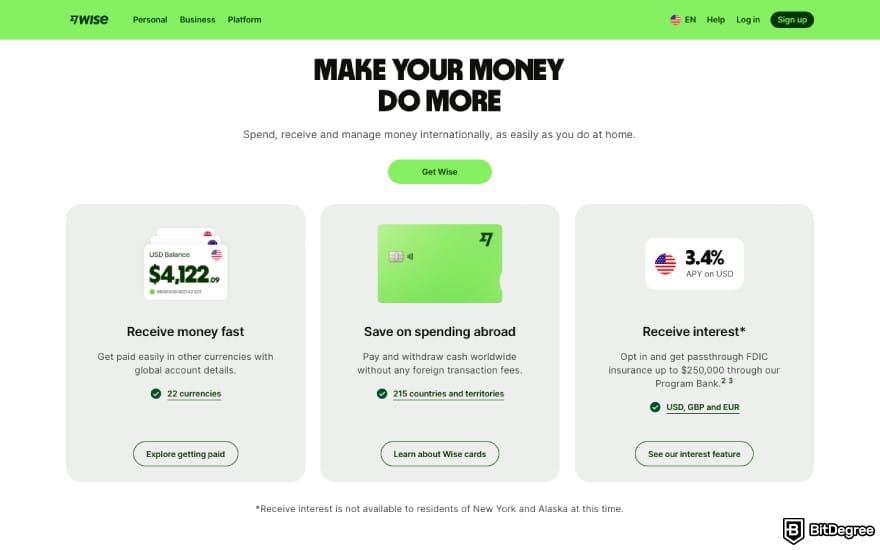
If there's no currency conversion involved, adding money to your Wise account via a bank transfer only costs $0.17 per transaction. It will take up to 3 business days to arrive. Debit card top-ups take about 30 minutes, but you'll trade speed for cost and pay a higher fee of $1.25.
Another factor that will probably determine your choice of a top-up method is deposit limits. With bank transfers, you're allowed up to $20,000 per transfer/day, but the limit for debit card top-ups is nowhere close at only $2,000 per transfer/day.
| | |
|---|---|
| |
| |
| |
| Visit site Read review |
Table: Wise features
To begin with, let's take a look at the process of moving money from your savings account to Wise through a bank transfer:
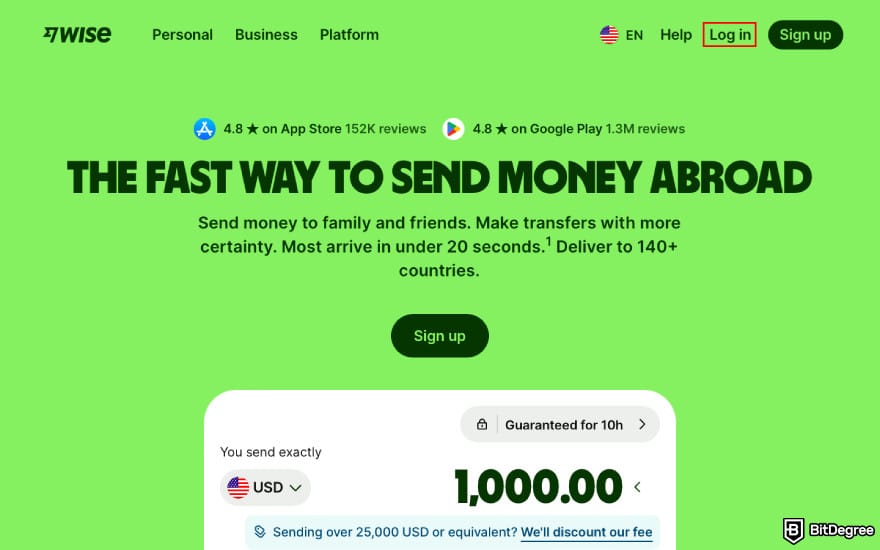
![How to withdraw from savings account: click [Add money] on Wise.](https://assets.bitdegree.org/images/how-to-withdraw-money-from-savings-account-wise-add-money.jpg "How to withdraw from savings account: click [Add money] on Wise.")
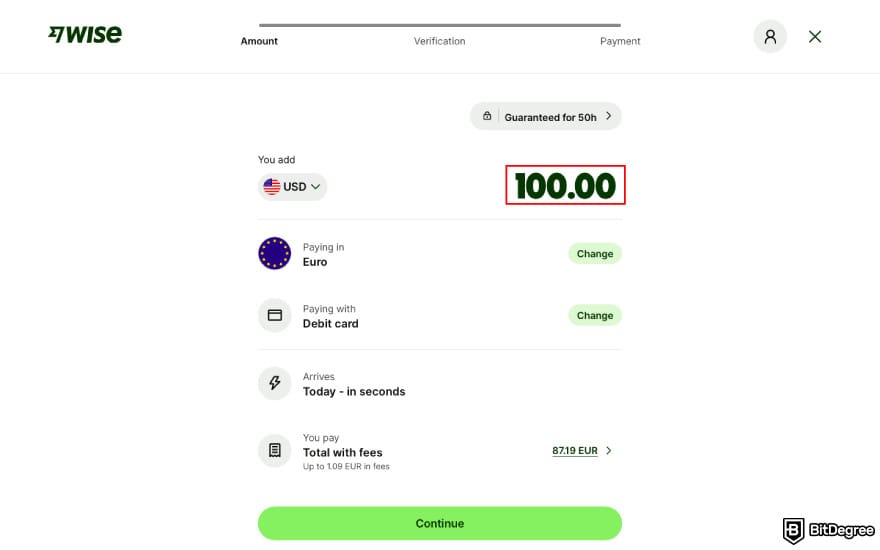
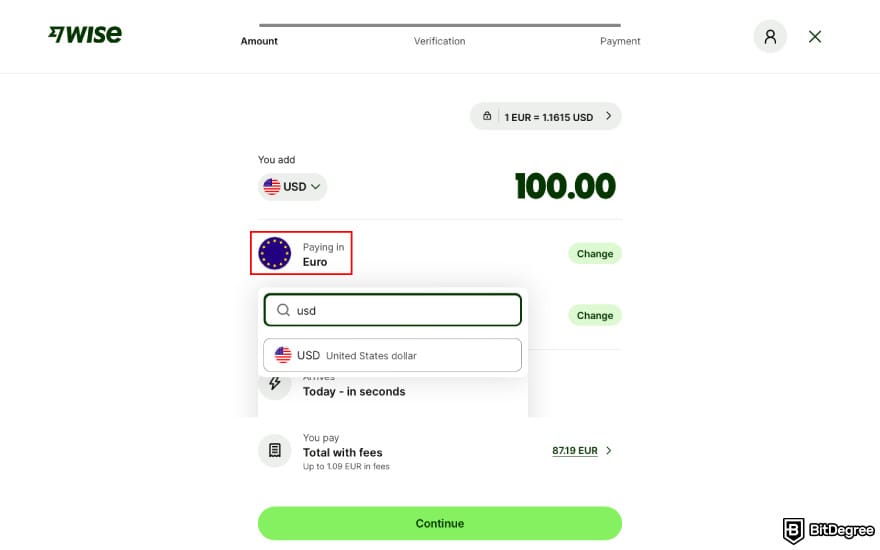
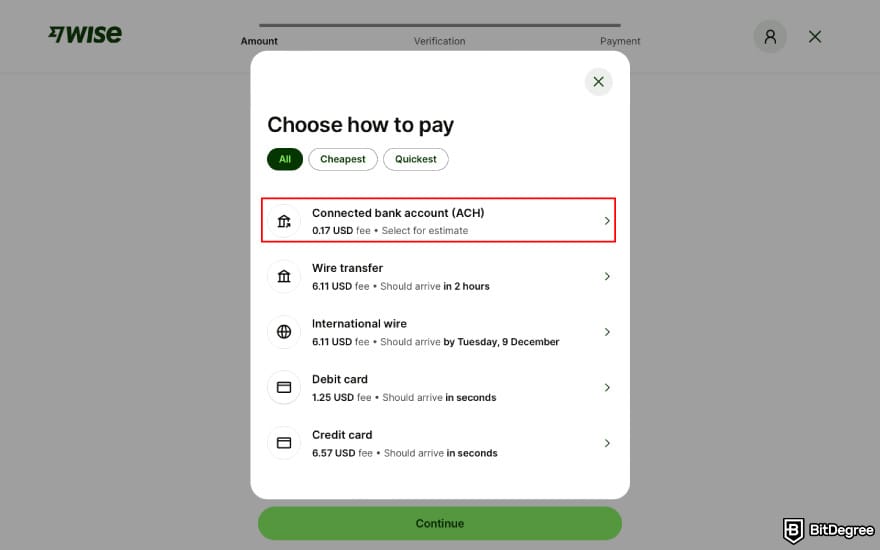
![How to withdraw from savings account: click [Continue with Connected bank account (ACH)] on Wise.](https://assets.bitdegree.org/images/how-to-withdraw-money-from-savings-account-wise-connect.jpg "How to withdraw from savings account: click [Continue with Connected bank account (ACH)] on Wise.")
![How to withdraw from savings account: click [Instant verification] on Wise.](https://assets.bitdegree.org/images/how-to-withdraw-money-from-savings-account-wise-instant-verification.jpg "How to withdraw from savings account: click [Instant verification] on Wise.")
That's it! From now on, this bank account will stay connected to your Wise account for easier transfers. You can see and manage all your connected accounts by clicking on your name icon in the top-right corner of the dashboard and going to [Payment methods].
The workflow for a debit card deposit is much simpler. The first steps are the same, except for choosing [Debit card] on the "Paying with" panel. After clicking [Continue], you'll just need to enter your card details and click [Pay].
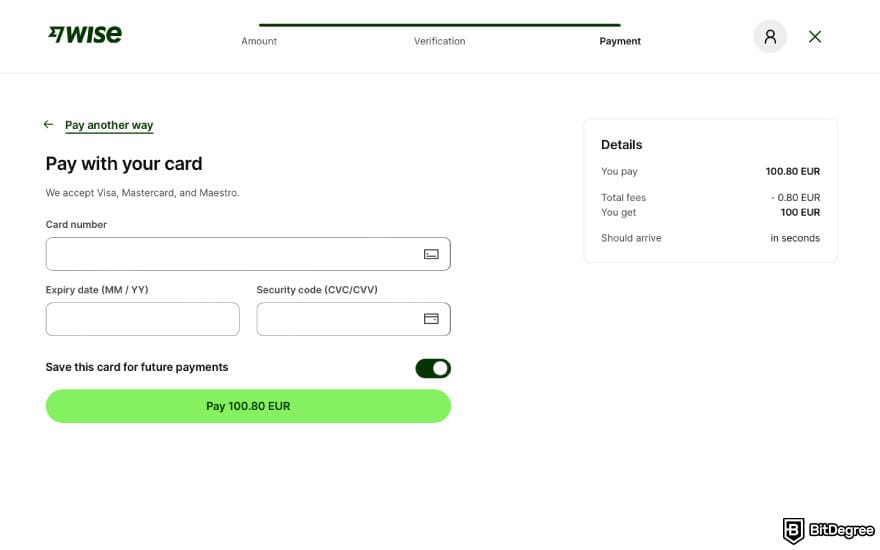
You can also save this card as a payment method for easier access during subsequent transfers.
Key Considerations & Tips
The essentials of how to withdraw from a savings account aren't hard to pick up. As with most things, howewer, the devil's in the details. Before you take the plunge, here's some more advice to nudge you in the right direction.
First things first: make sure you have a bulletproof reason for your withdrawal. A savings account isn't meant for petty expenses: the whole point of interest rates is that you gain more from keeping the money in your account than spending it.

Besides, not saving enough money is one of the most common financial regrets. In one study, 52% of Americans aged 62–95 expressed this regret,[2] while only 1.5% reported a regret for saving too much.
In the end, the decision to withdraw your money from a savings account will always be subjective to some degree, but it's hard to argue that some reasons are better than others. Here are some situations and circumstances where dipping into your savings account is likely to outweigh the long-term loss of interest earnings:
- Emergencies. There are times when, despite all of our efforts to the contrary, life simply gets in the way. Whether it's something mundane like your car breaking down or a more serious threat like medical bills, there's no reason to feel guilty about using your savings to cover these unforeseen expenses.
- Investments. If you're ready to diversify your assets, pulling some of your savings into a solid investment opportunity is as good a use for them as any. Just make sure it's an amount you can afford to lose.

- Inflation. If you have a traditional savings account, a low interest rate of ~0.62% APY or less might not be keeping pace with the annual inflation rate, in which case, you might as well withdraw it or switch to a HYSA.
Just as some cases are more likely to pay off than others, there a circumstances where you'll be more likely to regret taking the plunge:
- Impulse Purchases. As tempting as it can be to shave off some of your saved money to cover that last-minute getaway you couldn't otherwise afford, it's usually not the best use of a savings account.
- Uncertain Market Conditions. Many people scramble to pull out their savings during a recession or other economic crisis, but acting out of panic and FOMO rarely works out in the long run.
So, how exactly do you determine whether withdrawing your savings is worth it? There's no one single formula that works for everyone, but here's my idea of a good starting point. Pick a specific timeframe and calculate the amount of yield you'll earn in interest from the money currently sitting in your savings account, plus any deposits you're planning to make during that time.

Once you have an educated guesstimate of your profits down the line, measure it against the projected annual inflation rate, the money you might gain or lose in investments, or other factors, depending on your reason for withdrawal.
This shouldn't be a one-and-done thing, either. At some point in the future, take a look at your withdrawal patterns. You might realize you'll be better served using a different type of savings account (e.g., one with a higher yield or a lower/higher liquidity).
For instance, if it turns out that most of your withdrawals are for covering medical expenses, but you find yourself battling the temptation to waste your savings on frivolous purchases, you might want to switch to a savings account that specifically caters to healthcare needs, since the process of how to withdraw money from a flexible savings account or HSA involves a few more hoops to jump through.

Finally, consider the tax implications. In the US, any annual interest earned from savings accounts is considered taxable income and must be reported to the IRS (Internal Revenue Service). The amount you'll have to pay will be determined by your tax bracket.
You can find out which bracket you fall into on the IRS website, but for the years 2025 and 2026, the rates range from 10% to 37%, depending on your annual income, marital status, and other factors.
Your bank will only send you a 1099-INT form if the amount you earned in interest that year exceeds $10, but you must still report all interest.
Let me clarify again, just in case: the taxes are charged only on the earned interest, not on the total balance of your savings account. So, for example, if you have $10,000 in your savings account with a 0.2% interest rate, you'll only get taxed on the $20 the bank pays you.
Keep in mind that this, too, will be affected by what type of savings account you own. Traditional savings accounts and HYSAs are taxed regularly, as are certificates of deposit and money market accounts. On the other hand, IRAs allow deferring taxes until retirement and only paying them upon withdrawal.
Browse our collection of the most thorough Crypto Exchange related articles, guides & tutorials. Always be in the know & make informed decisions!


Conclusions
The basics of how to withdraw money from a savings account are far from rocket science: it all boils down to choosing where you want your funds to go (e.g., cash or another bank account) and getting up to speed with the fees and limits your banking provider has placed on this type of withdrawal.
Once you look past the surface, however, there's more to the picture you should be aware of. Savings accounts aren't all created equal, and the type you have will ultimately determine how or when you're allowed to withdraw and how your earnings will be taxed. Last but not least, make sure you have a good reason for withdrawing your savings, so it's worth the trouble in the end.
The wait is over - Ogvio is finally here! Sign up today and enjoy blazing-fast money transfers with low fees (or none at all).
Scientific References
1. Dutta A. S., Kulkarni K. G., Lai K. P.: 'Tackling the Economic Challenges of COVID-19: A Look at the Federal Reserve System: History and Present Day';
2. Hurwitz A., Mitchell O. S.: 'Financial regret at older ages and longevity awareness'.
Send Money Worldwide
Check out the best ways to send money to other countries quickly, safely, and with minimal fees.































About Article's Experts & Analysts