









Payoneer used to be the platform for freelancers and international payments, and it may still work for a lot of people. But the payments industry has changed a lot, and more people and businesses now seek a Payoneer alternative that fits their ongoing needs and lifestyle.
Some people want better exchange rates, others care about instant transfers, and some want crypto-friendly options like what Ogvio offers. Growing businesses may look for a more corporate, scalable platform with advanced controls, while teams that have downsized may prefer a simpler, cheaper tool that fits a leaner setup.
In this guide, I’ll break down the best Payoneer alternatives, what they’re good at, and who they’re best for, so you can pick the one that actually matches your current workflow. The platforms we'll look into today are:
- Ogvio - Flexible For Business and Personal Use
- Wise - A Well-Rounded Money Transfer Service
- Finom - EU Market, AI-Powered Business and Accounting Tools
- PayPal - Widely Accepted, PCI DSS Compliant, Buyer/Seller Protection
- Grey - Multi-Currency Account, FinCEN-Regulated, Toptal Integration
- WorldFirst - 210+ Countries, Integrates With 130+ Marketplaces
- Tipalti - Enterprise-Level Features, AI Agents, Tax Compliance Tool
1. Ogvio - Flexible For Business and Personal Use
Ranks #1 out of 7 Money Transfer Services
- + Remittance-oriented
- + Instant transfers
- + Incremental-to-no fees
- + Crypto support
- + @Tag functionality
- + Free transfers between users
- - No card (coming soon)
Ogvio supports near-instant transfers in 160+ countries and runs on a stablecoin infrastructure, so you can send money with low fees (often zero fees for transfers between Ogvio users).
Compared to "older platforms" like Payoneer, Ogvio feels more modern, faster, and more crypto-friendly. Payoneer is a well-known and long-running platform that focuses on marketplace and business payouts. Ogvio, on the other hand, is built for global workers who want faster payments and lower currency exchange fees.
 |  | |
|---|---|---|
| Bank - free Crypto - free Card - varies | Bank - mostly free; up to 1% SWIFT - varies Wire - varies | |
| Varies |
| |
|
| |
|
| |
| Visit site Read review | Visit site |
Table: Ogvio and Payoneer pricing
In terms of security, Ogvio uses advanced 256-bit AES encryption, transaction PINs, and on-chain vaults to protect funds. Because it’s a non-custodial platform, users get direct control over their wallets, and funds aren’t held by third parties or intermediaries.
Ogvio is also a FinCEN-licensed Money Service Provider (MSB) in the United States, which means it follows strict US regulations. FinCEN helps track suspicious transactions, prevent money laundering, and fight financial crime, working with law enforcement to keep financial systems safer and more transparent.
Key Features
Check this list to see whether Ogvio can be your Payoneer alternative:
- Flexible payment methods. Users and businesses can fund their Ogvio accounts or send payments via bank transfer, credit/debit card, Apple/Google Pay, or even crypto, offering flexibility depending on workflow and preference.
- Ogvio’s @Tag feature. Instead of long account numbers or routing codes, Ogvio lets you send and receive money using a simple @Tag username with no delays or fees.
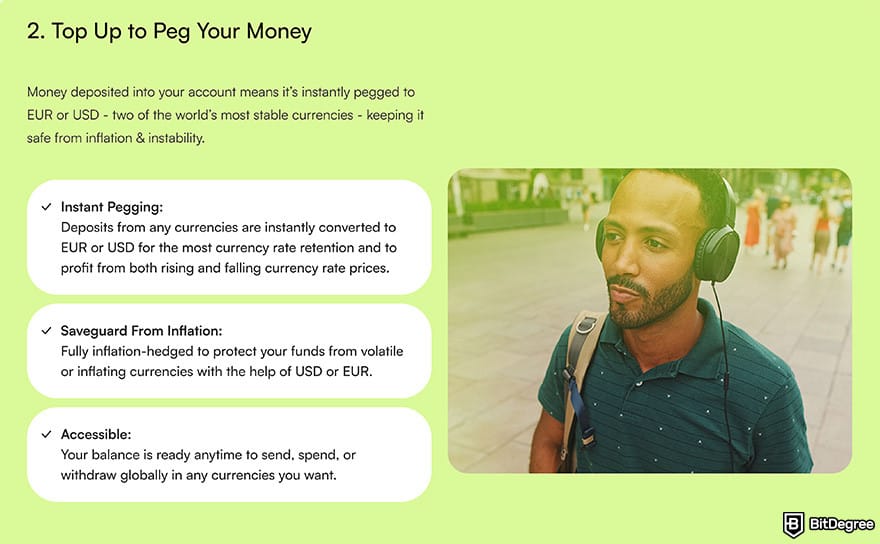
- Wide currency support and stability. Businesses can deposit funds in more than 40 supported currencies, which are then automatically pegged to stable EUR or USD accounts to help protect against local currency volatility and inflation.
- Custom business solutions. For businesses, Ogvio keeps things flexible. You can customize payment flows to match how your company actually works. Additionally, you get hands-on support and customization, so you’re not forced into a default setup.
- Earn feature. Ogvio now has an Earn feature that lets you grow your money passively. You just enable Earn, choose how much to deposit, and your balance can increase over time.
If we compare to Payoneer, Ogvio offers a fresh, crypto-supported approach with faster transfers, smarter features, and more control over your money. It may still be new, but its early traction and feature set make it a promising option for freelancers and businesses alike.
2. Wise - A Well-Rounded Money Transfer Service
Ranks #2 out of 7 Money Transfer Services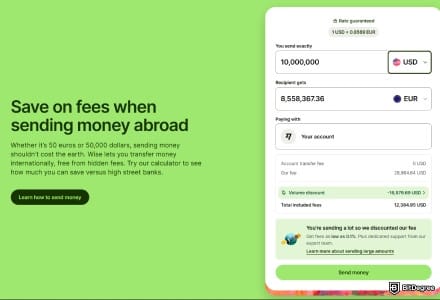
- + Transparent fees
- + Fair exchange rates
- + A smooth user experience
- + Multi-currency accounts
- - Service coverage is broad, but not entirely worldwide
- - Cash pickups aren’t available
- - Added compliance checks for large transfers
Wise is a global fintech platform that helps individuals and businesses send, receive, and manage money across multiple currencies. It’s known for keeping things simple: real exchange rates, upfront fees, and a user-friendly interface.
Wise was awarded the “Most Innovative Company of the Year” at the Logistics UK Awards in 2023 and has received many other awards.
What many people like about Wise is its multi-currency account. You can get paid “like a local” by receiving local bank details in major markets such as the US, UK, EU, and Australia. Instead of opening multiple foreign bank accounts, the platform lets you handle everything from one dashboard.
 | | |
|---|---|---|
 US US Canada Canada Germany Germany+160 more | US UK Germany+190 more | |
| EN DE FR +15 more | EN CN KO +17 more | |
 USD USD CAD CAD EUR EUR+40 more | USD EUR GBP GBP+70 more | |
| Fiat-only | Fiat-only | |
| Visit site Read review | Visit site |
Table: Comparison of Payoneer and Wise coverage
Compared to Payoneer, Wise is much more focused on transparency and everyday usability. Yes, Payoneer is strong in marketplace payouts and mass payments, but it often comes with FX markups and more complex fee structures. Meanwhile, Wise keeps costs predictable by using the mid-market exchange rate and clearly showing fees before you confirm any transaction.
Key Features
While Wise works a bit differently from Payoneer, it’s still a good alternative. Here’s why:
- Multi-currency debit cards. You and your team members can get physical and digital debit cards to help separate your money and spending.
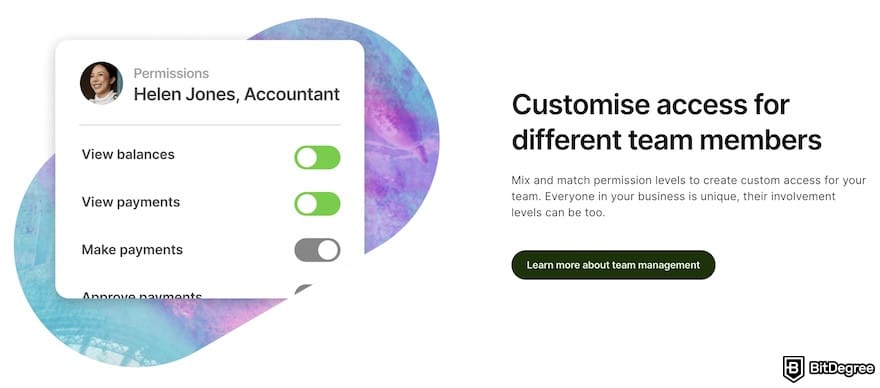
- Team management features. It’s possible to set custom spending permissions and give your team access to specific cards, accounts, or features, so everyone only sees and uses what they actually need.
- Business integrations. Wise works with tools like Xero and QuickBooks for seamless accounting reconciliation.
- Batch and team payments. The tool supports bulk payouts and multiple user access for teams, useful for payroll or contractor payments.
- 24/7 customer support. Wise’s support teams are available by phone or online, wherever you are in the world.
If your focus is on keeping costs down and streamlining international cash flow, Wise can often be a smarter Payoneer money transfer alternative.
3. Finom - EU Market, AI-Powered Business and Accounting Tools
Ranks #3 out of 7 Money Transfer Services
- + Business-specific features
- + Intuitive interfaces
- + Cashback promotions in all plans
- + Assistance via phone, chat, or email
- + Secure and GDPR compliant
- - Sudden account freeze
- - Unclear extra charges for added features
- - Most features are limited to the EU market
Finom is like a modern business banking platform, designed for freelancers, startups, and SMEs that want better control over payments, invoicing, and cash flow. Compared to Payoneer, Finom leans more into business management and banking, which can feel more “all-in-one”.
It offers a full suite of business tools, including company bank accounts, local IBANs, invoicing, expense tracking, and AI-powered accounting features. This makes it easier to manage company finances without switching between multiple platforms.
| |  | |
|---|---|---|
|
| |
| Per-transaction | Plan + per-transaction | |
| | | |
| A freelancer-friendly platform offering local receiving accounts in multiple currencies. | A digital banking option for European businesses and entrepreneurs. | |
| Visit site | See TOP10 Brands Read review |
Table: Comparison of Payoneer and Finom features
Founded in 2019 in Amsterdam, Finom is licensed as an Electronic Money Institution (EMI), which means it operates under European financial regulations and provides regulated digital banking services.
The platform mainly targets European markets, including France, Germany, and Italy, and feature availability can vary by country.
Compared to Payoneer, this may feel a bit limiting in terms of geographic coverage, especially if you work heavily outside Europe. However, for users and businesses operating in the EU, Finom can feel more tailored, compliant, and business-ready.
Key Features
Let’s see what Finom offers to know whether it can be one of your potential alternatives to Payoneer:
- Helpful AI tools. You can snap a photo of a receipt, and the system will instantly recognize and extract the relevant data. Transactions are smartly categorized, and tax reports such as UStVA, UStE, EÜR, GewSt, and ZM can be prepared and filed in seconds.
- Reliable chatbot. Based on my experience, it gave clear, easy-to-follow answers. Also, I uploaded a screenshot when I couldn’t find a specific menu, and the bot quickly guided me step by step on what to do next.
- Business debit cards and cashback perks. Finom offers business debit cards tied to your account, so you can spend directly from your business balance. Some plans also include cashback on eligible purchases.
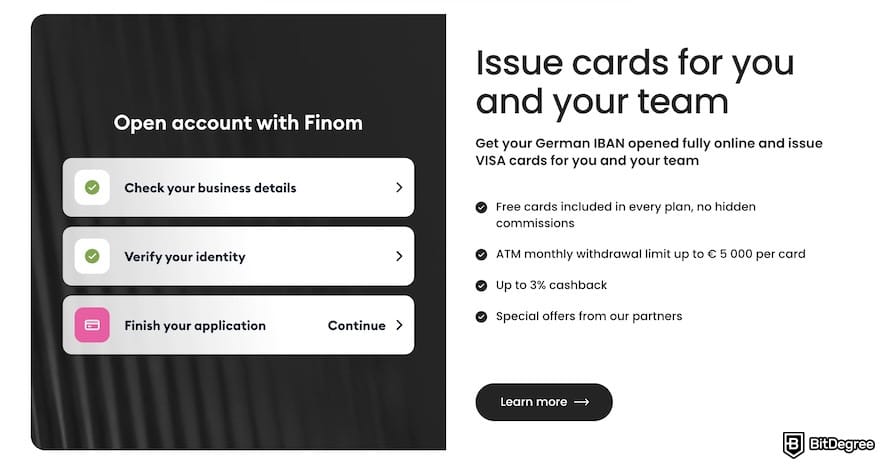
- Team access and business controls. If you’re working with a team and need more structure than a personal payout account, Finom makes collaboration easier. You can assign roles, control spending, and manage employee cards.
- Various integrations. You can export reports and accounting records to popular software like DATEV, Wiso, Lexware, and Sevdesk. It supports automatic syncing of invoices, payments, and accounting entries, and uses precise data extraction from any document, so your financial data stays accurate with minimal manual work.
Overall, Finom can be one of your Payoneer business alternatives, especially when you operate the business in Europe.

Did you know?
All Money Transfer Services may look similar to you, but they're NOT all the same!
4. PayPal - Widely Accepted, PCI DSS Compliant, Buyer/Seller Protection
Ranks #4 out of 7 Money Transfer Services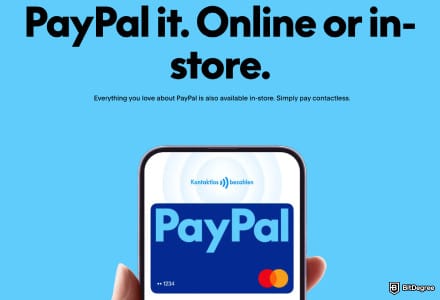
- + Easy to use
- + Simple payment process
- + Strong security
- + Wide coverage
- + Access to crypto
- - High fees
- - Not available everywhere
- - Customer support complaints
It’s easy to see why PayPal is often considered a strong Payoneer alternative. It’s one of the most established online payment platforms, trusted by over 426 million active users, including merchants, businesses, and individuals worldwide.
If you use Payoneer mainly for its marketplace integrations, PayPal offers similar advantages. PayPal integrates with popular freelance platforms and is often recommended as a Payoneer alternative international eCommerce brands can trust due to its partnership with marketplaces like Etsy and Shopify. PayPal also integrates with Coinbase, which is suitable for users who often move between fiat and crypto.
| |  | |
|---|---|---|
| Android/iOS | Android/iOS | |
|
| |
|
| |
| 1 Working capital - Capital Advance | 1 PayPal Savings - 3.8% APY (US-only) 2 Buy now pay later 3 Brand cashbacks | |
| 1 None | 1 Mass Pay 2 Donation and nonprofit tools 3 Buyer protection | |
| Visit site | Visit site Read review |
Table: Comparison of Payoneer and PayPal user experience
From a security standpoint, PayPal is PCI DSS compliant and operates under multiple regulatory licenses across regions. PCI compliance means PayPal follows strict standards designed to protect cardholder data.
The PCI DSS framework covers areas such as network security, access control, encryption, and ongoing vulnerability management, helping reduce the risk of fraud[2] and data breaches.
Key Features
Check these PayPal features to see if it’s a good Payoneer alternative for you:
- Personal use cases supported. Unlike Payoneer, which focuses on cross-border business and marketplace payouts, PayPal also supports peer-to-peer transfers and everyday purchases.
- No monthly fee. PayPal offers free account setup with no ongoing maintenance fees unless you use specific paid services. This setup can be beneficial for freelancers and small businesses looking to keep costs low.
- Buyer and seller protection programs. The platform provides dispute resolution and protection for eligible transactions. In cases such as unauthorized payments or items not received, PayPal can step in to mediate and help protect funds.

- Crypto support. PayPal allows users in supported regions to buy, sell, and hold several cryptocurrencies, and in some cases, transfer crypto to external wallets and exchanges.
- Business loans. PayPal offers business financing options, ranging from $5,000 to $100,000, with funding available as soon as the next business day after approval. Eligibility usually requires a PayPal Business account and a minimum annual revenue.
PayPal can be a strong alternative to Payoneer, thanks to its broad acceptance, various integrations, protection tools, and ease of use for both personal and business cases. That said, it’s worth noting that PayPal’s FX conversion markups and fees can be higher, and pricing isn’t always the most transparent, which should be something to factor in if you often make international payments.
5. Grey - Multi-Currency Account, FinCEN-Regulated, Toptal Integration
Ranks #5 out of 7 Money Transfer Services
- + User-friendly platform
- + Expense management and invoicing tools
- + Free peer-to-peer transfers
- + Multi-currency account
- - High card creation fees
- - More limited regional availability
Founded in 2020, Grey was created to make it easier for global professionals (remote workers, digital nomads, and freelancers) to receive international payments without the barriers of traditional banking.
It operates under money services licenses regulated by FINTRAC (Canada) and FinCEN (USA), providing digital financial services across Africa, Europe, the Americas, and Southeast Asia.
Key Supported Countries | European countries, Nigeria, Kenya, Tanzania, Uganda, South Africa, Ghana, Brazil, Mexico, Philippines, Indonesia |
|---|---|
Currencies for Receiving Payments | NGN, USD, GBP, EUR, USDC |
Currencies for Sending Payments | USD, NGN, GBP, EUR, TZS, KES, UGX, BRL, MXN, IDR, ZAR, GHS, PHP, USDC |
Supported Languages | English, Arabic, Indonesian, Portuguese, Spanish (Español), Swahili, German (Deutsch) |
Table: Grey coverage
So, if you’re wondering whether your country supports PayPal (or similar tools), you may also want to check Grey, especially if you work with international freelance platforms like Toptal. The Grey team has published guides showing how freelancers in countries such as Pakistan and India can receive payments from Toptal directly into their Grey account.
Once set up, Toptal earnings in currencies like USD, EUR, or GBP can be transferred straight to your Grey account, where you can hold, convert, or withdraw them locally at competitive rates.
Key Features
Here are the reasons why Grey can be your Payoneer money transfer alternative:
- Multi-currency account. This fintech platform lets users receive, send, exchange, and manage multiple currencies all from one app, including opening foreign bank accounts in USD, EUR, or GBP.
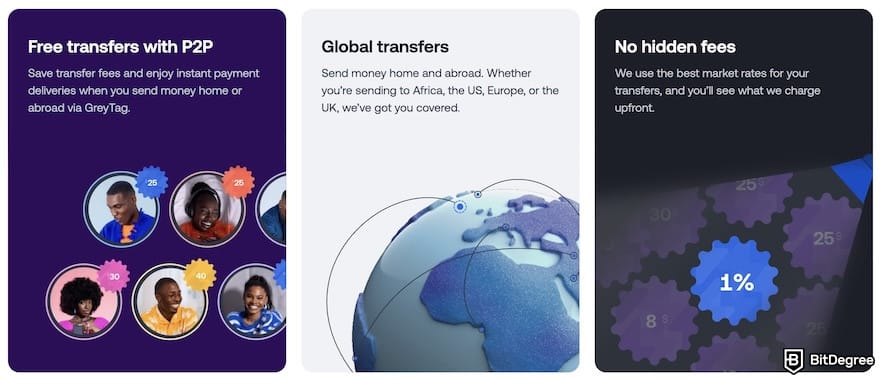
- Free peer-to-peer transfers. With a GreyTag, you can send and receive payments instantly within the platform. You no longer have to send your banking details for international transactions.
- Expense management and invoicing tools. Built-in tools help freelancers and small business owners keep track of spending and send invoices to clients.
- Virtual cards. Collaborating with Mastercard, Grey provides virtual debit cards you can use to spend money in 80+ countries and pay for subscriptions without paying card maintenance fees.
- Bill payments. You can pay your electricity and cable TV bills with just a few taps on your account. At the moment, this feature is available only to Nigerians.
Grey is relatively new, but it can be a practical Payoneer alternative for freelancers and remote workers who need simple access to global payments, especially in regions where PayPal or other platforms are limited or unavailable. That said, because Grey is still expanding, feature availability (such as bill payments or local payout options) may vary by country.
📚 Read More: Is PayPal Available in Pakistan?
6. WorldFirst - 210+ Countries, Integrates With 130+ Marketplaces
Ranks #6 out of 7 Money Transfer Services
- + Multi-currency accounts
- + Competitive exchange rates for high-volume transfers
- + No setup or account maintenance fees
- + Free and instant internal transfers
- - Only businesses can open an account
- - Minimum transfer amounts may apply
- - The app may not be available in some countries
WorldFirst is a global payments platform, often positioned as a cost-effective alternative to Payoneer. Since its launch in 2004, London-based WorldFirst has supported over 1 million businesses, helping clients send more than £87 billion across borders.
The platform enables users to pay, receive, hold, and spend funds in multiple currencies, and it's regulated by the UK’s Financial Conduct Authority (FCA). In February 2019, WorldFirst was acquired by Ant Financial Group, with Alibaba holding approximately 33% ownership in the company.
Founded in | 2004 |
|---|---|
Founders | Jonathan Quin and Nick Robinson |
Headquarter | London, England |
Licensing and Regulation | De Nederlandsche Bank (DNB), Australian Securities and Investments Commission (ASIC), the UK's Financial Conduct Authority (FCA), the Monetary Authority of Singapore, the US's Financial Crimes Enforcement Agency (FinCEN), and Hong Kong Customs and Excise Department |
Table: WorldFirst's company information
It’s especially popular with eCommerce sellers, since it integrates with 130+ marketplaces, including Amazon, Etsy, and Shopify. Import-export companies and businesses with frequent international transactions can also rely on WorldFirst because of its broad currency support (40+ currencies listed at the time of writing).
Talking about accessibility, WorldFirst provides coverage in South Asia and Europe, serving 210+ countries and territories. It’s also officially registered in many countries, including the Netherlands, Singapore, and the US.
Key Features
If you’re searching for a Payoneer alternative international businesses can trust, WorldFirst is worth checking out.
- 20+ local currencies. WorldFirst’s World Account lets you receive, hold, convert, and send funds in 20+ local currencies from a single wallet, which is more than double the number of local currency accounts Payoneer provides.
- Affordable World Card. You can get a business debit card at no additional cost. Also, when you spend in supported currencies directly from their relevant balance, there will be no foreign exchange fees.
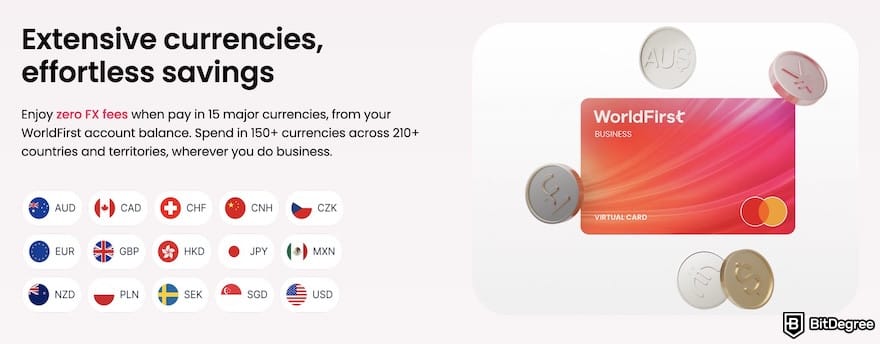
- Competitive and transparent FX. WorldFirst typically offers competitive exchange rates with capped mark-ups around 0.5-0.75% for cross-currency conversions, which can help protect profit margins on international transactions.
- Business-first integrations. WorldFirst integrates with accounting platforms, like Xero and NetSuite, to help you have smoother reporting and reconciliation in one dashboard.
- 24/7 multilingual customer support. WorldFirst’s customer support teams come from 20+ regions and are fluent in 11+ languages. The company claims to make them available in 24 hours, with a typical response time of 60 seconds.
Overall, WorldFirst is among the best Payoneer business alternatives, especially for companies that need wide currency coverage, lower FX costs, and seamless integrations.
7. Tipalti - Enterprise-Level Features, AI Agents, Tax Compliance Tool
Ranks #7 out of 7 Money Transfer Services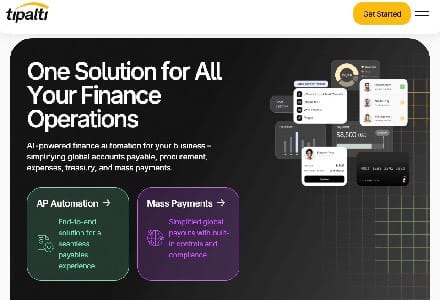
- + Comprehensive automation for businesses
- + Automated tax form collection
- + Responsive AI agents
- + Customizable portals
- - High cost
- - Slow support replies
Launched in 2010, Tipalti is a Payoneer alternative built for scale. Instead of focusing on freelancers or solo payouts, the features are designed for companies with complex international payout needs. Tipalti focuses on high-volume, automated partner payments, compliance, and financial controls, making it ideal for enterprises.
Founded in | 2010 |
|---|---|
Founder | Chen Amit |
Headquarter | California, United States |
Licensing and Regulation | De Nederlandsche Bank (DNB), the United States Treasury's Financial Crimes Enforcement Network (FinCEN), |
Table: Tipalti's company info
It automates the entire payout flow, from onboarding partners and collecting tax forms to paying them out globally and reconciling everything in your accounting system. At the time of writing, the platform has been trusted by many big companies, including Scribd and Brooklinen. Recently, Tipalti also received the Best SaaS for FinTech 2025 by the FinTech Awards, showing how strong its reputation is in the payment industry.
The platform supports payments in 120+ currencies across 200+ countries and territories, using more than 50 methods like bank transfers, wires, and PayPal.
In terms of security, Tipalti operates under strict compliance and AML rules. The platform verifies businesses through KYC checks, runs ongoing reviews, and may suspend accounts that fail compliance requirements. It also limits usage to business payments only and blocks restricted industries such as gambling, adult content, firearms, and certain money services.
Key Features
If you need something that “outgrows” Payoneer for managing large-scale payments, vendors, or partners, these features show why Tipalti is the best alternative to Payoneer for enterprises:
- Tipalti AI Agents. It’s a 24/7 conversational AI that you can chat with to get insights about invoices, purchase orders, and spend data. You can ask it to generate custom spend reports, read invoices, and more.
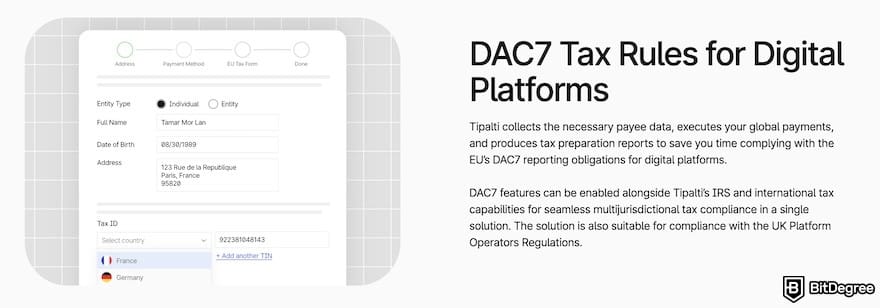
- Tax compliance assistant. Tipalti handles tax stuff for you, guiding partners through W-8 and W-9 forms, validating tax IDs with a KPMG-approved process, and keeping everything compliant. It also generates 1099 and 1042-S reports and lets you file them directly inside the platform.
- Finance-team-friendly integrations. It plugs directly into ERP and accounting tools like NetSuite, QuickBooks, Xero, and Oracle, so payouts, reports, and books actually stay in sync.
- Enterprise-grade support and customization. Businesses can get a dedicated support team, branded partner portals, and self-service dashboards in multiple languages. They can also customize approval steps and payment workflows, which helps manage large-scale payments more easily and securely.
- Corporate cards. Tipalti Card works anywhere Visa is accepted (over 200 countries and territories). You can set specific spending limits and rules on each card and get alerts to help keep expenses in check. If a card is misused, it can be canceled instantly.
All together, Tipalti feels more like a full finance ops system, which can be the best alternative to Payoneer for enterprises that need automation, strict compliance, and total visibility over global payments.
Why People Look For Payoneer Alternatives
Payoneer may still be a go-to platform for freelancers and cross-border payments. But lately, more people are looking for alternatives because the experience doesn’t always match their current needs anymore.
From what I see, one of the biggest frustrations is accounts getting frozen or funds being locked with little explanation. If your income depends on fast access to your money, that kind of uncertainty can feel stressful and risky. No one wants to keep wondering when (or if) they’ll get their money back, right?

Another common complaint is slow customer support and long review times. When verification or compliance checks take weeks, it can delay payments, hurt cash flow, and slow down client work, which is the opposite of what freelancers and businesses want.
Then there’s the fee issue. Payoneer isn't one of the cheapest ways to send money internationally because, over time, Payoneer has added or increased fees on withdrawals, transfers, and currency conversions. Additionally, FX markups can quietly eat into your earnings, so you may end up receiving less than expected, especially if you work with international clients.
Meanwhile, newer fintech platforms are stepping in with smoother UX, faster processing, and more flexible features. So honestly, I get why people start looking at the “greener grass” when they experience Payoneer’s issues.
Then, for some freelancers or businesses, it may be about lifestyle or need changes. Some users tend to need a bigger or more scalable platform as their business grows and their team expands. On the other hand, some freelancers may want a Payoneer alternative for personal use, like Ogvio, especially if they mix work income with personal spending.
📚 Read More: Best Money Transfer Apps
Comparing Payoneer Alternatives
Payoneer can still work for many freelancers and businesses, but it’s clearly not the only option anymore. With increased fees, slower support, and newer fintech tools entering the game, a lot of people are starting to explore Payoneer alternatives that better match their workflow, budget, and speed expectations.
Below is a quick side-by-side comparison of alternatives to Payoneer mentioned above:
Best For | Key Strengths | Trade-offs | |
|---|---|---|---|
Ogvio | Freelancers, remote workers, crypto-savvy users | Fast payouts, crypto with stablecoin rails, low FX fees, @Tag payments, Earn (APY), modern UX | New platform, no corporate cards yet |
PayPal | General payments, marketplaces, international clients | Widely accepted, easy setup, buyer/seller protection, strong integrations | High fees, currency conversion costs, account freeze risk |
Grey | Toptal users, receiving USD/EUR/GBP | Virtual foreign bank accounts, simple UX, good for salary & freelance payouts | Limited user availability |
WorldFirst | Cross-border eCommerce & import/export businesses | Strong FX rates, multi-currency accounts, business-focused | More enterprise-leaning, less freelancer-friendly |
Wise | SMEs, startups, international transfers | Transparent FX, multi-currency accounts, debit card, strong reputation | Some features restricted by country, not payout-specialized |
Tipalti | Large companies, mass payouts, payroll | Automated tax compliance, batch payouts, enterprise-grade workflows | Expensive, complex, not ideal for solo freelancers |
Table: Comparison of alternatives to Payoneer
What I can tell is that the best Payoneer alternative depends on how you work. Some platforms are better for freelancers and solo creators, others are built for global businesses, marketplaces, or finance teams handling large volumes.
If Payoneer feels too slow, expensive, or limiting, switching to a more modern platform like Ogvio can save money, speed up payouts, and reduce stress. Meanwhile, those with more complex business needs may want to check Tipalti or WorldFirst.
📚 Read More: Best International Money Transfer Services
Conclusions
If you’re tired of high fees, slow support, locked funds, or clunky UX, be aware that you don’t have to stick with a platform that feels outdated or stressful. There are now better Payoneer alternatives depending on your needs.
The right option can save you money, time, and a whole lot of frustration. Are you running a growing business or paying teams? Finom or Tipalti helps make your accounting tasks easier. Meanwhile, PayPal may be suitable if you connect with marketplaces or freelancing platforms.
If you want faster and crypto-friendly options, Ogvio can be your Payoneer alternative for personal use and business cases. It offers near-instant transfers, low fees, and modern flows.
Scientific References
1. Gaviyau W., Sibindi A.B.: 'Global Anti-Money Laundering and Combating Terrorism Financing Regulatory Framework: A Critique';
2. Daah C., Qureshi A., Awan I., Konur, S.: 'Enhancing Zero Trust Models in the Financial Industry through Blockchain Integration: A Proposed Framework'.
Send Money Worldwide
Check out the best ways to send money to other countries quickly, safely, and with minimal fees.






























About Article's Experts & Analysts



Disclosure: To keep our site running & free of charge, we may sometimes receive a small commission if a reader decides to purchase services via some links on site, at no extra cost.