
If you live somewhere in Europe, you’ve likely heard of Paysend. From its inception, the company has carved out a familiar name in the region’s remittance market. As of recently, though, it has expanded its footprint in Asia. In this Paysend review, let's take a closer look if it’s worth your time.
For transferring and requesting money, Paysend does its job well, and it even has dedicated financial solutions for businesses. However, if you need more than just the basics, like holding fiat-crypto balances or earning returns on them, it’s not nearly as powerful as alternatives like Ogvio.
But even from this brief overview, you might still need more clarity on the good, the bad, the ugly, and how Paysend works overall. Let’s get into it.
Verdict at a Glance
Paysend is an easy-to-use remittance platform designed primarily for fast and flat-fee transfers with wide receiving coverage. It is a strong choice for casual remitters and those who prefer cash pickups. However, its transfer limits can be a hard ceiling, and it doesn’t have any features to manage or grow your balances.
Pros
- Flat transfer fees
- 50+ sending countries
- Cash pickup
- Bank-level security
Cons
- Restrictive transfer limits
- Stopped offering Cards and Accounts
Table of Contents
- 1. Paysend Review: Quick Overview
- 2. Paysend Alternatives
- 3. Who is Paysend For?
- 4. Advantages
- 5. Limitations
- 6. Fees
- 6.1. Sending Limits
- 7. User Experience
- 8. Coverage
- 9. Customer Support
- 10. Security
- 11. Paysend Card
- 12. Business Features
- 13. How to Use Paysend
- 13.1. Create an Account
- 13.2. Send Money
- 14. Comparison to Other Money Transfer Services
- 14.1. Paysend VS Ogvio
- 14.2. Paysend VS WorldRemit
- 14.3. Paysend VS Wise
- 15. Conclusions
Paysend Review: Quick Overview
To start off this Paysend review, it would be a good idea to first understand what is Paysend? The table below should give you the quickest answer:
Type | Money transfer service |
|---|---|
Is Paysend Safe? | Yes |
Best for | Casual remitters, beginners, cash pickup recipients, businesses |
Established in | 2017 |
Headquarters | London, United Kingdom |
Supported Countries | United States, Ireland, Uzbekistan, and 167 more |
Licenses | FCA, FINTRAC, etc. |
KYC Verification | Yes |
Security | Bank-level security, PCI-DSS compliance, 2FA, transaction monitoring, etc. |
Features | Remittance, Paysend Enterprise, etc. |
Supported Fiat Currencies | EUR, USD, MXN, and 117 more |
Funding Methods | Bank, debit/credit card, mobile wallets, cash, etc. |
Fees | Flat €1.5 or $1.99 transfer fee |
Crypto Support | Fiat-only |
Customer Service | Live chat, request ticket, help center, etc. |
Table: A quick overview of Paysend
This is just an initial exploration, though, and it certainly isn’t enough to make an informed decision about whether you should use Paysend or not. Even if you’re already a user, you might wonder if you should stay or move on. Whichever page you’re on, let’s unpack the platform further.
Paysend Alternatives
Paysend focuses on a simple send-and-receive experience. For some people, that functionality is enough, but others need more than the bare minimum.
Here are my top picks for Paysend alternatives, based on what I’ve tried out so far:
- Ogvio. For sending money abroad, Ogvio gives better rates than Paysend as it sticks to mid-market FX standards. But it’s also more than that, since you can use Ogvio for your full financial journey - from holding to even earning on your balance. And for businesses, Ogvio offers API-driven solutions that are as customizable as Paysend Enterprise.
- WorldRemit. Paysend has a strong presence in the European market, but if you want a worldwide reach, WorldRemit is better. It’s especially popular for its mobile-optimized transfer routes, since you can send money to someone else’s phone number in select corridors.
- Wise. Wise simplifies global money management for freelancers, travelers, and even businesses. It is available in 160 countries and supports 40 currencies (as of writing), though feature availability varies by country.
 |  |  | |
|---|---|---|---|
|
|
| |
| Per-transaction | Per-transaction | Per-transaction | |
| | | | |
| A global money transfer service with an additional volatile currency rate pegging to USD or EUR. | A trusted digital remittance service with upfront fees and great rates, but limited options for cash delivery. | An easy-to-use digital transfer app for small to medium-sized remittances. | |
| Visit site Read review | Visit site Read review | Visit site Read review |
Table: Comparison of Ogvio, WorldRemit, and Wise
While Paysend’s level of simplicity may be sufficient for some users, others might prefer a platform that gives them flexibility from day one, considering how one’s remittance needs usually evolve with time.

Did you know?
All Money Transfer Services may look similar to you, but they're NOT all the same!
Who is Paysend For?
While researching Paysend, I tried to see if it’d fit my own use case, or whether my coworkers, friends, or even my neighbor, who regularly receives money from her daughter overseas, would find it useful.
From what I’ve seen and tested so far, Paysend is best for:
- Casual Remitters. I used to think that Paysend was mostly for EU-based money senders, but my perception changed once I saw that many users in the emerging markets, such as India, Mexico, and Nigeria, also rely on this platform - especially to receive funds.
- Beginners. Paysend is easy to use, and most people even access its features through its user-friendly mobile app. The onboarding process is quick, and you simply have to follow the on-screen prompts to set up a transfer. It’s even possible to send funds abroad without a bank account.
- Cash Pickup Users. Mobile transfers are convenient, but some people have greater peace of mind when they can collect the funds in person. Thankfully, Paysend supports this offline service and even enables a hybrid experience. You can swiftly arrange the transfer online and have the recipient collect it at a local branch.
- Enterprises. Paysend offers a B2B, API-driven global payout solution that makes perfect sense for corporates who move money at scale, across borders, and programmatically. Businesses can plug payout automation, multi-rail payment networks, and FX-optimized cross-border settlements into their payment stack.
But how does Paysend work for each of these groups? I’ll break down the platform’s strengths, feature by feature.
Advantages
User Paysend reviews often sprinkle in praises for the following strengths:
- Ease of use;
- Broad sending country coverage;
- Low transfer fees;
- Relatively fast settlement times;
- Bank-level security.
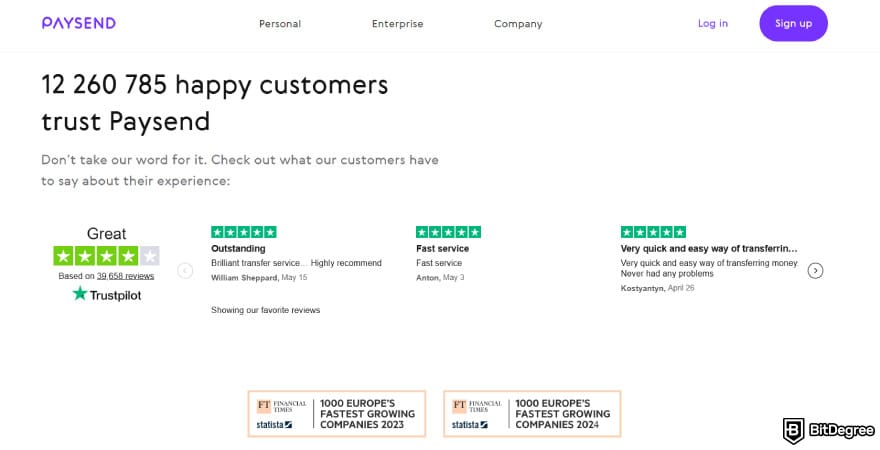
Paysend currently gets a 4.2 out of 5 rating on TrustPilot, which is a strong showing for a money transfer service. The feedback frequently highlights the Paysend mobile app, pointing to its intuitive interface and how it makes the transfer process much more efficient.
On its website, the platform says you can send to 170+ countries. But, as is common elsewhere, outbound transfers aren’t available from all those locations. Nevertheless, Paysend supports around 49 sending countries - more than what same-category platforms could offer.
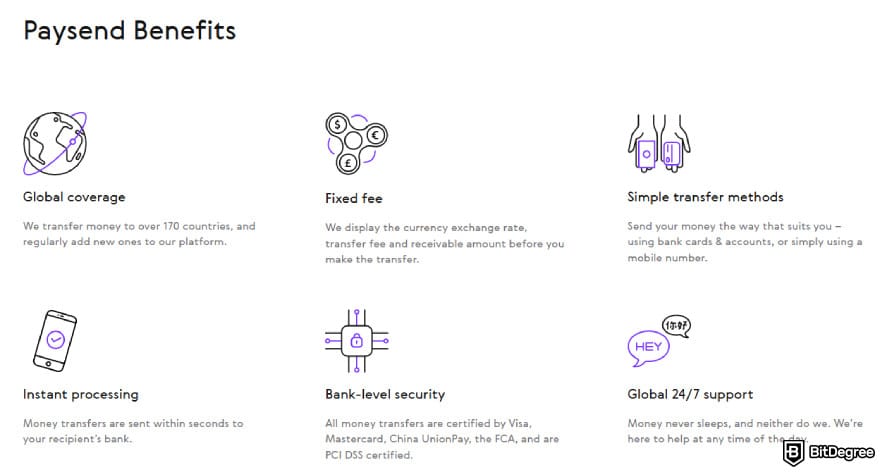
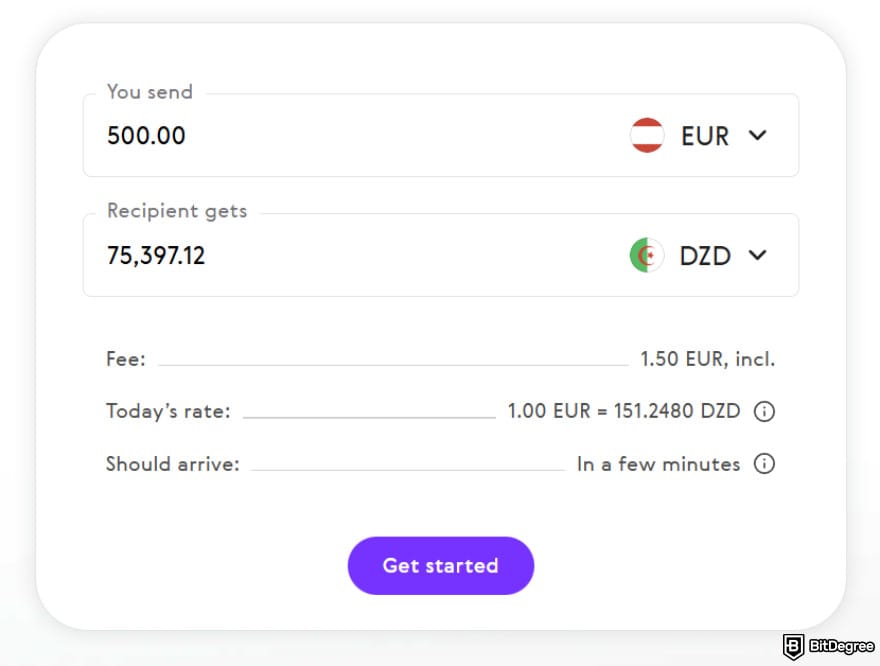
Figuring out how much you’ll pay isn’t complex, either, as it’s part of Paysend’s user-friendly approach. If you’re a new user, make sure to take advantage of Paysend’s fee-free first transfer. What’s nicer, though, is that you pay a flat fee, even if you send out larger amounts.
And you don’t have to sleep overthinking when the transfer will arrive, because in the majority of the cases (85%, to be exact), it’ll land in under 10 minutes. Note that bank transfers may take longer, often up to 3 business days, to reach their destination.
Now, you may ask, is Paysend safe? The platform cements user trust by complying with recognized regulatory requirements. It holds state-specific licenses across the US - a country known for its stringent financial oversight. In addition, Paysend is PCI-DSS certified, and all transfers are overseen by established payment networks, such as Visa, Mastercard, and China UnionPay.
Limitations
Here are a couple of areas where Paysend falls short:
- Too "simple"
- FX markups
- Modest transfer limits
- Discontinuity of Paysend Card and Accounts
Paysend works best if you want to send remittance overseas (or make local transfers if you’re in the US). You cannot earn interest on your balance, peg it to stable currencies for inflation protection, or diversify it with crypto like on Ogvio.
And while Paysend only charges approximately a dollar for every transfer, hidden fees arise from FX markups, which can be significant. Paysend offsets that by avoiding a percentage-based fee structure, but when you move smaller volumes, you technically lose the sense of “cost efficiency”.
Even if you’re sending bigger sums, the maximum amount you can transfer is capped at $10,000 daily or $50,000 monthly, under the condition that you’ve passed Tier 3 verification. Some people may want to upgrade their limits, but might hesitate at the additional verification required, which can include more sensitive documents such as bank statements or proof of residence. If your volumes sit above that ceiling, you’re in territory Paysend simply wasn’t built for: large one-off transfers are what specialists like OFX and its peers handle, and freelancers invoicing overseas clients at scale tend to gravitate towards Payoneer-style platforms instead. Our OFX alternatives and Payoneer alternatives roundups cover each of those ends.
Paysend used to have multi-currency wallets as well as virtual and physical cards, but it has stopped offering them since June 8, 2023. That said, UK and EEA users who registered before that deadline can continue using them.
Fees
Paysend fees are thankfully simple to work out. However, you need to understand the following disclaimer, as noted by the company itself:
Paysend fees are separate from any charges your bank may apply.
Apart from that, there might be additional fees, not charged by Paysend, but by the specific local provider you use. So, when I am describing Paysend fees, I will only focus on the costs incurred by the platform. Of course, to give you the full context, I will also walk you through any external fees you should prepare for.
Let’s start with some good news - as that’s often the preferred place to start. For the following actions, Paysend will not charge you at all:
- Setting up a multi-currency account;
- Adding funds to your multi-currency account with cards;
- Storing funds in an active multi-currency account;
- Exchanging currencies;
- Using the Paysend Card abroad (excluding standard ATM fees);
- Sending money to another Paysend user with your multi-currency account.
The takeaway here is that, for account-level activities, Paysend won’t burden you with extra fees.
But once you interact with external rails, such as initiating outbound transfers or processing bank-related transactions, fees will show up.
Thankfully, Paysend takes a transparent approach. You’ll see the exact quote once you’ve selected the sending and receiving countries.
Other services incur charges as well:
Fees | |
|---|---|
Remittance to another country | Flat at €1.5 or $1.99 + FX markup |
Multi-currency account top-up using a bank account | Standard fee based on the chosen top-up method |
Cash withdrawals | 2% of the total if you withdraw over £200 GBP or €200 |
External money transfers | Standard bank or digital wallet (or any chosen method) charges |
Card payments in a different currency | 2% of the total payment |
Table: Paysend fees
These aren’t the only fees you should expect. After all, there are additional fees that Paysend doesn’t control. Allow some room for extra charges or anticipate deductions if you:
- Send money with a credit card;
- Receive money into your bank account.
Therefore, whenever you move money, thinking “Where did the rest of it go?”, now you understand why.
Sending Limits
You probably can already tell that Paysend fees aren’t sky-high. Pair that with transfers that arrive in minutes, and you get the reason why user Paysend reviews are trending positively.
But fees are only part of the equation. Paysend keeps its sending limits pretty tight, categorized by verification levels. This is where some users get tripped up. They’d expect extra savings on lower fees, only to hit a ceiling on how much they can actually send. Splitting the transfers into smaller amounts isn’t a way out either - every transaction incurs a fee.
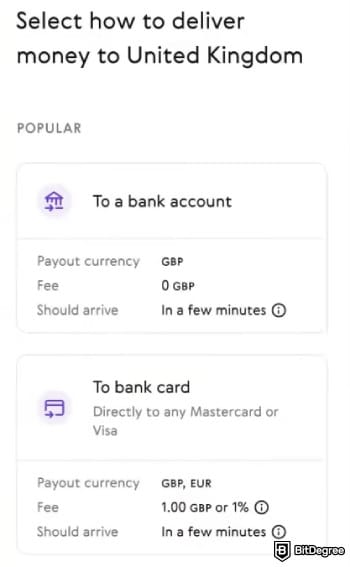
Let’s try to understand Paysend limits first, so you can plan around these restrictions better:
Daily Limits | Annual Limits | |
|---|---|---|
Tier 1 (Basic) | $999 | $10,000 |
Tier 2 (Advance) | $5,000 | $20,000 |
Tier 3 (Ultimate) | $10,000 | $50,000 |
Table: Paysend sending limits
Based on the limit brackets, Tier 1 realistically supports personal use. If you’ve used up your maximum sending allowance, Paysend will send a notification to verify your account, complete with the instructions. Here’s what to expect, though: more limits, more personal data required.
I’ll give you a sneak peek at the types of documents the platform will ask you to submit:
- An identification document with a photo. This could be your international passport, national ID, driving license, or biometric residence permit - especially if you’re living, working, or studying abroad. Completing this requirement will upgrade you to Tier 2.
- Address and source of funds. This could be proof of your residence (non-Canadian accounts only), a bank statement verifying your source of income, and a completed source-of-funds questionnaire. Completing this requirement will upgrade you to Tier 3.
If the current limit doesn’t cover your transaction volume, you’ll need to talk to Paysend’s KYC team.
User Experience
Paysend provides multiple channels to move money: its website, mobile app, and cash pickup locations.
Most people access Paysend on their mobile devices because it’s a convenient way to track outbound transfers without booting up their PC each time. Plus, you get instant notifications, so you can take immediate action when you notice a status change.
On the App Store, Paysend is rated 4.8/5. One user in Belarus says that it’s the only app that works for them, and they can send the money to a debit card instantly. User Paysend app reviews Google Play Store beg to differ, though, and the rating is 3.8/5.
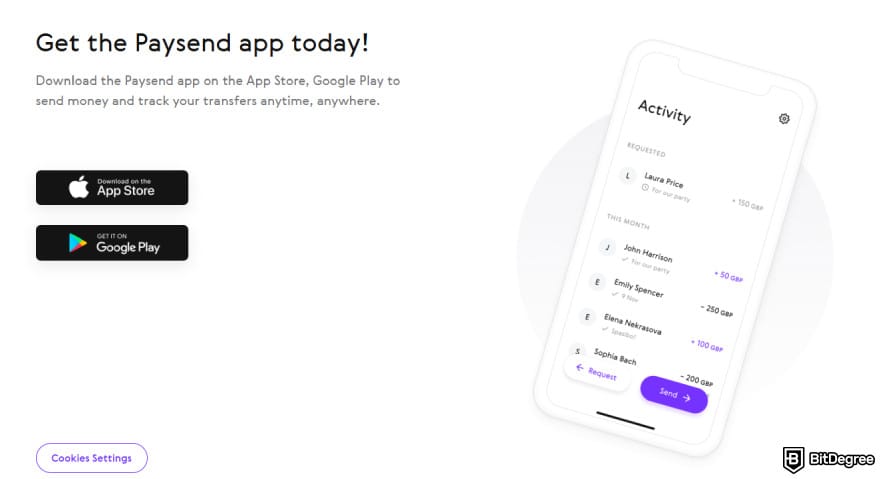
People cite more issues there, although the app still works fine overall. Some users are happy with the reasonable fees, while others run into technical issues like payments getting stuck or accounts getting flagged for violation without definitive reasons. But Paysend's support team is almost always available, responding to every comment and suggesting the next step.
If you’re a browser-heavy user, you’ll find the same functionality, minus mobile-only features like push notifications. But that shouldn’t be a dealbreaker, and the experience is positive all around. I particularly like how the web design is clean, minimalistic, and clutter-free, so you can focus on pushing the buttons that get you to the next action.
For Paysend users in the Philippines, Vietnam, or Latin America, Paysend offers payout flexibility with cash pickup, letting you receive cash at authorized locations.
Surprisingly, funds are made available just as quickly as online transfers - in minutes. This offline option is particularly popular among those who don’t have bank accounts.
Coverage
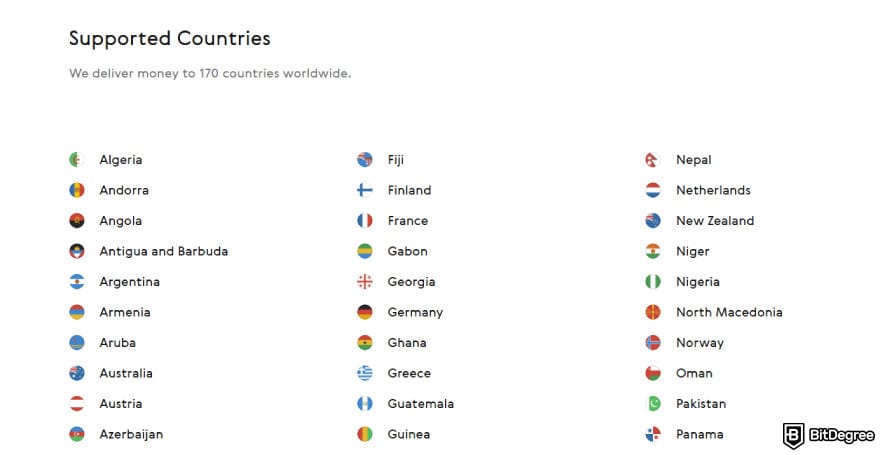
Paysend started out as an EU-focused remittance solution, but now, it plans to add more countries under its reach. It lets you send money online to 170+ countries, but if you’re in the Philippines, Vietnam, or Latin America, you get the added convenience of an omnichannel experience: set up the transfer online, and your recipient just has to show their ID when collecting the funds at a nearby agent location.
Based on the country, here’s where you can find Paysend’s local pickup points:
- The Philippines: United Bank, M Lhuillier, Palawan Pawnshop, etc.
- Vietnam: Vietcombank.
- Mexico: 7-Eleven, Walmart, etc.
- Guatemala: Banco Industrial, Banco G&T, etc.
- Dominican Republic: Caribe Express and Banco BHD.
- El Salvador: Davivienda El Salvador, Banco Promerica, and Fedecrédito.
- Honduras: Banco de Occidente, Banco Atlántida, etc.
As you can imagine, a network spanning 170+ countries is far-reaching. Your funds can reach destinations like Angola, Macau, Mexico, and Luxembourg, even if your recipient lives in a rural area.
But receiving coverage isn’t the same as sending coverage, and Paysend only enables outbound transfers in 49 countries. Thankfully, the list covers most regions: Europe, the US, Asia-Pacific, Africa, and the Middle East.
Paysend’s global presence is extensive, but can it speak your language? The website caters to 17 locales, supporting diverse languages such as Bahasa Indonesia, Türkçe, Polski, and the main one - English.
Customer Support
Paysend’s customer support is also multilingual, and the team can address your inquiries in Simplified Chinese, Français, and 7 other languages. In case you’re wondering, don’t worry, English is supported.
Onto customer support channels, self-guided users may appreciate the Help Center, or even the YouTube channel with all the video tutorials if you’re a visual learner.
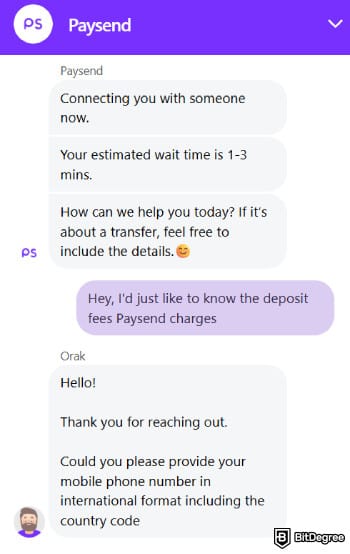
For more pressing issues, you can submit a Request (which works like an email) or start a chat with one of the platform’s agents. Other platforms are beginning to incorporate AI into their customer support flows,[1] but Paysend leans toward human contact, which some users may appreciate.
Security
Since your money is on the line here, it’s only normal to expect your remittance provider to protect your funds with the best security measures.[2]
Protection starts from your account, and Paysend layers in two-factor authentication (2FA) and passcodes (OTPs) as a safeguard.
Whether Paysend is safe or not, it depends on how well you make use of the security features available at your disposal.
Paysend states that data security is a core principle behind any interactions on the platform. It’s completely safe to share personal details, such as your mobile phone number, your transaction number, etc. In fact, Paysend needs them to assess the risk of your activities without compromising your account.
And when you make transactions, Paysend monitors them closely, and it proves that with its PCI-DSS certification. The platform also works with its banking partners, such as Visa, Mastercard, China UnionPay, and SEPA, to continuously monitor incoming and outgoing payments.
Paysend Card
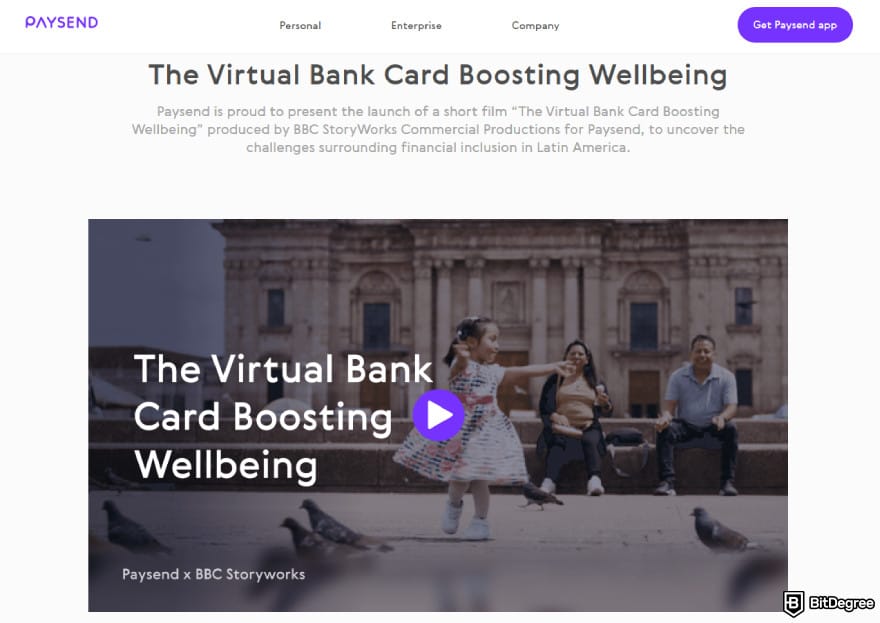
Throughout this review, you might’ve come across a couple of mentions of the Paysend multi-currency account, which is actually connected to the Paysend Card.
This prepaid card, backed by Mastercard, lets you hold balances in 13 currencies, such as EUR, GBP, and USD. You can use it to seamlessly transfer money or even link it to Apple Pay or Google Pay for online or offline spending.
📚 Read More: Best Digital Wallets
However, Paysend has stopped offering this card to new customers in the UK and EEA, where it used to be available, and the cut-off date was June 8, 2023.
Likewise, Paysend used to issue a physical plastic card, but it’s no longer available today.
Nonetheless, users who joined before that date can continue using their cards, and you can even utilize them to withdraw cash at any ATMs that support Mastercard.
There are withdrawal limits, and the rules follow a simple formula:
- Monthly: Up to €1,200 or £1,000.
- Every 6 months: Up to €2,500 or £2,200.
Truthfully, the ATM withdrawal limits above are pretty low - but Paysend might just allow you to cash out without limitations if you’re willing to go through additional KYC.
Business Features
As established before, Paysend is not exclusively designed for individuals. It has business features on the side, which can help medium- to big-size enterprises improve their global payment reach with support for 25 billion+ endpoints, from Mastercard to Western Union.
Paysend Enterprise lets you conduct business transactions in 120+ currencies with minimal FX margins, making it more cost-efficient than traditional methods.
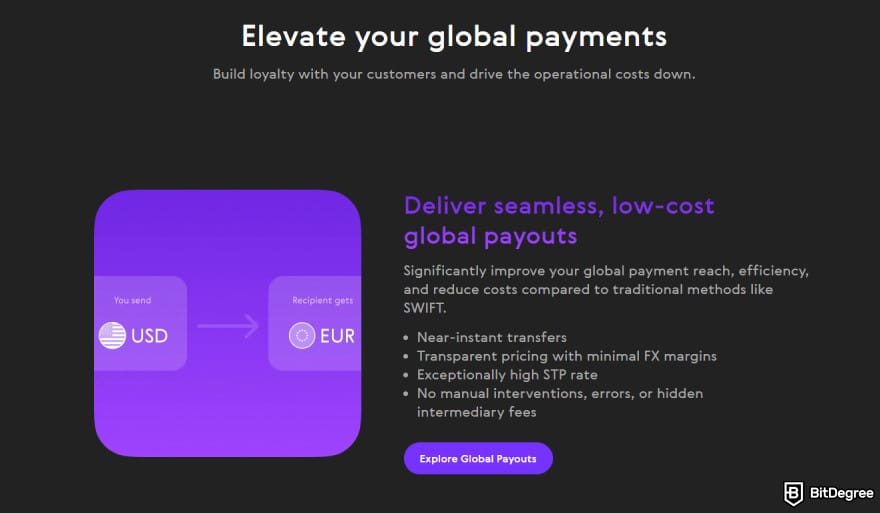
Settlement time also surpasses that of legacy banks. Half of all payments made with Paysend Enterprise are credited to bank accounts or other payout destinations in less than 5 seconds, with the rest taking under 24 hours.
The system has an STP rate of 99%, meaning that your end-to-end electronic payments flow smoothly without manual intervention. As a result, your finance team can spend less time firefighting and more time closing the books on schedule.
How to Use Paysend
Now, let’s see how Paysend works in practice, so you can also get a taste of its user experience.
Create an Account
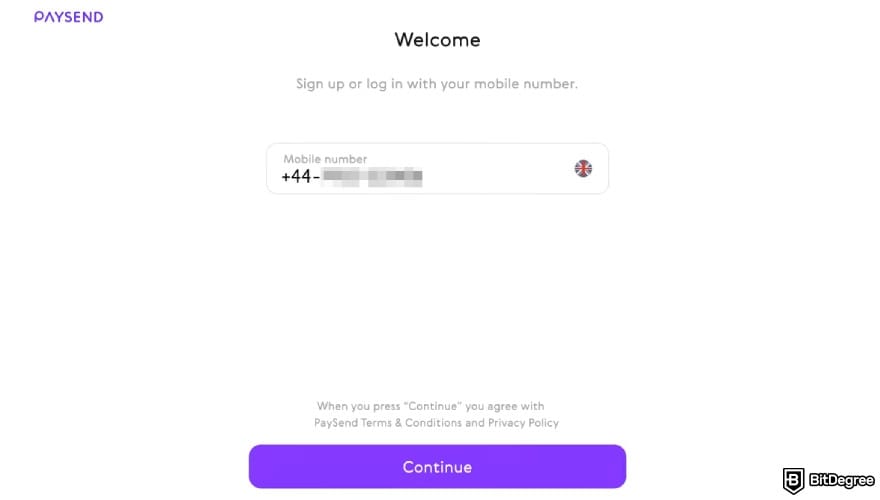
Signing up on Paysend is the first thing you'll need to do. Follow the steps below.
![Paysend review: the [Sign up] button at the top right corner.](https://assets.bitdegree.org/images/paysend-review-signup-1.jpg "Paysend review: the [Sign up] button at the top right corner.")
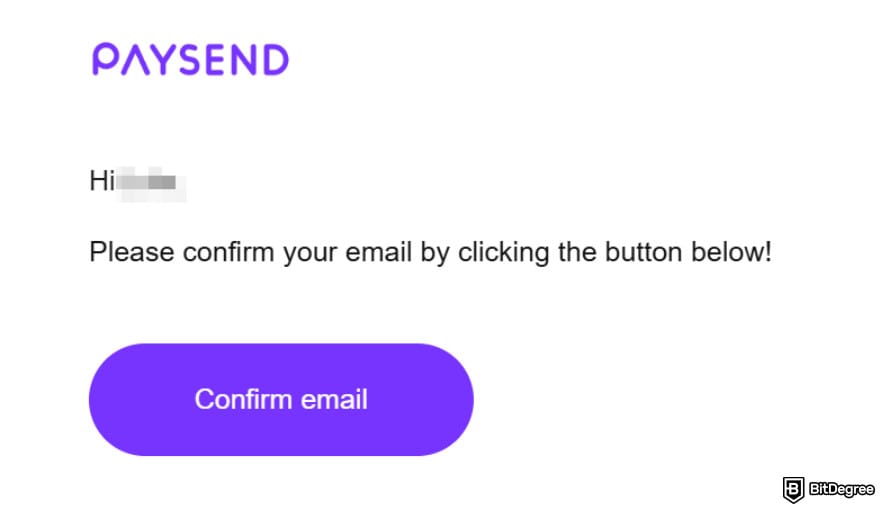
Your account is all set up now.
Send Money
With your account ready, you can begin making transfers with Paysend. Here’s how to do it, and for a change of pace, let’s do it via the mobile app.

- To a SEPA bank account;
- To a bank card;
- To a bank account
Do not forget to consider the fees coming from each method.
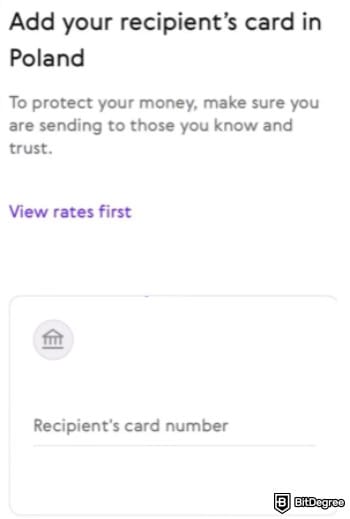
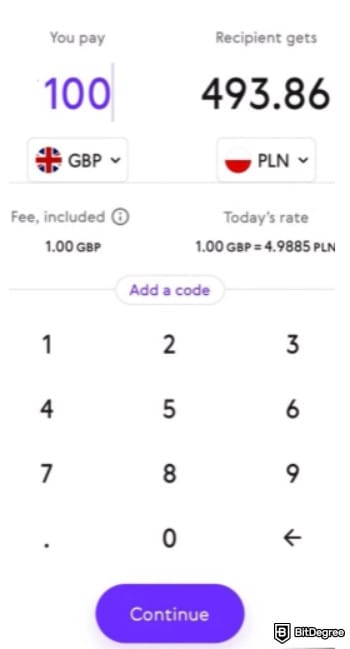
Your transfer is on its way.
Comparison to Other Money Transfer Services
Throughout this Paysend review, you might’ve come across some features that sparked your interest, or some that didn’t. Either way, let’s see how Paysend fares against some of the top money transfer services right now.
Paysend VS Ogvio
Paysend used to be a full-suite money management tool. In some ways, it still is - provided that you’re an old user who signed up early for the Cards and Accounts features. So, if the features Paysend used to roll out are what you’re looking for, you will find most of them on Ogvio.
What I like about Ogvio is that you can send or receive money globally, as long as you’re based in any of the 160+ countries it supports. It doesn’t limit “sending” or “receiving” countries - at least for the most part. The fees stay around 1-2% across corridors, and most transfers arrive in seconds or minutes.
| |  | |
|---|---|---|
UK Germany Germany France France+160 more |  US USUK UAE +167 more | |
| EN ID CN +6 more | EN ES FR +14 more | |
 USD USD EUR EUR CAD CAD+40 more | EUR BRL BRL MXN MXN+117 more | |
 USDC USDC BTC BTC ETH ETH+ 7 more | Fiat-only | |
| Visit site Read review | See TOP10 Brands Read review |
Table: Ogvio VS Paysend's coverage
For now, Paysend works for sending and receiving. But Ogvio brings in functionality such as holding and even earning. Funds inside your Ogvio account don’t just stay unused - you can earn passive income at an annual interest rate of up to 3.5% (rates might fluctuate). And unlike other earning programs, Ogvio doesn’t charge upfront fees on what you earn.
And there’s more that Ogvio has in store. You can convert your cash to crypto (or the other way around), swap it with other assets (such as BTC and ETH), and cash out any gains to your bank account.
📚 Read More: Ogvio Review
Businesses get some love from Ogvio, too. FX rate stays competitive, so you save more each time you pay your global team. And if you have any specific customizations you want to add to your financial workflow, such as API-based integration, reach out to Ogvio Business’s team, and they will gladly help you out.
Transfers to fellow Ogvio users are completely free. Take advantage of these now by signing up!
Paysend VS WorldRemit
There are a couple of big names in the remittance industry - and one of them is WorldRemit. Similar to Paysend, WorldRemit allows sending from 50+ countries, and it has made its presence clear in almost every region, even in the Middle East.
WorldRemit supports bank transfers, cash pickup, and, uniquely, mobile money. This lets your recipient receive funds to an electronic wallet linked to their mobile phone, and they don’t even need a bank account.
| | | |
|---|---|---|
|
| |
|
| |
|
| |
| Visit site Read review | See TOP10 Brands Read review |
Table: WorldRemit VS Paysend's asset movement
And if your recipient runs out of data, you can also use WorldRemit’s airtime top-up feature. There’s less chance of errors since WorldRemit will ask you to input the recipient’s phone number twice, and the airtime credit is delivered to your recipient in seconds. At the moment, Paysend doesn’t have this feature.
Nevertheless, Paysend’s fees are more competitive, since it uses a fixed fee structure instead of a percentage one. Plus, it lets you send to 170+ countries, whereas with WorldRemit, you can send to 130+ countries.
Paysend VS Wise
Wise is a super app that lets you send money abroad and do a lot more. Users keep coming back for its competitive FX rates, and you get discounted fees if you send the equivalent of $25,000 or more. For receiving money, though, not all corridors are supported - so check if you can actually hold money inside your Wise account where you live.
📚 Read More: Does Wise Work in Nigeria?
This platform is also well-known for its multi-currency card. This spending solution helps you to stay on budget when traveling abroad. There are no exchange rate markups, ATM withdrawals are free for the first $100, and you can pay international merchants with Apple Pay or Google Pay.
| | | |
|---|---|---|
|
| |
| Per-transaction | Per-transaction | |
| | | |
| A trusted digital remittance service with upfront fees and great rates, but limited options for cash delivery. | A user-friendly money transfer app for personal or bank-based cross-border transfers. | |
| Visit site Read review | See TOP10 Brands Read review |
Table: Wise VS Paysend's main features
And if you have idle USD, GBP, and EUR balances, you can earn between 2-3% annual percentage yield (the rate is not fixed) on all of them. This earning program is FDIC-insured up to $250,000 through partner banks.
Businesses can also use Wise to generate foreign account details, create invoices, or manage team spend. Note that these solutions already come packaged, leaving little room for flexibility compared to customizable setups like Ogvio Business or Paysend Enterprise.
Conclusions
The verdict of this Paysend review is that it’s a platform well worth your time if you lean into a send-and-receive remittance experience, and that’s that. Fees stay flat, transfers arrive fast, and you can send from around 49 countries, and those are the biggest perks you can get.
However, Paysend’s transfer limits are modest. To upgrade them, you need to pass extra verification checks, and not a lot of people are comfortable with that. Besides, Paysend no longer offers cards or multi-currency accounts to new users. For now, the platform is best suited for straightforward money transfers.
Ogvio meets your needs if you want a broader financial setup, from sending and holding to earning on idle funds. Sign up today.
Scientific References
1. Perumallaplli R.: ‘Conversational AI for Customer Support: Automation in Large Enterprises’;
2. Jafri A., Amin S. I. M., Rahman A. A., Nor S. M.: 'A Systematic Literature Review of the Role of Trust and Security on Fintech Adoption in Banking’.
Send Money Worldwide
Check out the best ways to send money to other countries quickly, safely, and with minimal fees.































About Article's Experts & Analysts


- + Flat transfer fees
- + 50+ sending countries
- + Cash pickup
- + Bank-level security
- - Restrictive transfer limits
- - Stopped offering Cards and Accounts

See BETTER-RATED Money Transfer Services
A user-friendly money transfer app for personal or bank-based cross-border transfers.
Disclosure: To keep our site running & free of charge, we may sometimes receive a small commission if a reader decides to purchase services via some links on site, at no extra cost.