
There’s a new way to move money, and Rizon is stepping into the spotlight with stablecoins. In this Rizon review, we'll be looking at how the app turns digital dollars into something you can actually use.
To put things into context, more platforms are taking a similar path. Ogvio is one example that’s also making crypto more accessible to everyone. Plus, it partners with BitDegree and the Season 9 Airdrop - an initiative with some very generous rewards for anyone to check out!
So, where does Rizon stand exactly? Let’s go through what it offers so you know what to expect before jumping in.
Verdict at a Glance:
Rizon seems like a promising stablecoin app that makes sending and spending digital dollars easy. It has a self-custody wallet and a Visa-supported card. However, availability is still limited, and you’ll want to understand how stablecoins work before using Rizon.
Pros
- Accepted by 100M+ merchants
- Support for 10+ networks
- Ability to withdraw from ATMs worldwide
- User-friendly app
Cons
- Limited availability
- Inconsistent customer support experience
- High fees for non-USD transactions
Table of Contents
- 1. Rizon Review: Quick Overview
- 2. Who’s Rizon For?
- 3. Advantages
- 4. Limitations
- 5. Rizon Card
- 6. Fees and Limits
- 7. Security
- 8. User Experience
- 9. Customer Support
- 10. How to Use Rizon
- 10.1. How to Top Up Your Rizon Account
- 10.2. How to Send Money Using Rizon
- 10.3. How to Withdraw Money From Rizon
- 11. Comparing Rizon With Other Fintech Services
- 11.1. Rizon VS Ogvio
- 11.2. Rizon VS Revolut
- 11.3. Rizon VS Monese
- 11.4. Rizon VS Wise
- 12. Conclusions
Rizon Review: Quick Overview
Starting off this Rizon review, let’s first go over the basics quickly. What is Rizon, and what does it do? Is it a money transfer app? Not quite. Launched in August 2025, Rizon sits between the stablecoin wallet and neobank spaces.
At its core, Rizon allows you to send, receive, and spend digital dollars in the form of USD Coin (USDC) and USD Token (USDT). I’ll explain more about this later. Before diving into more details, here’s a quick rundown of Rizon and what it has to offer:
Type | Stablecoin wallet and global payment app |
|---|---|
Is Rizon Safe? | Yes |
Best for | Sending digital dollars; users looking to use stablecoins in their daily lives |
Established in | 2025 |
Availability | Over 90 countries (Visa card acceptance may vary by region) |
Security | Non-custodial wallet, encrypted transfers, face ID, passkeys, and biometric verification |
Features | Instant transfers, multi-chain deposits, card spending at 100+ merchants, ATM withdrawals, and earning options |
Supported Currencies | USDC and USDT |
Deposit Methods | On-chain deposits through supported networks (Polygon, Arbitrum, Solana, and more) |
Customer Support | Help Center and AI chat |
Privacy & Anonymity | Basic KYC for card issuance; on-chain transactions remain pseudonymous |
Table: Quick overview of Rizon
As you see, Rizon is aiming to make money stablecoins easier for everyday use. Plus, the card also gives it a real-world utility by allowing you to spend at over 100 merchants worldwide.
Who’s Rizon For?
Based on how Rizon works through its features, you might’ve guessed who it’s best for. With the stablecoin and money features in mind, I’ve grouped them into several types of people:
- Regular money senders. If you regularly send money abroad to friends and family, Rizon makes cross-border transfers fast.

- Freelancers. Perfect if you get paid in stablecoins or work with international clients. Plus, you don’t need to convert it to fiat currencies.
- Travelers and digital nomads. Rizon appeals through its Visa card that’s available worldwide. So wherever you are, you can always access your money and spend it.
- Casual crypto traders. Great for traders looking for the security of a self-custody wallet with the simplicity of web2.
In the end, Rizon can be a great fintech solution for those who prefer digital money every time (unless you’re withdrawing cash at an ATM with the card). I’d argue it’s also good for those curious about crypto and want to dip their toes in the pool before jumping in fully.

Did you know?
All Money Transfer Services may look similar to you, but they're NOT all the same!
Advantages
When learning about Rizon’s advantages (a.k.a the things that make the platform great), it’s made clear to me that all the features are made with one thing in mind. And it’s accurate with what Rizon describes on their website:
The first truly global dollar app.
Now, here are the things worth highlighting:
- Flexible transfer options;
- Instant transfers;
- Self-custody wallet;
- Spend stablecoins globally;
- Earning options.
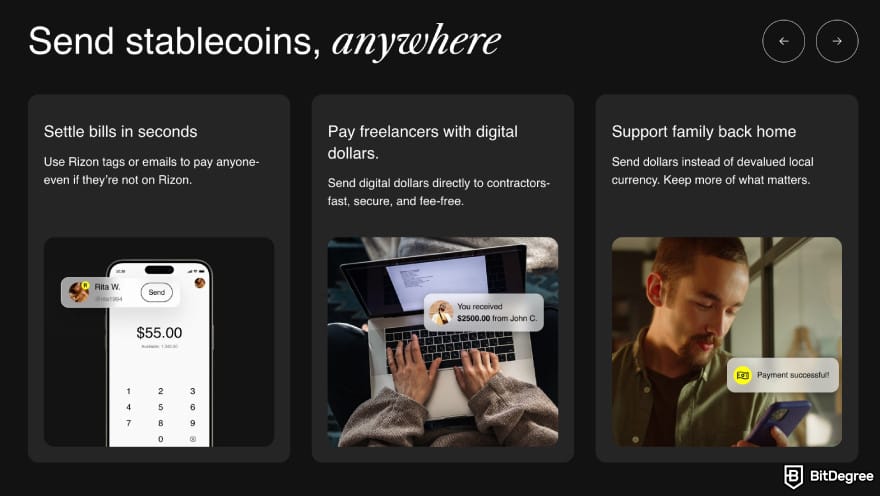
Let’s go over the points one at a time, starting with the flexible transfer options. I appreciate how Rizon gives users multiple options to transfer money, and not limiting it to one. You can move funds to mobile phones (using email address), external wallet, Rizon users, and bank accounts.
Using the bank accounts allows you to send dollars directly to banks in 30+ countries.
The next thing I want to appraise is the instant transfers. Using blockchain for money transfers does reduce delays,[1] and its adoption isn’t uncommon anymore. That’s likely why Rizon leans toward that idea, giving users a way to move funds without the usual waiting time.
Now, the self-custody wallet is one of the main advantages. Having a self-custody wallet means you hold your own recovery phrase that you use to access your funds. This gives you the security of crypto ownership without complex wallet setups.
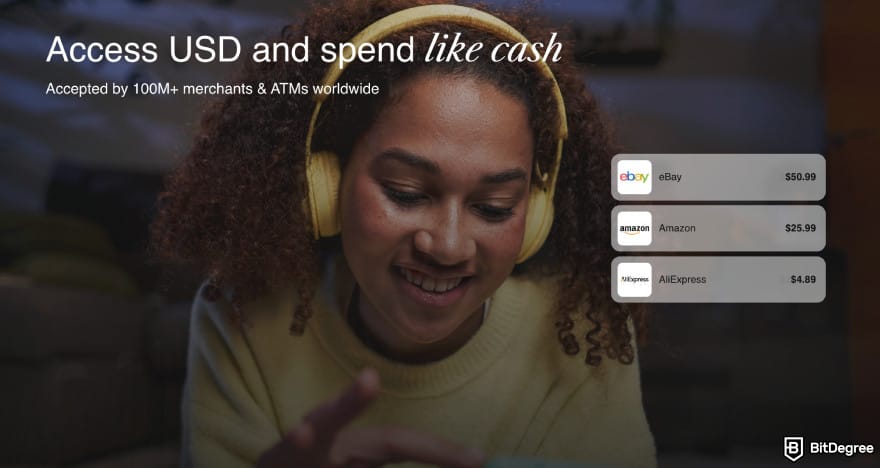
Moving on, let’s talk about spending stablecoins. As mentioned earlier, Rizon supports USDC and USDT that you can use for everyday transactions. You can send money to friends and spend it at over 100 merchants globally.
But why USDC and USDT? Both stablecoins are pegged to USD 1:1. This means their value stays stable even when the broader crypto market goes up and down. But it’s also not without risk, which I’ll go over in the next chapter.
Similar to money transfer apps, Rizon also offers earning options. You can get 5% cashback, shopping rewards (RizPoints), and bonuses from referring friends. While it’s not life-changing money, it’s still a nice perk for active users.
Overall, Rizon’s advantages prove it’s not trying to compete with trading-heavy crypto platforms like Kraken, and it’s simply built for people wanting fast, stable, and flexible ways to use digital dollars.
Limitations
Despite the advantages, it’s still important to understand where Rizon falls short. These points don’t make it a bad option, and they simply help set the right expectations before you start using it. Now, here are the main limitations to keep in mind:

- Non-custodial wallet risks;
- Not available everywhere;
- Crypto risks;
- Early-stage ecosystem.
Going deeper into each point, let’s first talk about the non-custodial wallet. While no one else can’t access it, not even Rizon, losing your recovery keys will turn into more than just a bad day. You’ll lose access to your money.
So it's better to be safe than sorry and learn all you need to know about a non-custodial wallet before owning one.

Next, Rizon isn’t available everywhere as of yet. Right now, only users in select countries can sign up and create an account. But I think that’s understandable considering the platform was released in August 2025.
Another limitation is the stablecoin risks. Both USDC and USDT rely on the strengths of USD, which can be both a good and bad thing. Aside from network congestion, stablecoins can also depeg,[2] where they lose their value.
In addition to the crypto risks, your recipient will receive your money in either USDC or USDT. While the coins have real-life utility, some might not want to jump into crypto just yet. So this is also something you need to consider before using Rizon.
At the end of the day, don’t let these things put you off. Rizon is a great app, and it’s promising when you understand its limitations upfront.
Rizon Card
The Rizon Card is what makes the app feel less like a crypto wallet and more like a real spending tool. You can use it at over 100 merchants worldwide that accept Visa. There are two versions: virtual and physical.
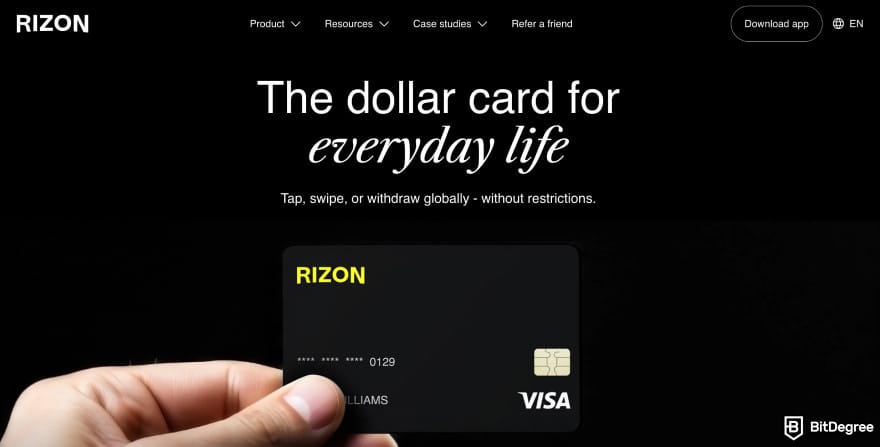
You can use the virtual card for online transactions, like shopping and paying for subscriptions. And with the physical card, you can use it at ATMs to withdraw cash (with funds coming directly from your USDC or USDT balance.
One useful feature is how the card handles currencies. When you’re making a payment, Rizon automatically uses whichever stablecoin offers the lowest conversion fee. You can also display your balance in your local currency, even though your funds stay in digital dollars.
Since it’s Visa-supported, you can link the card to Google Pay, Apple Pay, and even PayPal.
That said, the card does come with a few limitations. Since Rizon isn’t available everywhere yet, the same goes for the card. Plus, it doesn’t offer the same fund-freezing protection you’d get from a regular bank card. There’s also the ATM withdrawal fee, but I’ll cover that in the next part.
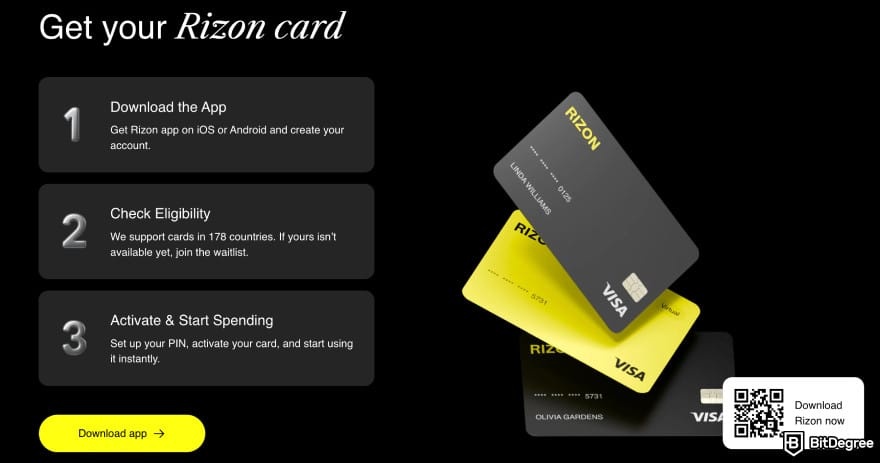
To get the card, you need to pass Rizon’s quick KYC process (that takes less than two minutes). The virtual card is issued instantly, while the physical one will be delivered to your address.
Fees and Limits
When it comes to Rizon fees, I like how the app keeps things fairly simple. First, there’s no charge to issue the virtual card, and since the physical card isn’t launched yet, there are no fees at the moment (but we’ll see how it goes).

If you’re checking Rizon price in terms of overall cost to use the app, it’s still one of the lighter options in the fintech category. Rizon also doesn’t apply any account maintenance fees, which is a nice change compared to many traditional fintech apps.
Adding further to how Rizon compares to other apps, it has no tiered plans. So all features and perks are available to all users.
Now, let’s talk about transaction costs. All of Rizon’s main transfer and spending fees are listed in the table below.
Transaction | Fee |
|---|---|
Deposit | Free |
Card spend | Free |
Card spend (for non-US users) | FX fee and up to 1.5% |
Send (email, SMS/WhatsApp, Rizon user) | Free |
Send (wallet) | Network fee + 0.1% |
ATM withdrawal | 2% fee + $3.00 |
Table: Details on Rizon’s transaction fees
After fees, the next thing you need to know is the limits. These apply to several things, from deposits to ATM withdrawals. You can check the numbers in the table below.
Limits | Fee |
|---|---|
Deposit | No limit |
Card spend | No limit |
Send limit (email, SMS/WhatsApp, Rizon user) | No limit |
ATM withdrawal | $250 per day |
Table: Rizon’s limits, from deposits to ATM withdrawals
Looking at Rizon's fees and limits for ATM withdrawals, it’s clear that Rizon prioritizes digital spending over traditional cash use. That lines up with Rizon’s focus on fast, digital payments.
Security
Up to this point, you might wonder, “Is Rizon safe?” especially with all the self-custody wallet setup, or possibly, its other features. And that answer is yes, it’s safe. It helps if you know how Web3 and non-custodial wallets work, so let me get that out of the way first.
Rizon is reinventing money transfers with digital dollars, and they’re doing that through stablecoins (mainly USDC and USDT). The whole setup is done under blockchain and smart contract vaults. Naturally, the security measures follow this setup.
What does that mean? First, it means that your self-custody wallet is secure and encrypted. It also means only you have access to your wallet (and your funds), and not Rizon or any third party.
The access to your wallet is through private keys. Because you have access, you’re responsible for keeping your private keys safe.
Beyond the Web3 foundation, Rizon adds familiar security tools to help strengthen the app experience. While it's not ground-breaking, it's just enough to make your transactions safe:
- Face ID. You use it when verifying your account for the first time.
- Passkeys. Required to access your self-custody wallet, so always keep it secure.
- Biometric verification. Using your fingerprint when logging in to the app.
Together, these features make Rizon’s setup both secure and user-friendly.
📚 Related Reading: The Power of Crypto Self-Custody
User Experience
Since Rizon is newly launched (just three months old at the time of writing), it’s still too early to get a full picture of its user experience. If you're looking for a Rizon app review on sites like G2 or Trustpilot, there’s not much you can find just yet. So I’ll be skipping that part in this article.
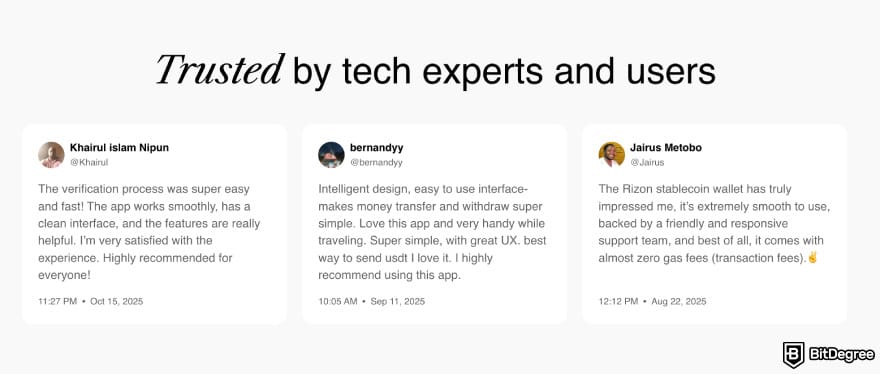
Instead, here’s what the experience looks like based on how the app currently works. First, let’s start with ease of use. The app interface is simple enough to check your balance or send digital dollars. The main actions (wallet, card, transfers) are placed front and center.
Rizon is currently a mobile-only app. You can’t access your wallet or dashboard on a desktop.
Onboarding is also smooth. Signing up, completing KYC, and activating the virtual card are quick, and nothing is out of the usual process that you’d find on other apps. The self-custody wallet setup is straightforward, too, though you may need a moment to understand how it works.
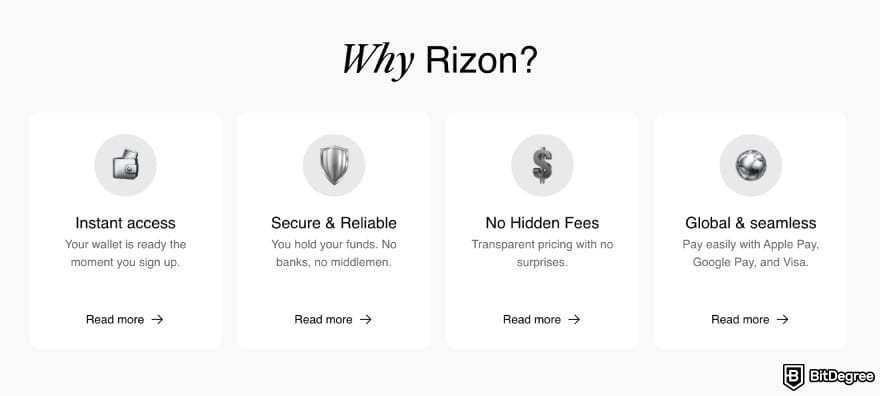
All in all, Rizon offers a smooth experience for a newly launched app. It still has room to grow, but the core layout is already easy enough for most users.
Customer Support
Right now, Rizon’s customer support is still in its early stages. You mainly get two options: the Help Center and the built-in AI chat.

The Help Center basically lists all the essentials, like account information, how-to guides, legal documents, and reward campaigns. This is the page you’d go to if you’re learning how the app works or needing quick instructions.
If you're curious about how Rizon works legally (with all the blockchain setup), you can find that in the Help Center page, too.
The AI chat is there to answer basic questions and point you in the right direction. It’s not perfect, but it covers common issues well enough.
The one that stands out the most is the Contact Us page. When you access this page, you can immediately tell that Rizon is a brand-new product. The page is bare with only a simple contact form.
On a more positive note, Rizon’s FAQ page is quite helpful. It covers basic questions and it’s categorized by topics, like transactions, cards, fees and more. The page makes finding answers a bit easier while the rest of the customer support system continues to develop.
How to Use Rizon
Continuing this Rizon review, let’s go through how to use the app. Rizon runs on stablecoins and uses a self-custody wallet, but the flow is similar to a typical money app (and also simple enough for beginners!)
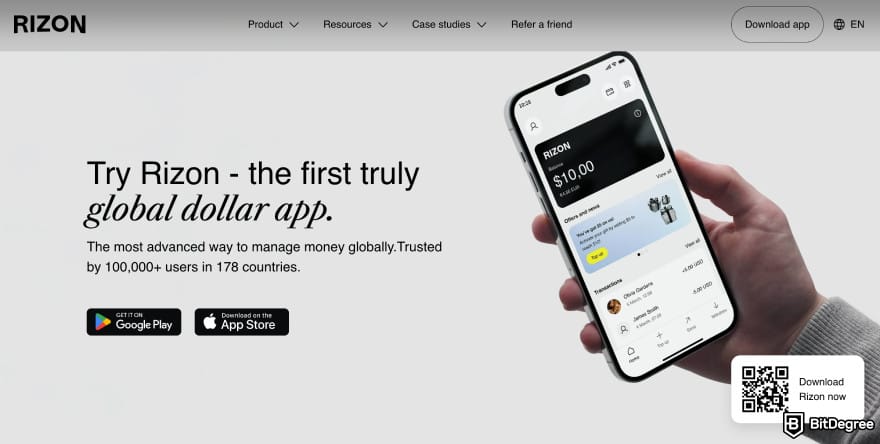
Signing up is quick. Download the app, add your email, and type in the verification code. Just like that, you can access your account. Then, complete the KYC before you can start depositing, sending money, or using the card.
How to Top Up Your Rizon Account
To deposit money into your Rizon account, you’ll be transferring stablecoins from a supported network. Once your KYC is done, here’s how to top up your balance:
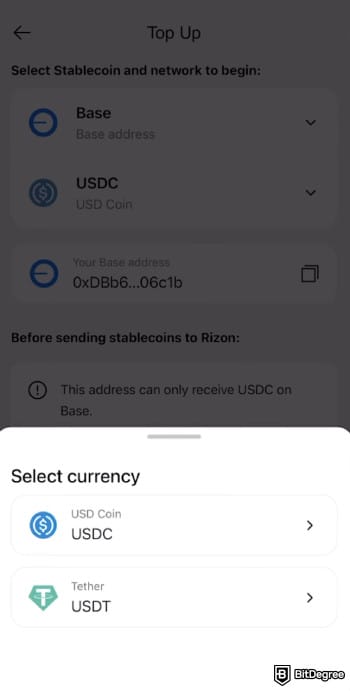
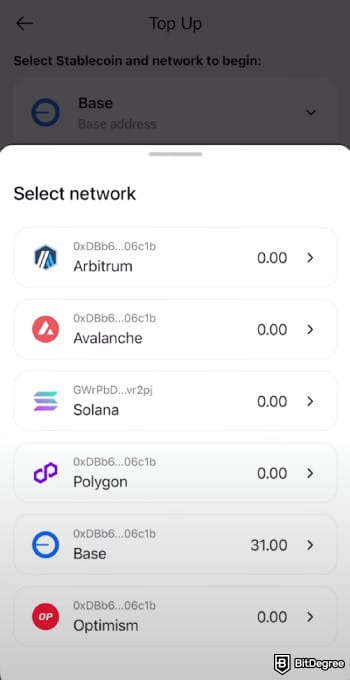
After that, you’re good to go! Just complete the transfer from your external wallet or exchange.
How to Send Money Using Rizon
Sending money with Rizon is also simple. You can do it using a RizTag, email, or phone numbers. Here’s how:
![Rizon review: Rizon app homepage highlighting the [Send] button.](https://assets.bitdegree.org/images/rizon-review-rizon-app-homepage-highlighting-the-send-button.jpg "Rizon review: Rizon app homepage highlighting the [Send] button.")

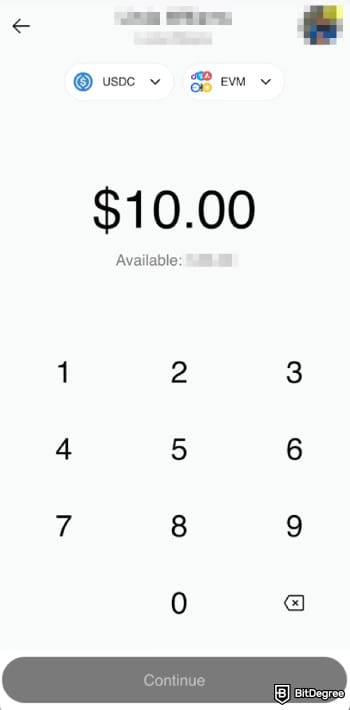
And that’s it! Your digital dollars are on their way to your recipient.
How to Withdraw Money From Rizon
Withdrawing money from Rizon works similarly to deposits, just in reverse. Here’s how to cash out your money:
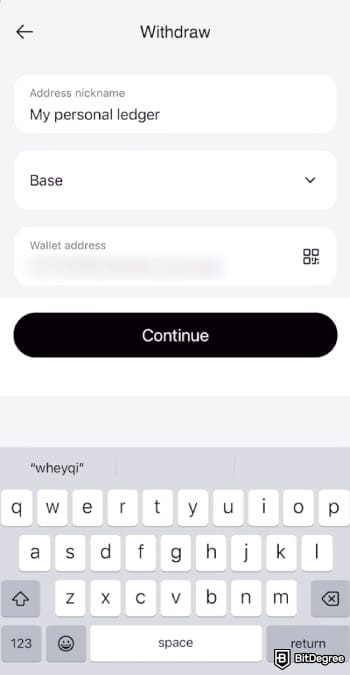
Once you confirm the transaction, your funds will be sent to the wallet address you’ve selected.
Comparing Rizon With Other Fintech Services
No Rizon review is complete without seeing how it stacks up against other money apps. While Rizon is still new, it sits in a category filled with strong competitors, each with its own strengths, limitations, and quirks. Here’s how it compares.
Rizon VS Ogvio
Ogvio is a global digital money app that focuses on fast, low-cost transfers using stablecoins and fiat currencies. It's the strongest alternative to Rizon in this category.

Both Rizon and Ogvio let you send digital dollars, hold stablecoins, and move money internationally. Their apps also have a simple interface and focus on making crypto feel accessible.
Coverage is a big difference. Ogvio is supported in over 160 countries, while Rizon currently covers around 90+ so far. As for transfers, Ogvio offers fiat routes and bank-to-bank transfers, while Rizon is (still) mostly stablecoin-based.
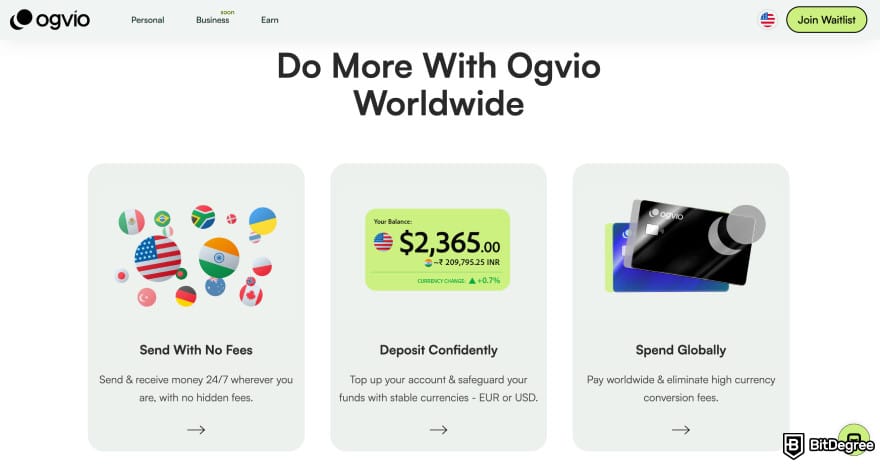
Ogvio uses the @Tag username system (similar to RizTag), and it makes sending money as easy as sending a DM. It also partners with BitDegree, which is currently hosting the Season 9 Airdrop.
If you're not familiar with how airdrops work, they're basically free crypto rewards you get for completing simple tasks. In BitDegree's case, you need to collect as many bits as possible.
As for fees, Ogvio generally offers cheaper routes for fiat transfers and a more transparent fee structure. Rizon fees depend on stablecoin network costs and conversion rates.
📚 Read More: Ogvio VS Rizon
Rizon VS Revolut
Revolut is a European neobank (based in the UK) offering multi-currency accounts, cards, loans, crypto trading, and budgeting tools. It’s a full financial app, and not just a transfer tool.
Both let you pay internationally, spend with a Visa/Mastercard-supported card, and manage multiple currencies in one place.
Revolut supports fiat currencies, savings vaults, and advanced budgeting tools, while Rizon is only built around stablecoins. Another thing that makes Revolut different is that it’s available in many regions, while Rizon isn’t available everywhere.
Revolut also offers travel insurance, card security control, along with stock and crypto trading inside one app.
Honestly, Revolut has more levels when it comes to fees (and it can get confusing). There are five plans, and each comes with different exchange limits and fees. Rizon keeps it simple with costs tied mostly to network fees and conversions.
📚 Learn More: Revolut VS Rizon
Rizon VS Monese
Monese is a UK-based online banking app that gives you instant account creation, multi-currency accounts, cards, and international transfers.
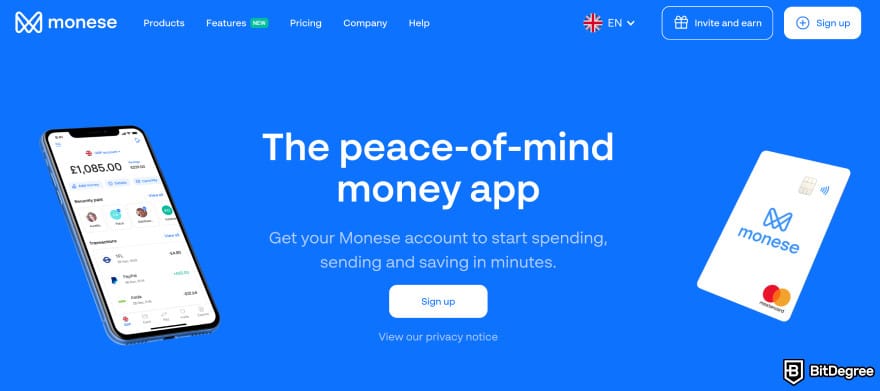
Both Monese and Rizon focus on easy onboarding, simple money transfers, and a beginner-friendly interface.
Now, here’s where they’re different. Monese is built entirely around fiat banking, while Rizon is built around stablecoins and self-custody. Monese also offers SEPA transfers, direct debit, and local accounts, features Rizon doesn’t offer.
Monese gives users quick access to European IBAN accounts without needing local proof of address. If you ask me, this is especially useful for expats and travelers.
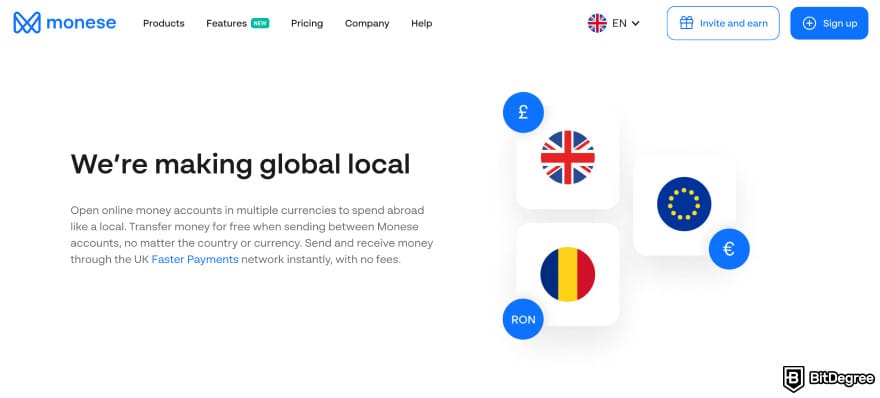
When it comes to fees, Monese has tiered subscription plans with monthly fees, ATM limits, and exchange markups. Rizon’s costs mainly come from transferring stablecoins with no monthly plan fees at the moment.
📚 Further Reading: Monese VS Rizon
Rizon VS Wise
Finally, the last competitor in this Rizon review is Wise. It is one of the most popular money transfer apps, focusing on low fees, fast transfers, and clear pricing. It’s a traditional fintech app, not a crypto one, and helps people send money to bank accounts in many countries.
Both Wise and Rizon let you transfer money internationally and keep the experience simple. Wise works with many fiat currencies, and Rizon works with stablecoins. Based on my findings, both can be useful for travelers or people who send money overseas.
The big difference is how they operate. Wise is a fully regulated financial service that supports more than 160 countries. It also gives you local account details like IBANs, which Rizon does not have.
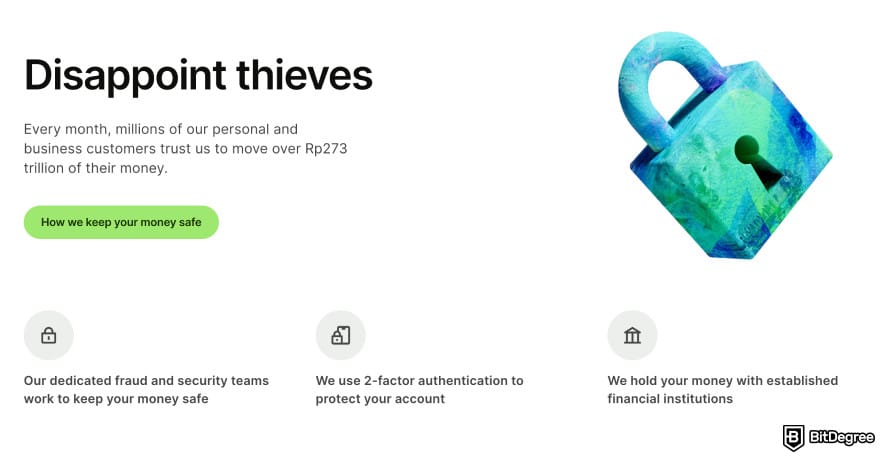
Now, about fees, Wise always offers the mid-market exchange rate. This means you always get the best rate when sending money.
📚 Read More: Wise VS Rizon
Conclusions
To wrap up this Rizon review, the app is showing a lot of promise for anyone interested in stablecoins. Rizon brings a fresh angle by focusing on Web3 features, a self-custody wallet, and digital dollars you can actually spend.
There are a few points to help you set the right expectations for Rizon. The app isn’t available everywhere, and new users might need time to get used to handling private keys (for the non-custodial wallet). Even so, Rizon has a solid start with its real-life stablecoin utility.
Other apps like Ogvio, Revolut, and Monese offer more features and more ways to move money.
Scientific References
1. Hosseinkhani N.: ‘Blockchain Technology and Cryptocurrency: Transformations and Applications in Financial Markets’;
2. Carapella F.: ‘Stablecoin Self-Regulation’.
Send Money Worldwide
Check out the best ways to send money to other countries quickly, safely, and with minimal fees.



































About Article's Experts & Analysts


- + Accepted by 100M+ merchants
- + Support for 10+ networks
- + Ability to withdraw from ATMs worldwide
- + User-friendly app
- - Limited availability
- - Inconsistent customer support experience
- - High fees for non-USD transactions



See BETTER-RATED Money Transfer Services
A lifestyle neobank making stablecoin spending as easy as swiping your card.
Disclosure: To keep our site running & free of charge, we may sometimes receive a small commission if a reader decides to purchase services via some links on site, at no extra cost.