












Have you recently moved to the Philippines and need to cross "Open a new bank account" off your checklist? Or maybe your debit card will expire soon and, instead of renewing it, you're mulling over making a switch to a different provider? Whatever your reasons are, you'll want to find the best bank in the Philippines that keeps your money safe while offering a top-notch customer experience.
As of writing this, the Philippines' sprawling banking system encompasses over 529 institutions, from large commercial banks to neobanks, rural banks, and credit unions. If this sounds like an intimidatingly large assortment, let me save you a weekend's worth of research: in this thorough guide, I've rounded up the top 7 banks worth your time:
- Ogvio - Instant international Transfers With Low Fees
- Bank of the Philippine Islands - Oldest Bank in the Philippines
- Philippine National Bank - Low Minimum Deposit & Large Selection of Cards
- Metrobank - Checking & Savings Accounts with Flexible Deposit Requirements
- Banco de Oro - Versatile Card Selection & Debit Card Rewards
- GoTyme Bank - The Fastest-Growing Digital Bank in the Philippines
- Tonik Bank - Best Digital Bank Solutions for Savings
Should you make a beeline for the winner, Ogvio, and dive straight into its numerous benefits as an innovative digital bank with support for global remittances in both fiat and crypto - or would a traditional, brick-and-mortar bank be a better fit? Find out right here and now!
1. Ogvio - Instant international Transfers With Low Fees
Ranks #1 out of 7 Money Transfer Services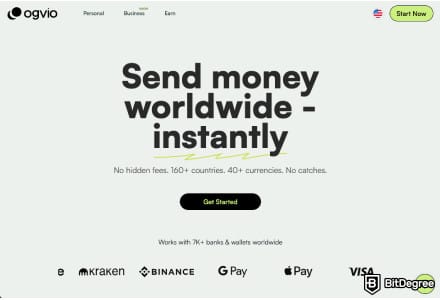
- + Remittance-oriented
- + Instant transfers
- + Incremental-to-no fees
- + Crypto support
- + @Tag functionality
- + Free transfers between users
- - No card (coming soon)
As the fintech sphere is swiftly catching up with traditional banks, a new category of platforms has emerged, offering a hybrid approach that blends conventional banking with the convenience of instant money transfers. Enter Ogvio, a digital bank whose blockchain-based architecture gives it an edge in security, speed, and cost-effectiveness.
If most of your banking needs boil down to making online payments, Ogvio might very well be the best digital bank in the Philippines. You can send money to any of the 160+ supported countries and regions in their local currencies with just a few clicks. Thanks to Ogvio's integration with local instant payment railways, most transactions are instant and much cheaper than international wire transfers.
 | |
|---|---|
| |
| Per-transaction | |
| | |
| A global money transfer service with an additional volatile currency rate pegging to USD or EUR. | |
| Visit site Read review |
Table: Ogvio features
What's more, user-to-user transfers on Ogvio are completely free, no matter how much you're sending and where. This app also supports making payment requests (either by generating a shareable link or directly in-app), which makes it perfect for everyday use cases like paying your friends back for lunch.
There are two main ways to pay for an Ogvio transfer: directly from your balance (after topping up your account first), or paying with a bank transfer, mobile wallet, or a credit/debit card as you go. Bank transfers require KYC verification, which is restricted in certain countries, but unverified users can still access all the other payment methods.
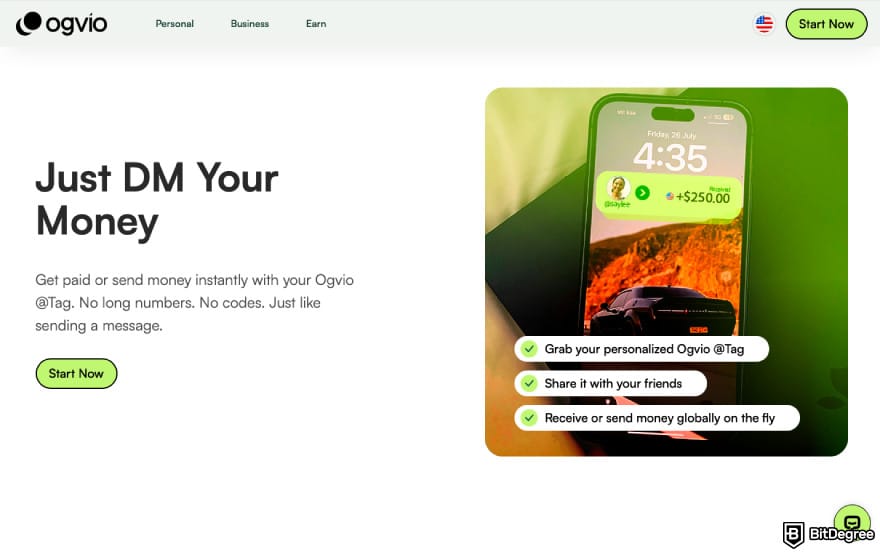
You can top up your account with any of the 40+ available currencies, but Ogvio will automatically peg your balance to USD or EUR (your choice) upon deposit: that way, the value of your funds will remain stable against unexpected inflation or market swings many local currencies are prone to.
Ogvio's unique infrastructure comes with another benefit: it's possibly the best bank in the Philippines for crypto enthusiasts. You can buy, trade, and sell 9 cryptocurrencies on the Base network directly on the app, and even cash it out as fiat without the hassle of manual conversion. For all intents and purposes, Ogvio can be used as a self-custodial crypto wallet alongside its main purpose as a money transfer service.
Make the most out of Ogvio by getting some friends on board! For every 3 invited people who pass KYC and transfer at least $30 each, you'll earn $10 in rewards, while your referees get a 100% fee discount on their next transfer.
2. Bank of the Philippine Islands - Oldest Bank in the Philippines
Ranks #2 out of 7 Money Transfer Services
- + Fast domestic transfers
- + 24-hour customer support
- + Has prepaid cards
- - High international remittance fees
- - Some customers report issues with the mobile app
Founded in 1851, Bank of the Philippine Islands is the oldest bank not only in our country in question but all of Southeast Asia. As of writing this, it's the third largest bank in the Philippines by assets and the second largest one by market capitalization, boasting over 900 branches nationwide and abroad.
BPI offers three types of checking accounts: Regular Checking, Maxi One, and BizLink Checking. The first is a solid go-to option for your average customer. It requires an initial deposit and an ADB of PHP 10,000. In contrast, Maxi One functions as a two-in-one checking and savings account, with an annual interest rate of up to 0.0925%, but has a higher entry barrier, with a minimum deposit of PHP 25,000.
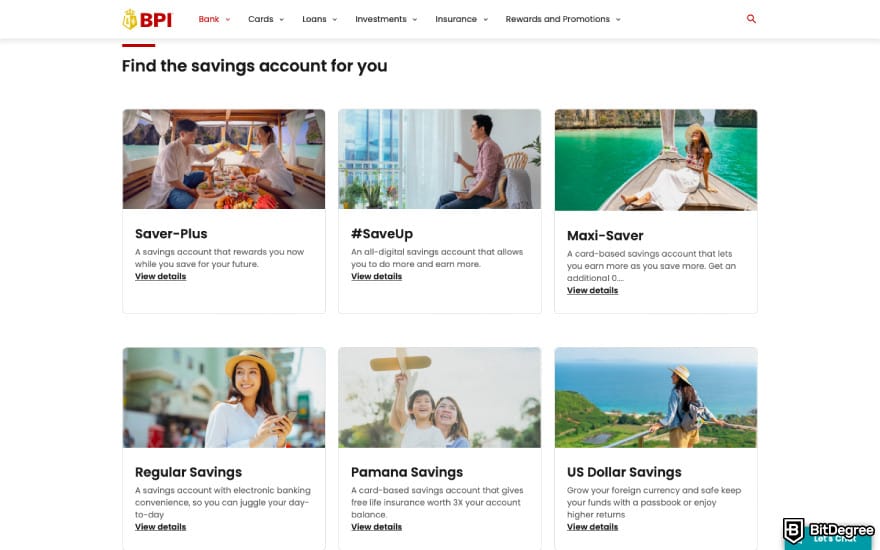
When it comes to actual savings accounts, BPI's lineup includes 9 types of accounts. Some of these, namely, Pamana Padala and Padala Moneyger, are tailored for remittances, while #MySaveUp is a digital savings account that can be opened with the GCash app. However, none of them include a high-yield option, so if you're looking for the best bank for a savings account, the Philippines has better alternatives.
As of January 2026, BPI's range of cards consists of only credit and debit cards; the bank discontinued its prepaid card line back in December 2024. You can choose between a Mastercard debit card, which supports withdrawals from any BancNet or Mastercard-affiliated ATM both in the Philippines and abroad, or an EVM debit card for cashless shopping in over 45,000 merchants nationwide.
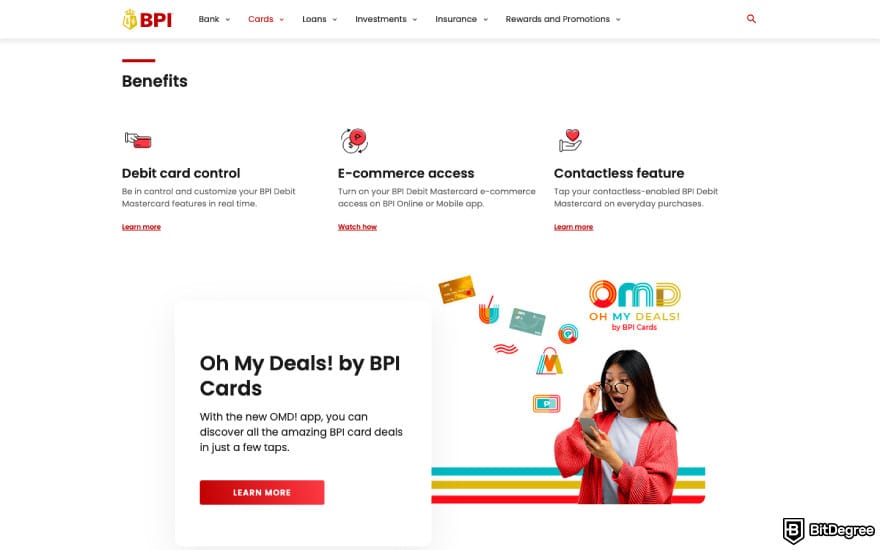
BPI supports digital banking through an online platform and a mobile app. You can pay your bills online to over 600 providers (or use the QuickPay feature to pay them right away without having to enroll the biller), or link your BPI account to a mobile wallet. Some of the checking and savings accounts are fully digital, letting users open a new account online.
In addition, you'll find several types of financing products (loans for cars, motorcycles, housing, or personal purchases), a forex service, and a whole assortment of investment options, such as government securities, corporate bonds, equities, multi-asset funds, and shares.
3. Philippine National Bank - Low Minimum Deposit & Large Selection of Cards
Ranks #3 out of 7 Money Transfer Services
- + Large network of local branches and ATMs
- + InstaPay and PESONet support
- + Fee discount promos
- - Batch-based transfers aren’t instant
- - International transfers can come with extra deductions
Founded in 1916, the Philippine National Bank has over 700 domestic branches and more than 1,400 ATMs, as well as 70+ overseas branches and subsidiaries in Europe, Asia, North America, and the Middle East. It offers a well-rounded range of products in both personal and corporate banking, including several types of savings accounts, loans, and insurance.
PNB's Budget Checking Account is one of the best starter account options. It's a non-interest-bearing account that requires an initial deposit and a minimum balance of only PHP 5,000, making it an ideal account for low-income customers. The Regular Checking Account is a step-up, otherwise identical to the former, except for the higher initial deposit and minimum balance of PHP 10,000.
If you're looking for the best bank for a savings account, the Philippine National Bank really stands out for its accessibility. The Debit Savings Account has some of the lowest initial deposit and minimum balance requirements of only PHP 3,000 (although the minimum average daily balance to qualify for interest is PHP 10,000). The other three accounts cater to underage clients, pensioners, and passbook holders.
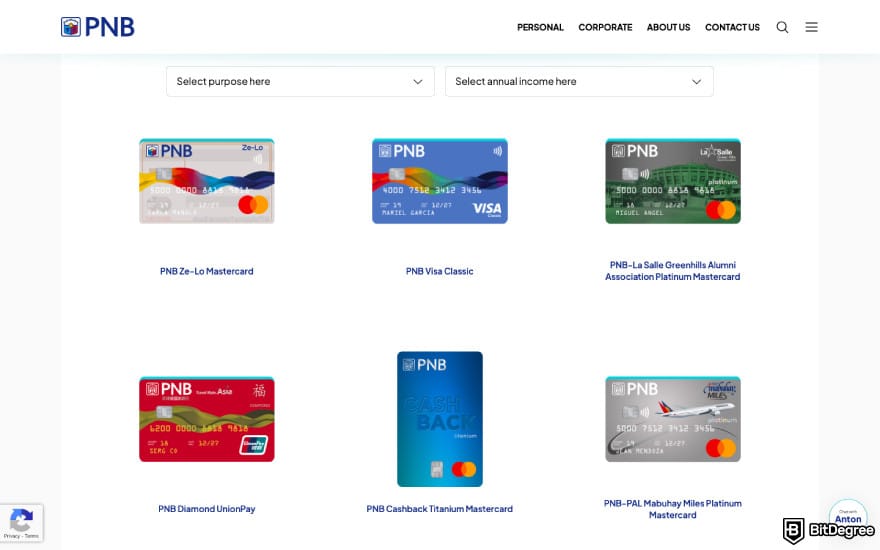
If you find most other banks' card choices too limiting, PNB is possibly the best bank in the Philippines in this regard. It offers a total of 20 credit, debit, and prepaid cards. PNB Ze-Lo Mastercard credit card is the one to go with if you don't want any annual fees, while the Cashback Titanium Mastercard has the highest cashback reward of up to 8%. Both prepaid cards have a top-up and balance limit of PHP 100,000.
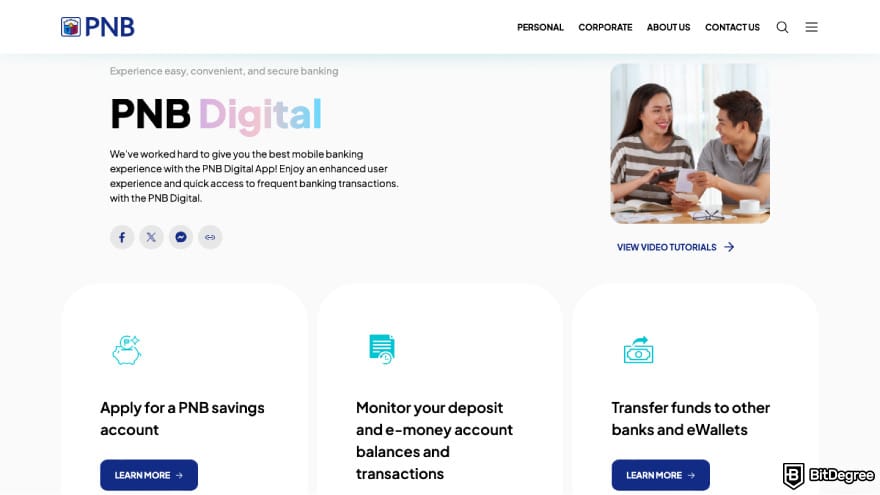
PNB has a mobile banking app that lets you access virtually every feature available on the desktop web platform, plus a few more. You can use it to open a new bank account, transfer money between PNB accounts, other local banks, and eWallets, pay bills, or request money via QR code. It also includes a PNB branch and ATM locator.
When it comes to additional services, PNB's offerings aren't that extensive, but you'll still find a few types of loans and insurance packages. The Housing Loan covers purchases of up to PHP 750,000, while the Auto Loan covers up to 80% of the price of a new car, starting from PHP 300,000. PNB has Life and Non-Life Insurance, the latter including personal accidents and emergencies, other casualties, and car insurance.

Did you know?
All Money Transfer Services may look similar to you, but they're NOT all the same!
4. Metrobank - Checking & Savings Accounts with Flexible Deposit Requirements
Ranks #4 out of 7 Money Transfer Services
- + Supports InstaPay and PESONet payments
- + Fee discount promos
- + Broad international support
- - Restrictive transfer limits for domestic transfers
- - Higher InstaPay fees than some other alternatives
The fourth largest bank in the Philippines in terms of total assets, Metrobank has 570+ branches in the country and 32 overseas offices. While best known for investment and premium banking (in 2023, it was voted as the best bank in the Philippines for ultra-high net worth clients), it's more than a solid pick for the average customer, as well.
Metrobank has two personal checking accounts: Regular Checking Account and Account One. The regular account is lower maintenance, only requiring an initial deposit of PHP 10,000, while Account One asks for a minimum of 25,000. The latter also offers a 0.0625% interest rate if your balance has at least PHP 50,000. Both accounts come with a passbook and a debit card.
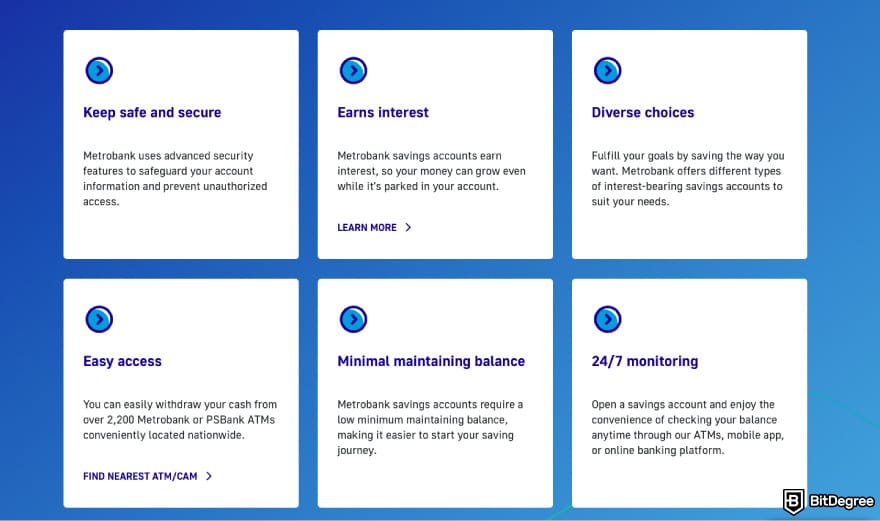
For those wondering, "What is the best bank in the Philippines for a savings account?", Metrobank might not hit all the boxes, but it will certainly help you make up your mind. The website has a picker that lets you specify your needs and get recommendations. Most accounts offer roughly the same interest rate of ~0.0625%, but some require a lower initial deposit than others, starting from only PHP 2,000.
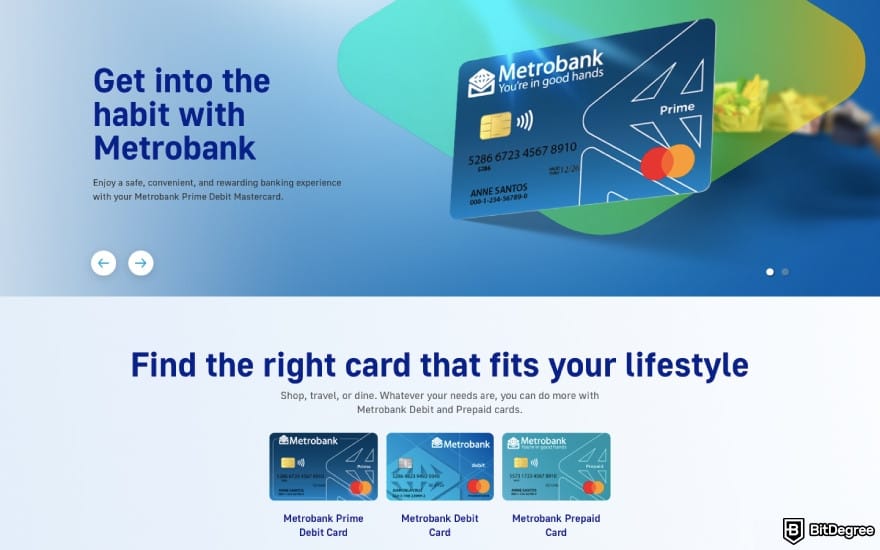
Metrobank has a modest selection of credit, debit, and prepaid cards. The Prime debit card has a maximum daily withdrawal limit of PHP 50,000 and can be used for contactless purchases worth up to PHP 2,000. Meanwhile, the prepaid card has a monthly balance limit of PHP 150,000 (this is a total limit for all the prepaid cards connected to the same account). The Cashback credit card offers 0.2-5% rebates.
Like most of the candidates on this list, Metrobank has a fully functional online banking platform and an online app. The online banking platform lets users make transfers through InstaPay or PESONet, top up their mobile phone data, and schedule or automate transactions, while the mobile app stands out for its Cash2Go feature: you can convert your available credit limit into cash and repay in installments.
On top of all that, Metrobank offers home, car, and personal loans, an integrated marketplace for cars and properties, and a number of other services. There are three types of insurance packages (health, life, and travel insurance) and a mix of investment products, including UITF and stocks.
5. Banco de Oro - Versatile Card Selection & Debit Card Rewards
Ranks #5 out of 7 Money Transfer Services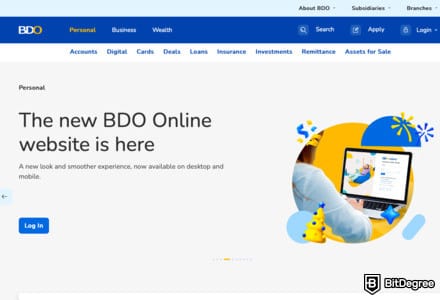
- + InstaPay and PESONet support
- + High daily cap for PESONet transfers
- + More than 1,400+ branches in the country
- - Early cut-offs for international wire transfers
- - Service charge and documentary stamps for receiving SWIFT transfers
Also known as BDO Unibank, Banco de Oro is a universal bank based in Mandaluyong. It has over 1,300 operating branches and more than 4,000 ATMs nationwide. It caters to private and corporate customers, as well as high-net-worth clients who require private banking services. Aside from checking and savings accounts, loans, and insurance, you'll also find a marketplace for real estate, vehicles, and machinery.
Banco de Oro offers two checking accounts: Peso Checking Account and Smart Checking Account. The first one is a non-interest account that requires a minimum initial deposit and maintenance balance of PHP 5,000. For the Smart Checking Account, you'll need a minimum deposit and balance of PHP 15,000 or PHP 25,000, if you want to take advantage of its 0.0625% annual interest rate.
As for savings accounts, you'll find six types. The US Dollar Savings Account is a great pick for non-resident Filipinos. Its $200 initial deposit requirement isn't too high, but the monthly average daily balance and the minimum balance to earn interest are higher at $500. PHP-based savings accounts are split into five options, including an Optimum Savings Account with tiered interest rates of up to 1.50%.
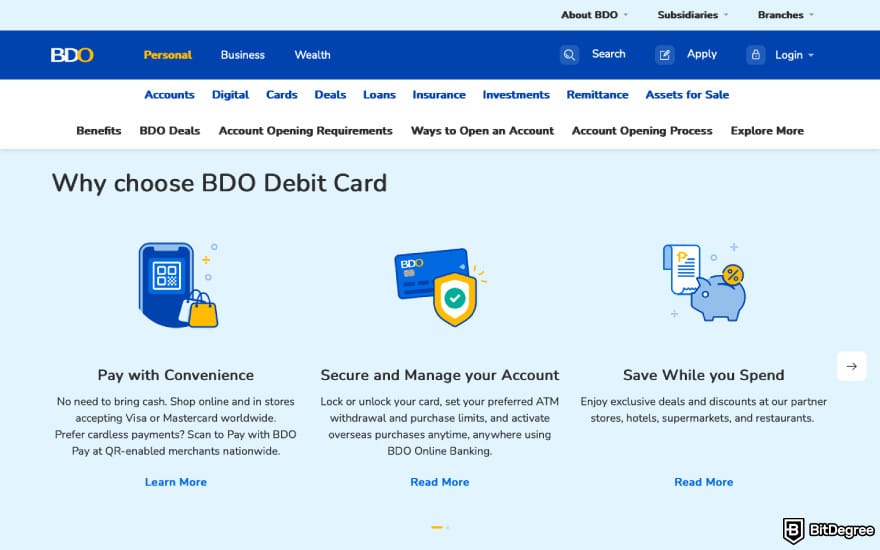
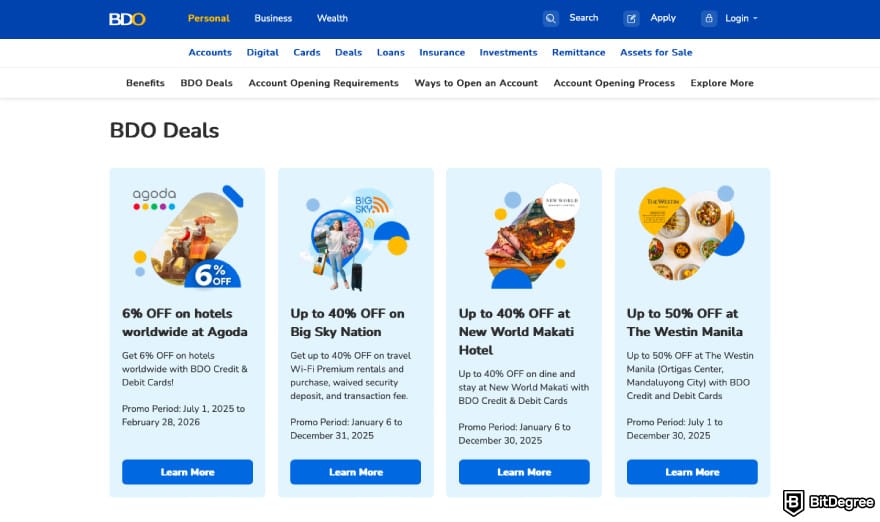
Banco de Oro's card collection is pretty extensive: aside from Visa, Mastercard, and UnionPay, you'll find a few other providers not offered by most other Filipino banks, such as American Express. The debit card has a withdrawal limit of up to PHP 200,000 per day and a maximum purchase limit of PHP 500,000. Both BDO credit and debit cards are eligible for various promos and discount deals for hotels worldwide.
This bank's mobile app lets users open and manage their accounts, keep track of their finances, and make several types of transactions. The mobile app comes with the QR code functionality as a way to deposit or withdraw money from cardless ATMs. One of BDO's most convenient features is the BDO Pay app you can use for in-store payments or quick money transfers, paying utility bills, or splitting the bill with friends.
Banco de Oro has four types of loans: Home, Auto, Multipurpose, and Personal, the latter offering an amount of up to PHP 2 Million and a flexible repayment system in 6, 12, 18, 24, or 36-month terms. In addition, there's a Life Insurance package, while the Non-Life Insurance options include travel, pet, vehicle, or medical insurance. The bank occasionally offers travel insurance promos for credit or debit cardholders.
6. GoTyme Bank - The Fastest-Growing Digital Bank in the Philippines
Ranks #6 out of 7 Money Transfer Services
- + Free PESONet transfers
- + Quick account opening process
- + Cryptocurrency support
- - No outgoing international transfers
- - Limited borrowing features
What is the best digital bank in the Philippines? If you'd rather go with a local neobank than an international platform, GoTyme is definitely up there as one of the most attractive alternatives to traditional banks. It supports free and instant money transfers and remittances, and even rivals some conventional banks in its flexible high-yield savings and loan options.
Opening a GoTyme account online only takes about 5 minutes. Despite primarily operating as a digital bank, GoTyme also has physical kiosk locations in over 500 Filipino cities, where you can create a new account, print a debit card, or book an over-the-counter deposit or withdrawal. However, this bank has no web platform, only a mobile app.
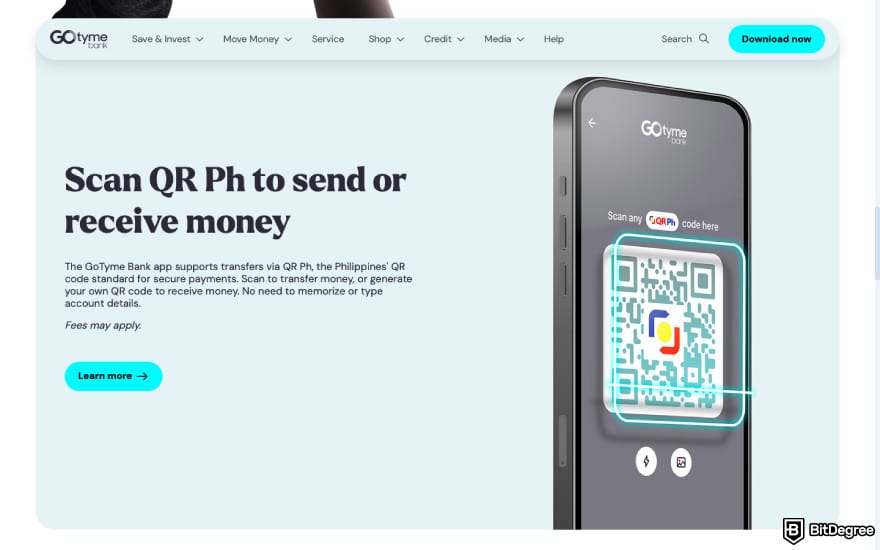
Like most other digital banks, GoTyme offers 100% free internal transfers, but it goes a step beyond by extending free transfers outside its own ecosystem, as well. You get a monthly allowance of 20 free InstaPay transfers to any bank. After that, each transfer costs PHP 9. In addition, GoTyme supports QR Ph, the Philippines' QR code-based contactless payment system.
GoTyme's Visa debit card (available as a physical or virtual card) is the gateway to this neobank's extensive rewards system. You'll earn 1 point for every PHP 100 spent in any of GoTyme's 17 partner stores. Those points can be used to top up your mobile phone data or cover bank transfer fees, or be withdrawn as cash. Withdrawals from Visa-supported ATMs worldwide have no additional fees.
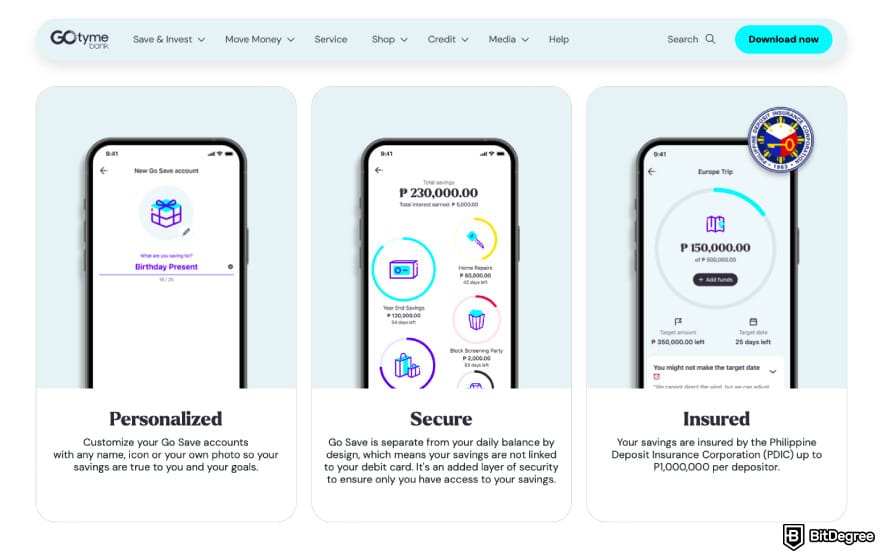
GoTyme allows opening up to 5 savings accounts with an annual interest rate of up to 4%, covered by the Philippine Deposit Insurance Corporation (PDIC) up to PHP 1 million per customer. You can set a target date for your savings goal and schedule automatic daily, weekly, or monthly deposits - or simply round up the price of purchases made with your debit card as a seamless way to accumulate some savings on the go.
This bank supports deposits through linked bank accounts, InstaPay, PESONet, or mobile wallets, and allows withdrawing the savings partially or in full. Meanwhile, crypto enthusiasts can check out GoTyme's crypto investment features, provided in partnership with the Philippines' central bank. As of writing this, GoTyme supports 11 cryptocurrencies, including BTC, ETH, SOL, XRP, and LTC.
7. Tonik Bank - Best Digital Bank Solutions for Savings
Ranks #7 out of 7 Money Transfer Services
- + Higher savings rates than most traditional banks
- + Free user-to-user transfers
- + Group savings
- - Doesn't support international remittances
- - Relatively low transaction limit for virtual card
If you're looking for the best digital bank, the Philippines has no shortage of options these days. As the first neobank to gain a digital banking license from the Philippines' central bank, Tonik has definitely earned one of the top spots in this category. It offers several types of savings "stashes", loans, free money transfers between other Tonik accounts - and, of course, a physical or virtual debit card.
Tonik's PESONet and InstaPay transactions cost around PHP 8, while QR Ph P2M and QR Ph P2B payments are free. Internal transfers have the benefit of a generous transaction cap: with a limit of PHP 1 million, you're unlikely to go over. PESONet transfers are capped at PHP 250,000, while InstaPay and QR Ph payments have a relatively low per-transaction limit of PHP 50,000.
The virtual Mastercard debit card comes free with your account, but a physical card (not yet available, but coming soon) will cost PHP 300. Users who only need a card for online purchases could make do with a virtual card, but it comes with a downside of a lower daily transaction limit of PHP 250,000. Meanwhile, the physical debit card has a much higher daily cap of PHP 450,000.
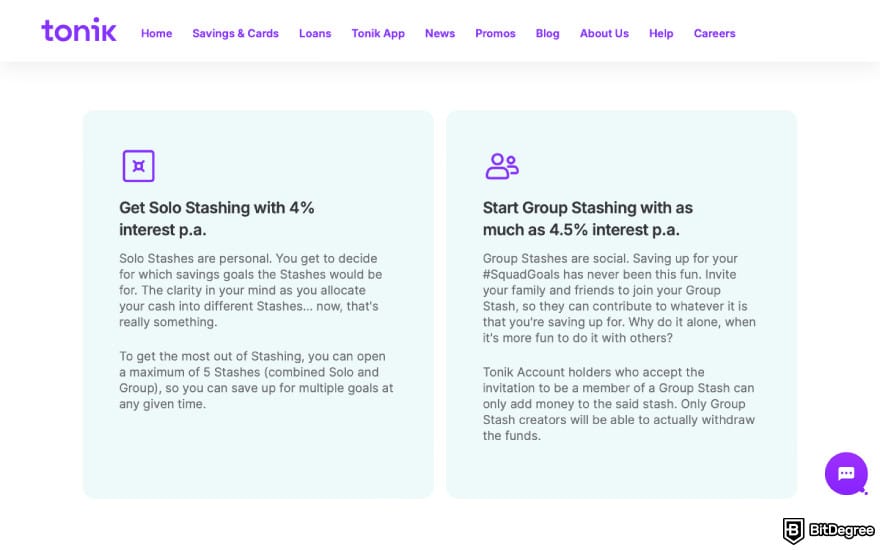
Tonik's savings accounts are called Stashes. You can open a maximum of 5 Stashes, opting for a Solo Stash for yourself or a Group Stash for joint savings (it needs at least 3 people, with no maximum member limit). The Solo Stash has a 4% annual interest rate, while the Group Stash offers a slightly higher 4.5% rate. However, only the creator of the Group Stash will be able to withdraw the funds.
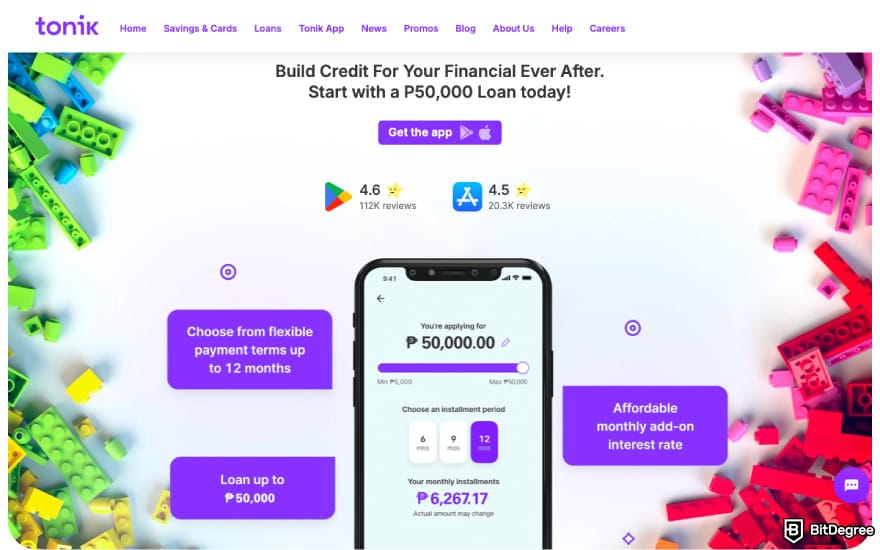
What is the best digital bank in the Philippines for financing options? Tonik could certainly give some conventional banks a run for their money. The Credit Builder Loan lets you borrow up to PHP 50,000 and choose between a 6, 9, or 12-month repayment plan. Unfortunately, this type of loan has some pretty restrictive age requirements, only being available to users aged between 23 and 58.
Whereas the Shop Installment Loan is essentially a buy-now-pay-later plan. You can purchase up to 3 items with one loan between PHP 5,000 and PHP 100,000 and repay it in installments in 3, 6, 9, or 12 months (there's an option to pay it off early at no additional charge). It has a 4.5% fixed monthly interest rate and doesn't require any previous credit history or collateral.
How to Choose the Best Bank in the Philippines: Key Factors to Consider
What is the best bank in the Philippines overall? As you've probably guessed, the answer is - that depends. Nobody wants to get locked into a bank that turns out to be the wrong fit once you've already opened an account and made the initial deposit. Which is why it's crucial to sort out your priorities in advance.
On that note, here's a quick checklist on all the factors to take into account (no pun intended) when choosing a new bank in the Philippines:
1
Branch & ATM Network Availability. If you live in one of the major Filipino cities, this likely won't be an issue for you, but those in rural areas should definitely check if the bank they're considering offers services in their location.
2
Account Types. Are you looking for a regular basic checking/savings account - or maybe you're after something a bit more specialized? Some banks offer a wider variety of accounts aimed at seniors, youth, freelancers, non-resident Filipinos, or other groups.
3
Minimum Deposit & Balance Requirements. Low-income customers or those with casual banking needs will probably want to opt for a low-maintenance account that doesn't require a large initial investment. If you need a savings account, don't forget to check the minimum balance for earning interest.
4
Transfer Fees & Speed. Most traditional and digital banks offer free internal transfers, but if you'll be sending money to other banks or abroad on a regular basis, check if the bank in question supports the popular payment options like InstaPay and PESONet and how much it charges for remittances.
5
Digital Banking Features. In this day and age, a functional online banking platform and a fully-featured mobile app are a bare minimum expectation, but some banks are still behind on digital banking support, especially when it comes to usefulness and ease of use, which are among the most important factors[1] for Filipino users.
6
Customer Support. This is one of the most overlooked factors. Make sure the bank you're considering offers more than one customer support channel (chatbots are often a hit or miss), and flick through user reviews to see if the support team can be relied on to respond quickly enough.
All the top 7 banks I've curated on this list meet the above-mentioned criteria, but they're not all interchangeable. For instance, digital banks are obviously ahead in the game when it comes to online money transfers or mobile banking, but they might lack extensive financing products typically found in traditional banks. And if you're considering other banks, this checklist is a good starting point to narrow down your choices.
How to Open a Bank Account in the Philippines
Now that you've picked the best bank in the Philippines for your particular use case(s), it's time for the next step. The process of how to open a bank account will be a bit different for Filipinos and foreign nationals. Resident foreigners (those staying in the country longer than 180 days) are eligible for the same types of bank accounts as Filipinos, while those staying less than 180 days will be limited to foreign currency accounts.
Once you've determined what type of account you want (and are able to) open, get ready to present the following documents:
Documents | |
|---|---|
For Filipinos | Two types of identification documents (e.g., passport, driver’s license, or UMID) |
Proof of address (e.g., a utility bill) | |
Taxpayer Identification Number (TIN) | |
Initial deposit required for the bank account of your choice | |
For Foreigners | Passport |
Alien Certificate of Registration (ACR) or Immigrant Certificate of Registration (ICR) if you're staying longer than 59 days | |
Proof of address | |
Reference letter from a current or previous bank (required by certain banks) | |
Initial deposit | |
Visa or work permit (if applicable for your account type) |
Table: Documentation for opening a bank account in the Philippines
The rest of the process will depend on the bank. Some let customers open a new account online, while others still require a visit to the local branch. You'll be asked to fill out a form and complete the KYC verification by providing your personal and employment details and specifying your source(s) of funds. On the other hand, digital banks typically don't require an initial deposit or a minimum balance.[2]
As for the credit or debit card, some banks issue it on the same day, though most will deliver it within 7-14 business days. If it's a digital bank, you can get started with a virtual card right away while you wait for the physical card to get shipped.
How to Send Money to the Philippines with Ogvio: A Step-by-Step Guide
Looking for the best digital bank? The Philippines supports plenty of established players, but Ogvio has entered the scene with fanfare, already proving itself to be one of the most promising new additions to this niche. When it comes to domestic and international transfers, it's more than a match for any traditional bank.
Instead of fiddling around with a complicated transfer workflow, you'll get to enjoy a minimalist interface focused on making or receiving payments as smoothly as possible, with no extra bloat to get lost in.
Ogvio now has an in-app calculator that will show you the exact amount your recipient will get, along with the exchange rate and a breakdown of all the fees involved. Click [Calculator] on the dashboard to check it out and see the fees in advance.
So, let's see how it works in action! Here's a full tutorial on how to transfer money to the Philippines in just a few minutes:
![Best bank in the Philippines: click [Get Started] on Ogvio.](https://assets.bitdegree.org/images/best-bank-in-the-philippines-ogvio-get-started.jpg "Best bank in the Philippines: click [Get Started] on Ogvio.")
![Best bank in the Philippines: click [Send Money] on Ogvio.](https://assets.bitdegree.org/images/best-bank-in-the-philippines-ogvio-send-money.jpg "Best bank in the Philippines: click [Send Money] on Ogvio.")
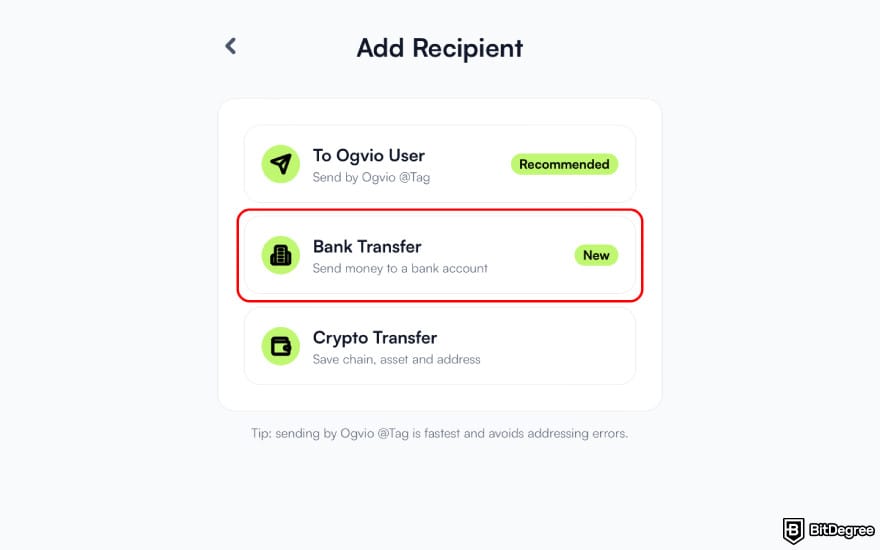
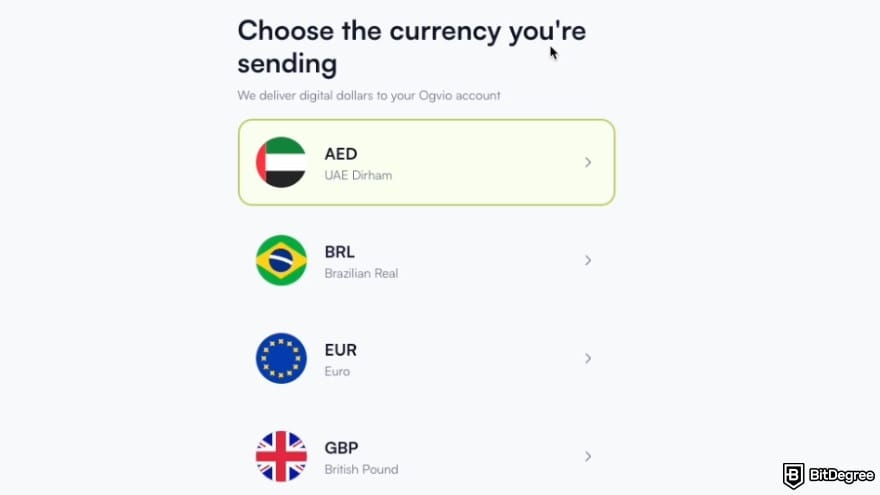
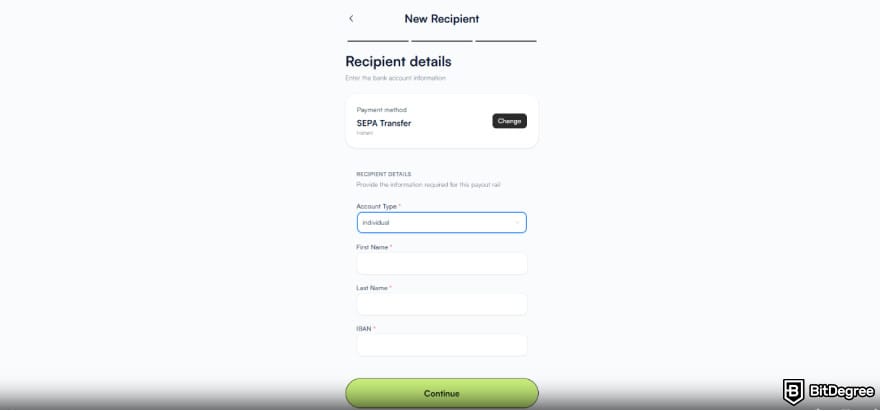
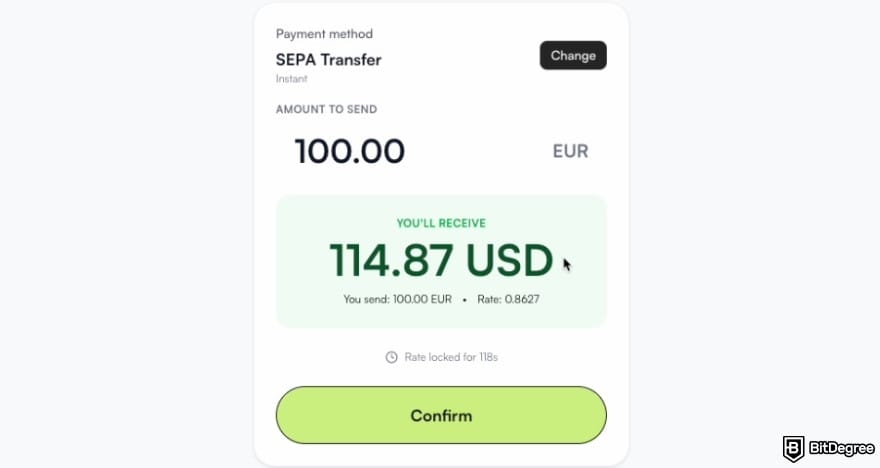
Here you go! You'll see all your transactions on the [Activity] panel.
📚 Learn More: How to Send Money from UAE to Philippines
Conclusions
Plenty of banks are vying for the title of the best bank in the Philippines, but only a handful have actually made the cut to this list, thanks to their wide selection of accounts and other products, reasonable deposit requirements, and accessibility. Any of these picks could become home to your new bank account in just a few hours or days, whenever you're ready to take the plunge.
Even so, choosing a new bank isn't something to be taken lightly. Make sure to comb through each bank's website and check all the essential details like the minimum deposit and balance requirements, interest rates (and the minimum required balance to qualify for interest), and transaction or withdrawal limits. When in doubt, I'd recommend getting the big-picture decisions out of the way first, such as a traditional VS digital bank.
Learn how to transfer money to the Philippines with this BitDegree Mission and earn 2,000 Bits towards your stake of the $20,000 prize pool in Airdrop Season 9!
Scientific References
1. Ballo J. B., Estandian V. C. A., Padual S. R. M., Torres R. R., German J. D., Redi A. A. N. P.: 'Assessing Digital Bank Preferences in the Philippines: An Application of Analytic Hierarchy Process';
2. Victorino, M. L. S.: 'Exploring Digital Banking in the Philippines: An Aid for Digital Financial Inclusion'.
Send Money Worldwide
Check out the best ways to send money to other countries quickly, safely, and with minimal fees.


















About Article's Experts & Analysts




Disclosure: To keep our site running & free of charge, we may sometimes receive a small commission if a reader decides to purchase services via some links on site, at no extra cost.