Key Takeaways
- OKX charges a 0.08% maker fee and a 0.10% taker fee for spot trades at the base tier;
- Futures fees begin at 0.02% for maker orders and 0.05% for taker orders for regular users;
- You can keep your costs lower by reaching a higher VIP tier, joining active promotions, and using referral offers.
Cheap, low-cost, zero-fee — exchanges throw these words around so freely nowadays that they barely mean anything anymore. They sound appealing at first, but once you start trading, the final bill can look rather different. That is exactly why OKX fees deserve a closer look before you decide whether the exchange is really that affordable.
From what I found, OKX earns much of its low-fee reputation. Its standard spot and futures rates are competitive, and active traders may be able to reduce them further. Even so, the platform uses a layered fee system, meaning the amount you pay can depend on far more than the rate shown on the first page.
Rather than taking the word “cheap” at face value, let’s work through the details together and see whether OKX holds up against Binance and Bybit.

Did you know?
Subscribe - We publish new crypto explainer videos every week!
What is a Smart Contract? (Explained with Animations)


Table of Contents
OKX Fees: Quick Overview
There isn’t a single OKX fee that applies to every trade. Your actual rate depends on multiple factors such as the product you use, the trading pair, your account level, and other applicable conditions. This is the layered structure I mentioned earlier, and it can leave new users scratching their heads.
Latest Changelly Coupon Found:To make things a bit clearer, here’s a breakdown of the regular-user fees that you'd likely encounter before factoring in anything that could adjust the final rate:
Fees | |
|---|---|
Spot | 0.08% maker / 0.10% taker |
Futures | 0.02% maker / 0.05% taker |
Options | 0.02% maker / 0.05% taker |
Margin | Applicable spot trading fee plus interest |
Margin | 50% of the maker or taker rate on each leg |
Deposit | Free |
Withdrawal | Varies by asset & network |
Table: OKX fees overview
OKX reassesses its fee groups from time to time. The platform recalculates your account level according to qualifying balances and trading activity, with resulting fee updates usually applied between 20:00 and 22:00 UTC.
Your actual rates may also vary depending on your location.
For that reason, treat the rates above as a baseline and confirm the live charge displayed in your account before submitting a substantial order.
📚 Check Out: OKX Review
Looking for more in-depth information on related topics? We have gathered similar articles for you to spare your time. Take a look!

OKX Trading Fees
OKX trading fees depend mainly on how your order executes and the fee tier assigned to your account. Selected stablecoin and fiat-quoted pairs may also follow separate pricing. This means a single advertised rate won’t represent every market available on the platform.
The exchange assigns Regular and VIP levels using qualifying assets or trailing 30-day trading activity. Where different products place you in different tiers, it extends the highest eligible fee benefit across its instruments.
Maker and Taker Fees Explained
OKX follows the familiar maker-taker pricing structure used by many leading exchanges. If you need a quick reminder of how the two sides work, the distinction is simple:
- A maker adds liquidity by submitting a limit order that stays open instead of matching immediately. That order sits on the book and becomes available for another trader to take.
- A taker removes liquidity by executing against an order already sitting on the book. This commonly happens when you place a market order or an immediately filled limit order.
So, if your order waits to be matched, you’re the maker. If it matches instantly with someone else’s order, you’re the taker.
Makers usually receive lower OKX fees because their orders contribute liquidity and support a more active market.[1]
Spot Trading Fees
At the base "Regular" tier, spot trades cost 0.08% maker and 0.10% taker. The number holds for the vast majority of pairs, including BTC, ETH, and most mid-cap tokens alike.
Maker | Taker | Example Pairs | |
|---|---|---|---|
Standard spot groups | 0.08% | 0.10% | BTC/USD, ETH/USDT, SOL/USDT |
Fee-free stablecoin pairs | 0.00% | 0.00% | PYUSD/USDT, USDC/USDT |
Other listed stablecoin pairs | 0.00% | 0.05% | RLUSD/USDT, USDG/USDT, USDT/USDⓈ |
TRY pairs | 0.10% | 0.10% | BTC/TRY, ETH/TRY, PI/TRY |
Special-fee pair | 0.10% | 0.15% | USDT/TRY |
Table: OKX spot trading fees for regular users
Qualifying for a higher OKX VIP level is one way to bring those rates down. Your tier depends on the stronger of two measurements: the value of assets held in your account or your trading volume over the past 30 days.
Here’s how the spot trading tiers break down:
Tier | Assets / 30D Trading Volume (USD) | Maker | Taker |
|---|---|---|---|
Regular | < 100,000 / < 1,000,000 | 0.080% | 0.100% |
VIP 1 | ≥ 100,000 / ≥ 1,000,000 | 0.0675% | 0.080% |
VIP 2 | ≥ 200,000 / ≥ 5,000,000 | 0.060% | 0.070% |
VIP 3 | ≥ 2,000,000 / ≥ 10,000,000 | 0.055% | 0.065% |
VIP 4 | ≥ 5,000,000 / ≥ 20,000,000 | 0.030% | 0.045% |
VIP 5 | ≥ 20,000,000 / ≥ 100,000,000 | 0.025% | 0.035% |
VIP 6 | ≥ 50,000,000 / ≥ 200,000,000 | 0.000% | 0.030% |
VIP 7 | ≥ 100,000,000 / ≥ 500,000,000 | -0.002% | 0.025% |
VIP 8 | ≥ 250,000,000 / ≥ 1,000,000,000 | -0.005% | 0.020% |
VIP 9 | ≥ 500,000,000 / ≥ 5,000,000,000 | -0.0075% | 0.0175% |
Table: OKX spot trading fees by VIP level
As shown above, reaching VIP 7 changes the maker fee from a charge into a negative rate. In practice, this means OKX credits you with a rebate instead of taking a percentage from the transaction.
Trading on pairs with zero maker and taker fees won’t contribute to the 30-day volume that determines your fee tier.
OKX calculates a trading fee using this formula:
Trading fee = fee rate × amount of crypto received
For example, say you purchase 1 BTC at 100,000 USDT through a market order. As a regular taker, you pay 0.10% × 1 BTC, resulting in a fee of 0.001 BTC. Your final received amount is therefore 0.999 BTC.
If you sell 1 BTC through a maker order for 100,000 USDT instead, the charge is 0.08% × 100,000 USDT, or 80 USDT. After the fee, you receive 99,920 USDT.

- Accepts fiat currencies
- Simple to use
- Supports only trusted cryptocurrencies
- A leading cryptocurrency exchange platform
- Best for all type investors
- Accepts fiat currencies

- Industry-leading security
- Accepts fiat currencies
- Advanced trading tools
- Industry-leading security
- Strong regulatory reputation
- Advanced trading tools

- Wide range of tradable assets
- Robust copy trading feature
- Flawless security record
Margin Trading Fees
Margin trading allows you to borrow crypto and take positions in either market direction while securing the loan with assets in your account. Unsurprisingly, borrowing adds another cost to the equation, leaving you with two charges:
1
You pay the applicable maker or taker fee when the spot trade executes.
2
OKX charges interest on the borrowed asset used to make the position larger.
There’s no single borrowing rate that applies across the platform. The APR can change depending on the asset, account level, trading pair, and market conditions, making the live rate on the margin trading page the one worth checking before you open a position.
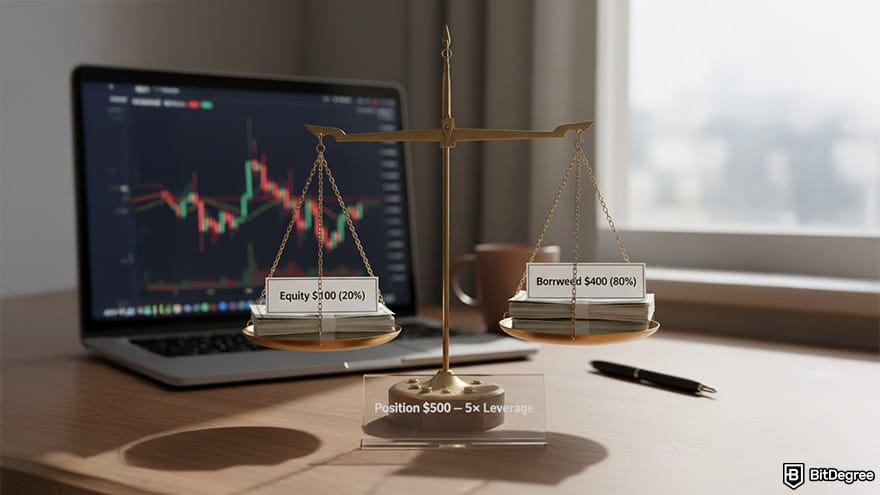
Borrowing limits can also vary according to the pair and your account tier. They determine the maximum amount available to borrow, but they don’t remove either trading fees or interest charges.
📚 Check Out: OKX Margin Trading
OKX Futures Fees
OKX futures fees follow their own schedule and are generally easier to understand and cheaper than spot fees at the standard level. Here’s what regular users pay:
Maker | Taker |
|---|---|
0.020% | 0.050% |
Table: OKX futures fees
OKX futures covers perpetual contracts (no expiry, held indefinitely) and dated contracts that settle on a fixed date.
For VIP tier purposes, the platform bundles the trading volume from both types into one combined total. So, regardless of which contract you trade or how you divide your activity, the same schedule applies.
Like spot pairs, futures contracts are classified into different token groups, with each following its own ladder:
Tier | Assets / 30D Trading Volume (USD) | Group 1 Maker / Taker | Group 2 Maker / Taker |
|---|---|---|---|
Regular | < $100K / < $5M | 0.020% / 0.050% | 0.020% / 0.050% |
VIP 1 | ≥ $100K / ≥ $5M | 0.016% / 0.045% | 0.016% / 0.045% |
VIP 2 | ≥ $200K / ≥ $10M | 0.015% / 0.036% | 0.015% / 0.036% |
VIP 3 | ≥ $2M / ≥ $50M | 0.010% / 0.028% | 0.010% / 0.028% |
VIP 4 | ≥ $5M / ≥ $200M | 0.008% / 0.027% | 0.008% / 0.027% |
VIP 5 | ≥ $20M / ≥ $600M | 0.005% / 0.026% | 0.005% / 0.026% |
VIP 6 | ≥ $50M / ≥ $1B | 0.000% / 0.025% | 0.000% / 0.025% |
VIP 7 | ≥ $100M / ≥ $1.5B | -0.002% / 0.020% | -0.005% / 0.025% |
VIP 8 | ≥ $250M / ≥ $2B | -0.005% / 0.020% | -0.010% / 0.025% |
VIP 9 | ≥ $500M / ≥ $20B | -0.005% / 0.015% | -0.010% / 0.020% |
Table: OKX futures maker & taker fees by VIP level
You only need to satisfy one of the requirements listed in the table, either qualifying assets or trading volume. OKX also applies the highest fee benefit available to your account across its instruments. So, a tier earned through futures volume can also carry over to other products.
The wider altcoin category (Group 2) mirrors the same ladder up to VIP 6, then begins to diverge slightly. At the top, its maker rebate improves to -0.01% by VIP 8, while taker fees remain a little higher. Since every taker rate stays positive, orders that execute immediately still cost something regardless of tier.
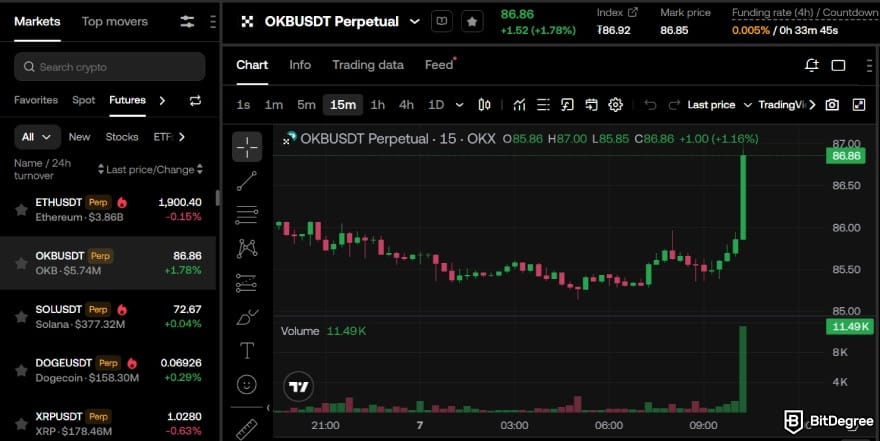
To estimate OKX futures fees, start with the total value of your position rather than the margin used to open it. For a USDT-margined futures or perpetual trade, the simplified calculation is:
Futures trading fee = position value × applicable fee rate
For example, imagine opening a 10,000 USDT BTC perpetual position at the regular-user tier. A taker order would carry an opening fee of:
10,000 USDT × 0.05% = 5 USDT
If the same position enters the order book and eventually fills as a maker, the fee would be:
10,000 USDT × 0.02% = 2 USDT
You’ll normally pay another trading fee when closing the position. Provided the position value stays unchanged, and the exit uses the same order type, the estimated costs are:
Fee to Open | Fee to Close | Total Fee | |
|---|---|---|---|
Maker | 2 USDT | 2 USDT | 4 USDT |
Taker | 5 USDT | 5 USDT | 10 USDT |
Table: Maker & taker costs for a 10,000 USDT futures trade
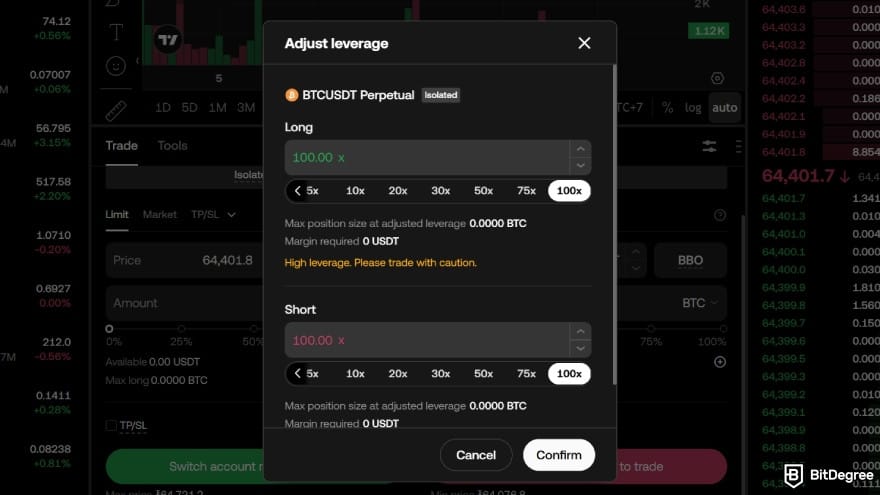
Using leverage doesn’t lower the position value on which the trading fee is calculated.
For example, you may commit just 1,000 USDT as margin to control a 10,000 USDT position at 10x leverage, but the fee still applies to the entire position. This can make a harmless-looking percentage rather less harmless, so consider the trading cost before increasing your leverage.
Your OKX futures fee calculation should also account for the funding rate. This system transfers payments between long and short traders and applies exclusively to perpetual contracts. Expiry futures settle on their scheduled date, which removes the need for recurring funding payments.
A positive funding rate means long traders pay short traders, while a negative rate reverses the direction of payment. OKX simply facilitates the transfer between both sides and doesn’t collect an additional service fee from the funding exchange.
On most contracts, funding exchanges take place every 8 hours at 00:00, 08:00, and 16:00 UTC. A few contracts settle more often, following 1-, 2-, or 4-hour cycles.
Say you hold a long BTC perpetual position valued at $10,000 when the positive funding rate is 0.01%. The resulting payment would be about $1 to short-position holders. It isn’t much once, but the total can grow if you leave the position running for weeks. Exit before the next settlement, and that payment doesn’t apply.
If insufficient margin causes OKX to liquidate your leveraged position, you’ll pay a liquidation charge alongside the underlying trading fee. The platform calculates it using your applicable taker rate, so higher-tier users, such as those at VIP 4, pay less than regular traders.
Apart from that, the pricing doesn’t hide many unpleasant surprises. I’d consider OKX relatively transparent when it comes to fees. The structure is admittedly complex, but it also provides enough detail to estimate what each transaction may cost.
OKX Options Fees
OKX uses a maker-taker structure for options trading as well, but regular users pay a flat 0.03% whether their order is classified as maker or taker. The difference starts to matter at higher VIP tiers, where maker rates decrease more quickly and can eventually become negative.
As with spot and futures, your options fee tier depends on either your qualifying asset holdings or trailing 30-day options trading volume:
Tier | Assets / 30D Trading Volume (USD) | Maker | Taker |
|---|---|---|---|
Regular | < $100K / < $3M | 0.030% | 0.030% |
VIP 1 | ≥ $100K / ≥ $3M | 0.028% | 0.030% |
VIP 2 | ≥ $200K / ≥ $5M | 0.025% | 0.030% |
VIP 3 | ≥ $2M / ≥ $10M | 0.020% | 0.030% |
VIP 4 | ≥ $5M / ≥ $25M | 0.020% | 0.025% |
VIP 5 | ≥ $20M / ≥ $50M | 0.015% | 0.020% |
VIP 6 | ≥ $50M / ≥ $100M | 0.010% | 0.020% |
VIP 7 | ≥ $100M / ≥ $1.5B | -0.005% | 0.020% |
VIP 8 | ≥ $250M / ≥ $2B | -0.010% | 0.020% |
VIP 9 | ≥ $500M / ≥ $20B | -0.010% | 0.013% |
Table: OKX options fees by VIP level
Eligible maker trades begin receiving rebates once you reach VIP 7. Taker orders still carry a positive fee at every tier, although the rate becomes progressively lower.
OKX works out options fees using the contract multiplier, contract size, number of contracts, and your applicable rate. There’s also a 7% premium cap, which stops the fee from looking absurdly large when the option itself carries only a tiny premium.
For a coin-margined option with a positive fee rate, the simplified calculation is:
Options trading fee = the lower of:
1
Fee rate × contract multiplier × contract size × number of contracts
2
7% × total option premium
Say that you buy 100 BTC call option contracts with the following terms:
- Contract multiplier: 0.01
- Contract size: 1 BTC
- Total notional value: 1 BTC
- Fill price: 0.05 BTC
- Regular-user fee rate: 0.03%
The standard trading fee would be:
0.03% × 0.01 × 1 BTC × 100 = 0.0003 BTC
The fee cap would be:
7% × 0.05 BTC × 0.01 × 1 × 100 = 0.0035 BTC
Since OKX applies the lower figure, the final charge is 0.0003 BTC
Coin-margined options charge fees in the underlying cryptocurrency (such as BTC). For USDT-margined contracts, the fee is calculated and paid in USDT.
Maker and taker fees aren’t always the only charges you need to consider. Depending on how the position develops, exercise, liquidation, and clearance fees may also apply.
Type | Note |
|---|---|
Exercise fee | Applies only when an option is exercised and is capped using the applicable taker rate and 7% of the settlement value |
Day-option exercise fee | No exercise fee for options that don’t expire on Fridays |
Forced-liquidation fee | Based on the user’s taker tier, subject to a 7% cap using the option’s mark price |
Sell-option clearance fee | 2.5% for BTC options and 4% for ETH options |
Buy-option clearance fee | 0.1% for BTC and 0.15% for ETH under portfolio margin |
Options combo fee | RFQ combo trades may receive a discount of up to 50% |
Table: Additional OKX options fees
Options that expire without being exercised don’t incur an exercise fee. For RFQ combo trades, OKX generally identifies the higher-notional side for each underlying asset and charges that leg rather than automatically billing all legs.
OKX Deposit Fees
OKX doesn’t impose its own fee on crypto deposits. Whether you transfer BTC, ETH, USDT, or another supported asset, the platform credits the deposit without deducting a receiving charge, regardless of the amount or selected network.
You’ll need to complete identity verification before making a deposit. This requirement supports the platform’s regulatory compliance process and helps maintain account security.[2]
The transfer may not be completely cost-free for the sender, though. Their wallet or exchange can still deduct a withdrawal or gas fee before the crypto reaches OKX. If someone else sends the funds, the charge comes out of their wallet, not your balance.
OKX Withdrawal Fees
Every crypto withdrawal from OKX to an external wallet carries a network fee. Instead of following the maker-taker structure used for trading, the amount varies according to the asset and blockchain network you choose. Here are a few examples to put that into perspective:
Asset | Network | Min. Withdrawal | Fee |
|---|---|---|---|
BTC | Bitcoin | 0.000095 BTC | 0.000015 BTC |
Solana | 0.00011 BTC | 0.0000032 BTC | |
Sui | 0.00011 BTC | 0.00000004 BTC | |
ETH | Base | 0.0021 ETH | 0.0000047 ETH |
Ethereum | 0.0011 ETH | 0.000022 ETH | |
Optimism | 0.00011 ETH | 0.0000066 ETH | |
USDT | Ethereum | 2.1 USDT | 0.094 USDT |
Solana | 0.31 USDT | 0.21 USDT | |
Tron | 0.21 USDT | 2.2 USDT | |
USDC | Base | 0.12 USDC | 0.014 USDC |
Ethereum | 0.67 USDC | 0.17 USDC | |
Polygon | 0.12 USDC | 0.015 USDC |
Table: Examples of OKX withdrawal fees
As the table shows, using the same cryptocurrency doesn’t guarantee the same withdrawal cost.
For example, ETH withdrawal through Ethereum (ERC20) costs 0.000022 ETH, compared with just 0.0000047 ETH through Base. The difference was also noticeable for USDT, with fees ranging from 0.094 USDT on Ethereum to 2.2 USDT on Tron.
Don’t choose a network based on price alone, though. The destination wallet or exchange needs to support the selected asset on that exact blockchain. Otherwise, those few cents saved on the withdrawal fee could turn into a considerably more expensive headache.
📚 Check Out: How to Withdraw Money From OKX
How to Reduce OKX Fees
Unfortunately, there isn’t one magic switch that makes every OKX fee disappear. You can, however, reduce your overall trading costs by using several practical strategies. Here are some worth considering:
- Use maker orders. Since OKX charges lower maker fees than taker fees, allowing your order to sit on the book can reduce your trading cost. The trade-off is that a limit order may never fill if the market doesn’t reach your chosen price.
- Qualify for a higher VIP tier. The exchange gradually cuts its fees as you progress through the VIP levels, and one strong metric is enough to qualify. You don’t need both a large balance and high 30-day volume to move up.
- Claim eligible promotions & rebates. From time to time, OKX offers rebate cards, fee vouchers, cashback, or similar perks that can help lower your total costs. Following the platform’s in-app announcements and official channels is the easiest way to stay informed.
- Choose a lower-cost withdrawal network. Fees for the same asset can vary widely between blockchains. Provided the transfer isn’t urgent, choose a lower-cost option that the destination wallet or exchange supports without any compatibility surprises.
You can also sign up with the BitDegree referral code to access an eligible OKX fee discount. Depending on the active campaign and your account eligibility, the offer may include a welcome bonus, free crypto, or boosted staking rewards.
OKX VS Binance VS Bybit Fees
To properly judge whether OKX fees are competitive, we need to compare them with what other exchanges charge. The OKX VS Binance fee comparison is naturally one of the most common questions I encountered. I’ll also bring Bybit into the discussion so we can see how all three platforms measure up.
 |  |  | |
|---|---|---|---|
| - | - | 80,000,000 USD | |
| 0.000015 BTC | 0.00005 BTC | 0.00001 BTC | |
| Up to 0.1% | Up to 0.1% | Up to 0.50% | |
| Not Supported ❌ | Not Supported ❌ | Supported ✅ | |
| See TOP10 Brands Read review | See TOP10 Brands Read review | See TOP10 Brands Read review |
Table: Fee comparison between OKX, Binance, and Bybit.
At the standard level, OKX comes out ahead on spot maker fees. Its regular users pay 0.08% for orders that add liquidity, compared with 0.10% on Binance and Bybit. All three charge the same 0.10% base taker fee, though, so its advantage disappears when an order executes immediately against the order book.
Spot | Futures | Options | |
|---|---|---|---|
OKX | 0.08% maker / 0.10% taker | 0.02% maker / 0.05% taker | 0.03% maker / 0.03% taker |
Binance | 0.10% maker / 0.10% taker | 0.02% maker / 0.05% taker | 0.024% maker / 0.024%taker |
Bybit | 0.10% maker / 0.10% taker | 0.02% maker / 0.055% taker | 0.02% maker / 0.03% taker |
Table: OKX VS Binance VS Bybit fees at base tier
Futures tell a slightly different story. OKX VS Binance fees are identical at 0.02% for makers and 0.05% for takers, whereas Bybit charges a slightly higher 0.055% taker rate. The difference is only about 10%, but repeated leveraged trades can make that narrow gap add up quickly.
Options trading makes the comparison a little more interesting. OKX and Binance apply a flat fee regardless of whether the order is a maker or taker, whereas Bybit maintains the usual split at 0.02% maker and 0.03% taker. Even so, Binance offers the lowest taker rate among the three platforms.
At the standard level, OKX combines the lowest spot maker fee with futures rates equal to Binance’s, making it a competitive option without requiring you to hold a native token. Binance can become more attractive through its BNB discount, whereas Bybit leads slightly on options maker fees but falls just behind on futures taker pricing.
There isn’t one universal cheapest choice. The answer depends on what you trade, whether your orders add or remove liquidity, which discounts you unlock, how you withdraw your funds, and where your account is registered.
📚 Check Out: Binance Fees
Browse our collection of the most thorough Crypto Exchange related articles, guides & tutorials. Always be in the know & make informed decisions!


Conclusions
Compared with much of the competition, OKX fees are attractively priced. Its standard spot maker and futures rates are particularly friendly to regular users, and traders who naturally reach the higher VIP levels can reduce those charges even further.
Of course, no exchange is cheapest in every possible scenario, and OKX is no exception. Your total bill can still depend on the product, trading pair, asset, location, funding method, and withdrawal network, although promotions and eligible referral benefits may help soften it.
The content published on this website is not aimed to give any kind of financial, investment, trading, or any other form of advice. BitDegree.org does not endorse or suggest you to buy, sell or hold any kind of cryptocurrency. Before making financial investment decisions, do consult your financial advisor.
Scientific References
1. Yagi, I., Hoshino, M., Mizuta, T.: 'Analysis of the impact of maker-taker fees on the stock market using agent-based simulation';
2. Mansoor N., Antora K. F., Deb P., et al.: 'A review of blockchain approaches for KYC'.
About Article's Experts & Analysts