Key Takeaways
- BTCC TradFi lets you trade gold, silver, WTI crude, Brent crude, and natural gas directly from your crypto account with zero deposit fees and up to 50x leverage;
- Metals and energy commodities are driven by completely different market forces, and understanding what moves each instrument is just as important as knowing how to place the trade;
- Commodities can gap sharply around macro events, making stop losses, conservative leverage, and demo account practice essential habits before going live with real capital.
Wars move gold. OPEC meetings move oil. Inflation prints move both. For anyone figuring out how to trade commodities, understanding what drives these markets is step one, and having the right platform to act on them quickly is step two.
BTCC TradFi covers both. Gold, WTI crude, Brent crude, silver, natural gas, and more. These are some of the most actively traded commodities in the world, available directly from your BTCC futures account, using USDT as margin.
I've gone through the full BTCC TradFi experience for commodities, so you don't have to figure it out blind. If you're a crypto trader looking to diversify into macro assets or a complete beginner drawn to gold and oil markets, keep reading!

Did you know?
Subscribe - We publish new crypto explainer videos every week!
What is Uniswap? (UNI Token Explained With Animation)


Table of Contents
- 1. What Are Commodities and Why Trade Them?
- 2. How to Trade Commodities and Metals on BTCC - Step by Step
- 2.1. Create Your BTCC Account
- 2.2. Fund Your Account
- 2.3. Place Your First Commodity Trade
- 3. BTCC Commodity Trading Fees
- 4. Metals vs Commodities: Key Trading Differences
- 5. Commodities vs Stocks vs Crypto on BTCC
- 6. Who Can Use BTCC TradFi for Commodities?
- 7. Risk Management for Commodity Trading Beginners
- 8. The Security Case for Trading Commodities on BTCC
- 9. Conclusions
What Are Commodities and Why Trade Them?
At their core, commodities are raw materials and natural resources that drive the global economy. Unlike stocks, which represent ownership in a company, or crypto, which is driven largely by market sentiment and adoption, commodities are tangible assets whose prices are shaped by real-world supply and demand dynamics.
Latest Changelly Coupon Found:When a drought hits wheat-producing regions, prices move. When a major oil pipeline goes offline, energy markets react. When central banks start stockpiling gold, the price reflects it.
For traders, that makes commodities one of the most macro-sensitive asset classes available. They're widely used as a hedge against inflation, a diversification tool away from equities, and a way to take a position on geopolitical events without picking individual stocks or tokens.
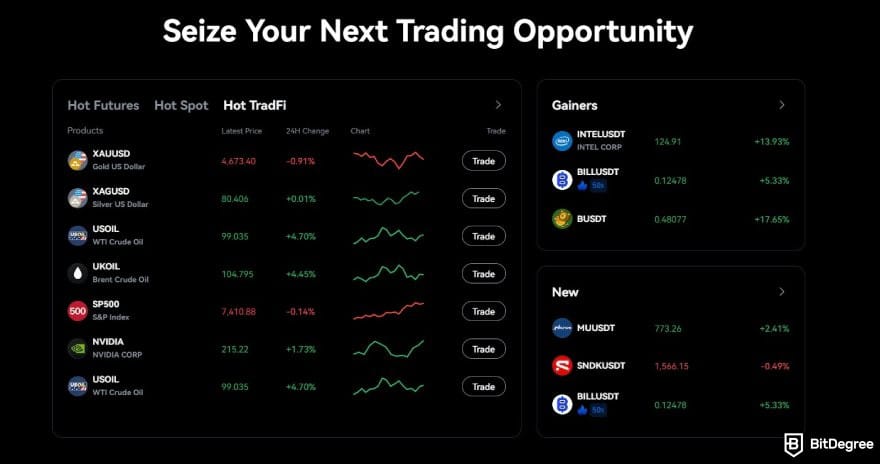
On BTCC, the instruments covered in this guide are split across two distinct categories: Metals, which include gold, copper, and silver. The other one is Energy, which covers WTI crude, Brent crude, and natural gas. Technically speaking, these are separate instrument classifications on the platform. For simplicity, I'll refer to all of them collectively as "commodities" throughout this article.
Here's a quick breakdown of what's available:
Category | Ticker | |
|---|---|---|
Gold | Metals | XAUUSD |
Silver | Metals | XAGUSD |
WTI Crude Oil | Commodities | USOIL |
Brent Crude Oil | Commodities | UKOIL |
Natural Gas | Commodities | NGAS |
Table: Metals and Commodities instruments on BTCC
On BTCC, these instruments are traded through BTCC TradFi, the platform's dedicated section for traditional financial assets. Instead of buying and owning the underlying asset, you're trading price contracts that follow real-world commodity prices in real time, with USDT as margin.
Looking for more in-depth information on related topics? We have gathered similar articles for you to spare your time. Take a look!


How to Trade Commodities and Metals on BTCC - Step by Step
Now that you understand the trading instruments and why they can be worth your time, it is time to actually learn how to trade commodities and metals on BTCC. I'll cover everything from creating a new account to closing your first trade.
Create Your BTCC Account
Making a new account on BTCC is straightforward. Here's how to do it on a desktop:
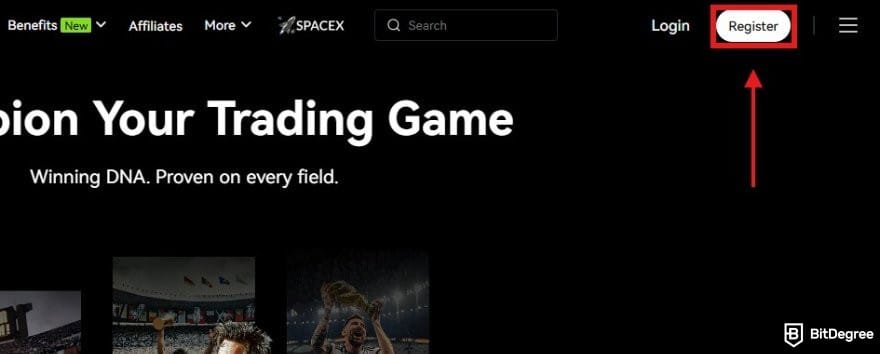
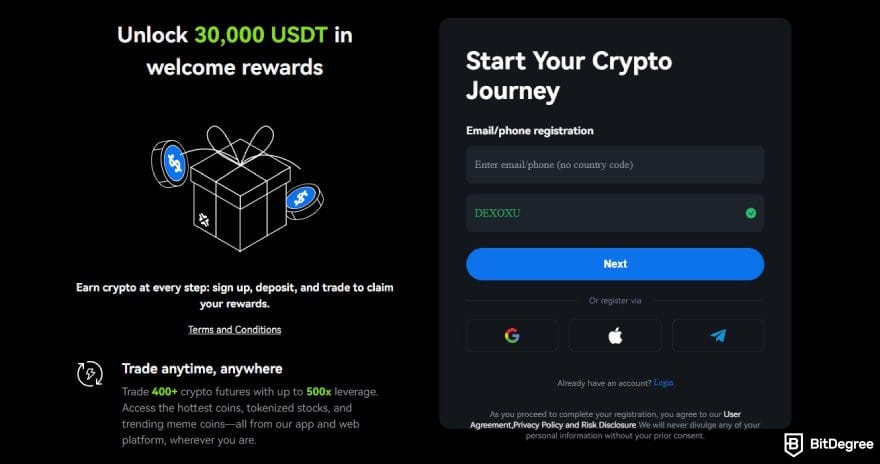
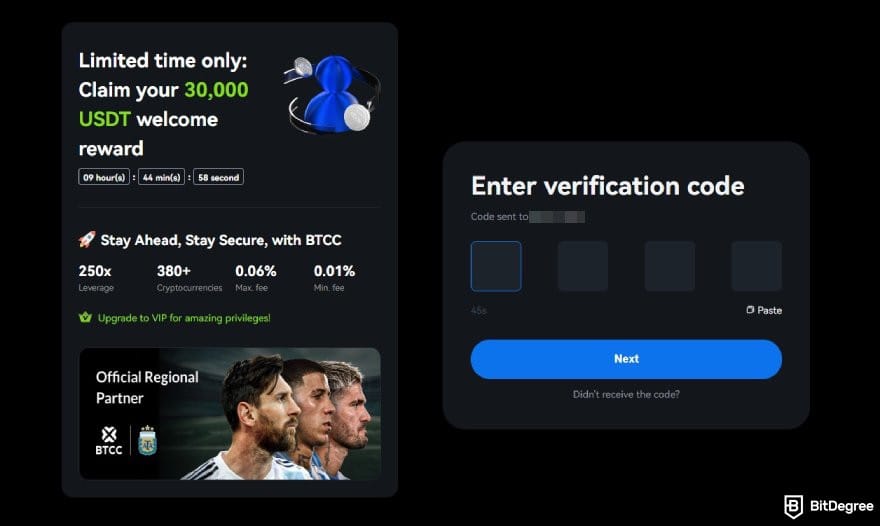
In my experience, you can complete the registration process in less than 10 minutes. However, keep in mind that the KYC verification may take longer depending on your region and other factors.
Fund Your Account
Once your account is set up, it's time to make your first deposit. Here's how:
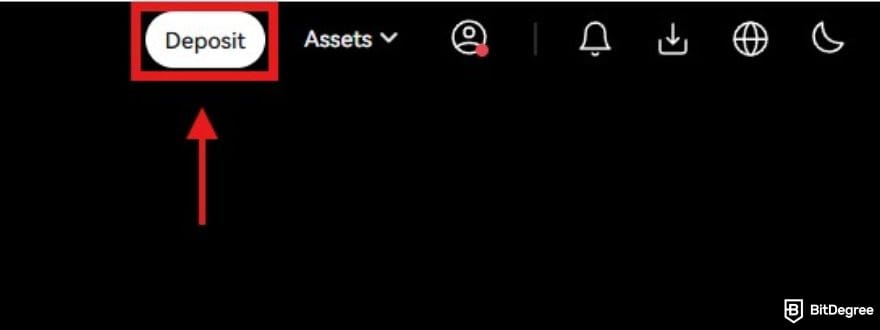
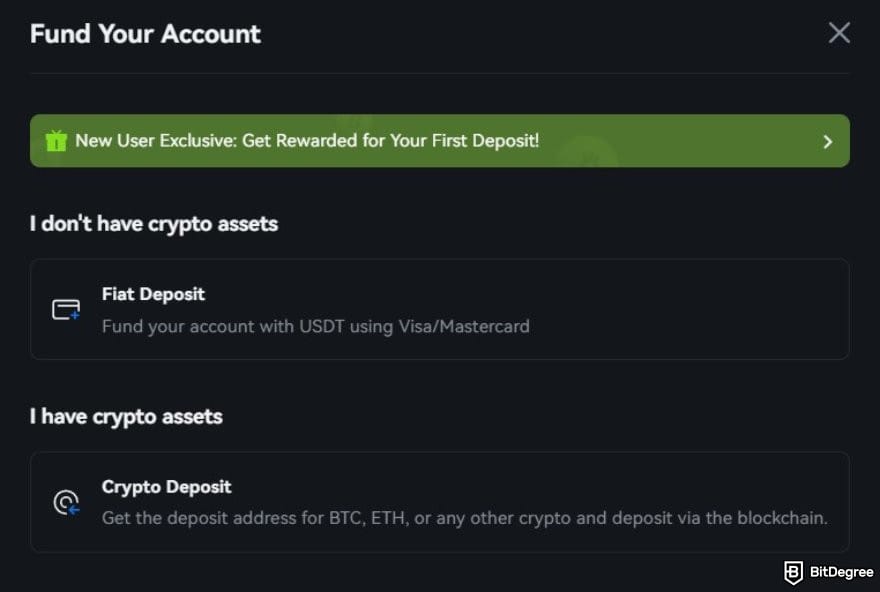
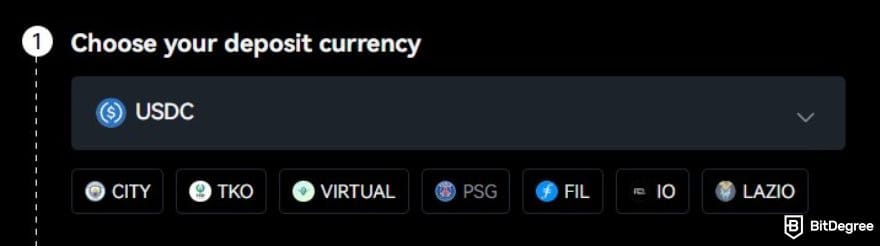
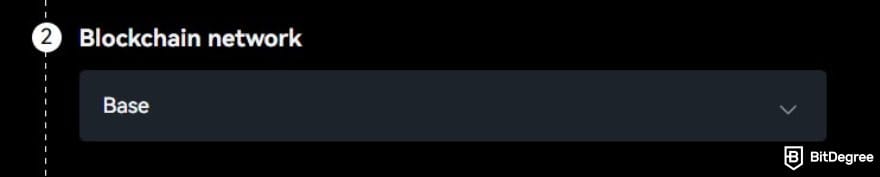
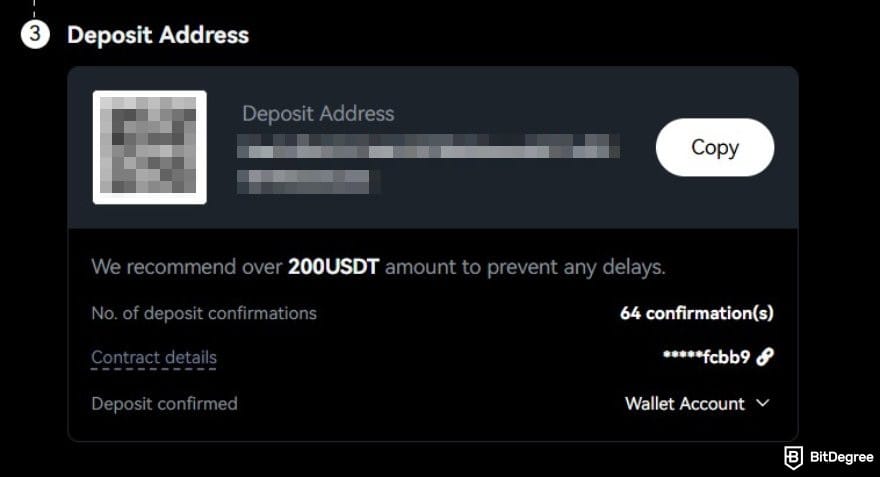
Alternatively, you can deposit fiat via Visa or Mastercard. Both deposit methods carry zero fees. Once funds are in your main wallet, transfer them to your TradFi account via [Assets] > [Transfer] > [Wallet Account to TradFi Account]. It's instant.
Not ready to trade with real money yet? BTCC offers a demo account loaded with 100,000 USDT in virtual funds. If you're new to commodities trading for beginners, spending some time on the demo before going live is genuinely worth it.

- Accepts fiat currencies
- Simple to use
- Supports only trusted cryptocurrencies
- A leading cryptocurrency exchange platform
- Best for all type investors
- Accepts fiat currencies

- Industry-leading security
- Accepts fiat currencies
- Advanced trading tools
- Industry-leading security
- Strong regulatory reputation
- Advanced trading tools

- Wide range of tradable assets
- Robust copy trading feature
- Flawless security record
Place Your First Commodity Trade
With your account funded, here's how to place your first commodity trade on the BTCC desktop version.
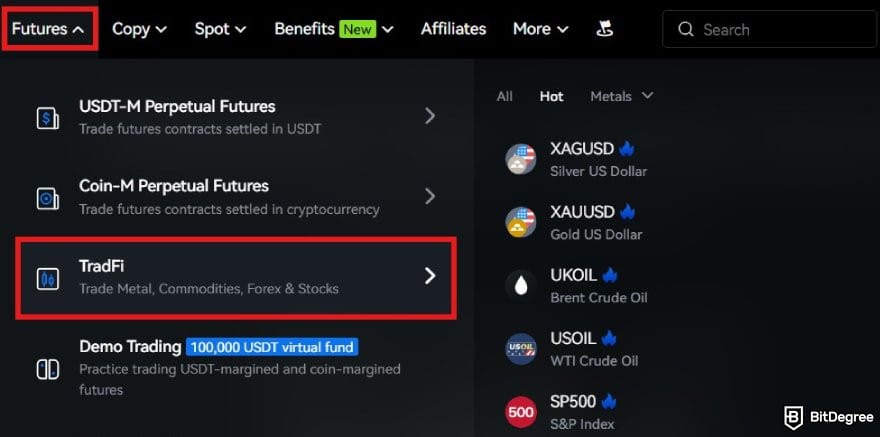
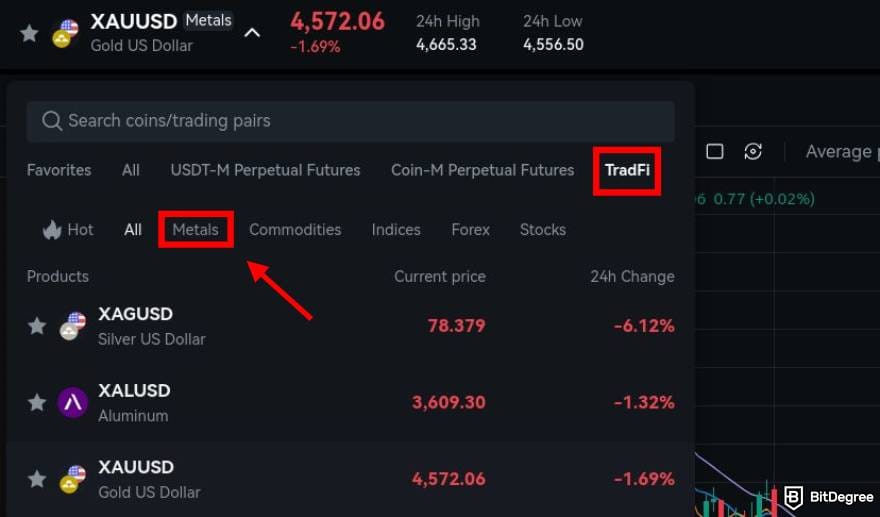
For energy, head to the [Commodities] section for WTI crude (USDOIL), Brent crude (UKOIL), and natural gas (NGAS). Tap the instrument you want to open its trading interface.
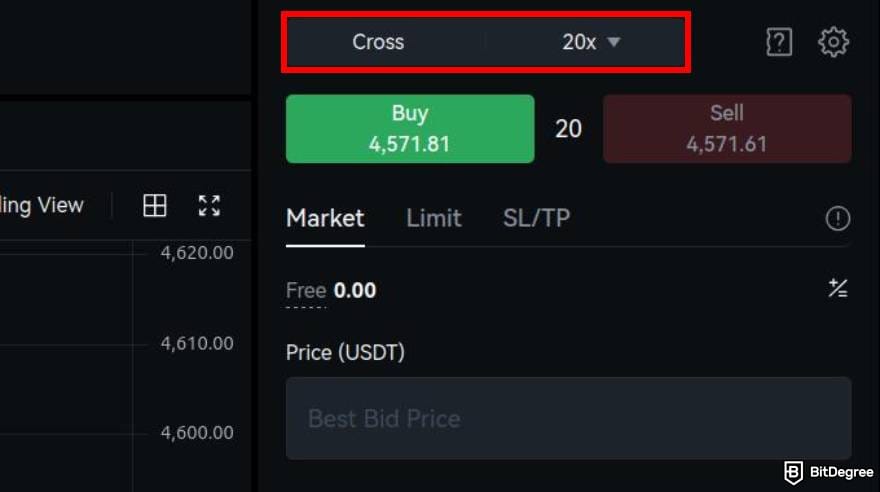
As I said, commodities can move sharply around macro events, including an OPEC announcement, a CPI print, and a geopolitical flare-up. For beginners, I think 2x-5x is the sensible starting range.
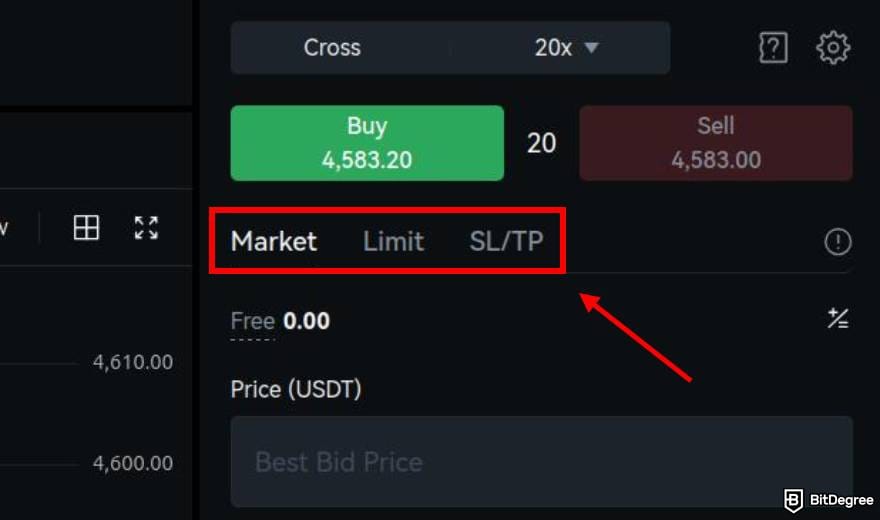
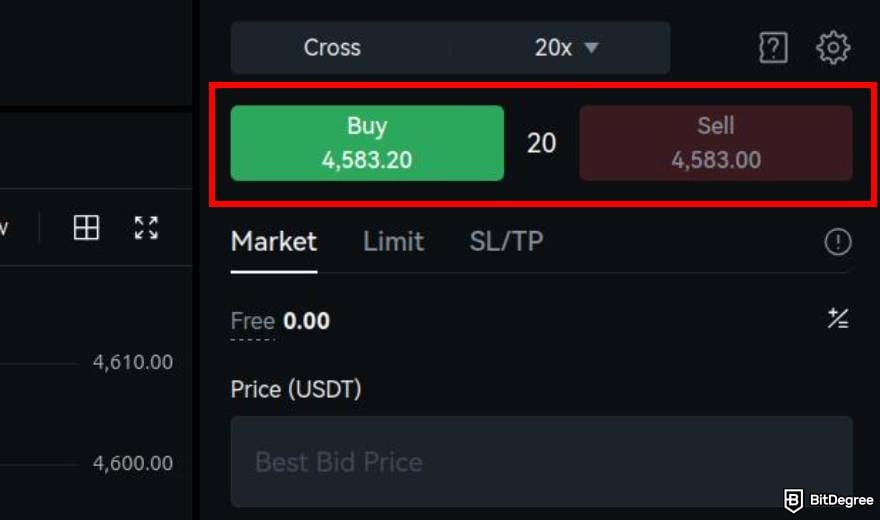
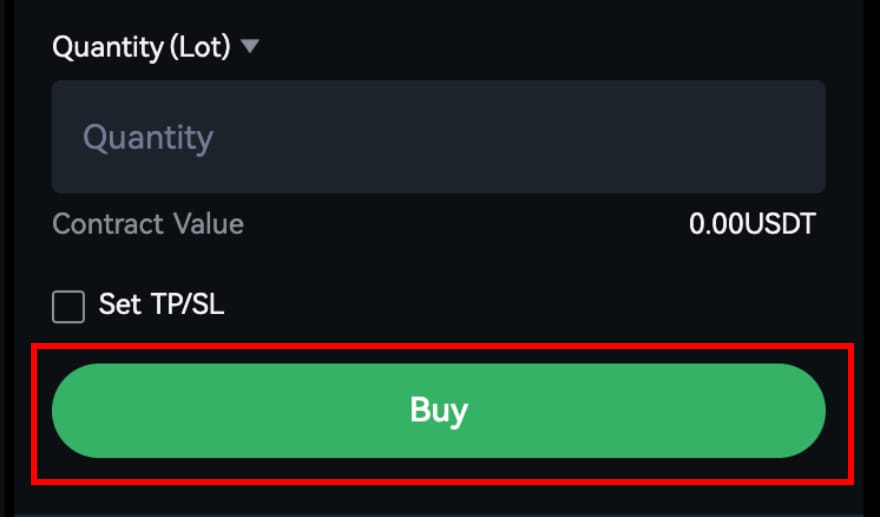
Before confirming, enable the [Take Profit and Stop Loss] checkboxes and set your levels. With leveraged commodity contracts, an unprotected position during a macro shock can move against you faster than you'd expect.
📚 Check Out: How to Use BTCC Crypto Exchange
Commodity prices don't always move gradually. A surprise Fed statement or an unexpected supply disruption can shift gold or oil significantly in minutes. Factor that into your position sizing and always have a stop loss active before you step away from the screen.
BTCC Commodity Trading Fees
Aside from learning how to trade commodities and metals on BTCC, it's worth knowing exactly what comes out of your pocket. The good news is that BTCC keeps the fee structure straightforward.
The platform uses a taker/maker fee model. At VIP0, that's 0.06% for taker and 0.02% for maker.
Futures trading fees | |
|---|---|
VIP 0 | 0.02% maker/0.06% taker |
VIP 1 | 0.02% maker/0.06% taker |
VIP 2 | 0.018% maker/0.042% taker |
VIP 3 | 0.017% maker/0.04% taker |
Table: BTCC trading fee structure
Say you open a long position on gold (XAUUSD) for 1,000 USDT. With a limit order at VIP0 maker rates, you'd pay just 0.20 USDT in trading fees. With a market order at taker rates, that goes up to 0.60 USDT.
Your fee rate improves as your VIP level increases, and it can go as low as 0.01% maker/0.015% taker at VIP 7. VIP1 status kicks in with a deposit of just 200 USDT, immediately unlocking discounted rates.

Additionally, BTCC has a "Forced Liquidation Fee" that applies if your margin balance falls too low and the system automatically closes your position. The rate for commodity contracts is 1.2%, calculated against the liquidation quantity and price. It's worth knowing about, but with a stop loss set on every trade, it's something you should rarely run into.
Say that same 1,000 USDT gold position moves sharply against you because a surprise Fed rate decision hits, gold gaps down, your margin runs out, and BTCC triggers a forced liquidation. At a 1.2% fee rate, you'd be charged 12 USDT as a liquidation fee. No additional closing fee gets stacked on top of that. It's a worst-case scenario, but one that a properly set stop loss should prevent entirely.
Metals vs Commodities: Key Trading Differences
Not all commodities trade the same way. Gold and oil might both be listed under BTCC TradFi, but they're driven by completely different forces. Understanding those differences is what separates a trader who gets caught off guard by a sudden move from one who saw it coming.
Metals (Gold, Silver, Copper, etc.)
Gold is the classic safe-haven asset. When uncertainty rises like a geopolitical conflict, a banking crisis, or a spike in inflation, money tends to flow into gold. It moves on central bank policy, US dollar strength, real interest rates, and global risk sentiment.
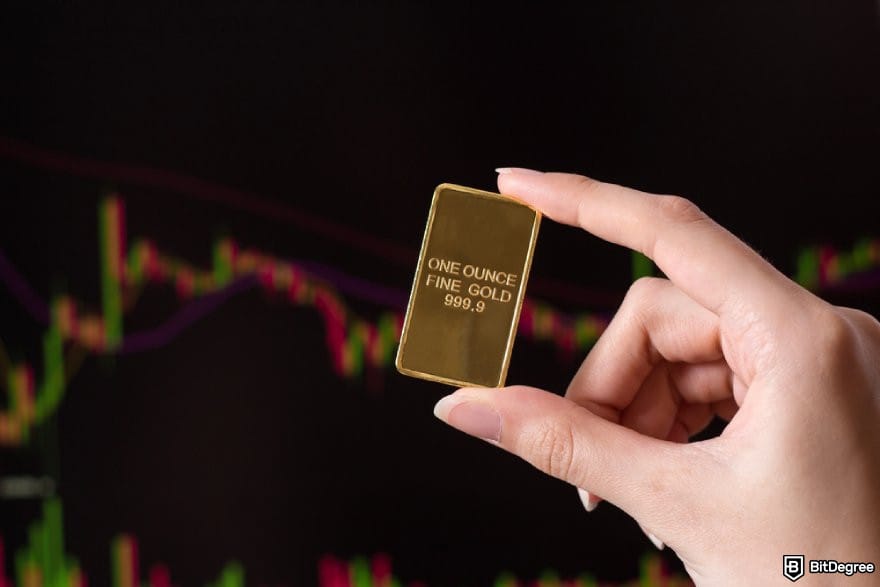
Silver behaves similarly but with a twist: it's also an industrial metal, which means it reacts to manufacturing demand and economic growth data on top of the safe haven dynamics. That makes silver generally more volatile than gold and a slightly more unpredictable trade.
Commodities (WTI, Brent, Natural Gas)
Oil is a pure supply and demand story. WTI (West Texas Intermediate) and Brent crude are the two global benchmarks. WTI reflects US supply conditions while Brent is the international standard. Both react sharply to OPEC production decisions, geopolitical disruptions in major oil-producing regions, inventory data releases, and global demand forecasts.
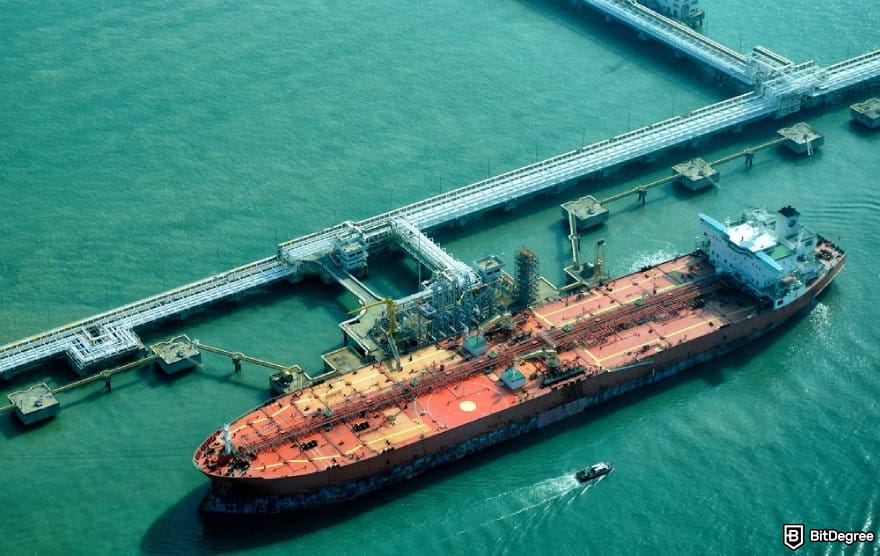
Natural gas adds another layer. It's highly seasonal, heavily weather-dependent, and can spike dramatically during periods of high heating or cooling demand. Here is a simple comparison table to give you a better outlook on what makes these two instruments different:
Metals | Energy | |
|---|---|---|
Primary Driver | Inflation, USD, geopolitics | Supply/demand, OPEC, weather |
Volatility Profile | Moderate, spikes on macro shocks | High, especially around OPEC dates |
Safe Haven Appeal | Strong (gold especially) | ✗ |
Trading Hours | 24/7 | 24/7 |
Seasonal Factor | Low | High (natural gas especially) |
Best Suited For | Macro-aware, inflation-focused traders | Supply/demand, news-driven traders |
Table: Comparison between metals and energy commodities as trading instruments
The key takeaway is this: metals and energy require different inputs to trade well. Gold rewards traders who follow central bank policy and macro data. Oil rewards traders who track supply decisions and energy demand. Knowing which one aligns with how you already consume financial news is a good starting point for deciding where to focus first.
Commodities vs Stocks vs Crypto on BTCC
If you're already trading crypto or stocks on BTCC, adding commodities to your setup doesn't require a new account or a new platform, just a different market to follow. But each asset class has its own rhythm, and it's worth knowing how they sit alongside each other.
Commodities (TradFi) | Stocks (TradFi) | Crypto (Futures) | |
|---|---|---|---|
Trading Hours | almost 24/7 | Market hours | 24/7 |
Primary Driver | Macro, geopolitics, supply/demand | Earnings, company news, macro | Sentiment, on-chain activity, and news |
Volatility Profile | Moderate to high | Moderate | High |
Max Leverage | Up to 50x | Up to 50x | Up to 225x |
Margin Asset | USDT | USDT | USDT or Coin-M |
Safe Haven Appeal | Strong (gold) | ✗ | ✗ |
Table: Comparison between commodities vs stocks vs crypto on BTCC
The key portfolio angle here is diversification. Gold in particular tends to move independently of both stocks and crypto, sometimes rising precisely when the other two are selling off. For a crypto-heavy trader, a long gold position during a risk-off period is a hedge. That's something neither stocks nor crypto can reliably offer.
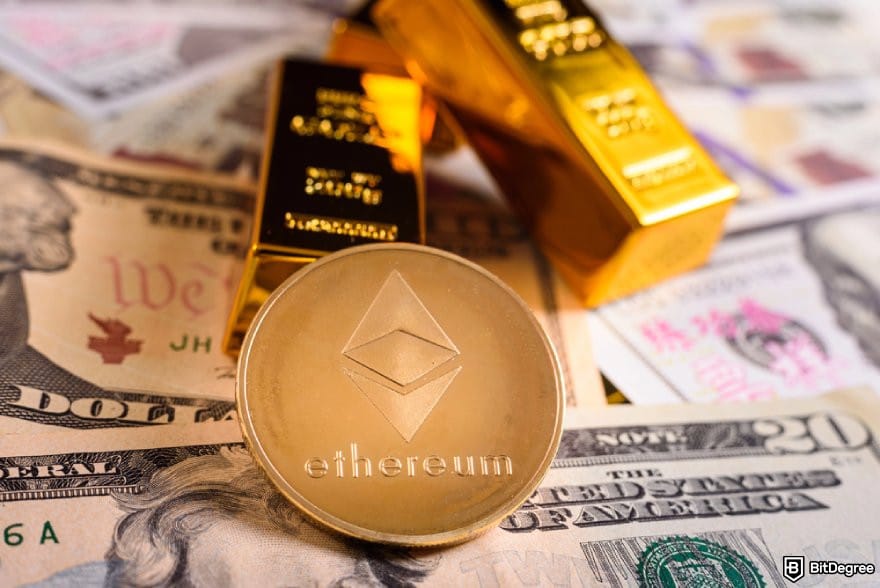
The broader point is that BTCC is one of the few platforms where you can hold a crypto futures position, a stock contract, and a gold trade simultaneously. All of them are margin-traded in USDT and managed from the same interface. That's a genuinely rare combination.
Who Can Use BTCC TradFi for Commodities?
BTCC TradFi isn't built for one type of trader. Depending on where you're coming from, the commodity trading features on offer serve different purposes. Here's who stands to benefit most:
- Crypto traders looking to diversify. If your portfolio is heavily crypto-exposed, adding gold or oil positions gives you access to assets that don't always move with the crypto market.
- Macro-aware beginners. For those who already follow inflation data, central bank decisions, and geopolitical news, commodities are the natural next step into markets that directly react to those events.

- Platform consolidators. BTCC is a great option for traders who want crypto futures, stock contracts, and commodity trading all under one login without juggling multiple accounts.
- Traders who want regulated access. BTCC TradFi is good, particularly for those based in regions where getting commodity exposure through a traditional broker is unnecessarily complicated.
On the regional side, BTCC is one of the more globally accessible platforms available. Verified traders from over 190 countries and regions worldwide can access the platform. For US and Canadian traders specifically, BTCC holds a stronger position than most crypto platforms in this space.
BTCC is licensed by FinCEN in the United States and FINTRAC in Canada, meaning it operates with full regulatory compliance in both markets, with USD and CAD supported for deposits.

For traders in these regions who have historically struggled to find a compliant platform that also offers commodity exposure, that's a meaningful distinction.
Risk Management for Commodity Trading Beginners
Commodity markets have their own brand of risk, and it's different from what you'd experience trading stocks or crypto. Prices don't just trend gradually in one direction. They gap, spike, and reverse sharply around specific, often predictable events.
📚 Check Out: 5 Top Crypto Trading Strategies
Understanding those events before you trade is half the risk management job done. Here are some factors to consider before you start making your first commodity trade:
1
Macro Event Risk
Gold and oil are among the most macro-sensitive instruments you can trade. A surprise CPI print can send gold surging before most traders have time to react. An unexpected OPEC production cut can gap oil several percentage points in minutes. Federal Reserve statements, geopolitical flare-ups, and US dollar movements all feed directly into commodity prices in real time.
2
Seasonal Risk for Natural Gas
Natural gas is in a category of its own when it comes to seasonal volatility. Demand spikes during winter heating seasons[1] and summer cooling peaks, which means price behavior in January looks completely different from price behavior in April. Before opening a natural gas position, it's worth checking where you are in the seasonal cycle. It's a variable that simply doesn't exist when trading gold or stocks.
3
Don't Assume Gold Always Diversifies Your Crypto Portfolio
This one catches crypto traders off guard. The general narrative is that gold is a safe haven that moves independently of risk assets, and most of the time, that's true. But during broad market sell-offs, correlations between asset classes can temporarily spike. Gold isn't immune to sharp drawdowns[2] when liquidity dries up across the board. It's a diversification tool, not a guaranteed hedge.
4
Always Set a Stop Loss
Same rule as stocks, same rule as crypto, but even more critical here given the gap risk around macro events. A stop loss on every trade is non-negotiable. With leveraged commodity contracts, an unprotected position during a macro shock can be wiped out before you even see the move coming.
5
Keep Leverage Conservative
Up to 50x is available on BTCC TradFi commodity contracts, but that ceiling is built for experienced traders with defined risk strategies. For beginners, 2x–5x keeps your exposure manageable while you're still learning how each commodity responds to its specific market drivers. Scale up only when you have a clear read on what moves the instrument you're trading.
6
Understand Liquidation
If your margin ratio hits 100%, BTCC will trigger a forced liquidation on your position, automatically closing it at an unfavorable price and charging a 1.2% liquidation fee. The buffer between a losing trade and a liquidation event is your margin. Keep enough of it in your account, set your stop loss well before that threshold, and forced liquidation becomes a last resort rather than a regular occurrence.
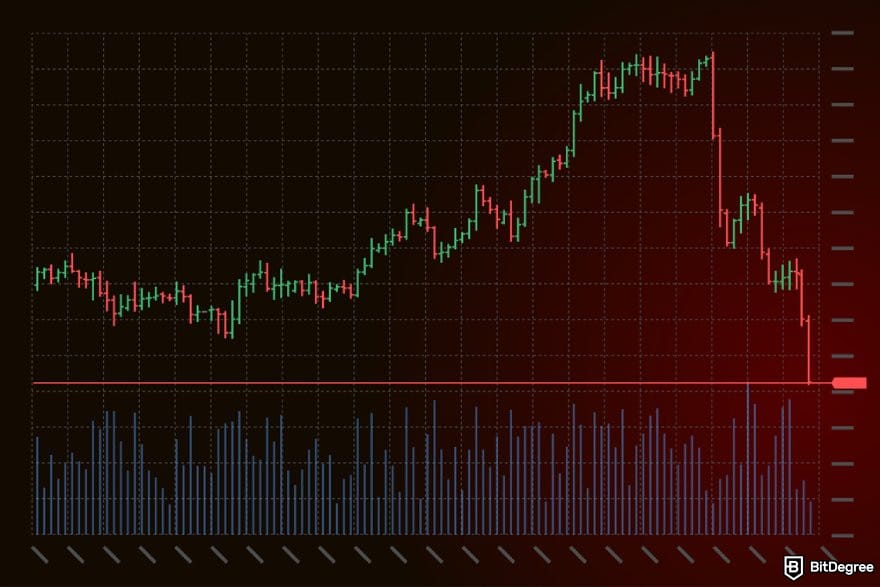
Commodity markets reward traders who come prepared. That's why it is important to know what moves your instrument, respect the leverage, and let your stop loss do its job. The traders who last in commodity markets aren't necessarily the ones who call every move right, they're the ones who manage risk well enough to stay in the game.
The Security Case for Trading Commodities on BTCC
Putting real capital into any trading platform is a matter of trust, and for commodity traders coming from a traditional brokerage background, security standards aren't negotiable. Here's what BTCC brings to the table.
No Major Security Breaches
Since its inception in 2011, BTCC has operated without a single security breach or hack incident. In an industry where major exchanges have lost hundreds of millions in user funds to security failures, that track record carries real weight.

Segregation of Assets
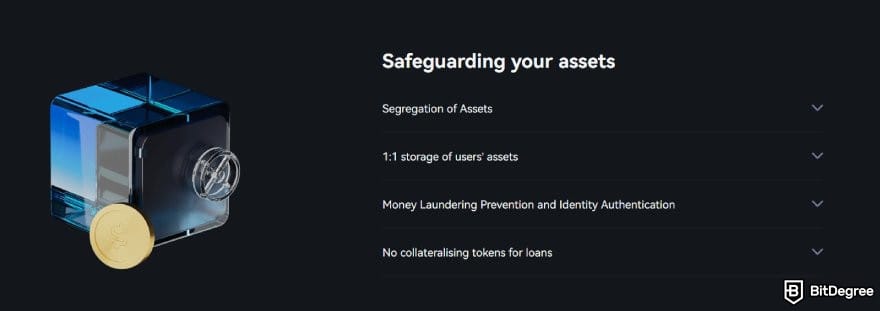
Users' margins are held in a dedicated trust account, completely separate from BTCC's company funds. Assets are stored in a multi-signature cold wallet for enhanced protection against online threats. There is no commingling of user and company funds and no possibility of a bank run scenario.
BTCC stores user assets on a one-to-one basis. If you deposit Bitcoin, Bitcoin is stored. If you deposit Tether, Tether is stored. Your funds are always accounted for in full, and you can withdraw your assets at any time.
No Token Issuance or DeFi Exposure
BTCC does not issue any tokens and is entirely self-funded. The platform has no involvement in staking or DeFi projects, which means BTCC's financial stability is completely unaffected by token sell-offs or extreme market conditions, a meaningful distinction in an industry where several exchanges have collapsed precisely because of that exposure.
Encrypted Communication and Secure Login
All personal data is protected via SSL encryption, and sensitive account information is encrypted at both the data and system levels with strictly monitored access. For account security, BTCC supports two-factor authentication (2FA) via phone, email, or Google Authenticator.
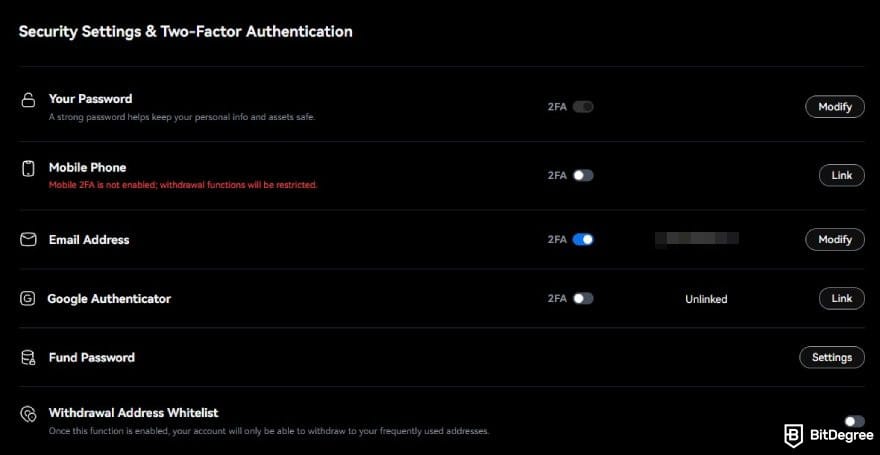
The web version also includes a login history section so you can monitor when and where your account has been accessed. If incorrect login attempts exceed a set threshold, your account is automatically locked, and you're notified via email or SMS.
Penetration Testing and Regular Audits
BTCC's security team conducts regular internal and external system audits to identify and address vulnerabilities before they become risks. The platform also undergoes regular maintenance and updates across both web and app versions, and users are notified ahead of each update.
In addition to protecting user assets, BTCC enforces a comprehensive set of anti-money laundering and counter-terrorism financing measures. Identity verification (KYC) is required before depositing or withdrawing fiat currency.
PCI DSS Certified
In March 2023, BTCC achieved Payment Card Industry Data Security Standard (PCI DSS) certification, significantly reducing the risk of credit card fraud and cyberattacks on the platform. It's a certification most crypto exchanges don't hold, and one that matters when you're depositing via Visa or Mastercard.
Most traders only think about platform security after something goes wrong. BTCC's track record and infrastructure are worth knowing about before that ever becomes a concern. The fundamentals are solid, and that matters when the markets you're trading can move as fast as gold and oil do.
Browse our collection of the most thorough Crypto Exchange related articles, guides & tutorials. Always be in the know & make informed decisions!



Conclusions
Gold reacts to inflation. Oil moves on supply decisions. Silver tracks both industrial demand and global uncertainty. These are some of the most macro-sensitive markets in the world, and with BTCC TradFi, you can trade all of them without ever leaving your crypto platform.
Learning how to trade commodities doesn't have to mean opening a separate brokerage account, dealing with currency conversion, or navigating a platform built for a different era. BTCC TradFi puts gold, WTI crude, Brent crude, silver, and natural gas under the same login you already use. All of these with zero deposit fees, up to 50x leverage, and access for traders in the US, Canada, and beyond.
To recap: set up your account, fund it, transfer to your TradFi wallet, and you're ready to place your first commodity trade in minutes. Use the demo account first if you're new to leveraged trading. Keep your leverage conservative, set a stop loss on every trade, and let the platform's 15-year security track record be the last thing you need to worry about.
The content published on this website is not aimed to give any kind of financial, investment, trading, or any other form of advice. BitDegree.org does not endorse or suggest you to buy, sell or hold any kind of cryptocurrency. Before making financial investment decisions, do consult your financial advisor.
Scientific References
1. Ergen, I., Rizvanoghlu, I.: 'Asymmetric impacts of fundamentals on the natural gas futures volatility: An augmented GARCH approach';
2. Faraj, H., McMillan, D., Al-Sabah, M.: 'The diminishing lustre: Gold’s market volatility and the fading safe haven effect'.
About Article's Experts & Analysts