
Finding a crypto swap platform that actually respects your privacy without cutting corners on reliability isn't easy, which is exactly why I put together this SimpleSwap review after spending real time testing the platform firsthand.
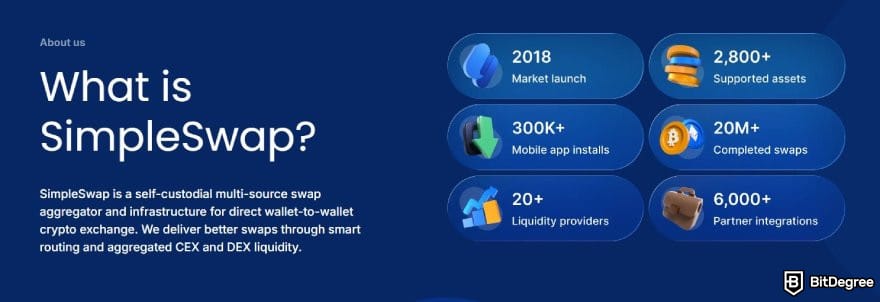
SimpleSwap has been operating since 2018, aggregating liquidity from 20+ CEX and DEX sources to offer wallet-to-wallet swaps across 2,800+ cryptocurrencies, all without requiring an account for most transactions.
I dug into everything from the swap flow itself to security, fees, and how the platform handles compliance checks, so you don't have to piece it together yourself. If you've been searching for a straightforward alternative to account-heavy exchanges, this should give you a clear picture of where SimpleSwap earns its reputation, and where it still asks a little patience from its users.
Verdict at a Glance
SimpleSwap stands out for its self-custodial, account-free swap flow, multi-source liquidity aggregation, and genuinely wide asset coverage, backed by transparent rate comparisons across multiple routes. Where it falls short is in areas outside its direct control, namely third-party fiat fees, unguaranteed processing times, and occasional route unavailability.
Pros
- No registration needed for most swaps
- Multi-source liquidity aggregation
- Wide asset and network coverage
- Self-custodial
- Fixed and floating rate flexibility
Cons
- Fiat fees depend on third parties
- Processing times aren't guaranteed
- Some assets may be unavailable
Table of Contents
- 1. SimpleSwap Review: Quick Overview
- 2. Who's SimpleSwap For?
- 3. Advantages
- 4. Limitations
- 5. Security
- 6. Localization and Regional Adaptability
- 7. Trading Tools
- 8. Bonuses and Special Offers
- 9. Fees and Limits
- 10. Customer Support
- 11. User Experience
- 12. How to Use SimpleSwap
- 13. Conclusions: Is SimpleSwap Right for You?
SimpleSwap Review: Quick Overview
Before diving into the details of this SimpleSwap review, here's a quick snapshot of what SimpleSwap is and how it stacks up on the essentials. Since this SimpleSwap review is looking at a swap aggregator rather than a traditional exchange, some of the usual categories work a little differently here, and I've broken those down below the table.
Type | Self-custodial swap aggregator (CEX/DEX liquidity) |
|---|---|
Is SimpleSwap Safe? | Yes. Self-custodial model, no funds held on the platform between swaps |
Best for | Users who want quick crypto-to-crypto swaps without creating an account |
Established in | 2018 |
KYC Verification | Risk-based. Most crypto-to-crypto swaps don't require verification, but flagged transactions may need it |
Security | Self-custodial, wallet-to-wallet transfers, no permanent account balance to target |
Features | Aggregates 20+ CEX/DEX liquidity sources, fixed and floating rate swaps, Address Check wallet screening |
Supported Coins | 2,800+ cryptocurrencies across 100+ networks |
Funding Methods | Wallet-to-wallet for crypto swaps; fiat purchases handled by third-party payment providers |
Swap Fees | Built into the exchange rate, not a separate maker/taker structure |
Fiat Support | Limited, via third-party providers |
Customer Support | 24/7 live chat |
Privacy & Anonymity | High. Most swaps require no registration or personal information |
Table: SimpleSwap quick overview
Now that you know the essentials, let's get into how SimpleSwap.io actually performs where it matters.
Who's SimpleSwap For?
SimpleSwap.io is built around one core idea: swapping one crypto asset for another as quickly and privately as possible, without the account creation, balance management, and verification steps that come with a traditional exchange.
During my testing, that focus showed up in almost every part of the experience, from the swap flow itself to how little friction stood between picking a pair and sending funds.
That said, "quick and private" doesn't mean "for everyone". SimpleSwap works best for people who already know which two assets they want to trade and just want to get it done, rather than users who want to actively trade, chart price movements, or hold a balance on the platform between transactions.
If you're the kind of crypto user who wants margin trading, leverage, or a dashboard full of order types, I suggest you look elsewhere. That said, here's a closer breakdown of who gets the most out of SimpleSwap, and why:
- Privacy-conscious swappers. If you'd rather not hand over personal details just to trade one coin for another, SimpleSwap's account-free flow for most crypto-to-crypto swaps is a clear draw. In my experience, this is where SimpleSwap earns the most loyalty from its users.
- Cross-chain and multi-asset traders. With 2,800+ supported cryptocurrencies across 100+ networks, SimpleSwap is well suited to users who regularly move between less common assets or need to bridge across different networks in a single flow, rather than sticking to a handful of major coins.
- Beginners who find traditional exchanges intimidating. There's no order book to learn, no deposit-then-trade sequence, and no dashboard full of trading tools to figure out. Many users seem to appreciate that the entire experience is just "pick assets, enter address, send," which lowers the learning curve considerably.
- Wallet-first users. Because SimpleSwap sends funds directly wallet-to-wallet rather than holding a balance, it fits naturally into the habits of users who already manage their crypto through a personal wallet and don't want funds sitting on an exchange between transactions.
- Users who value rate certainty. The option to lock in a fixed rate before confirming a swap is useful for anyone who's been caught out by price movement mid-transaction on a floating-rate platform, giving more predictability over what they'll actually receive.
This should give you a solid read on whether SimpleSwap fits your own swapping habits, but knowing who it's for is only half the picture, so let's look at what SimpleSwap actually does well next.

Did you know?
All Crypto Exchanges may look similar to you but they're NOT all the same!
Advantages
SimpleSwap.io brings a handful of genuine strengths to the table, and most of them tie back to that core self-custodial, aggregator-first design. Here's what stood out the most during my time with the platform.
- No registration needed for most swaps;
- Multi-source liquidity aggregation;
- Wide asset and network coverage;
- Self-custodial by design;
- Fixed and floating rate flexibility.
For most crypto-to-crypto transactions, SimpleSwap lets you skip account creation entirely. You pick your assets, enter a receiving address, and send. That said, this isn't an absolute rule. SimpleSwap applies a risk-based AML/KYC approach behind the scenes, so a transaction flagged for compliance review can still require verification. This is the exception rather than the norm for straightforward swaps, but it's worth knowing going in.
SimpleSwap pulls from 20+ CEX and DEX providers and routes each swap through whichever source offers the best terms at that moment, rather than routing every swap through a single liquidity pool. This sets SimpleSwap apart from a lot of competitors, since many similar platforms rely on a narrower set of liquidity sources.
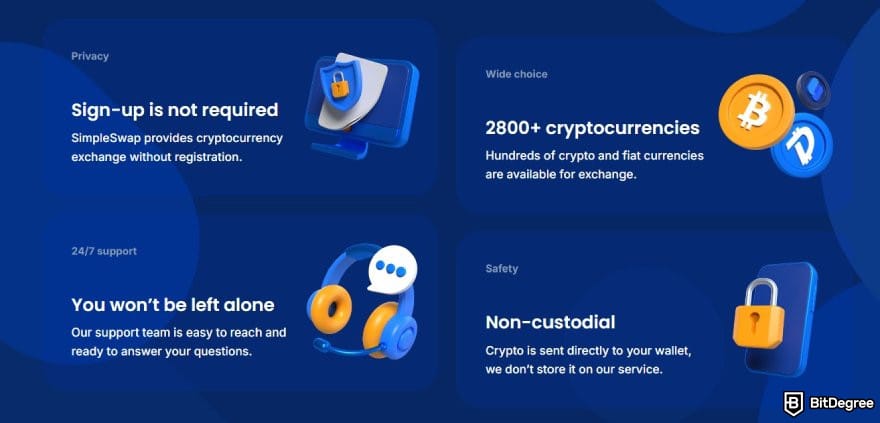
With 2,800+ supported cryptocurrencies across 100+ networks and 3.2M+ available pairs, SimpleSwap covers a lot more ground than most swap services, especially when it comes to less common altcoins and cross-chain pairs. During my testing, this made it easy to move between assets that some other platforms simply don't list.
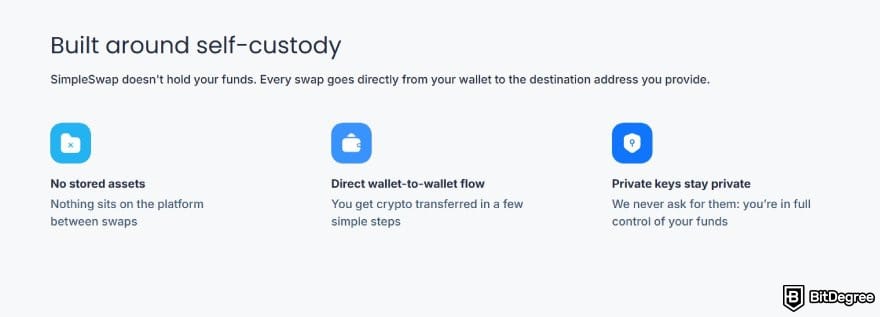
Additionally, the platform doesn't hold a standing balance for users between swaps. Funds move directly wallet-to-wallet, which means there's no exchange-held balance for a bad actor to target and no funds sitting idle on the platform after a swap completes.
Users can also choose a fixed rate to lock in the exchange rate up front, or a floating rate that follows the market during processing. This gives you some control over the risk-reward tradeoff, depending on whether you'd rather have price certainty or the chance at a better rate.
What I think is notable is that none of these advantages rely on trusting SimpleSwap the company so much as trusting the mechanics of how it operates. Aggregation, self-custody, and rate flexibility are structural features, not brand promises, which is a different kind of trust than you'd extend to a centralized exchange holding your funds.
Limitations
No platform is perfect, and SimpleSwap has a few trade-offs worth knowing about before you swap. Here's a rundown of where it falls short.
- Fiat fees and limits depend on the third-party provider;
- Processing times aren't guaranteed;
- Some assets or routes may occasionally be unavailable.
SimpleSwap doesn't process fiat purchases itself. The available payment methods, fees, and limits are set by whichever partner handles that transaction rather than by SimpleSwap directly. Therefore, it's worth checking before you commit to a fiat purchase, since terms can vary from one provider to the next.
How long a swap takes also depends on external factors like blockchain confirmations, network congestion, and which liquidity route gets used, so times can vary from swap to swap rather than following a fixed timeline.
Additionally, liquidity conditions, network maintenance, or provider-side restrictions can temporarily affect specific coins, networks, or pairs, which is worth keeping in mind if you're set on a particular swap.
As you can see, most of these limitations stem from the same root cause: SimpleSwap is an aggregator, not the sole source of liquidity or fiat processing, so a fair share of its performance depends on third-party partners and external network conditions rather than on SimpleSwap itself.
Security
I know what you're thinking. "No account needed to swap? Is SimpleSwap even safe to use?" That's a fair question, and the answer is a bit more nuanced than a simple yes or no. It starts with how the platform is built rather than any specific security feature bolted on top. Here's what that means in practice, and where the platform still leaves some responsibility with the user.
The foundation is SimpleSwap's self-custodial model. Users don't maintain a balance on the platform between swaps. Instead, each exchange is initiated as a separate transaction: the user sends funds to the designated deposit address, and the exchanged assets are delivered to the destination wallet once the swap is completed.
That said, SimpleSwap does process funds during the window of an active transaction, so "self-custodial" describes the absence of a stored balance, not a total absence of fund handling.
On the verification side, SimpleSwap applies a risk-based approach to AML/KYC rather than requiring it universally. Most crypto-to-crypto swaps can go through without an account or identity verification, but transactions are monitored for compliance risk indicators, and a flagged transaction or user may be asked for standard or enhanced verification, including identity or source-of-funds information.
I think this approach gives SimpleSwap more flexibility than a platform that mandates verification for everyone, while still leaving room for checks where they're actually warranted.
SimpleSwap also puts noticeable effort into user-facing security education through its Safety Academy, a dedicated resource covering 13 documented attack patterns, including phishing, pig butchering scams, wallet drainers, address poisoning, and fake support impersonation. It includes an interactive check users can run before sending funds, along with a clear reminder that confirmed on-chain transfers can't be reversed by SimpleSwap or anyone else once they're sent.
Simpleswap.io is its only official domain. Avoid any other lookalike or phishing sites that impersonate the platform.
For an added layer of protection before sending funds, registered users can also run a wallet address through SimpleSwap's Address Check feature, which screens the address on a selected network and returns a risk assessment based on third-party screening services. This shifts some of the security responsibility back to the user in a useful way, giving them a way to catch a risky address before a swap is finalized rather than after.
So, is SimpleSwap legit? Between the self-custodial structure, the risk-based verification system, and the tools SimpleSwap gives users to check addresses and recognize scams, I'd say it's legit. However, keep in mind that security here leans on a mix of platform design and user awareness rather than resting entirely on one or the other.
Localization and Regional Adaptability
Since SimpleSwap doesn't operate as a single licensed entity the way many centralized exchanges do, its regional footprint is shaped more by compliance restrictions and shifting local rules than by a fixed list of supported countries.
At the time of writing this SimpleSwap review, the platform's Terms of Service confirm that its services aren't available everywhere, and usage may be restricted depending on where you're accessing from. Restricted locations include a broad mix of regions, spanning sanctioned countries such as Iran, North Korea, Syria, and Cuba, several countries in active or recent conflict zones, and a notable list of EU member states, alongside the United States (and its territories) and the United Kingdom.
In practice, this means SimpleSwap's reach doesn't map neatly onto "the West" versus "everywhere else", and users should check their own location against SimpleSwap's terms before assuming access.
Beyond outright restricted locations, SimpleSwap's terms also make clear that availability isn't strictly all-or-nothing elsewhere either. The platform states that the range of available services may vary based on location and local regulatory constraints, and specifically calls out that the selection of available trading pairs can depend on where you're accessing SimpleSwap from.
This is pretty common among swap platforms to operate across many jurisdictions at once, since local regulation can affect specific features even in countries where the platform is broadly accessible.
There's also a regional wrinkle to eligibility itself. SimpleSwap requires users to be at least 18, or the legal age required to form a binding contract in their jurisdiction if that's higher, meaning the minimum age to use the platform isn't identical everywhere.
SimpleSwap's regional footprint looks less like a fixed map and more like a set of rules that shift depending on local regulation, which makes it worth double-checking your own country's status directly rather than assuming access based on general reputation.
Trading Tools
As I've noted several times in this SimpleSwap review, the platform offers a single core function: swapping one cryptocurrency for another, with a choice of rate type to fit different needs. Users select the asset they're sending and the asset they want to receive, then choose between a fixed rate, which locks in the quoted rate for a set window, or a floating rate, where the final amount can shift with market movement during processing.
SimpleSwap also lets you buy 30+ coins directly with a debit or credit card (Visa and Mastercard supported), with the purchased crypto sent straight to your wallet.
There's no margin trading, no leverage, no derivatives, and no order types beyond this single swap flow. That's consistent with SimpleSwap's overall positioning as a straightforward aggregator rather than a full trading platform, so if you're looking for advanced trading functionality, this isn't where you'll find it.
Bonuses and Special Offers
SimpleSwap keeps its promotional structure fairly simple compared to platforms built around recurring deposit bonuses, but there's still a real incentive worth knowing about if you're swapping for the first time, along with a couple of account perks that reward repeat use.
📚 Read More: SimpleSwap Promo Code
New users can currently get 20% off their first swap using code FIRSTSWAP20. It's still a solid way to reduce the cost of your first transaction.
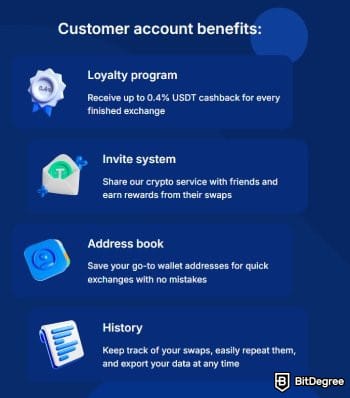
Beyond the first-swap offer, creating an account unlocks a couple of ongoing perks. The Loyalty Program pays up to 0.4% USDT cashback on every completed exchange, so the more you swap, the more that adds up over time. There's also an Invite system that rewards users for referring friends to the platform, earning a share of their swap activity.
Fees and Limits
Crypto exchanges come in all shapes when it comes to fees, and SimpleSwap's model looks a little different from what you'd see on a traditional trading platform. Instead of a maker/taker fee structure, SimpleSwap works its cost into the quoted exchange rate itself, alongside a couple of other charges that only apply in specific situations.
Fees | Limits | |
|---|---|---|
Swap Cost | Built into the quoted exchange rate, not charged separately | Varies by trading pair, shown at time of swap |
Network Fee | Estimated and factored into the final calculation | Depends on the blockchain network used |
Refund Fee | Network fee may be deducted from the refunded amount | Applies only if a refund is requested |
Recovery Fee | 1% of the returned amount, $100 minimum | Applies only to frozen funds returned after compliance review |
Table: SimpleSwap fees overview
Here's a closer look at each of these, since none of them work quite like a standard trading fee.
- Swap Cost. Rather than charging a separate percentage fee on top of your trade, SimpleSwap builds its cost into the exchange rate you're quoted before confirming a swap. What you see is what you get, without a fee line added afterward.
- Network Fee. Since blockchain network fees fluctuate and aren't set by SimpleSwap, the platform provides an estimate and includes it in your final calculation rather than a fixed figure.
- Refund Fee. If a swap needs to be refunded, SimpleSwap may deduct the associated network fee from the amount returned, and in some cases an additional payment in the mainnet coin may be required to cover it.
- Recovery Fee. This one only comes up in a specific scenario: if funds are frozen during a compliance investigation and later released back to their owner, SimpleSwap applies a 1% administrative fee with a $100 minimum. This isn't part of a normal swap and won't affect most users.
None of these fees follow a fixed schedule the way a maker/taker table would suggest, which fits SimpleSwap's overall model: costs here are built into the process itself rather than charged as standalone line items, and most users will only ever encounter the swap cost and network fee.
Customer Support
SimpleSwap's customer support is available 24/7 through live chat directly on the platform, alongside an email channel for anything that needs more detail. This matters more than it might on a traditional exchange, since SimpleSwap's account-free model means most users won't have a dashboard or support ticket history to fall back on if something goes wrong mid-swap.
Independent SimpleSwap reviews on third-party sites back the good support experience with a recurring theme of praise for how quickly issues get resolved once a user actually reaches support, alongside frequent mentions of fast, reliable swaps overall.
That said, the picture isn't uniformly positive. A number of lower-rated reviews center on a similar pain point: transactions flagged for compliance review, where users report frustration with how long the process can take and limited flexibility once a review is underway.
This lines up with SimpleSwap's own disclosed policy that flagged transactions can take up to 30 days to resolve, so while it's a documented part of the process rather than a support failure exactly, it's clearly where user patience wears thinnest.
My suggestion if you want to try out SimpleSwap is to start with a smaller, routine swap first, since that's where the platform's support reputation is strongest, and to keep your KYC documentation on hand in case a transaction ever gets flagged for compliance review.
User Experience
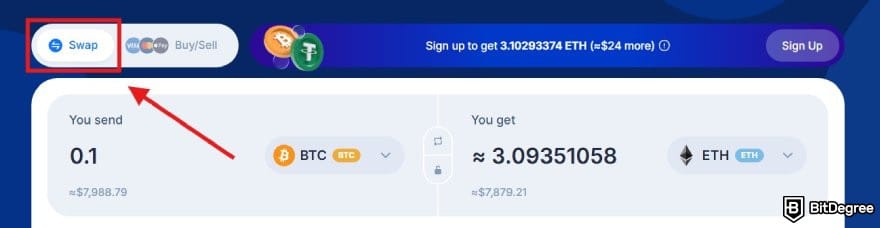
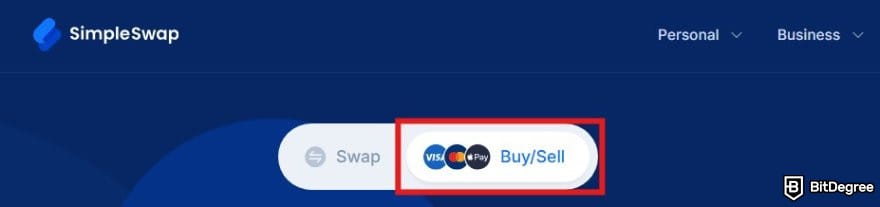
SimpleSwap's interface centers on choosing what you're sending, what you want to receive, and confirming. During my testing, this held up well, with the Swap and Buy/Sell functions kept in clearly separated tabs so the two flows never blend together.
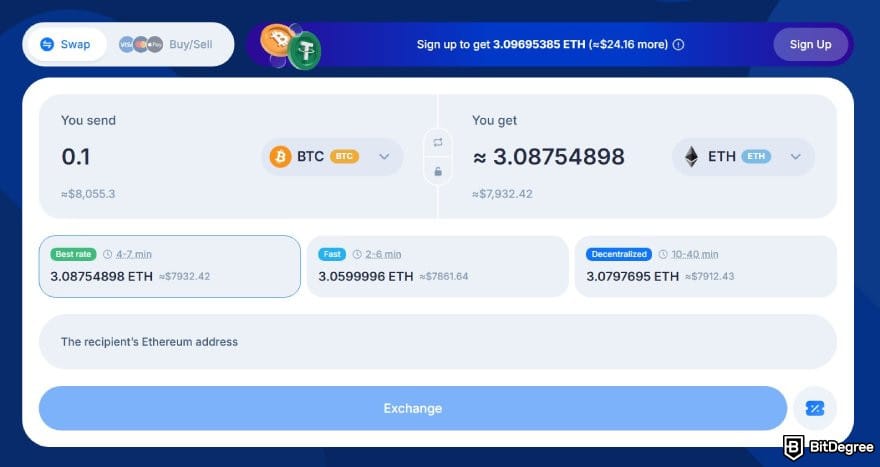
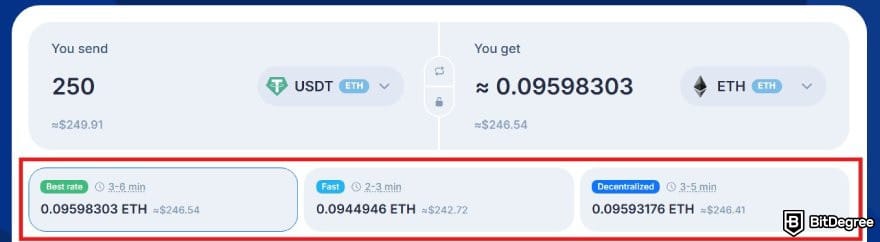
The Swap tab shows three routing options side by side, labeled [Best rate], [Fast], and [Decentralized], each with its own estimated time and payout, turning the platform's liquidity aggregation into something users can actually compare rather than a backend abstraction.
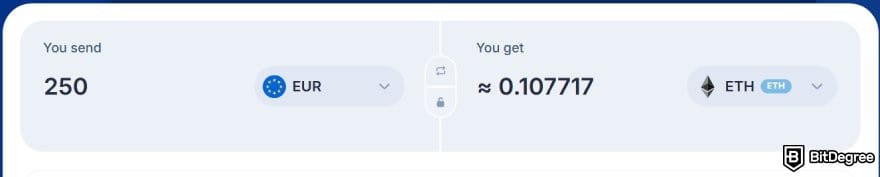
The Buy/Sell tab works similarly, listing providers such as MoonPay, Banxa, and Topper with their rates displayed upfront, and supporting Apple Pay, Google Pay, and card payments.
SimpleSwap offers a better final amount for users who sign up before swapping. A small trade-off against the platform's otherwise account-free convenience.
If you create an account, SimpleSwap also unlocks a couple of convenience features beyond the swap flow itself. An Address Book lets you save frequently used wallet addresses, which speeds up repeat exchanges and reduces the risk of a mistyped address. There's also a History feature that keeps a record of past swaps, which you can revisit or export whenever needed.
Combined with the better-rate incentive mentioned above, these are worth weighing if you find yourself using SimpleSwap regularly rather than for the occasional one-off swap.
How to Use SimpleSwap
In this part of the SimpleSwap review, I'll walk you through the two main flows the platform offers: swapping one crypto for another and buying crypto directly with fiat. Here's how each one works in practice.


How to Buy Crypto with Fiat
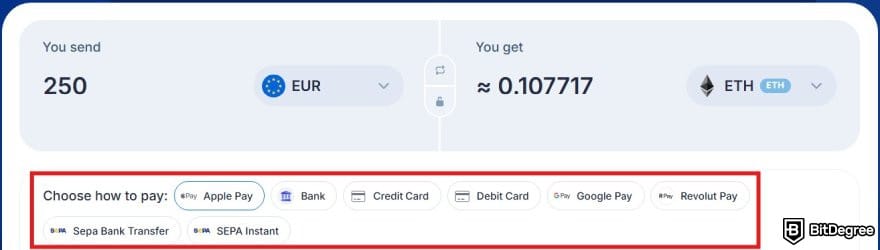
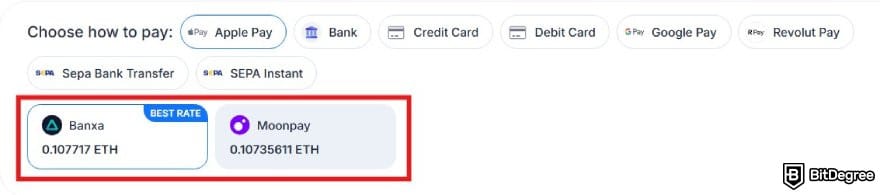

Both flows follow the same underlying philosophy: minimal setup, maximum visibility into what you're getting before you commit to anything.

- Accepts fiat currencies
- Simple to use
- Supports only trusted cryptocurrencies
- A leading cryptocurrency exchange platform
- Best for all type investors
- Accepts fiat currencies

- Industry-leading security
- Accepts fiat currencies
- Advanced trading tools
- Industry-leading security
- Strong regulatory reputation
- Advanced trading tools

- Wide range of tradable assets
- Robust copy trading feature
- Flawless security record
Conclusions: Is SimpleSwap Right for You?
As I conclude this SimpleSwap review, I think that it delivers on its core promise: fast, self-custodial crypto swaps without the friction of account creation. Its strength lies in liquidity aggregation, wide asset coverage, and a transparent interface that lets users compare routes and rates before committing, rather than trusting a single black-box process.
Where it falls short is in the areas outside its direct control. Fiat handling depends on third-party providers, processing times aren't guaranteed, and transactions flagged for compliance review can take considerably longer to resolve, which shows up clearly in user feedback.
Is SimpleSwap safe? For the most part, I think it is. Though with a self-custodial platform like this, some of that responsibility falls on you as much as the platform itself.
If you already know what you want to swap and value speed and privacy over trading features, SimpleSwap is a solid, low-friction option. If you'd rather have more control over a flagged transaction or want built-in trading tools, it's worth comparing SimpleSwap against other similar options before deciding.
The content published on this website is not aimed to give any kind of financial, investment, trading, or any other form of advice. BitDegree.org does not endorse or suggest you to buy, sell or hold any kind of cryptocurrency. Before making financial investment decisions, do consult your financial advisor.
About Article's Experts & Analysts


- + No registration needed for most swaps
- + Multi-source liquidity aggregation
- + Wide asset and network coverage
- + Self-custodial
- + Fixed and floating rate flexibility
- - Fiat fees depend on third parties
- - Processing times aren't guaranteed
- - Some assets may be unavailable
See BETTER-RATED Exchanges
A reliable, private crypto swaps, best for smaller, one-off trades.
Disclosure: To keep our site running & free of charge, we may sometimes receive a small commission if a reader decides to purchase services via some links on site, at no extra cost.