Key Takeaways
- MEXC spot fees for standard users are 0% for makers and 0.05% for takers, although pair-specific, regional, and promotional rates may reduce the cost further;
- MEXC futures fees can range from 0%–0.01% for makers and 0%–0.04% for takers, with the exact rate depending on the contract, region, and promotion;
- Crypto deposits are generally free, while withdrawal charges can vary by asset and network.
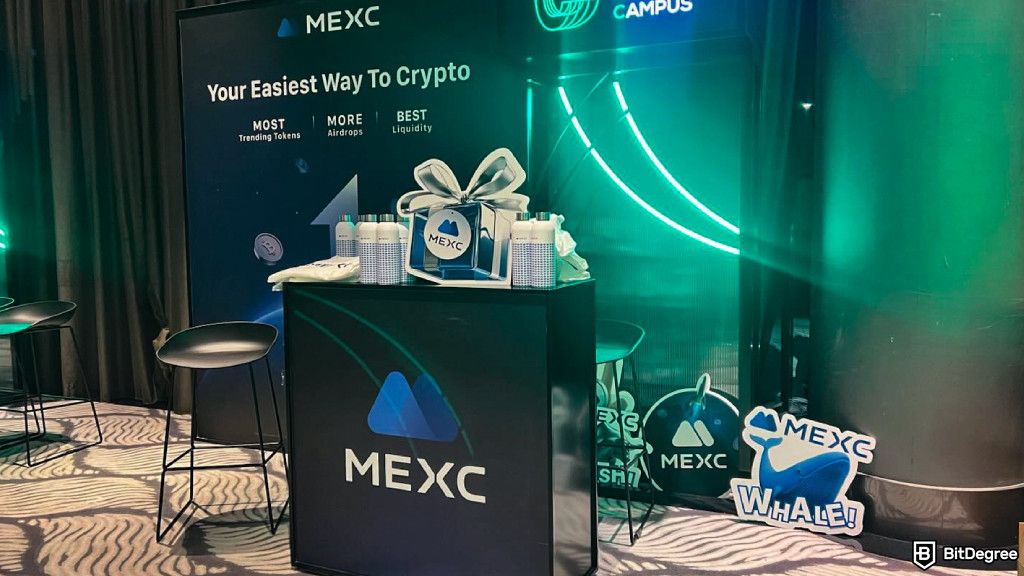
You may have stumbled upon MEXC while searching for a reliable crypto exchange. It’s well-regarded for its variety of trading services and secure transactions. At the same time, you might have heard that MEXC fees are among the most competitive in the industry. But is that really the case?
Understanding a platform's fees is very important to get the most out of your trades. From additional trading and withdrawal charges to other potential expenses, having a clear grasp of how they work can empower you to make smarter, more informed decisions.
By the end of my guide, you’ll understand how these charges work, where discounts may apply, and how MEXC trading fees compare with other major exchanges like Bybit, Binance, or Kraken.

Did you know?
Subscribe - We publish new crypto explainer videos every week!
What is AVAX? (Avalanche Network Explained With Animations)

Table of Contents
- 1. MEXC Fees at a Glance
- 2. MEXC Trading Fees
- 2.1. How MEXC Maker and Taker Fees Work
- 2.2. Spot Trading Fees
- 2.3. How to Calculate MEXC Spot Fees
- 3. MEXC Futures Fees
- 4. MEXC Zero-Fee Spot & Futures Pairs: What's Actually Free?
- 4.1. Standard Rates VS Zero-Fee Promotions
- 4.2. How Zero-Fee Eligibility Works
- 4.3. MEXC Deposit Fees
- 5. MEXC Withdrawal Fees
- 5.1. MEXC Withdrawal Fees by Coin and Network
- 5.2. MEXC Withdrawals Limits
- 6. How to Reduce MEXC Trading Fees?
- 6.1. Applying for VVIP Plans
- 6.2. Utilizing MX Tokens
- 6.3. Hunting for Special Trading Pairs
- 6.4. Taking Advantage of Promotions
- 7. Comparing MEXC Fees With Other Exchanges
- 7.1. MEXC VS Bybit Fees
- 7.2. MEXC VS Binance Fees
- 7.3. MEXC VS Kraken Fees
- 8. Conclusions
MEXC Fees at a Glance
Let’s start with a quick overview before exploring each MEXC fee more closely. The exchange uses maker-taker pricing for spot and futures trading, doesn’t charge for crypto deposits, and sets withdrawal fees according to the selected asset and network. Here’s the breakdown:
Latest Changelly Coupon Found:Fee | |
|---|---|
Spot | 0% Maker / 0.05% Taker |
Futures | 0% Maker / 0.02% Taker |
Deposit | Free |
Withdrawal | Varies by asset & network |
Table: MEXC fees overview
Before unlocking certain platform features, you’ll need to complete one important step: Know Your Customer (KYC). The process requires you to confirm your identity using a valid government-issued ID accepted in your country of residence.
In some cases, you may also need to complete facial recognition. This helps the platform meet compliance requirements and maintain a secure trading environment for everyone.[1]
Once your verification is complete, things become much smoother. You’ll unlock benefits like higher MEXC withdrawal limits, access to exclusive savings events, and even more advanced trading features.
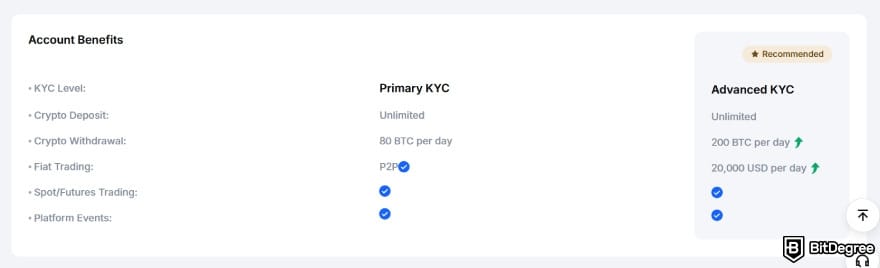
If you’re planning to make the MEXC platform your go-to trading exchange, then yes, completing KYC is a must. In case the process isn’t clear, this guide should tell you what to do.
Alright, now that we’ve covered the groundwork, let’s dive deeper and unpack MEXC trading fees!
📚 Check Out: MEXC Review
Looking for more in-depth information on related topics? We have gathered similar articles for you to spare your time. Take a look!


MEXC Trading Fees
MEXC’s trading fee structure is pretty simple and easy to understand. Rather than using a tiered system where charges vary based on your monthly trading volume, the platform keeps things consistent with a flat baseline fee for most users.
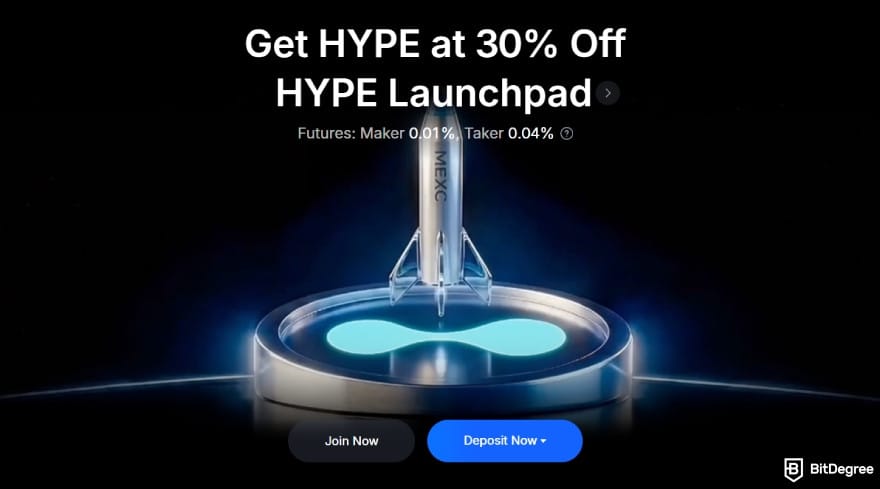
Now, if you’re an active trader, you might be wondering, “What’s in it for me if there’s no volume-based discount?” Well, no worries—MEXC hasn’t forgotten about you.
While the flat fee structure applies to most users, active traders can unlock exclusive perks through the Alpha Trader program. By meeting specific requirements, you can qualify for the plan and access the special benefits with reduced rates.
Alpha Trader represents the highest level within the MEXC VVIP M-Score framework, a premium program crafted specifically for high-volume traders.
How MEXC Maker and Taker Fees Work
MEXC still employs a maker-taker fee model across its trading products, just like most major exchanges in the industry. If you’re new to crypto trading or need a quick refresher, here’s the gist:
- A Maker adds liquidity to the market by placing limit orders that don’t match immediately. These orders sit on the order book, providing opportunities for others to trade against.
- A Taker, on the other hand, removes liquidity by matching with existing orders in the order book. This usually happens with market orders or limit orders that execute immediately.
To put it simply, if your order waits in the market for someone to match it, you’re a maker. If your order gets filled instantly by matching with someone else’s, you’re a taker.
Understanding this distinction is key to navigating trading costs and how exchanges operate. Many platforms, including MEXC, often reward makers with lower fees because they help keep the market active and liquid.[2]
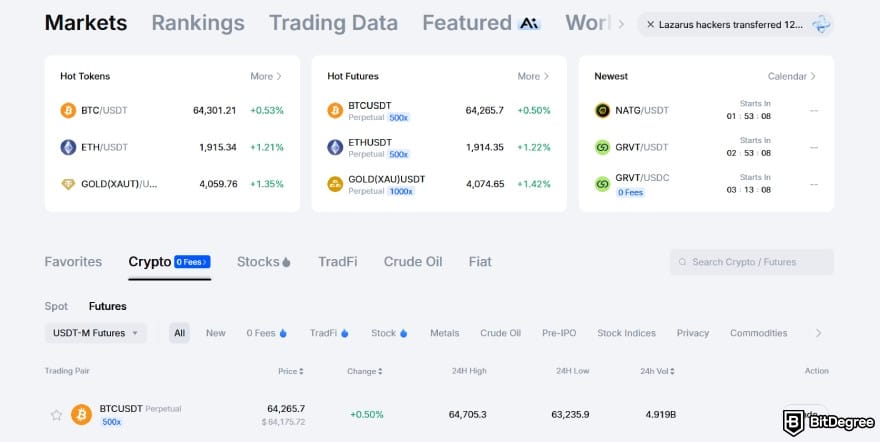
Also note that MEXC only charges a trading fee after an order has been executed. If the order stays open or is canceled before being filled, you won’t pay anything.
With the MEXC maker-taker model covered, let’s look at how it applies to spot trading.
Spot Trading Fees
As of writing, MEXC keeps its standard spot trading fee structure relatively straightforward for regular users:
Maker | Taker |
|---|---|
0.00% | 0.05% |
Table: MEXC spot trading fees
A zero maker fee means you don't need to pay a trading charge on an eligible spot order that adds liquidity to the market. An order that fills immediately as a taker, though, normally incurs a fee equal to 0.05% of the completed trade value.
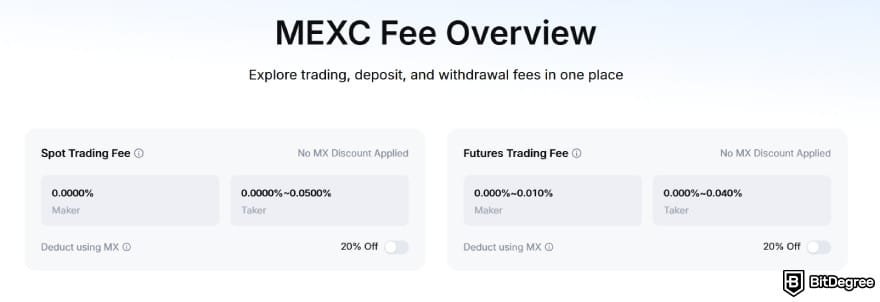
Still, it’s better to view this as the baseline rate rather than one that applies to every user and transaction. Taker charges may range from 0% to 0.05%, since selected pairs can qualify for lower or even zero-fee rates, while your location and account status may influence the final rate.
How to Calculate MEXC Spot Fees
You don’t need a Harvard degree to calculate MEXC spot fees. The underlying formula is actually quite simple:
Trading fee = completed trade value × applicable fee rate
Let’s use Jeff as our example. He sells 1 BTC for 100,000 USDT on the BTC/USDT pair, with the order entering the order book before execution. Because that makes it a maker trade, the calculation looks like this:
100,000 USDT × 0% = 0 USDT
Since the standard maker rate is 0%, you receive the full 100,000 USDT from the sale without a spot trading charge. That said, if the order matches immediately and qualifies as a taker trade, the calculation becomes:
100,000 USDT × 0.05% = 50 USDT
Once the 50 USDT fee is deducted, Jeff receives 99,950 USDT from the completed sale. You can apply the same calculation to smaller transactions. A 5,000 USDT taker trade at the standard 0.05% rate, for instance, would cost 2.50 USDT.
You can use the MX fee deduction feature to get a 20% discount on spot trading fees.
You should always calculate the fee using the rate applied to the specific trade. If the chosen pair receives discounted or zero-fee pricing, the resulting cost will be lower than the examples above.
MEXC Futures Fees
The MEXC futures fee structure is every bit as straightforward as its spot pricing. That said, futures trades start with lower baseline rates:
Maker | Taker |
|---|---|
0.00% | 0.02% |
Table: MEXC futures trading fees
Like the spot fee structure, the rates above are best treated as the usual pricing for most pairs and standard users, not a universal rule. Institutions, market makers, project teams, and API traders may receive a different fee schedule. You can also receive a 20% discount by using MX fee deduction.
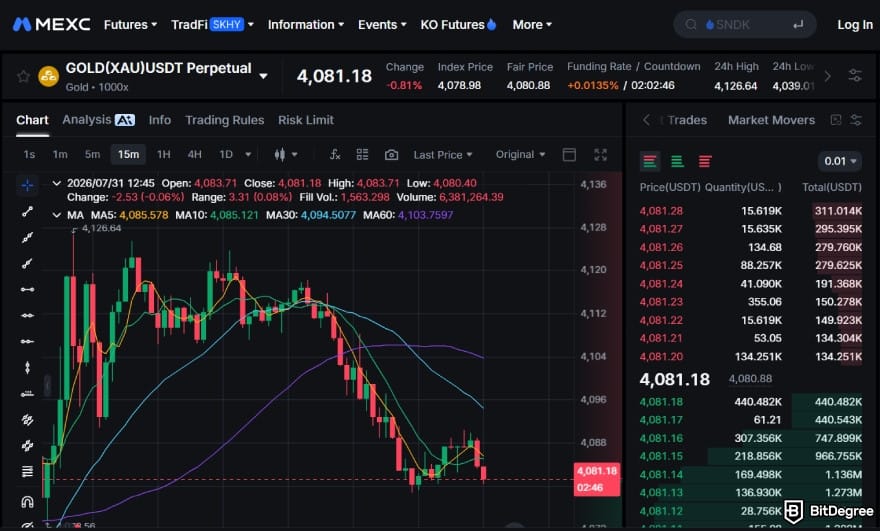
Let’s break it down with an example.
Imagine Jeff buys a 1 BTC long position in BTC/USDT futures at a price of 50,000 USDT. The taker fee would be 0.02% of the position value, which works out to 10 USDT. It is also automatically deducted so Jeff can focus on trading strategies without the hassle of manual calculations.
Another key factor you’ll encounter when trading perpetual contracts is the funding rate. Unlike normal MEXC futures fees, it isn’t a platform-imposed charge.
Instead, they’re payments exchanged directly between traders to keep the perpetual futures market aligned with the underlying asset’s price. These rates are calculated every 8 hours, and whether you pay or receive depends on whether the funding rate is positive or negative.
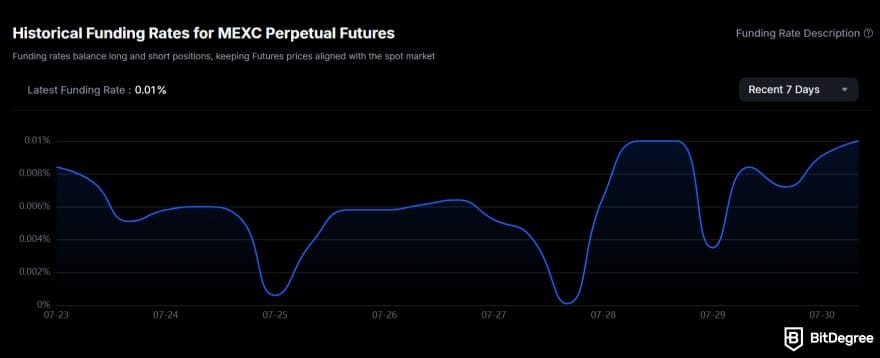
Let’s revisit Jeff’s 1 BTC long position at 50,000 USDT.
If the funding rate is positive (say 0.01%), Jeff would owe a funding fee to traders holding short positions. That means his payment would be 50,000 x 0.01%, which equals 5 USDT. On the other hand, if the funding rate is negative (say -0.01 %), Jeff would receive 5 USDT from the short traders.
Funding rate can have a noticeable impact on your trading costs. Therefore, it’s important to keep an eye on these rates alongside standard MEXC futures fees. You can check the current funding rates on the platform's website.
📚 Check Out: How to Trade Futures on MEXC
MEXC Zero-Fee Spot & Futures Pairs: What's Actually Free?
MEXC regularly advertises zero-fee spot trading promotions. That certainly sounds appealing, but it doesn’t make every spot order completely free. Zero-fee pricing only applies to selected pairs or qualifying conditions, and you may still pay the standard taker fee elsewhere.
Let’s dig a little deeper.
Standard Rates VS Zero-Fee Promotions
Selected MEXC markets go one step beyond discounted pricing by removing trading fees. Eligible trades included in the 0-Fee Fest promotion carry 0% maker and taker rates, leaving neither side of the order with a trading charge.
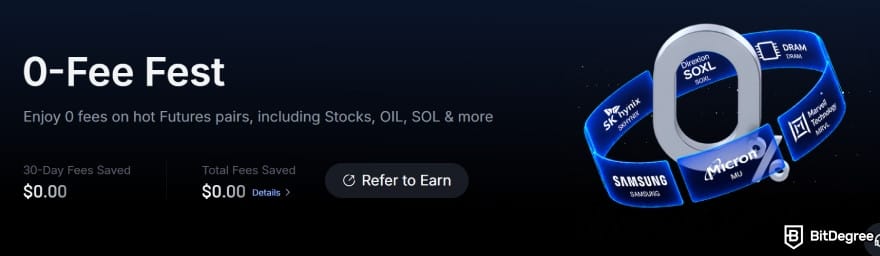
The coverage is kinda broad, too. Zero-fee pricing currently extends across all spot pairs and more than 100 selected futures contracts, including crypto markets such as SOL/USDT Perpetual and products linked to stocks, oil, and gold.
Here’s how the regular fee structure compares with the promotional rates:
Maker | Taker | Note | |
|---|---|---|---|
Spot (standard) | 0% | 0.05% | Default rate, permanent |
Futures (standard) | 0% | 0.02% | Default rate, permanent |
0-Fee Fest (futures) | 0% | 0.0% | Only on eligible pairs, while quota lasts |
Rotating spot promos | 0% | 0.0% | Promoted pairs only |
Table: MEXC standard rates VS zero-fee promotions
MEXC’s pricing can initially give the impression that 0% maker and taker fees apply everywhere. Unfortunately, that isn’t usually the case for most users. The standard spot structure is typically 0% for makers and 0.05% for takers, with zero fees on both sides reserved for qualifying pairs and limited promotions.
That distinction doesn’t make the zero-fee claim meaningless, though. Maker trades can still be free across spot and futures markets, while certain promotions or offers may reduce taker fees to 0% as well.
📚 Check Out: MEXC Referral Code
Did you know?
Subscribe - We publish new crypto explainer videos every week!
Hot VS Cold Wallet: Which One Do YOU Need? (Animated)

How Zero-Fee Eligibility Works
You don't need to manually apply for MEXC’s 0-Fee Fest. The platform automatically determines eligibility using factors such as account status, trading activity, effective volume, and risk assessments, which it reviews on a recurring basis.
So, if your chosen pair isn’t displaying zero fees, don’t assume your account has a problem. You may just not have qualified during the latest assessment cycle.
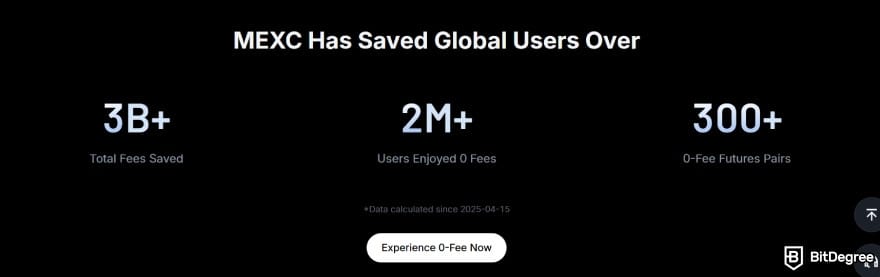
With that context in place, here are a few important points to remember about the zero-fee promotions:
- Quotas can expire. Some pairs cap how much zero-fee trading volume you get, and any unused portion is forfeited once the validity period ends.
- Eligibility can change. MEXC can increase, reduce, or remove your zero-fee quota between evaluation cycles based on your activity and risk profile.
- Discount doesn't stack. If a pair is running under the 0-Fee Fest, other trading fee discounts (MX token benefits, for example) won't apply on top of it.
- Liquidation fees still apply. Zero fees apply to opening and closing trades, not to forced liquidations. If your position is liquidated, the standard liquidation fee is still charged to your margin.
- Not everyone qualifies. Institutional accounts, market makers, project teams, and API users are excluded from the program.
To see whether a pair currently receives zero-fee pricing, check for the “0 Fees” label on the trading page. You can also disable the benefit if you don’t want it applied to your account.
The 0-Fee Fest calculator can also show you roughly how much the promotion may save you.
Overall, it’s a rather nice way for active traders to stop fees from nibbling away at their returns. Just don’t assume every trade will receive the zero-fee treatment forever.
MEXC Deposit Fees
When it comes to MEXC deposits, it’s good to know that the platform doesn’t charge any fees for crypto transfers. This means you can move your coins from other wallets or exchanges into your account without worrying about extra costs. Pretty convenient, right?
That said, there are some important details to keep in mind.
First, always double-check that the network you select on MEXC matches the network of the platform you’re withdrawing from. If it doesn't, your funds could be lost, so take an extra moment to confirm this step—it’s worth the hassle.
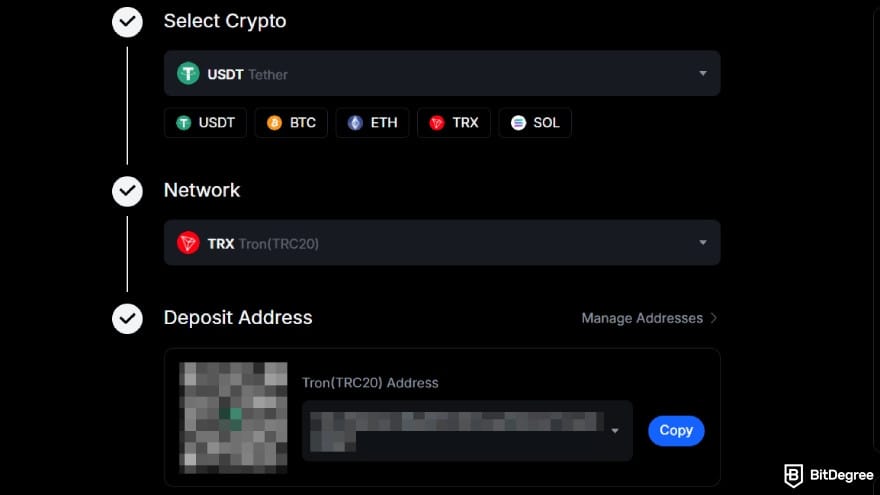
Also, note that some cryptocurrencies have a minimum deposit amount. If your deposit is below the threshold, it won’t be credited to your MEXC account and, unfortunately, cannot be refunded. To avoid this, always check the minimum deposit requirement for your chosen cryptocurrency before initiating a transfer.
Fiat purchases are where additional fees may come into play. You can buy crypto through cards, e-wallets, bank transfers, or P2P trading, although external payment processors handle these routes and apply their own charges rather than MEXC deposit fees.
MEXC Withdrawal Fees
Unlike deposit rates, which are free for all cryptocurrencies, MEXC withdrawal fees vary depending on the coins and the blockchain network you choose. Factors like network congestion can play a significant role.
Popular networks often come with higher costs due to high demand, while less crowded or faster ones tend to offer more competitive rates.
You’ll see the exact withdrawal charge on the confirmation screen before completing a transaction.
MEXC Withdrawal Fees by Coin and Network
MEXC doesn’t give you one neat withdrawal fee for everything. Each coin has its own rate, and multi-network assets can carry different charges depending on which blockchain you use.
The table below should give you a rough idea of how MEXC withdrawal fees vary by coin and network:
Crypto | Network | Min. Withdrawal | Withdrawal Fee |
|---|---|---|---|
USDT |
|
|
|
BTC |
|
|
|
ETH |
|
|
|
SOL |
|
|
|
MX |
|
|
|
Table: Typical MEXC withdrawal fees by asset and network
Think of the table above as a comparison guide rather than a collection of guaranteed quotes. MEXC uses dynamic pricing, meaning the live withdrawal fee can change and should be checked before every transfer.
Let’s use Jeff’s example again. Suppose he withdraws 1 ETH from MEXC. If he selects the Ethereum network, the withdrawal fee is 0.000029 ETH, so the amount he receives is:
1 ETH − 0.000029 ETH = 0.999971 ETH
If he uses Base Network instead, the fee drops to 0.0000013 ETH, leaving him with:
1 ETH − 0.0000013 ETH = 0.9999987 ETH
In this case, choosing Base saves Jeff 0.0000277 ETH in withdrawal fees. However, he should only use it if the receiving wallet or exchange supports ETH deposits through the Base network.

Don’t pick a network based on price alone, though. You should first confirm that it’s supported by your wallet, as an incompatible network can cause serious transfer problems.
MEXC Withdrawals Limits
Another important factor to consider is the amount of coins you can withdraw within 24 hours, which largely depends on your KYC verification level. Here’s how the MEXC withdrawal limit is structured:
KYC Level | Daily Withdrawal Limit |
|---|---|
Primary KYC | 80 BTC (equivalent) |
Advanced KYC | 200 BTC (equivalent) |
Institutional KYC | 400 BTC (equivalent) |
Table: MEXC 24-Hour Withdrawal Limit
For Primary KYC, you’ll need to provide identity documents, while Advanced verification also requires facial recognition. Institutional limits follow a separate business verification process with extra documentation.
The MEXC withdrawal limit shown inside your account is the safest figure to rely on because regional availability and verification requirements can vary.
📚 Check Out: MEXC KYC Requirements
How to Reduce MEXC Trading Fees?
Now that I’ve covered the essentials of MEXC fees, let’s move on to the more pleasant part: reducing them. Depending on how you trade, you may even qualify for zero fees in certain cases.
Applying for VVIP Plans
For frequent traders moving substantial volumes, the MEXC VVIP Program offers a practical way to reduce trading costs. It also comes with exclusive benefits intended to provide a more streamlined and rewarding experience on the exchange.
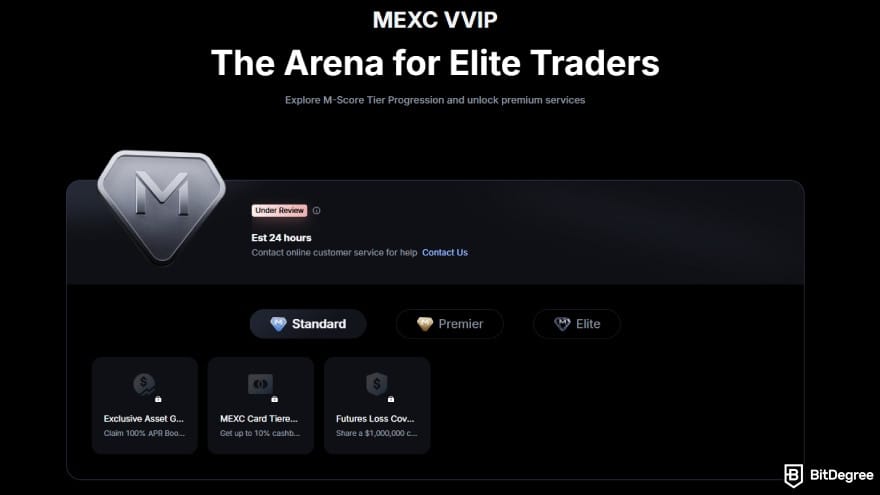
MEXC determines your VIP tier through its dynamic M-Score rating system. The platform calculates this score using factors such as your trading activity, engagement, and account security, with higher scores unlocking better privileges.
Each tier requires the following score:
- Standard. Requires an M-Score of 350–599;
- Premiere. Requires an M-Score of 600–799;
- Elite. Requires an M-Score of 800+.
Every tier brings something different to the table, but Elite members receive the most exclusive treatment. Here’s a quick overview:
Standard | Premier | Elite | |
|---|---|---|---|
Futures Earn APR Booster | +20% | +50% | +100% |
Card Cashback | 4% | 6% | 10% |
Futures Loss Coverage | 1% chance | 2% chance | 3% chance |
Position Limit Boost | ✗ | 2× | 3× |
VIP Support | ✗ | ✓ | ✓ |
Mystery Perk | ✗ | ✓ | ✓ |
Futures Loss Coverage Bonus | ✗ | ✗ | Up to 20 USDT |
Exclusive Futures Perk | ✗ | ✗ | ✓ |
Lead Trading Benefits | ✗ | ✗ | Up to 20% |
Instant Rewards | ✗ | ✗ | ✓ |
Alpha Trader Upgrade | ✗ | ✗ | ✓ |
Elite Experience Cards | ✗ | ✗ | 3 cards |
Table: MEXC VIP perks
While some benefits don’t directly lower your trading fees, the premium perks can still offset related costs and ease your overall expense burden. Whether you already trade at scale or plan to increase your activity, the VVIP program may help you improve both savings and efficiency.
Utilizing MX Tokens
Another method to reduce your MEXC rates is by using the platform’s native cryptocurrency, MX Token. Doing so provides a 20% discount on supported fees. The reduction currently applies to spot trades and selected futures transactions.
For spot trades, you’ll need sufficient MX in the relevant account and must turn on fee deduction. Then, the platform will use MX first when charging the trading fee. Once the balance is depleted, the discount ends and the regular rate returns.
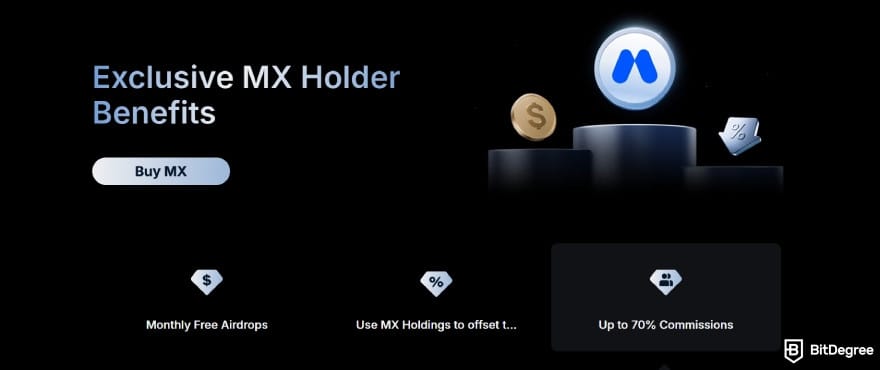
The futures setup is a little different. You must transfer MX into your futures wallet and enable the feature separately. Since main accounts and subaccounts keep their own balances and benefits, MX stored in one account won’t automatically pay fees charged to another.
The discount may not apply to every trading pair, and the option may be unavailable on certain accounts.
Holding or staking MX tokens in your account can also earn you monthly airdrops. Not a bad perk, I’d say.
📚 Check Out: MEXC Staking Explained
Hunting for Special Trading Pairs
Though not as consistent as previous methods, the platform's special trading pair discounts are still an appealing way to reduce your expenses. By staying informed about these offerings, you can significantly lower your MEXC fees.
Here’s how it works: the platform occasionally highlights specific spot and futures trading pairs with special discounts. On these pairs, MEXC maker-taker fees can drop significantly—sometimes even to zero.
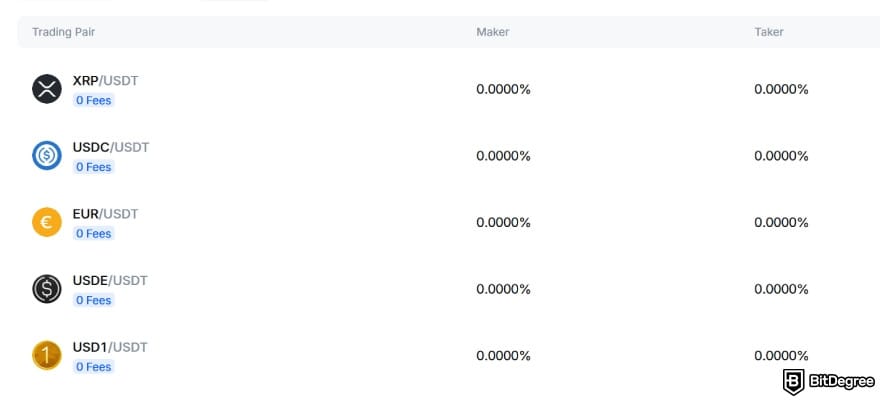
These discounted trading pairs aren’t set in stone, as MEXC updates them periodically. I’d recommend checking the official website regularly if you want to take advantage of the latest fee-saving opportunities. You may end up saving more than expected!
Taking Advantage of Promotions
When it comes to discounts, MEXC has a dedicated events page that keeps you updated on all the ongoing promotions. These can range from token giveaways to raffles with exciting rewards. And, of course, some of these promotions often include special offers to help you save on MEXC fees.
There’s always something happening on the platform to help lower your trading costs. For example, you might find promotions offering lower rates for trading new coins, discounts for specific trading pairs within a set time frame, or even waived fees for completing fun challenges.
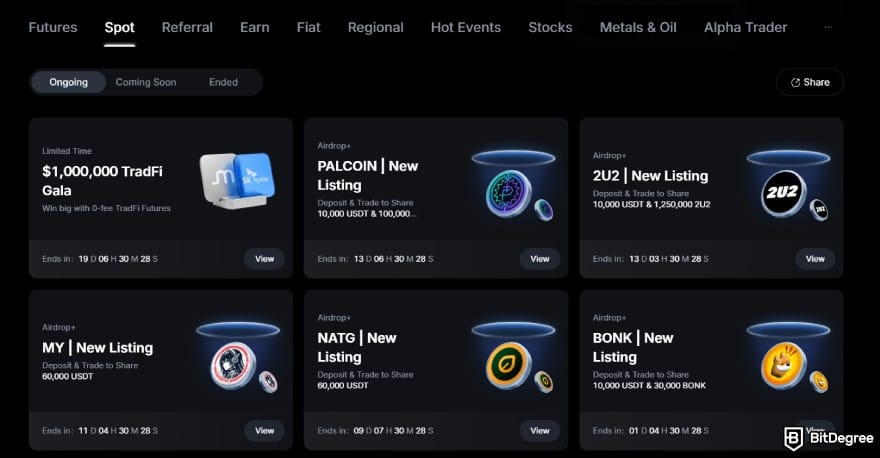
Keeping an eye on these offers not only helps you save on MEXC fees but also allows you to explore all the features the platform has to offer—often at a bargain! To stay ahead, I recommend checking the platform’s event page regularly.
You can also enter the BitDegree referral code to unlock trading discounts and other special benefits.
Comparing MEXC Fees With Other Exchanges
Now that you know the details of MEXC rates and some methods to reduce them, it’s time to see how they measure up against the big players in the crypto space.
MEXC VS Bybit Fees
Bybit is a major name in the crypto industry, known for its advanced trading tools and global reach. It offers an impressive range of trading options, including spot, futures, and options, all paired with competitive fees. But how does it compare to MEXC?
To start, both MEXC and Bybit use the maker-taker fee model for their trading products. That said, Bybit uses a more conventional VIP system where the fee reductions become clearer as you move up the tiers.
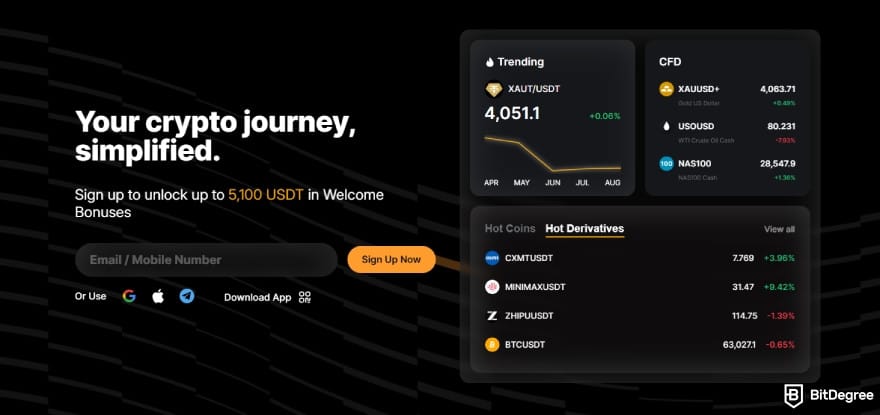
As your trading volume or asset balance increases, Bybit automatically moves you through its VIP tiers and lowers your fees accordingly. This can be pretty valuable for active traders handling larger volumes.
Here’s how their rates compare:
Exchange | Spot Trading Fee | Futures Trading Fee |
|---|---|---|
MEXC |
|
|
Bybit |
|
|
Table: MEXC & Bybit Fees Comparison
As the comparison shows, MEXC starts with lower trading fees. Bybit may still offer better value to highly active users, as its VIP system rewards large monthly trading volumes and substantial asset holdings with progressively reduced rates.
Keep in mind that Bybit fees may vary between regions. Your country of residence can affect the rates available to you, so the official website remains the best place to confirm the applicable pricing.
📚 Check Out: Bybit Review
MEXC VS Binance Fees
Binance is one of the most popular crypto exchanges—and it’s not hard to see why. It’s massive, highly liquid, and packed with features that cater to everyone. Whether you’re just starting with spot trading or diving into advanced derivatives with leverage, Binance has tools to suit your needs.
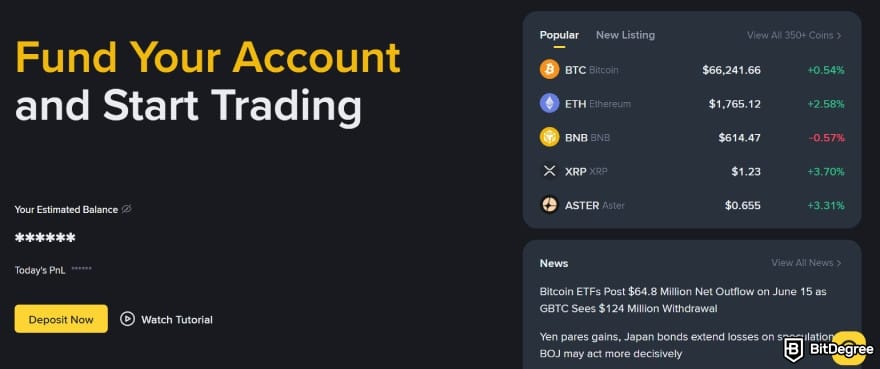
When comparing Binance VS MEXC fees, it’s important to understand how each platform sets up its charges. Both exchanges use a maker-taker rate model, but Binance employs a VIP tier system that reduces rates as you progress through the levels.
Advancing through Binance VIP tiers requires a large monthly trading volume and holding a specific amount of BNB in your account.
Here’s a quick comparison of Binance VS MEXC fees:
Exchange | Spot Trading Fee | Futures Trading Fee |
|---|---|---|
MEXC |
|
|
Binance |
|
|
Table: MEXC & Binance Fees Comparison
As you can see, MEXC fees are generally lower than Binance’s, especially for regular users. This can make MEXC a better choice if your trading volume is small or if you trade only occasionally. MEXC also offers zero-fee trading on eligible pairs, which accounts for the 0% rates at the lower end of its futures and spot fee ranges.
For active traders handling large volumes, though, Binance’s VIP structure can make a real difference. Moving up the tiers (and applying the BNB discount) can significantly reduce your fees.
📚 Check Out: Binance Review

- Accepts fiat currencies
- Simple to use
- Supports only trusted cryptocurrencies
- A leading cryptocurrency exchange platform
- Best for all type investors
- Accepts fiat currencies

- Industry-leading security
- Accepts fiat currencies
- Advanced trading tools
- Industry-leading security
- Strong regulatory reputation
- Advanced trading tools

- Wide range of tradable assets
- Robust copy trading feature
- Flawless security record
MEXC VS Kraken Fees
Kraken is another well-known cryptocurrency exchange in the space, widely praised for its strong security measures and strict adherence to regulatory standards. It offers a comprehensive suite of features, including spot trading, margin trading, and staking, catering to both beginners and experienced traders.
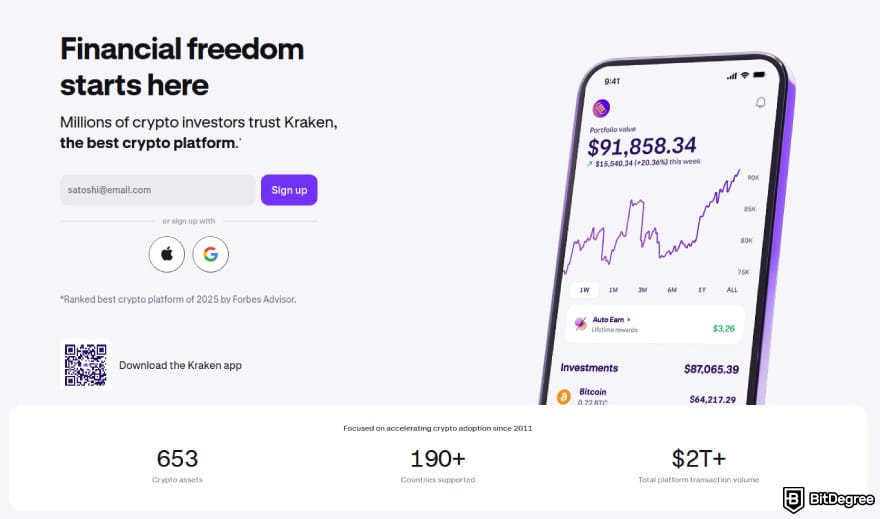
Like many competing exchanges, Kraken follows a maker-taker structure with tiered fee incentives. As your trading volume or eligible asset holdings increase, your rates can decrease. Here’s how Kraken’s fees compare with MEXC:
Exchange | Spot Trading Fee | Futures Trading Fee |
|---|---|---|
MEXC |
|
|
Kraken |
|
|
Table: MEXC & Kraken Fees Comparison
From the table, you can see that MEXC rates are generally lower than Kraken's, making it a solid choice for beginners or casual traders who prioritize minimizing costs. On the flip side, Kraken’s tiered fee structure can be better suited for seasoned or institutional traders with higher monthly trading volumes.
📚 Check Out: Kraken Review
Browse our collection of the most thorough Crypto Exchange related articles, guides & tutorials. Always be in the know & make informed decisions!


Conclusions
Wrapping up, it’s clear that MEXC fees are highly competitive, even when stacked against major players in the industry like Bybit, Binance, and Kraken. With its flat fee structure for spot and trading products, the platform ensures simplicity and transparency.
Beyond its low fees, the platform sweetens the deal with various add-ons, such as special trading pair promotions, native token discounts, and VIP privileges—all of which can help lower MEXC maker-taker rates and save you money in the long run.
Take a look at the live fees on MEXC and decide for yourself whether its low-cost structure suits your trading style.
The content published on this website is not aimed to give any kind of financial, investment, trading, or any other form of advice. BitDegree.org does not endorse or suggest you to buy, sell or hold any kind of cryptocurrency. Before making financial investment decisions, do consult your financial advisor.
Scientific References
1. Mansoor N., Antora K. F., Deb P., et al.: 'A review of blockchain approaches for KYC';
2. Galati L.: 'Exchange market share, market makers, and murky behavior: The impact of no-fee trading on cryptocurrency market quality'.
About Article's Experts & Analysts