



Coinbase VS Crypto.com - In-Depth Comparison
After going through Coinbase VS Crypto.com across security, fees, trading, and earning, the honest answer is that neither platform is objectively better; they're built for different priorities.
Coinbase is the more institution-facing name of the two. It's a publicly listed, US-regulated company, which gives it a level of financial transparency and regulatory standing that private companies like Crypto.com can't match.
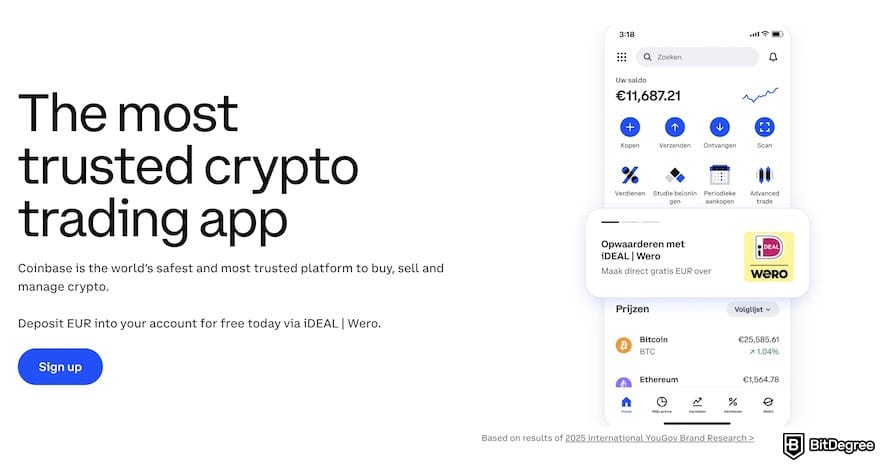
That trust translates into a cleaner, simpler experience, especially for beginners, and deep liquidity on major USD pairs backed by strong institutional flows.
📚 Read More: Coinbase Review
Crypto.com plays a different game. With well over 100 million registered users and heavy sponsorship spending across Formula 1, the UFC, FIFA, and the LA Lakers, it's built mainstream visibility that few exchanges can rival.
Between its Visa card, Crypto Basket, DCA tools, trading bots, staking program, prediction markets, and Onchain self-custody wallet, it packs more into a single app than almost any competitor.
📚 Read More: Crypto.com Review
Coinbase | Crypto.com | |
|---|---|---|
Best for | Beginners, institutional trust, ecosystem simplicity | All-in-one crypto ecosystem users |
Availability | Strong in major markets (US, UK, Europe) | Broad global reach, narrower fiat coverage |
Crypto selection | 240 to 320 cryptocurrencies | 400+ assets |
Spot fees (maker/taker) | 0.60% / 0.40% | 0.25% / 0.50% |
Futures fees (maker/taker) | 0.40% / 0.60% | 0.02% / 0.04% |
Margin trading | Not available in the same way for retail | Up to 10x (100+ pairs) |
Staking | 8 assets, up to ~14% APY | 40+ assets, tiered by membership |
Trading bots | ✗ | ✓ (Grid + DCA) |
Visa card | ✓ | ✓ |
Security certifications | SOC 2 Type II | ISO/IEC 27001, SOC 2, PCI DSS v4.0 |
History of fund loss | None.(customer crypto) | 2022 ($34M, reimbursed) |
Public company transparency | ✓ Publicly traded | Private company |
Table: Comparison of Crypto.com VS Coinbase
The table makes the trade-offs Coinbase VS Crypto.com clear. Coinbase leads on regulatory transparency, spot taker fees, and institutional trust. Crypto.com leads on futures fee cost, margin access, staking breadth, built-in automation, and overall ecosystem depth. Neither wins across the board.
If you want a simple, trusted entry point into crypto with strong regulatory backing and a polished beginner experience, Coinbase is the stronger pick.
On the other hand, if you want one app that covers trading, earning, spending, and portfolio management, and you're open to or already embedded in the CRO ecosystem, Crypto.com is the more versatile choice.
Verdict
Coinbase wins for beginners and users who prioritize institutional trust and simplicity; Crypto.com wins for active traders and users who want an all-in-one crypto lifestyle platform.
Coinbase VS Crypto.com - Market Position
Coinbase and Crypto.com take very different paths to reach the top of the crypto exchange rankings. One leans on institutional credibility, the other on brand visibility.
As a publicly listed company in the US, Coinbase is often positioned as the "default gateway" into crypto for retail users and institutions. That reputation is backed by regulatory scrutiny most exchanges don't face, and it reached a major milestone in 2025 when it joined the S&P 500.
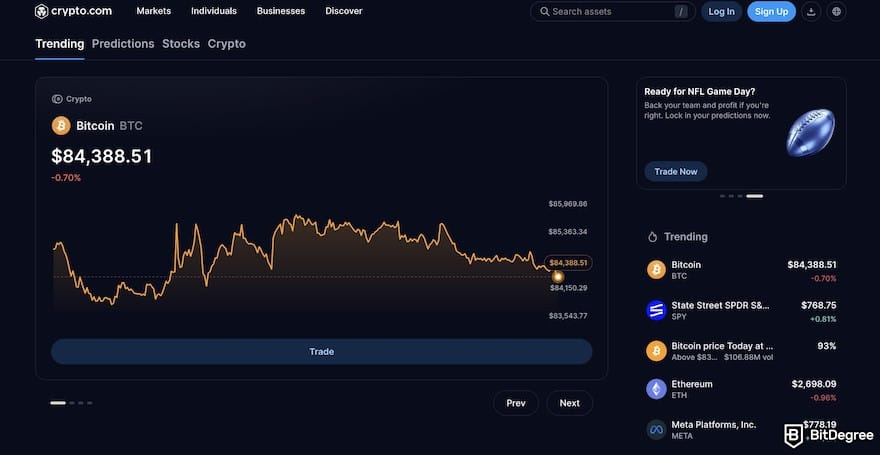
Crypto.com, meanwhile, has grown into one of the largest exchanges in the world by user base, with well over 100 million registered users. Its growth strategy leans on visibility: the platform sponsors Formula 1, the UFC, FIFA, and the LA Lakers, and its naming-rights deal for the Crypto.com Arena in Los Angeles is one of the most recognizable crypto-brand plays to date.
The centerpiece product behind a lot of that brand awareness is the Crypto.com Visa card, one of the most widely used crypto payment cards on the market, with transactions registered across a large number of countries and regions.
Verdict
Coinbase leads on institutional credibility and regulatory transparency, backed by its public listing and S&P 500 inclusion. Crypto.com leads on brand visibility and mainstream reach, driven by its high-profile sponsorships and the popularity of its Visa card.
Coinbase VS Crypto.com - Trading Features
Both Coinbase and Crypto.com have intuitive core trading features. However, Coinbase seems to focus on a beginner-friendly experience with simpler tools, while Crypto.com goes wider, adding trading bots, a broader derivatives lineup, and portfolio tools like Crypto Basket.
Coinbase's Trading Toolkit
Coinbase keeps its core trading experience simple and approachable, which makes it a solid pick for users who don't want to deal with a steep learning curve.
For basic trading, Coinbase offers:
- Spot trading for buying and selling crypto directly.
- Instant buy / simple buy for quick purchases without using the full trading terminal.
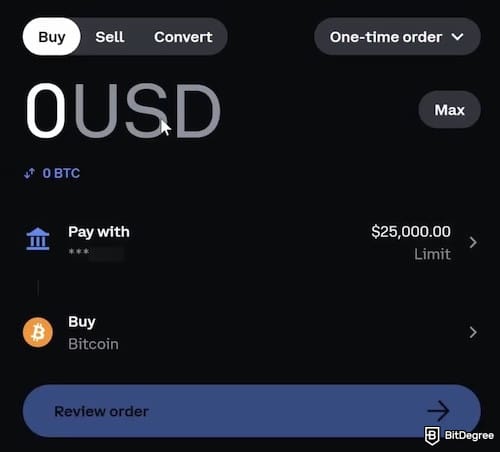
- Recurring buys for dollar-cost averaging into crypto automatically.
- Convert features for swapping one crypto asset into another with minimal setup.
For more experienced traders, Coinbase includes:
- Coinbase Advanced, offering live order books, TradingView-powered charts, and market/limit/stop orders.
- Futures trading in eligible regions.
📚 Read More: How to Trade Futures on Coinbase
For automation and pro-level trading, Coinbase provides:
- API trading for bots, scripts, and algorithmic strategies.
- Advanced order management for more precise execution.
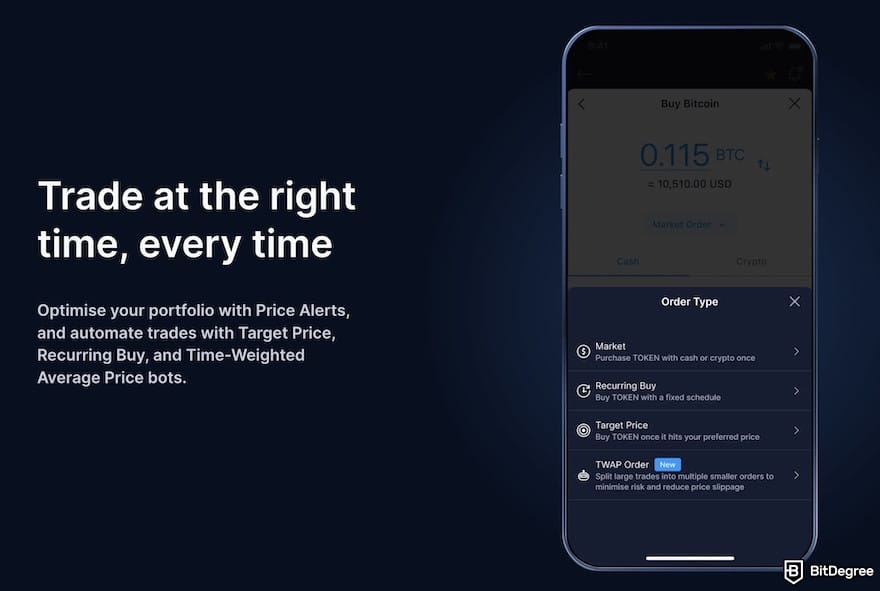
- Price alerts and market tools for tracking setups and market moves.
- Coinbase Prime, an institutional offering with custody, deep liquidity, and large-volume execution for professional traders and firms.

Compared to Crypto.com, Coinbase's trading ecosystem is noticeably leaner, and it no longer offers margin trading in the same way for retail spot users. Coinbase's strength is accessibility rather than breadth.
Crypto.com's Trading Toolkit
Crypto.com offers a wider range of trading tools, aimed at users who want more than the basics.
For basic trading, Crypto.com offers:
- Spot trading across hundreds of cryptocurrencies and trading pairs.
- Market, Limit, and Stop orders for managing entries and exits.
- Recurring purchases for dollar-cost averaging (DCA).
- Crypto Basket, a portfolio management feature for diversified exposure without manually buying multiple assets.
For advanced trading, Crypto.com supports:
- Margin trading with leverage on eligible markets.
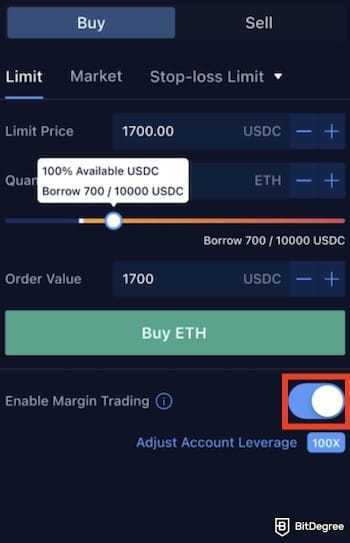
- Perpetual futures and derivatives trading.
- Advanced order types, including stop-loss, take-profit, post-only, IOC, and FOK orders.
For automation and pro-level trading, Crypto.com provides:
- Trading Bots, including Grid Trading Bots and DCA Bots.

API trading through REST, WebSocket, and FIX APIs.
- Institutional-grade infrastructure, including direct market access (DMA), OTC connectivity, and low-latency execution.
Compared to Coinbase, Crypto.com places a much stronger emphasis on feature variety, margin access, and automation tools built directly into the platform.
Verdict
Coinbase and Crypto.com serve different types of traders. Coinbase is the better fit for beginners who want a simple experience. Crypto.com is the stronger pick for active traders who want margin trading, automation through bots, and a wider derivatives lineup.
Coinbase VS Crypto.com - Fees
Both platforms use a volume-based maker-taker model for spot and futures trading, but they land in different places on cost, especially for beginners using the simple purchase flow.
Coinbase | Crypto.com | |
|---|---|---|
Account Opening | Free | Free |
Crypto Deposit | Usually free (network fee may apply) | Free |
Crypto Withdrawal | Variable network fee | Varies by asset/network |
Fiat Deposit | ACH free, SEPA ~€0.15, wire $10, Swift free | Free (ACH/SEPA); bank fees may apply |
Fiat Withdrawal | ACH free, SEPA free, wire $25, Swift £1 | ACH free; Fedwire $15; SWIFT $45; SEPA free |
Instant/Simple Buy | Up to 3.99% + ~0.5% spread | Spread + admin fee (shown at checkout) |
Card Payment | Up to 3.99% | Spread + applicable processor fees |
Spot (maker/taker) | From 0.60% / 0.40% | From 0.25% / 0.50% |
Futures (maker/taker) | From 0.40% / 0.60% | From 0.00–0.02% / 0.015–0.04% |
Table: Comparison of Coinbase VS Crypto.com pricing
Coinbase's simple buy and card fees are among the steepest in the industry, up to 3.99% plus spread, making it one of the pricier ways to buy crypto quickly. Crypto.com doesn't publish a flat percentage for its instant buy, since it's spread-based, but it's often seen as more competitive for casual purchases than Coinbase's simple buy flow.
📚 Read More: Coinbase Fees Explained
On the advanced trading side, Crypto.com's base spot maker fee (0.25%) undercuts Coinbase's (0.60%), though Coinbase's base taker fee (0.40%) is actually lower than Crypto.com's (0.50%).
Crypto.com also layers in additional ways to cut trading costs on top of standard volume tiers, through its Level Up program.
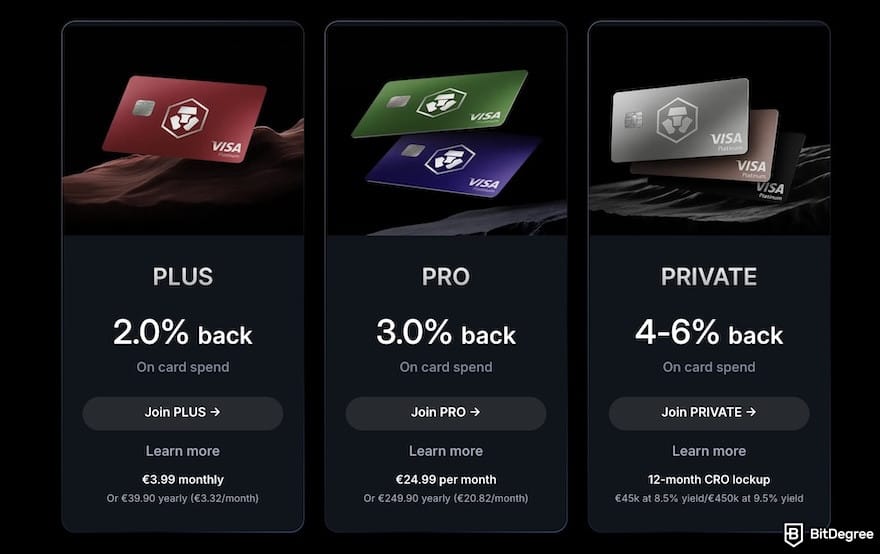
It lets users subscribe to a paid tier (Plus or Pro) for zero trading fees up to a monthly volume cap, or stake CRO to unlock the top-tier Private plan, which includes unlimited zero-fee trading along with extra perks like higher card cashback and elevated Earn rates.
Coinbase doesn't offer a comparable mechanism, its fee discounts are tied strictly to 30-day trading volume, with no subscription or staking path to reduce costs further.
Join the BitDegree mission and get free trial access to Crypto.com Level Up.
$1,000 Spot Trade Fee Comparison
Now, let's see how the pricing structure looks in a $1,000 spot trade.
Maker Fee | Fee on $1,000 | Taker Fee | Fee on $1,000 | |
|---|---|---|---|---|
Coinbase Advanced | 0.60% | $6.00 | 0.40% | $4.00 |
Crypto.com | 0.25% | $2.50 | 0.50% | $5.00 |
Table: Comparison of Coinbase VS Crypto.com's spot trades
On a $1,000 limit order, Crypto.com is cheaper: $2.50 versus $6.00 on Coinbase, a difference of $3.50 per trade. That's more than double what Coinbase charges for the same maker order, and the gap only grows as trade size goes up. At $5,000, for example, you'd be looking at $12.50 in maker fees on Crypto.com compared to $30.00 on Coinbase.
The gap narrows and flips slightly on market orders, where Coinbase's $4.00 taker fee actually beats Crypto.com's $5.00. It's a small reversal, just $1.00 per $1,000, but it means Coinbase isn't uniformly the more expensive platform. If you're someone who mostly places market orders rather than limit orders, Coinbase's advanced tier is marginally cheaper at the base level.
This split also says something about how each platform structures its incentives. Crypto.com leans harder into rewarding liquidity providers (its maker fee is less than half its taker fee), which pushes users toward limit orders. Coinbase's spread between maker and taker is smaller, so it doesn't nudge behavior in the same way.
In short, Crypto.com rewards limit orders more, and rewards them well, while Coinbase is only marginally cheaper for frequent market-order traders at the base tier, a gap that's easy to erase once volume or CRO staking gets factored in on Crypto.com's side.
$1,000 Futures Trade Fee Comparison
Futures fees deserve their own look because the differences here are much bigger than what you'll see on spot trading. Since futures traders tend to open and close positions more frequently, and often with larger sizes, even a small percentage gap can add up fast.
Here's how Coinbase and Crypto.com compare on a $1,000 futures trade at their base fee tiers.
Maker Fee | Fee on $1,000 | Taker Fee | Fee on $1,000 | |
|---|---|---|---|---|
Coinbase Futures | 0.40% | $4.00 | 0.60% | $6.00 |
Crypto.com Futures | 0.02% | $0.20 | 0.04% | $0.40 |
Table: Comparison of Coinbase VS Crypto.com's futures trades
Futures is where the gap becomes more apparent. Coinbase's base futures fees are 15-20x higher than Crypto.com's on both maker and taker orders. A $1,000 futures trade costs just $0.20-$0.40 on Crypto.com, compared to $4.00-$6.00 on Coinbase.
Scale it up, and the numbers stop looking trivial. At $10,000 per trade, Coinbase's taker fee runs $60 compared to Crypto.com's $4, a $56 difference on a single trade. For someone placing several futures trades a week, that gap compounds into hundreds of dollars a month, purely from the fee structure, before factoring in funding rates or spread.
Verdict
Crypto.com is the cheaper platform overall, especially for spot maker orders and futures trading. Coinbase edges ahead only on spot taker fees at the base tier, but its simple buy and card fees remain among the highest in the industry.
Coinbase VS Crypto.com - Security & Trust
Both platforms are large, well-funded exchanges, but they come from different worlds: Coinbase is a publicly traded, US-regulated company, while Crypto.com leans on certifications and institutional custody partnerships. Here's how they compare on security.
| Coinbase | Crypto.com |
|---|---|---|
2FA | ✓ | ✓ |
Passkeys / Security keys | ✓ | ✗ |
Cold storage | ✓ (majority of funds offline) | ✓ (Ledger Vault) |
Proof of Reserves | Holds customer assets 1:1 | ✓ |
Withdrawal whitelisting | ✓ | ✗ |
ISO/IEC 27001 | ✗ | ✓ |
SOC 2 Type II | ✓ | ✓ |
PCI DSS v4.0 Level 1 | ✗ | ✓ |
Public company transparency | ✓ Publicly traded | Private company |
Insurance / Protection fund | Crime insurance for certain custodial holdings* | WAPP, up to $250,000 for unauthorized withdrawals |
History of fund loss | None (customer crypto) | 2022 ($34M, reimbursed) |
Table: Security features on Coinbase VS Crypto.com
Crypto.com holds more formal certifications overall, including PCI DSS v4.0 Level 1 and ISO/IEC 27001, and uses Ledger Vault for institutional-grade cold storage. Coinbase matches it on SOC 2 Type II and adds passkey support and withdrawal whitelisting, which Crypto.com doesn't clearly offer.
Where they diverge most is public accountability. Coinbase's status as a publicly traded, US-listed company means it's subject to SEC reporting requirements, giving it a level of financial transparency Crypto.com, as a private company, doesn't have to match.
📚 Read More: Is Coinbase Safe?
Track record tells a mixed story on both sides. Crypto.com had a 2022 breach where attackers bypassed 2FA and stole around $34 million in Bitcoin and Ethereum (fully reimbursed), plus a 2023 Scattered Spider data breach that exposed personal information but no funds.

Coinbase has had its own customer-impact incidents: in 2021, roughly 6,000 accounts were compromised through a weakness in its SMS recovery process, and in May 2025, Coinbase disclosed that contractors were allegedly bribed to leak customer data including names, emails, ID details, and account balances.
No customer crypto was stolen in either Coinbase incident, but they raised concerns about internal access controls.
Both exchanges responded with upgrades. Crypto.com moved to a new 2FA system, added a mandatory 24-hour withdrawal delay, and launched WAPP, its own reimbursement program. Coinbase's response leaned more on its existing account-protection layers, like Vaults and trusted contacts, rather than a single new program.
Verdict
In terms of features and overall security, they’re close, with Coinbase edging ahead on transparency and Crypto.com edging ahead on certifications.
Coinbase VS Crypto.com: Liquidity
Coinbase is the deeper liquidity pool of the two, particularly on USD pairs, while Crypto.com trades some depth for a broader coin selection and a more retail-oriented ecosystem. That said, before comparing execution quality, it's worth looking at crypto selection first. This signals what each platform is optimizing for.
Coinbase offers a more curated list of assets with around 240 to 320 tradable cryptocurrencies, depending on your region and focuses on mainstream and higher-liquidity tokens. Meanwhile, Crypto.com lists around 433 coins across 593 trading pairs, giving it a wider selection.
Both support major coins like BTC, ETH, SOL, and USDC, but Crypto.com generally offers better altcoin diversity.
Coinbase benefits from its large institutional footprint, public listing, and strong USD market share. It processes roughly $425 billion in trading volume per quarter, and that scale, combined with its US-centric fiat rails, gives it particularly deep order books on major pairs like BTC/USD and ETH/USD. In practice, that translates into:
- Strong liquidity on BTC and ETH fiat pairs (especially USD);
- Deep order books on major institutional flows;
- Lower slippage on large market orders in core assets;
- Consistent execution for high-volume fiat trades;

- Strong integration with traditional banking rails;
- Stable pricing during high retail demand periods.
Crypto.com operates at a somewhat smaller scale by comparison. Its 30-day trading volume sits around $93 billion, a solid figure for a top-tier exchange but below Coinbase's throughput. Where it makes up ground is breadth and ecosystem depth. Its liquidity profile typically shows up as:
- Competitive liquidity on BTC, ETH, and major alt pairs;
- Deep order books maintained on its major trading pairs;
- Institutional access through direct market connectivity, OTC services, and low-latency execution;
- A wider range of tradable assets, useful for altcoin-focused traders;
- CRO-linked incentives that can affect order flow and liquidity on certain pairs;
- Reliable execution for standard retail-sized trades.
Across public data comparisons, Coinbase shows deeper liquidity and tighter spreads on core USD pairs and institutional flows, while Crypto.com trades some of that depth for a broader asset selection and a more retail-and-ecosystem-driven approach to liquidity.
Verdict
Coinbase leads in raw liquidity depth and institutional-grade execution on major fiat pairs, thanks to its scale and regulatory standing. Crypto.com holds its own for standard retail use and offers a wider trading selection, but its infrastructure doesn't yet match Coinbase's high-volume or institutional flows.
Coinbase VS Crypto.com - Broader Ecosystem
Beyond trading, security, and fees, both platforms have built out entire ecosystems around their core exchange. Coinbase leans into DeFi access, yield products, and education, while Crypto.com pushes harder into payments, card perks, and even prediction markets.
Crypto.com's Other Features
See what Crypto.com has to offer besides its trading package
1
Crypto.com Onchain (Ult)
Crypto.com's self-custody wallet, giving users full control over their assets. Beyond storage, it supports sending, receiving, swapping, and staking, plus dApp interaction.

It's integrated with Cronos, Crypto.com's own blockchain, letting users explore DeFi and manage assets across multiple chains from one interface.
2
Crypto-Backed Visa Debit Cards
The Crypto.com Visa Card is arguably the platform's biggest draw. It's funded through the app and spendable anywhere Visa is accepted, earning CRO rewards on eligible purchases. The tiered structure (Midnight Blue, Ruby Steel, Jade Green/Royal Indigo, Icy White/Rose Gold, Obsidian) unlocks better cashback, airport lounge access, and travel perks at higher levels.
3
Crypto.com Pay
A payments network for spending crypto directly with participating merchants, buying gift cards, topping up mobile plans, or transferring funds to other Crypto.com users. Some merchants offer cashback for paying through it.
4
NFT Marketplace
Crypto.com's own platform for buying, selling, and collecting digital collectibles from creators, brands, athletes, and entertainment partners.

5
Predictions
This lets eligible US users trade on real-world event outcomes through CFTC-regulated derivatives contracts rather than sports-betting-style bets. Users can enter with small amounts and close positions early to lock in gains or limit losses.
Coinbase's Other Features
Beyond buying, selling, and trading, Coinbase has built out a full ecosystem of products around its exchange. Here's a rundown of what else the platform offers.
1
Coinbase One
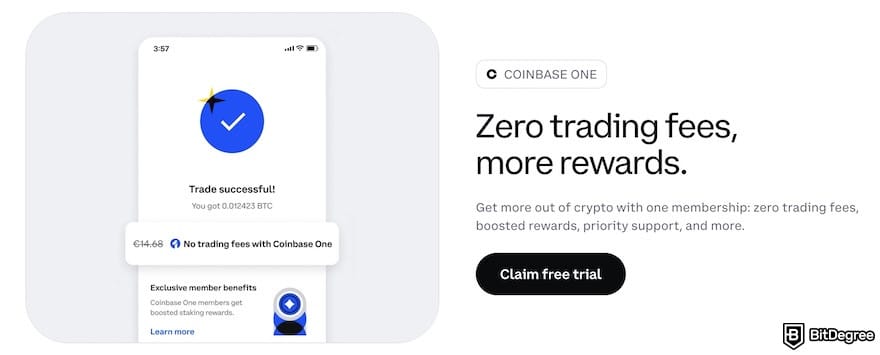
Coinbase's premium membership, starting at $49.99/year. It bundles reduced or zero trading fees, higher staking rewards, priority support, and partner perks like CoinTracker packages and PancakeSwap airdrops.
2
Base
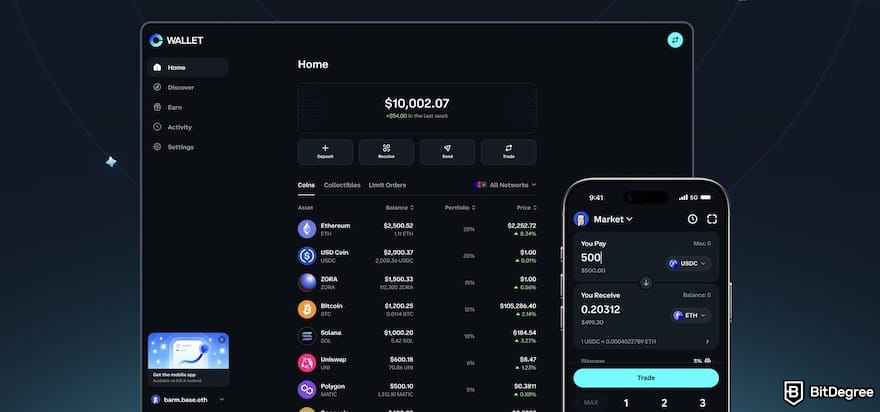
Formerly Coinbase Wallet, Base gives users full control over their assets and private keys, acting as a gateway into the broader Base ecosystem for DeFi, on-chain apps, and Web3 services at lower cost than the Ethereum mainnet.
3
Coinbase Earn
It lets users put idle crypto to work through staking (up to around 14% APY depending on asset/region), USDC rewards (3.50%, higher with eligible memberships), and USDC lending products (10%+ APY), often with flexible withdrawals.
4
Coinbase Wealth
Aimed at ultra-high-net-worth individuals, family offices, and professional advisors, offering institutional-grade custody, deep liquidity, financing, staking, lending, and white-glove trading support through Coinbase Prime.
5
Coinbase Card
A crypto debit card for spending crypto or stablecoin balances anywhere Mastercard is accepted, linked directly to a Coinbase account for easy conversion.
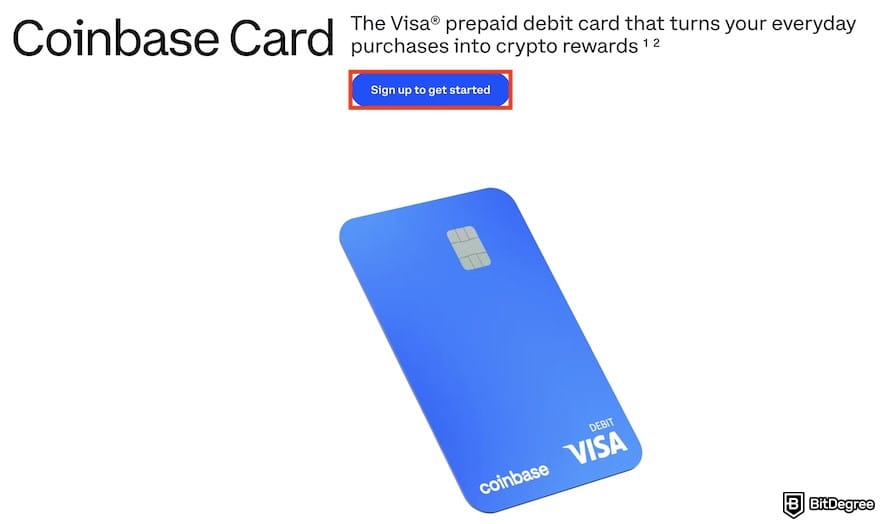
Users may qualify for crypto rewards or cashback depending on region and promotions.
6
Coinbase Quests
Formerly Coinbase Learn and Earn, this learn-to-earn program rewards users with free crypto for watching short lessons and completing quizzes. Rewards vary by campaign, typically a few dollars per lesson, with larger promotions offering more.
7
Coinbase NFT
Coinbase's NFT marketplace for discovering, buying, selling, and showcasing NFTs, with social features like following creators and building collections. Adoption has been more muted than expected, but it reflects Coinbase's push into the creator economy and Web3 ownership.
Both platforms clearly want to be more than exchanges. Crypto.com's ecosystem is more consumer-spending-focused, with its card, Pay network, and merchant integrations doing a lot of the heavy lifting. Coinbase spreads its bets wider, covering everything from institutional wealth services to education to DeFi access through Base.
Verdict
Crypto.com's other features are stronger for everyday spending and payments. Meanwhile, Coinbase's ecosystem is broader and more diversified, appealing to a wider range of users, from beginners to institutions.
Coinbase VS Crypto.com - Fiat Deposits and Withdrawals
Both platforms support major fiat rails, but they differ in currency breadth and how transparent their fee structures are.
Coinbase supports 60+ fiat currencies, though its strongest infrastructure is clearly built around USD, EUR, and GBP, with funding rails like ACH (US), SEPA (Europe), Faster Payments (UK), wire transfers, debit cards, and PayPal in selected regions.
Most of Coinbase's official funding documentation centers on these three core currencies, suggesting that support outside them leans more on card purchases or local processors rather than dedicated banking rails.
Crypto.com, on the other hand, is more limited on currencies but keeps its published fee schedule clear and easy to check:
| Fee |
|---|---|
USD Deposit | Free (retail clients) |
USD withdrawal (SWIFT) | $45 per transaction |
USD returned transaction (SWIFT) | $40 admin fee |
EUR deposit (SEPA) | Free |
EUR withdrawal (SEPA) | Free |
EUR returned transaction (SEPA) | €25 admin fee |
Table: Crypto.com's fiat pricing structure
For European users, both platforms land in the same place, with free SEPA deposits and withdrawals on either side. The real difference on fiat alone comes down to other factors, like fees or coin selection.
For USD users, the picture shifts. Coinbase's ACH deposits and withdrawals are free, while Crypto.com relies on SWIFT for USD withdrawals, which costs $45 per transaction, plus a $40 admin fee if a transaction is returned.
That makes Coinbase cheaper for anyone regularly moving USD off the platform.
Currency breadth is where the gap is widest. Coinbase's 60+ supported fiat currencies give it reach into far more regions, while Crypto.com's fiat coverage is effectively built around USD and EUR. Users outside those two currencies have limited or no direct fiat rails on Crypto.com and are more likely to rely on card purchases or crypto-only funding instead.
Verdict
Coinbase is the stronger choice for fiat flexibility, with broader currency support and free ACH/SEPA rails for its core markets. Crypto.com keeps things simple and transparent for USD and EUR users.
Coinbase Trading Walkthrough
You can buy crypto through Coinbase's standard interface with just a few clicks, but if you want more control over your trades, Coinbase Advanced offers advanced charts, live order books, and a range of order types. Here's how to buy crypto on Coinbase Advanced, step by step:
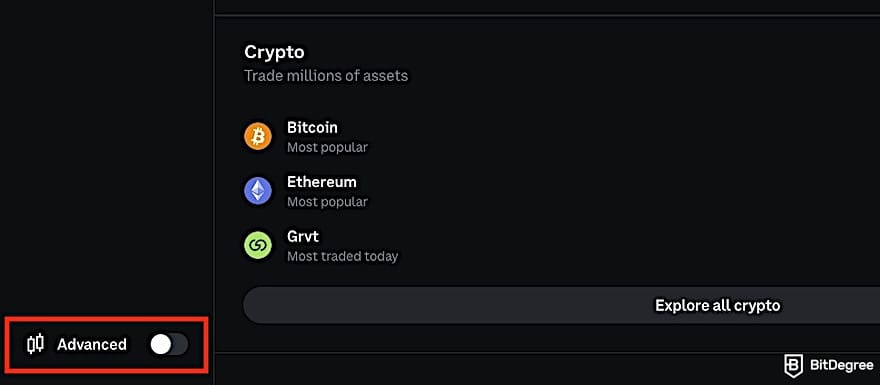
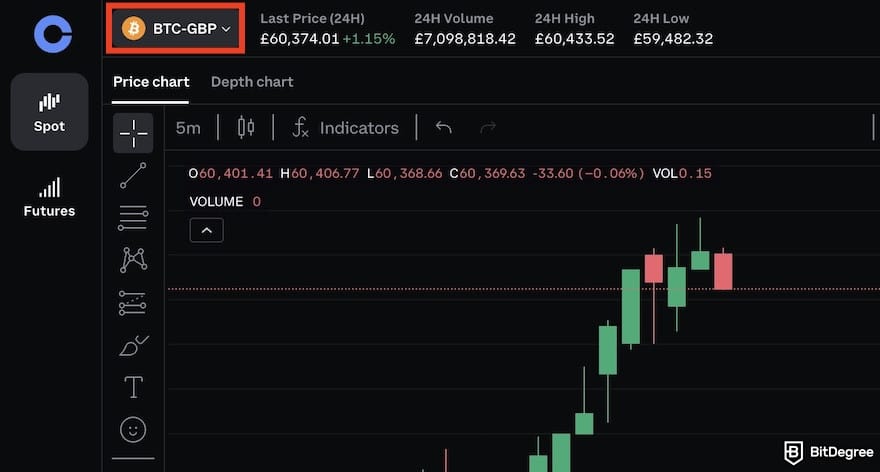
For example, entering $5 means Coinbase will use that amount to buy Bitcoin at the best price currently available.
When you submit a market order, Coinbase instantly pairs it with the lowest-priced seller available in the order book. This is known as a "taker order," since you're accepting an offer that's already sitting on the market.
Speed is the main advantage here, trades go through almost immediately. That makes market orders simple and convenient for beginners. If price control and lower fees matter more to you, though, a limit order is usually the better call.
Crypto.com Trading Walkthrough
Before you can trade on Crypto.com Exchange, your account needs to be verified to at least the Starter level.
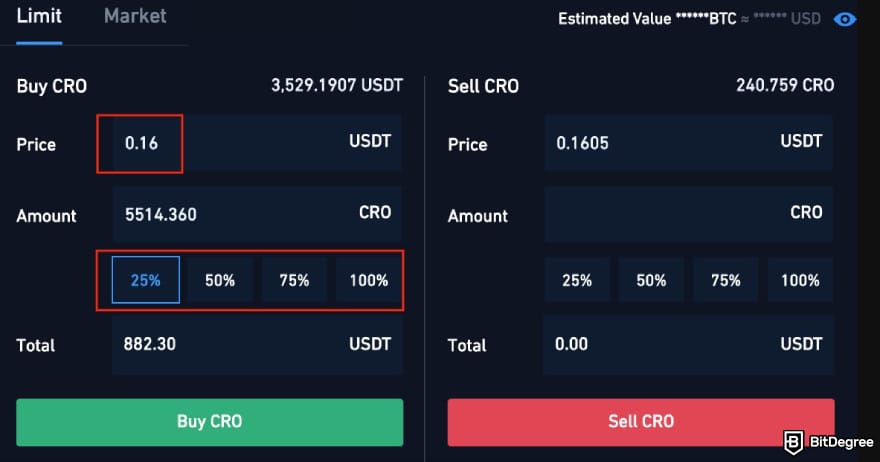
One thing to note: when placing a Limit order, the price field auto-fills with the current market price by default, but you're free to change it to whatever entry price you'd prefer before confirming.
Coinbase VS Crypto.com for Beginners
Both platforms have put real effort into making crypto approachable for first-timers, but they take different routes to get there.
Coinbase is generally considered the more beginner-friendly option, especially in major markets like the US, UK, and Europe, and here's why:
- Cleaner, simpler interface;
- Extremely straightforward buy/sell flow;
- Strong educational content through Coinbase Quests (formerly Learn and Earn), which rewards users with crypto for completing short lessons;
- A more widely recognized brand, which builds trust for newcomers;
- Very intuitive mobile app;
- A range of fiat payment methods for users in its core markets.
Crypto.com pitches itself to both newcomers and active traders who want fiat on-ramps, staking, and a rewards card in one app.
Where it pulls ahead for beginners is its Crypto Basket feature, which lets users build a diversified portfolio in a single tap, choosing from a range of pre-built options spanning different strategies and risk levels.

Its Instant Buy flow and recurring purchases also make it easy to get started without navigating a full trading terminal, and the Crypto.com Visa card gives new users an early reason to stick around beyond just buying and holding.
One thing worth noting is that Coinbase's strongest fiat infrastructure is built around USD, EUR, and GBP, while Crypto.com's fiat coverage is centered on USD and EUR.
So for beginners outside those core currencies, neither platform is a clear win on fiat accessibility alone, but Coinbase's broader 60+ currency support generally gives it the edge for international onboarding.
Verdict
For a true beginner, Coinbase is the classic recommendation, thanks to its simplicity, brand trust, and educational tools. Crypto.com is a strong alternative for newcomers who want an all-in-one ecosystem from day one.
Coinbase VS Crypto.com for Active Traders
Active traders care about fast execution, deep order types, fees that scale down with volume, and tools that hold up when markets get volatile. Coinbase and Crypto.com both offer professional-grade setups, but they lean into different strengths.
Coinbase, through Coinbase Advanced, gives active traders:
- TradingView-powered charts;
- Live order books;
- Futures trading;
- Advanced order types;
- API access;
- Lower volume-based fees compared to the standard Coinbase interface.
For larger traders and institutions, Coinbase's stack goes deeper through Coinbase Prime, offering aggregated liquidity, smart order routing, financing, custody, RFQ execution, and algorithmic execution tools.

Crypto.com's exchange is the more feature-dense of the two for active retail traders. It supports margin trading with up to 10x leverage across 100+ pairs, perpetual futures, and a range of order types including stop-loss, take-profit, post-only, IOC, and FOK.
Where it really pulls ahead is automation: built-in Grid and DCA trading bots let users run strategies without third-party tools, and REST, WebSocket, and FIX API access covers algorithmic trading. Institutional users get direct market access, OTC connectivity, and low-latency execution.
On paper, the core toolsets look fairly similar: charts, order types, API access, institutional infrastructure, but two things separate them.
First, Crypto.com offers native margin trading up to 10x leverage, something Coinbase no longer provides in the same way for retail spot users.
Second, fees diverge sharply at the advanced/futures level: Crypto.com's base futures fees are roughly 15-20x lower than Coinbase's, and its spot maker fee also undercuts Coinbase's, as covered in the "Fees" comparison.
Verdict
For active trading, Crypto.com is the stronger choice on cost, with lower fees, built-in automation through trading bots, and native margin access. Coinbase is the better fit if you prioritize institutional-grade policies and a more established execution environment.
Coinbase VS Crypto.com for Passive Users: Earning Opportunities
Both platforms let you earn on idle crypto, but they take different approaches to getting there. Coinbase keeps things simple with a smaller, curated asset list, while Crypto.com covers far more assets through a tiered membership structure.
Coinbase supports staking on around 8 major assets: ETH, SOL, ADA, DOT, ATOM, AVAX, POL, and XTZ. Its earning products fall under Coinbase Earn, where users can access staking, USDC rewards, and lending-style products depending on region:
- Staking rewards up to around 14% APY, depending on the asset;
- USDC rewards at 3.50% (higher with Coinbase One);
- USDC lending products offering 10%+ APY, often with flexible withdrawal access.
Coinbase One subscribers get up to a 15% boost on staking rewards, though the membership comes with a cost, starting at $49.99/year or roughly $4.99/month.
Crypto.com's earn program covers a much wider range, 40+ assets, using a tiered structure based on membership level: Standard, Pro, and Private. Private Members earn an extra 1% per year on top of base rates, paid in CRO, rewarding users already invested in the CRO ecosystem. Rewards are paid out weekly.
Verdict
Coinbase is the simpler option if you want an easy "set it and forget it" earning setup, with a small asset list. Crypto.com suits users who want a much broader selection of assets to earn from and don't mind navigating its tiered membership structure.
Final Verdict: Is Coinbase or Crypto.com Better?
Coinbase and Crypto.com are built for different kinds of users, and the "better" platform depends entirely on what you're looking to do.
If you want a simple, trusted entry point into crypto, backed by a publicly listed company, strong regulatory standing, and a beginner-friendly interface, Coinbase is the stronger choice. It shines for US-centric users, long-term holders, and anyone who values institutional trust.
Meanwhile, those wanting lower fees, especially on futures and margin trading, a wider selection of assets, built-in automation through trading bots, and an ecosystem that covers spending, staking, and earning all in one app can try Crypto.com. It's especially worth considering if you're already holding CRO or want a rewards-earning card as part of your daily spending.
Eventually, there's nothing stopping you from using both.
You can keep funds on Coinbase for its simplicity and institutional trust, while trading or earning more actively on Crypto.com to take advantage of its lower fees and broader toolset.