


Coinbase vs Kraken - In-Depth Comparison
When comparing Coinbase vs Kraken, which is actually better? Well, it’s not a simple question to ask because both are trusted global crypto platforms that offer professional-grade trading tools and support much more than basic buy-and-sell trading. However, there are some aspects that eventually make you think, “Ah, this is for me”.
Coinbase is generally the bigger household name, especially in major markets like the US, UK, and Europe. The ecosystem stretches beyond trading into products like a crypto wallet (Base), and the services are backed by a publicly listed company. Meanwhile, Kraken has a strong reputation for lower fees, broader fiat support, and a record of “no customer fund hacks”.
So, when choosing between Coinbase vs Kraken, you should start with your needs: What do I want to do on the platform? What kind of crypto user am I?
If you mostly want to buy crypto easily and explore a clean crypto ecosystem, particularly for users in major markets, Coinbase will feel more intuitive. However, those caring more about lower fees, margin trading, wider altcoin access, or better fiat support outside major markets should explore Kraken.
| Coinbase | Kraken |
|---|---|---|
Best for | Beginners, long-term holders, and crypto ecosystem users | Active and fee-conscious traders, global users |
Main strength | Simplicity, polished UX, ecosystem depth | Lower fees, broad fiat support, altcoin variety, no breaches |
Supported cryptocurrencies | ~240-300+ assets | 500-600+ |
Spot trading fees | Higher on standard buy flow, competitive on Advanced | Generally lower overall |
Futures/margin | Futures up to 20x | Futures up to 50x Margin up to 5x |
Passive earning | Staking on 8 assets + Coinbase Quests | Auto Earn on 21+ assets, ETH restaking, BTC staking and bonded staking |
Fiat support | Strong in major markets (US, UK, and Europe) | Broader multi-currency global support (10 currencies) |
Beginner experience | Very beginner-friendly, especially for major markets | Beginner-friendly, especially internationally |
Advanced trading | Strong institutional-style setup | Strong trader-native setup |
Overall verdict | Better for easy crypto access and ecosystem use | Better for lower-cost, broader, more flexible crypto access |
Table: An overview of the Coinbase vs Kraken comparison
Looking at those aspects, Coinbase is stronger if you want a polished crypto ecosystem built around digital assets and simplicity. Meanwhile, Kraken is a better option for those who want lower fees, broader asset access, stronger fiat rails, and a platform that scales better from beginners into active traders.
Coinbase vs Kraken - Market Position
Coinbase is generally the more mainstream and institution-facing name in the Coinbase vs Kraken comparison. As a publicly listed company in the US and one of the most recognized crypto platforms globally, Coinbase often gets positioned as the “default gateway” for retail and institutional use.
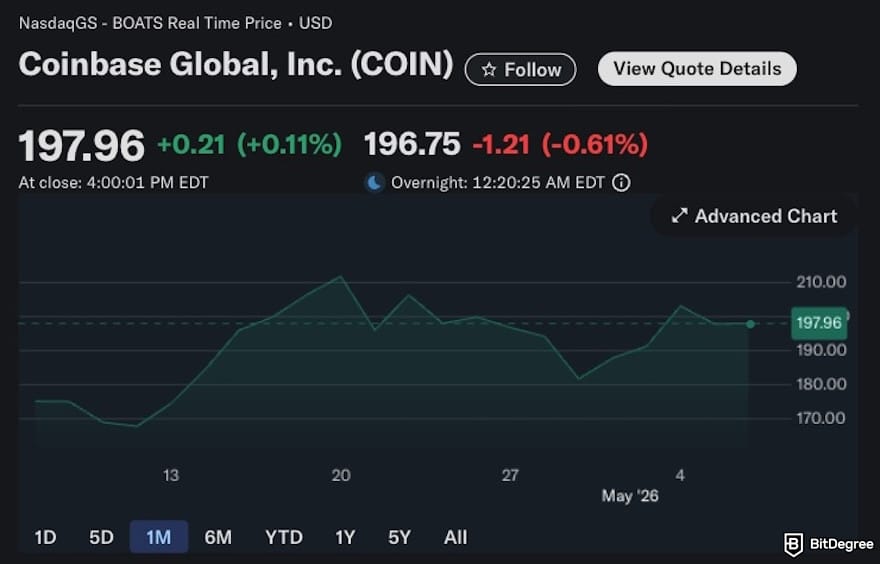
The reputation is backed by consistent recognition in rankings, reviews, and industry coverage. In fact, Coinbase regularly scores high in usability and trust metrics, and it even joined the S&P 500 in 2025, which is a big signal of how far it has moved into “traditional” finance territory.
Kraken, on the other hand, plays a different game. It’s not as loud or mainstream as Coinbase, but it’s widely respected in trading circles for being stable, secure, and more “pro-trader oriented”. The platform also holds multiple awards from Finder, an award-winning financial comparison site in Australia, and the Customer Centricity World Series.
Its strong security track record with no major hacks in over a decade and global footprint across 190+ countries and territories strengthen its reputation.
Verdict
Coinbase leads in brand power, institutional trust, and mainstream adoption, while Kraken holds its ground as the more “pro trader” platform with consistent quality in security and performance.
Coinbase vs Kraken - Trading Features
Both Coinbase and Kraken offer a solid lineup of trading products. I might say that their core trading features are mostly the same: spot trading, advanced charts, order books, API access, staking, and futures in eligible regions.
For basic trading, both platforms support:
- Spot trading for buying and selling crypto directly.
- Instant buy/simple buy for quick purchases without using the full trading terminal.
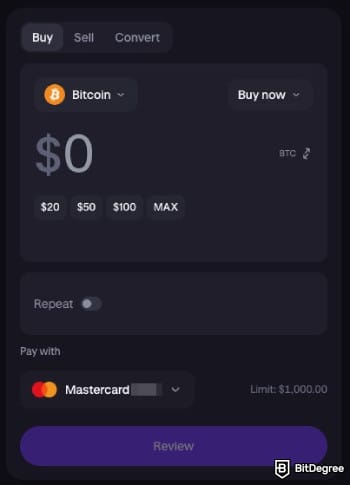
- Recurring buys for dollar-cost averaging into crypto automatically.
- Convert features for swapping one crypto asset into another with minimal setup.
For advanced trading, both step things up:
1
Coinbase Advanced offers live order books, TradingView-powered charts, market/limit/stop orders, and futures trading in eligible regions.
2
Kraken Pro includes advanced charting, real-time market depth, multiple order types (including stop-loss and take-profit), margin trading up to 5x, and futures trading with leverage in supported markets.
For automation and pro-level trading, both support:
- API trading for bots, scripts, and algorithmic strategies.
- Advanced order management for more precise execution.
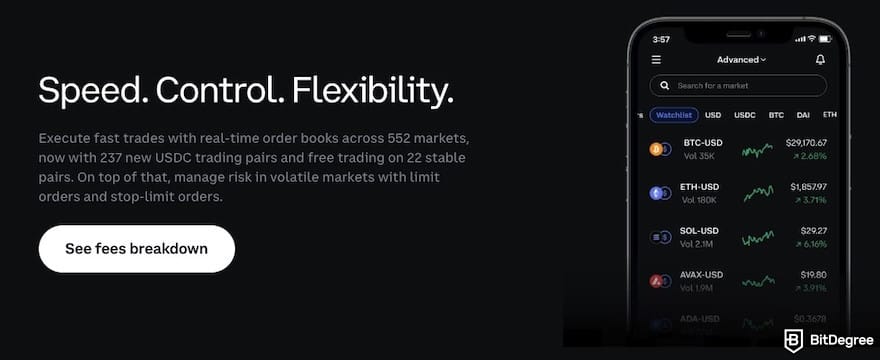
- Price alerts and market tools for tracking setups and market moves.
- Institutional services (Kraken Prime and Coinbase Prime), including custody, deep liquidity, and large-volume execution for professional traders and firms
The biggest difference is really in how they package trading. Coinbase focuses on having a simpler UX, which generally makes it easier for first-time buyers to navigate. Kraken, on the other hand, leans more toward active traders by offering margin trading up to 5x leverage (which Coinbase no longer offers in the same way for retail spot users).
Verdict
Coinbase and Kraken are fairly similar in core trading features, but they target different users. Coinbase is stronger for beginners who want a simpler experience, while Kraken is better suited for active traders with up to 5x margin, broader derivatives access, and more advanced order types.
Coinbase vs Kraken - Fees
When comparing fees, Coinbase and Kraken take different approaches. Coinbase keeps pricing fairly straightforward, but that simplicity often comes with higher convenience costs. Kraken's fee structure, meanwhile, tends to offer more competitive pricing across most categories, from simple purchases to advanced trading products.
See the fee table and $1,000 trade comparison below for a clearer side-by-side look at how those costs work in practice.
| Coinbase | Kraken |
|---|---|---|
Account opening | Free | Free |
Crypto deposit fees | Usually free (network fee may apply in some cases) | Mostly free (some exceptions depending on asset) |
Crypto withdrawal fees | Variable blockchain/network fee | Variable blockchain/network fee |
Bank deposit fees | ACH free, SEPA ~€0.15, wire deposits $10, Swift free | Varies by funding provider and currency |
Bank withdrawal fees | ACH free, SEPA free, wire withdrawals $25, Swift £1 | Varies by method and currency |
Simple Buy/Instant Buy fees | Variable convenience fee + spread; card purchases can reach up to 3.99% plus ~0.5% spread | Fixed trading fee + spread; often around 1.5% for crypto buys, ~0.9% for stablecoins |
Card payment fee | Up to 3.99% | 3.75% + $0.25 |
Spread markup | Yes (included in quoted price on simple buys) | Yes (included in Instant Buy / Convert pricing) |
Advanced spot trading - maker fee | Starts at 0.60% (<$10k 30-day volume), can drop to 0.05% | Starts at 0.25% (<$10k 30-day volume), can drop to 0.00% |
Advanced spot trading - taker fee | Starts at 0.40% (<$10k 30-day volume), can drop to 0.00% | Starts at 0.40% (<$10k 30-day volume), can drop to 0.05% |
Futures - maker fee | Starts at 0.40% (<$10k 30-day volume), can drop to 0.00% | Starts at 0.0200% (<$5,000,000 30-day volume), can drop to -0.0060% |
Futures - Taker Fee | Starts at 0.60% (<$10k 30-day volume), can drop to 0.04% | Starts at 0.0500% (<$5,000,000 30-day volume), can drop to 0.0125% |
Table: Comparison of Kraken vs Coinbase's fee structure
Kraken is generally the cheaper option, whether you’re making a simple crypto purchase or actively trading. For beginners, Kraken’s standard buy flow comes with lower fees than Coinbase’s regular interface.
📚 Read More: Kraken Fees Explained
For active traders, both Coinbase Advanced and Kraken Pro use a tiered fee model where trading costs decrease as your 30-day trading volume increases. However, Kraken starts with lower base maker/taker fees, making it the more cost-effective choice for most traders, especially those with lower trading volumes.
📚 Read More: Coinbase Fees Explained
$1,000 Spot Trade Fee Comparison
Assuming the base fee tier (lowest 30-day trading volume) and using each platform’s advanced trading interface, here’s how the $1,000 spot trade fee compares on Coinbase vs Kraken:
| Coinbase Advanced | Kraken Pro |
|---|---|---|
Maker fee (limit order) | 0.40% | 0.25% |
Fee on $1,000 trade (limit order) | $4.00 | $2.50 |
Taker fee (market order) | 0.60% | 0.40% |
Fee on $1,000 trade (market order) | $6.00 | $4.00 |
Table: $1,000 spot trade fee comparison between Coinbase and Kraken
The fee gap becomes much clearer when you compare actual trades side by side. On a $1,000 spot trade, placing a limit order (maker) on Kraken Pro would cost around $2.50 in fees, while the same trade on Coinbase Advanced would cost about $4.00.
That means Kraken saves you roughly $1.50 per trade when using limit orders. If you place a market order (taker) instead, the platform even saves you $2.0 per trade.
A few dollars might not sound like a huge deal at first, but those costs stack up surprisingly fast if you trade often.
For example, if your monthly trading volume reaches $10,000, you’d pay roughly $60 in taker fees on Coinbase Advanced, compared to about $40 on Kraken Pro. That’s a difference of around $20 per month, just from trading on the lower-fee platform.
$1,000 Futures Trade Fee Comparison
When it comes to futures trading, fee differences matter even more because traders tend to place larger positions and trade more frequently than in spot markets. A fee that looks tiny on paper can quietly eat into your profits over time, especially if you’re actively opening and closing positions.
Here’s how Coinbase Futures and Kraken Futures compare on a $1,000 trade at their base fee tiers:
| Coinbase Futures | Kraken Futures |
|---|---|---|
Maker fee (limit order) | 0.40% | 0.0200% |
Fee on $1,000 trade (limit order) | $4.00 | $0.20 |
Taker fee (market order) | 0.60% | 0.0500% |
Fee on $1,000 trade (market order) | $6.00 | $0.50 |
Table: $1,000 futures trade fee comparison between Coinbase and Kraken
The difference here is honestly wild. On a $1,000 futures trade, placing a limit order (maker) on Kraken Futures would cost just $0.20, while the same trade on Coinbase Futures would cost $4.00. That means Kraken saves you $3.80 per trade, which is a huge gap percentage-wise. If you place a market order (taker), Kraken still comes out far ahead. A $1,000 taker trade would cost around $0.50 on Kraken, compared to $6.00 on Coinbase, saving you $5.50 on a single transaction.
That said, trading fees are only one slice of the pie for futures trading. You also have to factor in spreads, funding fees for leveraged positions, and the cost of getting liquidated if a trade goes south. Plus, futures traders tend to move in and out of positions more often, so fees hit on both entry and exit. Small percentages may look harmless, but over dozens of trades, they can snowball fast.
Verdict:
If keeping fees low is high on your priority list, Kraken is the stronger pick overall. It offers lower costs for beginner purchases, more competitive spot trading fees, and substantially cheaper futures trading.
Coinbase vs Kraken - Liquidity & Execution
Kraken is often considered the more execution-focused exchange in the Coinbase vs Kraken comparison, while Coinbase is more toward institutional liquidity and fiat accessibility. Before diving into each platform’s features, it’s worth comparing their crypto selection first because it gives you a quick sense of what kind of exchange each one is trying to be.
As of early 2026, Kraken supports a wider range of cryptocurrencies (over 500 assets) while Coinbase offers a smaller but more curated list focused on mainstream and higher-liquidity tokens. Both support major coins like BTC, ETH, and USDC, but Kraken generally offers better altcoin diversity, while Coinbase tends to be more selective with listings.
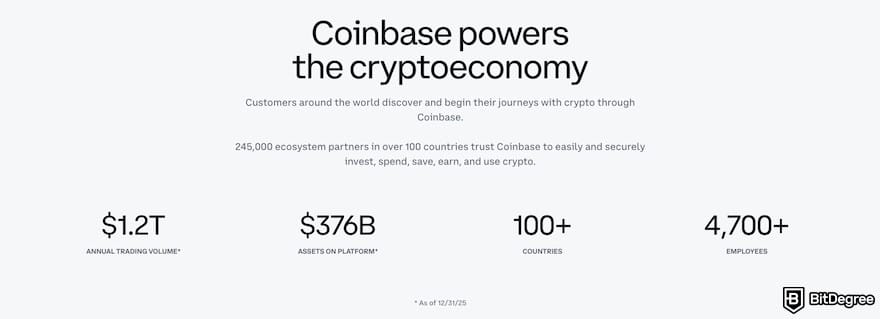
Coinbase benefits from its large institutional footprint, public listing, and strong USD markets. That gives it particularly deep order books on major pairs like BTC/USD and ETH/USD, especially for US-centric trading flows. In practice, that translates into:
- Strong liquidity on BTC and ETH fiat pairs (especially USD);
- Very deep order books on major institutional flows;
- Lower slippage on large market orders in core assets;
- More consistent execution for high-volume fiat trades;
- Strong integration with traditional banking rails;
- Stable pricing during high retail demand periods.
Kraken, on the other hand, is a bit smaller in raw trading volume, but it’s really strong when it comes to execution quality for active traders. It’s less about being the biggest liquidity pool and more about being efficient where it counts.
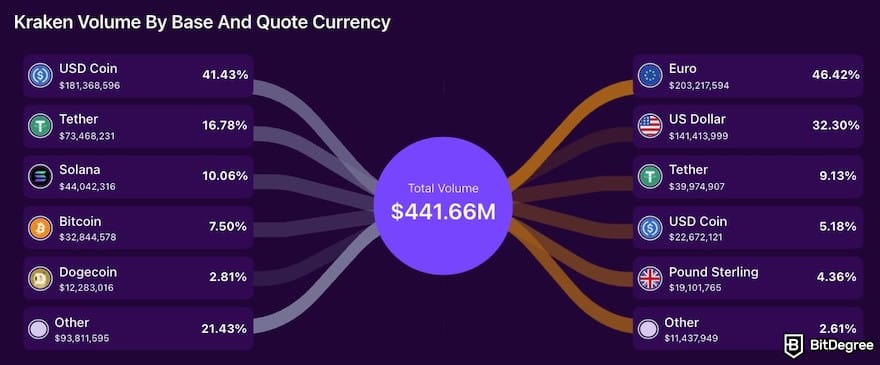
Its order books are still solid on major pairs, and it tends to feel more “precise” in how orders get filled, especially for users who care about execution over hype volume. That typically shows up as:
- Competitive liquidity on BTC, ETH, and major alt pairs;
- Tighter spreads on Kraken Pro for active traders;
- Efficient order matching for mid-sized trades;
- Lower slippage advantages relative to the fee structure for many users;
- Strong performance during volatile trading conditions;
- Consistent execution quality for spot trading strategies.
Across public data comparisons, Coinbase generally shows higher overall spot volume and deeper institutional liquidity, while Kraken offers more cost-efficient execution with slightly thinner (but still reliable) order books depending on the pair and region.
Verdict
Coinbase leads in raw liquidity depth and institutional-grade execution on major fiat pairs, while Kraken holds its ground with efficient order matching, competitive spreads, and strong execution quality for active traders.
Coinbase vs Kraken - Security & Trust
Security-wise, both Coinbase and Kraken check most of the boxes you’d expect from a major exchange. They both support strong account protections like two-factor authentication (2FA), passkeys, and withdrawal address controls.
| Coinbase | Kraken |
|---|---|---|
Two-factor authentication (2FA) | ✓ | ✓ |
Passkeys/security keys | ✓ | ✓ |
Anti-phishing protection | ✓ | ✓ |
Withdrawal address whitelist | ✓ | ✓ |
Public company transparency | Publicly traded company | Private company |
Proof of Reserves/asset transparency | Holds customer assets 1:1 | Cryptographic Proof of Reserves audits |
Security history | More direct customer-impact events | No hacks affecting customer funds |
Table: Comparison of Kraken and Coinbase's security features
That said, Coinbase has an edge in corporate transparency, thanks to its public-company reporting requirements, while Kraken has a stronger crypto-native security reputation, backed by early Proof of Reserves adoption, ISO certification, and additional account-locking features like Master Key and Global Settings Lock.
Coinbase feels more institutionally trusted, while Kraken is widely regarded as having a stronger security-first culture.
In fact, as of May 2026, Kraken has never suffered a platform-wide hack that resulted in customer funds being stolen, which is impressive considering how long it has operated. Yes, Kraken has faced security incidents, including a 2024 zero-day bug that led to roughly $3 million in losses from Kraken’s own treasury, but customer funds remained safe in each case.
📚 Read More: Is Kraken Safe?
On the other hand, Coinbase’s track record includes a few customer-impact incidents.
- In 2021, around 6,000 customer accounts were compromised after attackers exploited a weakness in Coinbase’s SMS account recovery process;
- In May 2025, Coinbase disclosed that contractors were allegedly bribed to steal sensitive customer information, including names, emails, ID details, and account balances.
No private keys and customer crypto were stolen, but the incidents have made people concerned in terms of its internal access controls and customer data protection.
📚 Read More: Is Coinbase Safe?
Verdict
Both exchanges are secure by industry standards, but Kraken has a cleaner security record. Coinbase benefits from stronger regulatory oversight, but its history includes more direct customer-impact events.
Coinbase vs Kraken - Broader Ecosystem
Beyond buying and trading crypto, Coinbase and Kraken have been building broader ecosystems around payments, investing, staking, and on-chain tools. This is where the two platforms start to feel more unique as crypto platforms with their own product stacks.
Coinbase’s Other Features
Coinbase is more than a trading platform now, since it has built its own ecosystem with a crypto wallet and more. The main extra features on Coinbase include:
1
Coinbase One
Coinbase One is Coinbase’s premium membership, with a basic plan starting at $49.99/year. It bundles perks like reduced or zero trading fees on eligible transactions, higher staking rewards, and priority customer support. You can also get partner deals, such as with a free package of CoinTracker and airdrops on PancakeSwap.
2
Base App
Formerly known as Coinbase Wallet, the Base app lets users have full control over their assets and private keys. It also serves as a gateway to the broader Base ecosystem, making it easier to explore DeFi, on-chain apps, and Web3 services with lower transaction costs compared to the Ethereum mainnet.
📚 Read More: The Base App Review
3
Coinbase Earn
Coinbase Earn lets users put idle crypto to work through staking, USDC rewards, and lending products.
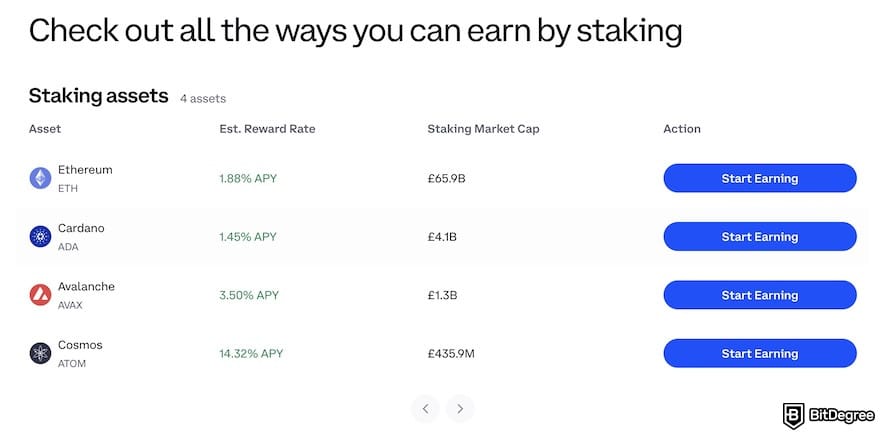
Depending on the asset and region, users can earn up to around 14% APY through staking, 3.50% rewards on USDC (higher with eligible memberships), and up to 10%+ APY through USDC lending products, often with flexible withdrawal access.
📚 Read More: Coinbase Earn Review
4
Coinbase Wealth
Coinbase Wealth is specifically aimed at ultra-high-net-worth individuals (UHNWIs), family offices, and professional advisors, offering institutional-grade custody, deep liquidity, financing, staking, lending, and white-glove trading support through the Coinbase Prime infrastructure.
5
Coinbase Card
Coinbase Card is a crypto debit card that lets users spend their crypto or stablecoin balances just like regular money, anywhere Mastercard is accepted. It can be linked directly to a Coinbase account, so you can convert digital assets into everyday spending without manually cashing out first.
Depending on the region and promotional period, users may also qualify for crypto rewards or cashback on eligible purchases.
6
Coinbase Quests
Previously known as "Coinbase Learn and Earn", Quests is Coinbase’s learn-to-earn program, where users can watch short educational lessons about cryptocurrencies and complete simple quizzes in exchange for free tokens. Rewards typically vary by campaign, but users can often earn a few dollars worth of crypto per lesson, with some larger promotions offering more.
7
Coinbase NFT
Coinbase NFT was launched as Coinbase’s marketplace for discovering, buying, selling, and showcasing NFTs. It supports social-style features like following creators, building collections, and interacting with digital art communities, aiming to make NFTs feel more accessible to mainstream users.
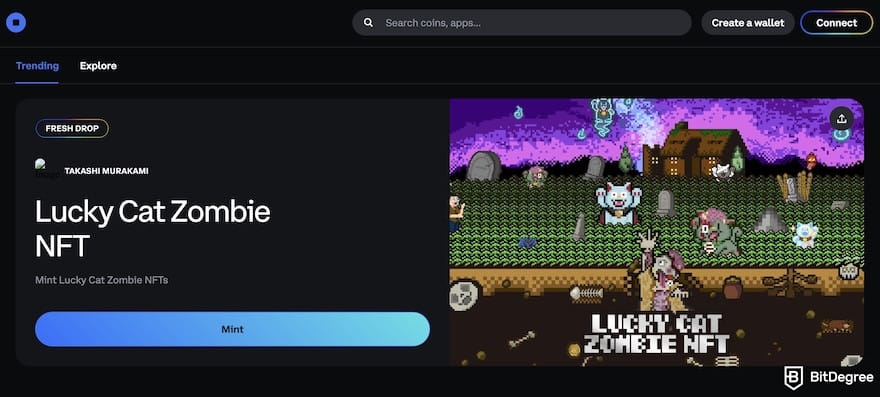
While adoption has been more muted than initially expected, it still reflects Coinbase’s push beyond exchange services into creator economies and Web3 ownership.
Kraken’s Other Features
Besides its exchange services, Kraken has expanded into a broader financial ecosystem that goes well beyond simply buying and selling crypto. Its ecosystem enables users to trade actively, spend crypto in daily life, or earn yield on idle assets.
1
Kraken Wallet
Kraken Wallet is a secure, self-custody cryptocurrency wallet that allows users to manage their own private keys while storing, sending, and receiving crypto assets and NFTs. Unlike the centralized Kraken exchange, this mobile app offers "your keys, your crypto" ownership and supports multi-chain access across major blockchains, including Bitcoin, Ethereum, and Solana.
2
Global P2P payments by Krak
Krak is a global money app launched by Kraken, combining traditional finance with digital assets. It enables users to send, spend, and save using 300+ crypto and fiat currencies via a mobile app, using personalized "@Kraktags" for instant, fee-free peer-to-peer transfers to over 160 countries.
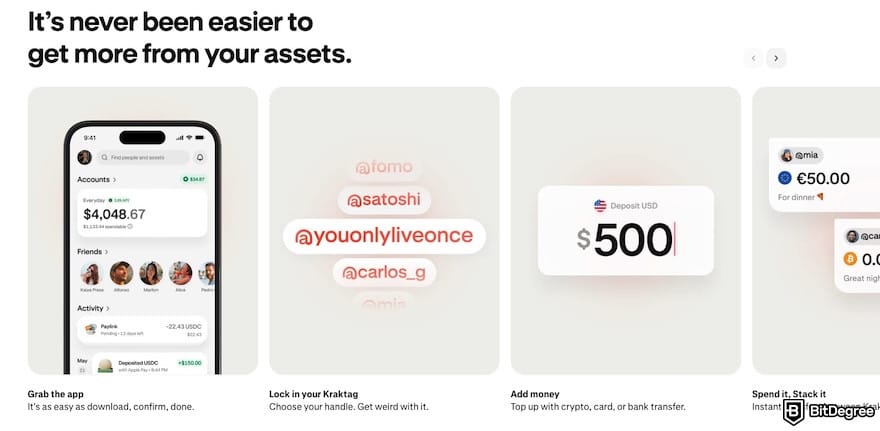
You can also use Krak’s Mastercard debit card to spend 600+ currencies at 110M+ merchants and get instant cashback in Euros, Pounds, or Bitcoin.
3
Stocks trading
US clients can now invest in over 11,000 stocks and ETFs across NYSE, NASDAQ, AMEX, and more with zero commissions. It’s possible to place orders 24/7, although it will be queued and executed at the start of the next trading session if you submit an equities order outside of market hours.
4
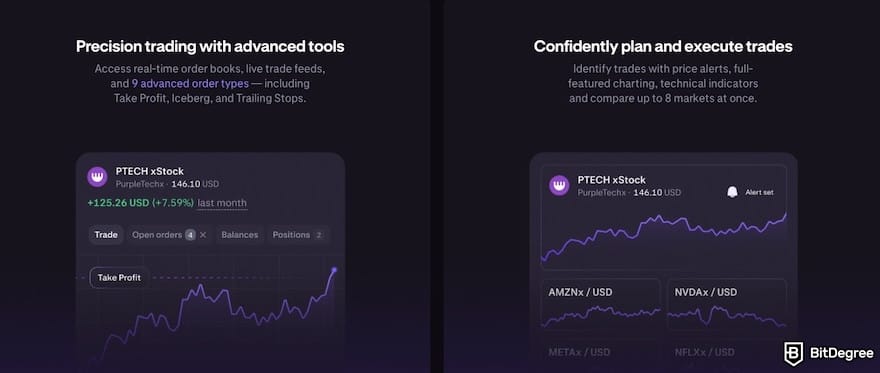
xStocks trading
Kraken lets you trade on tokenized representations of real-world stocks and ETFs. Each xStock is backed 1:1 by the underlying equity, but it trades on crypto rails. This feature is available in select non-US countries, including many markets in Europe.
5
Staking
Kraken supports staking on 20+ assets, with rewards that can reach double-digit APYs depending on the token and region. You can switch on Auto Earn to get passive income with no lock-up period, or choose Bonded Staking for potentially higher rewards in exchange for locking funds for longer. There are also ETH staking and BTC staking to help you earn more.
Verdict
Coinbase’s extra features are mostly crypto-focused, centered on digital assets and Web3 access. Kraken, on the other hand, takes a broader financial approach, expanding into payments, stocks, ETFs, and tokenized equities. Choose which you think is more suitable for your financial goals and lifestyle.
Coinbase vs Kraken - Fiat Deposits and Withdrawals
When it comes to moving money in and out of an exchange, both Coinbase and Kraken support major fiat methods, like bank transfers, wire deposits, and card purchases. Coinbase supports 60+ fiat currencies, though its strongest infrastructure is clearly built around USD, EUR, and GBP, with funding rails like ACH (US), SEPA (Europe), Faster Payments (UK), wire transfers, debit cards, and PayPal in selected regions.
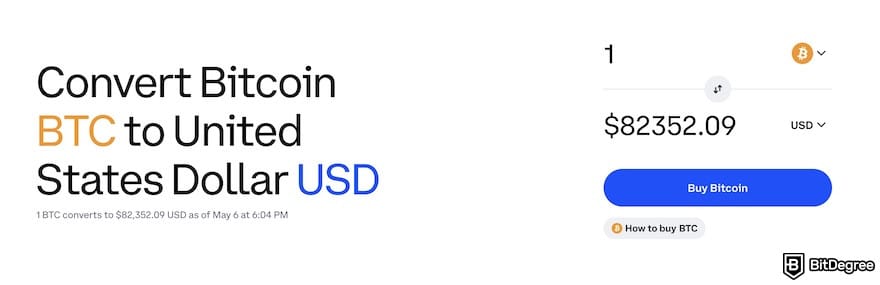
Many of Coinbase’s official funding guides and support documentation revolve around these three core currencies. This suggests that regional support outside them may rely more heavily on card purchases or local payment processors rather than dedicated banking rails.
Kraken, meanwhile, supports a smaller (but still broad) range of major fiat currencies:
- USD (US Dollar)
- EUR (Euro)
- CAD (Canadian Dollar)
- AUD (Australian Dollar)
- GBP (Pound Sterling)
- CHF (Swiss Franc)
- JPY (Japanese Yen)
- BRL (Brazilian Real)
- ARS (Argentine Peso)
- MXN (Mexican Pesos)
The deposit methods are clearly displayed by currency, along with fees, limits, and processing times, so Kraken’s fiat system feels much more transparent. For example, USD users may access ACH (Plaid), debit cards, PayPal (US only), and SWIFT, while EUR users can fund accounts via SEPA, SWIFT, debit cards, PayPal, and in the Netherlands, iDEAL with free deposits.
Kraken also supports Apple Pay and Google Pay purchases through Krak.
The main catch with Kraken is withdrawal holds. Certain purchase methods, such as ACH, PayPal, debit/credit cards, digital wallets, and some first-time instant purchases, can trigger a 72-hour withdrawal lock. ACH Plaid deposits may even be held for up to 7 days before withdrawal is allowed. This setup makes Kraken less flexible for users who want immediate access to move funds off-platform.
Verdict
Coinbase is generally better for simple fiat onboarding, especially in major markets like the US, UK, and Europe. However, Kraken is stronger for funding transparency and broader international fiat options, with clearer fee disclosures and more localized payment methods.
Coinbase Trading Walkthrough
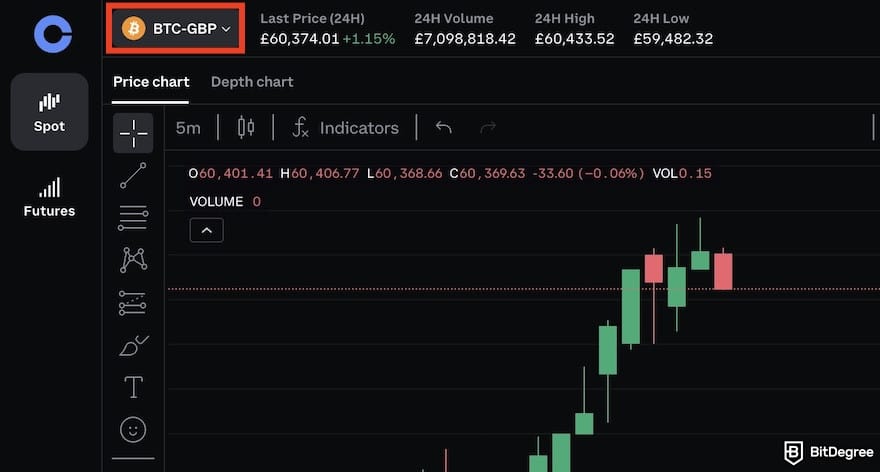
You can simply buy crypto through the standard Coinbase interface, but if you want a more hands-on trading experience, Coinbase Advanced gives you access to advanced charts, live order books, and different order types. In this tutorial, let me guide you through the steps on how to buy crypto on Coinbase Advanced:
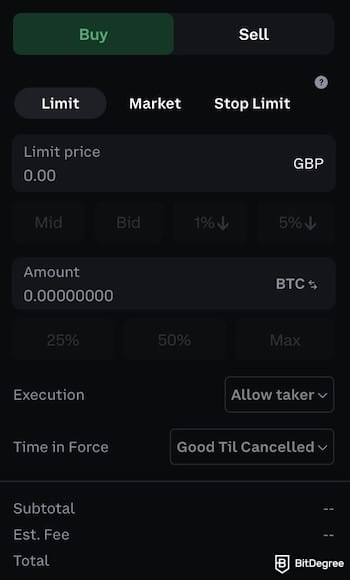
For example, if you enter $5, Coinbase will use that amount to buy Bitcoin at the best available price.
The main benefit of Coinbased Advanced is speed, as your trade is executed almost instantly. For beginners, market orders are simple and convenient. But if you want more control over price and fees, limit orders are usually the smarter choice.
Kraken Trading Walkthrough
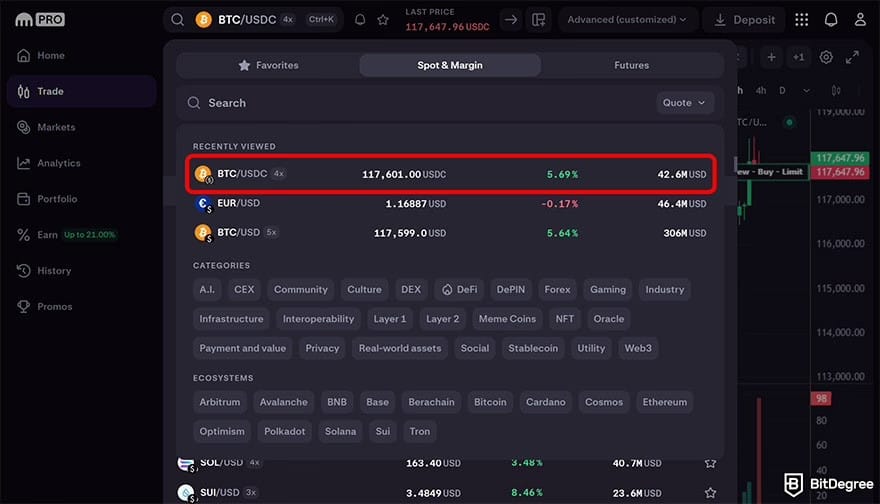
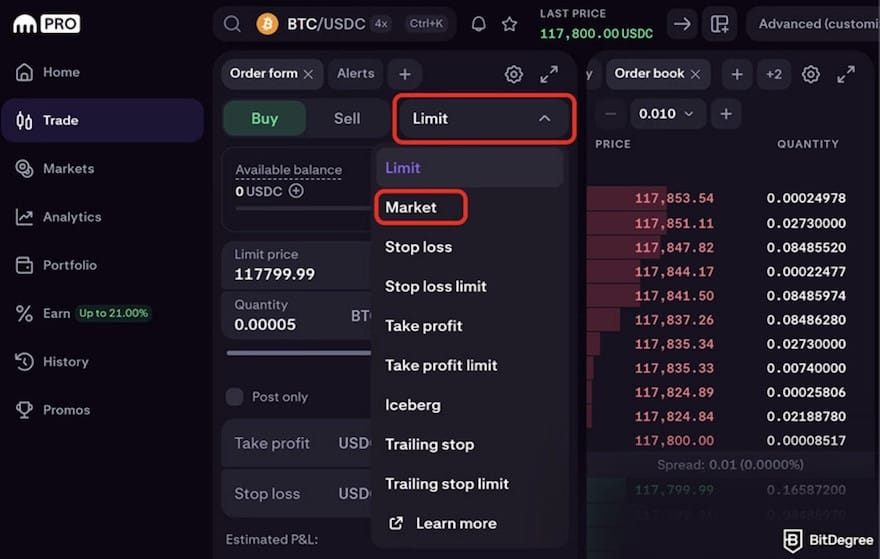
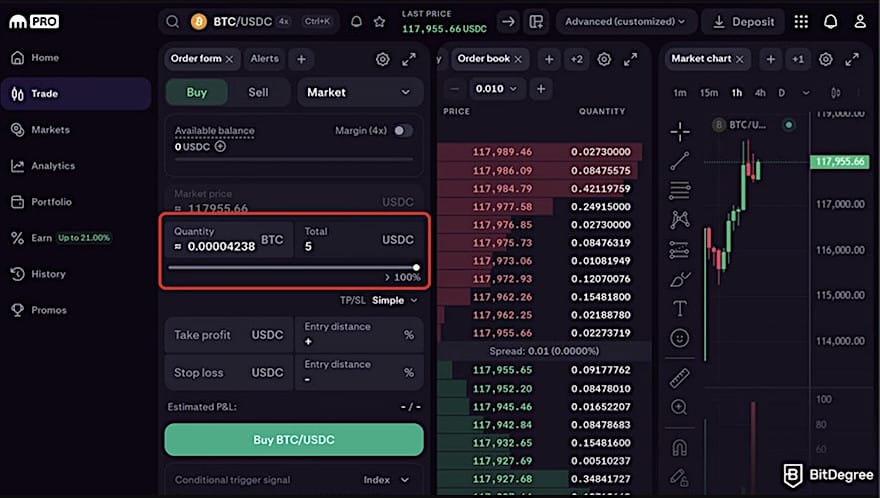
Similar to Coinbase, Kraken gives you two ways to get started. It’s possible to deposit funds and buy crypto quickly on the standard Kraken interface or choose to switch to Kraken Pro, which looks like a “proper” trading dashboard. For now, here’s how to place a simple market order on Kraken Pro:
You can access Kraken Pro using your existing Kraken account credentials, either by logging in through the Kraken Pro website or by downloading the dedicated mobile app on iOS or Android.
Coinbase vs Kraken for Beginners
Coinbase and Kraken are both beginner-friendly platforms, but Coinbase is generally considered more beginner-friendly, especially in major markets like the US, UK, and Europe, and here's why:
- Cleaner, simpler interface;
- Extremely straightforward buy/sell flow;
- Better educational content ("Learn and Earn");
- A more widely recognized brand, which builds trust for newcomers;
- The app is very intuitive on mobile;
- Various fiat payment methods for users in major markets.
Kraken's strengths that may benefit beginners include more assets available, such as xStocks, competitive fees (especially with Kraken+), and the DCA feature that is nicely surfaced right on the home screen.

One thing worth noting is that Kraken tends to have broader country support, so it may actually be more beginner-friendly for international users. The platform supports a wide range of fiat currencies, including USD, EUR, CAD, AUD, GBP, CHF, ARS, BRL, and MXN, and clearly lays out deposit methods, fees, limits, and processing times for each currency.
That transparency helps users understand exactly how to fund their accounts, often through localized payment rails like iDEAL and debit cards, depending on the region. For beginners outside Coinbase’s strongest markets, Kraken’s broader fiat coverage can make onboarding feel more natural.
Verdict
For a true beginner, Coinbase is the classic recommendation, but if Coinbase doesn't support buying in your region, Kraken is a capable and not-too-complex alternative.
Coinbase vs Kraken for Active Traders
Coinbase and Kraken offer professional-grade trading environments, but they have slightly different trading styles. The first option is strong for traders who want an institutional-style setup. Through Coinbase Advanced, users get:
- TradingView-powered charts;
- Futures trading;
- Advanced order types;
- API access;
- Lower volume-based fees compared to standard Coinbase.
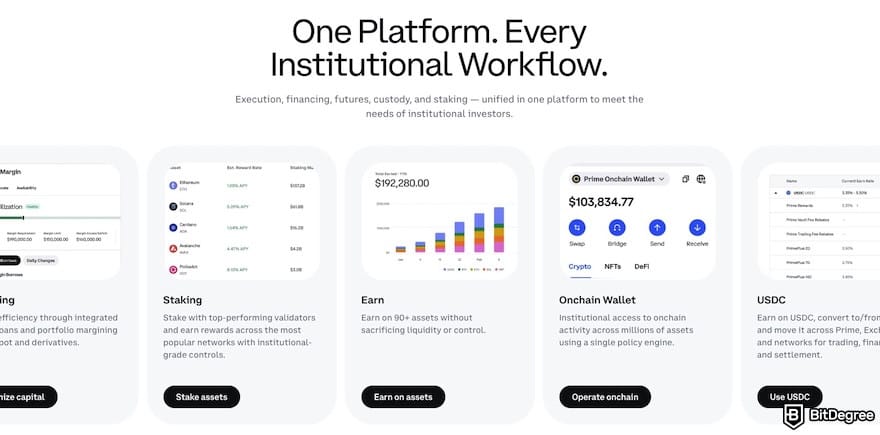
For larger traders, Coinbase’s institutional stack goes even deeper through Coinbase Prime, which offers aggregated liquidity, smart order routing, financing, custody, RFQ execution, and algorithmic execution tools.
Meanwhile, Kraken Pro feels more trader-native, offering:
- Advanced charting;
- Multiple order types;
- Customizable dashboards;
- Margin and futures trading;
- API connectivity;
- Consistently lower fees, especially at lower trading tiers.
For institutions and whales, Kraken has its own Prime/OTC infrastructure, so it also supports professional execution beyond retail order books.
Do they look similar? Yes, the core tools of Kraken and Coinbase are quite the same, but Kraken has its edge with margin trading and significantly lower fees (I’ve talked about this in the “Fees” section). Margin trading allows eligible users to borrow funds and open larger positions than their account balance alone would allow (up to 5x leverage in supported markets), potentially making the gains (and losses) much larger than in regular spot trading.
Note
For active trading, Kraken is the stronger choice, with lower fees, more tools, more assets, and more flexibility. Coinbase is better if you're in the US and prioritize regulatory safety and simplicity over cost efficiency.
Coinbase vs Kraken for Passive Users: Earning Opportunities
For passive crypto holders, both Coinbase and Kraken offer ways to earn yield, but Kraken is clearly stronger if earning rewards is one of your main goals.
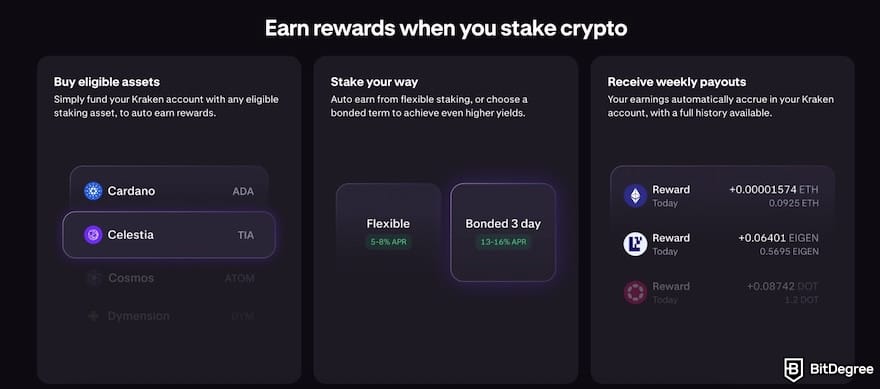
Kraken Staking supports staking on 21+ assets, so users get a much broader selection of coins to earn from compared with Coinbase. It also offers more ways to generate yield:
- Auto Earn (flexible rewards on idle assets);
- Bonded Staking (higher rewards for locking funds);
- ETH Restaking (double stake ETH using the EigenLayer protocol);
- BTC staking options in supported regions.
Moreover, Kraken advertises staking rewards of up to 21% APR on select assets, though actual yields vary widely depending on the token, market conditions, and location.
Meanwhile, Coinbase takes a simpler, more beginner-friendly approach. It currently supports staking on 8 major assets: ETH, SOL, ADA, DOT, ATOM, AVAX, POL, and XTZ. The platform also bundles passive income under Coinbase Earn, where users can earn through staking, USDC rewards, and certain lending-style products, depending on the region.
With Coinbase Earn, users can earn up to 14% APY (which is lower than Kraken, but still competitive). In case you subscribe to Coinbase One, you can get up to 15% boost in your staking rewards. However, it comes with a monthly or annual price, starting at €49.99 a year or €4.99 per month.
Verdict
Coinbase is fine if you want an easy “set it and forget it” earning option, though be aware of its security record. But if you want more supported assets, potentially higher APYs, and a clean safety history, Kraken is the stronger platform.
Final Verdict: Is Coinbase or Kraken Better?
Choosing between Coinbase and Kraken ultimately comes down to what kind of crypto user you are, because both platforms are excellent – just in different ways.
If you want the simplest onboarding experience, strong institutional backing, and a crypto ecosystem built around digital assets and Web3, Coinbase can be a better fit. It feels more mainstream and more integrated, from easy fiat deposits to products like Base Wallet.
However, beginners who want to scale to be active, pro traders may see Kraken as their “one”. It offers lower fees, a broader crypto selection, and a more trader-focused platform. This platform supports 500+ assets, offers margin and futures access, has a cleaner security record, and generally gives active users more value per trade, especially outside Coinbase’s strongest markets.