




Binance vs Crypto.com – In-Depth Comparison
Binance and Crypto.com look like natural rivals on paper. Both are well-known names in the crypto industry. Dig a little deeper, though, and you'll realize they approach crypto from very different angles.
Binance became a giant by giving active traders what they wanted: volume, liquidity, deep markets, and a platform that kept expanding fast. That formula turned it into one of the world's largest crypto exchanges.

Crypto.com took a different route. It leaned into brand recognition, from naming rights for the former Staples Center in Los Angeles to FIFA World Cup sponsorships and the high-profile "Fortune Favors the Brave" campaign. From there, it built a more everyday-user-friendly platform around its Visa card and mobile app.
Crypto.com sponsorship portfolio also includes Formula 1, the UEFA Champions League, UFC, AFL, the Philadelphia 76ers, and the LA Kings.
"Which one is better?" That’s not the right question to ask. The better one is: "What are you actually trying to do with crypto?"
As of 2026, Binance reports more than 320 million registered users and positions itself as the industry leader in customer assets and trading volume. Crypto.com, with over 150 million registered users, remains a major player, but it competes on a noticeably different scale when it comes to liquidity and market depth.
Here's the comparison in plain terms:
Best for | Active traders who want a full crypto trading ecosystem | Everyday crypto users who want real-life crypto features |
|---|---|---|
Main strength | Deep liquidity across a broad range of products | Beginner-friendly features with seamless credit/debit card access |
Supported cryptocurrencies | BTC, ETH, BNB + 500 more | BTC, ETH, SOL + 400 more |
Spot trading fees | Very competitive | Competitive |
Derivatives | Futures, perpetuals, & options | Strike & UpDown Options |
Crypto card | Binance Card | Visa Signature® Credit Card |
Beginner experience | Good starting point for a full-platform exposure platform | Casual-friendly with simple buy, earn, and spend tools |
Overall verdict | Best for size, liquidity, and platform access | Best for crypto spending, rewards, and everyday utility |
Table: a quick Binance vs Crypto.com comparison
In short, Binance has the edge when it comes to trading depth, liquidity, and ecosystem size. Crypto.com stands out for its consumer-friendly experience, card ecosystem, and focus on everyday crypto utility.
Binance vs Crypto.com – Market Position
On sheer market size, Binance operates in a different league. It claims around $120 billion in user assets, regularly records huge trading volumes, and benefits from liquidity network effects that smaller platforms can't copy overnight.
In practice, that market depth can mean tighter bid-ask spreads on major pairs, quicker order matching during high-volume periods, and better price execution for larger trades. If you're an active trader, that's not something to gloss over.
Crypto.com took a noticeably different route to market position. Where Binance built scale through traders, Crypto.com built recognition through consumers, sports sponsorships, and brand-heavy marketing. That made it a familiar crypto name even for people who don't actively trade, especially in the US.
Crypto.com's ecosystem has grown well beyond its original identity. Alongside the Visa card and mobile app, it now operates the Crypto.com Exchange, the Cronos Layer 1 blockchain, a standalone wallet, and several business-facing products. There's a lot more here than many casual users realize.
Verdict
Binance leads in trading volume, liquidity, and exchange market share. Crypto.com competes on consumer brand recognition and a spending-first identity.
Binance vs Crypto.com – Trading Features
Both offer trading products, but they are starting to differentiate beyond basic spot trading. Once derivatives, automation, and strategy tools enter the picture, Binance and Crypto.com are playing slightly different games.
Crypto.com Trading Features
To keep things clear for newer users, the platform has two separate products. The Crypto.com App is a simple consumer-facing mobile app, built for buying, holding, and spending crypto. The Crypto.com Exchange is the more advanced trading platform, with order books, charts, and all the usual tools that come with a professional exchange.
For basic trading, Crypto.com offers:
- Quick buy/sell gives you a simple way to trade 400+ supported tokens.
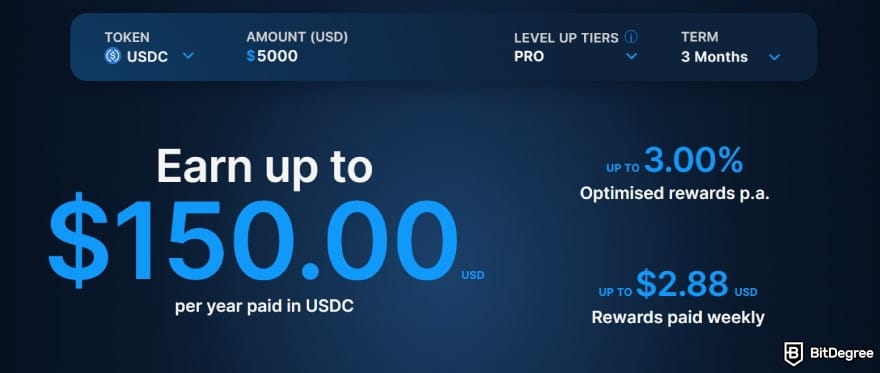
- Earn helps you put supported crypto assets to generate passive income.
- Pay lets you spend crypto across 300,000+ merchants worldwide.
- Crypto Baskets bundle multiple tokens into curated market themes.
For more advanced trading, the Exchange supports:
- Spot trading lets you trade crypto pairs with more precision.
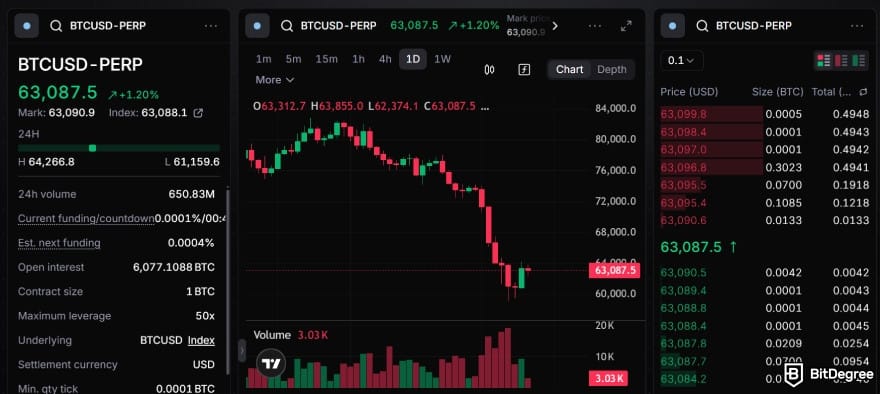
- Futures trading gives you access to leveraged crypto contracts.
- Trading bots help you automate selected market strategies.
- Exchange API gives you developer-level access to trading features.
Crypto.com works well for users focused on spot trading and perpetuals. But if your strategy depends on copy trading, you'll probably outgrow its feature set quickly.
Binance Trading Features
Binance gives you access to the full trading stack, from basic swaps to advanced options strategies. That range is one of the reasons active traders tend to take the platform seriously.
For basic trading, Binance offers:
- Spot trading across hundreds of pairs, including many small-cap altcoins.
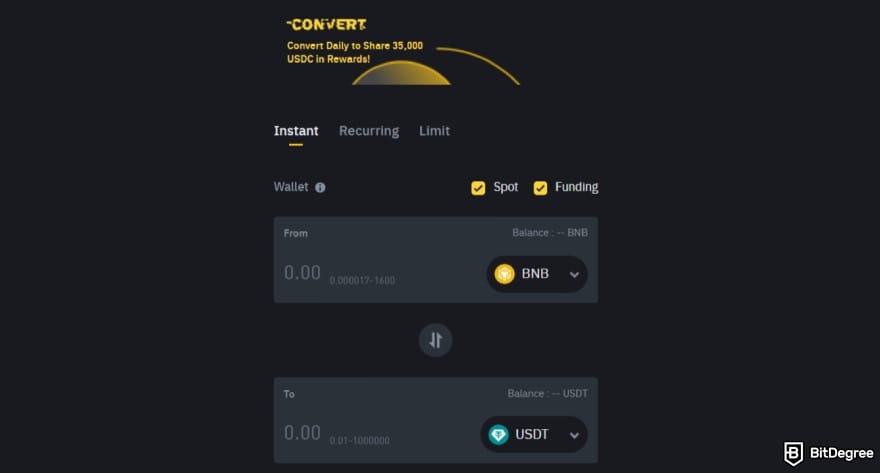
- Convert for quick swaps without entering the order book.
- P2P trading across a wide range of currencies and regions.
- Demo trading for practicing with simulated funds before risking real money.
For advanced trading, Binance supports:
- Margin trading with cross and isolated margin options.
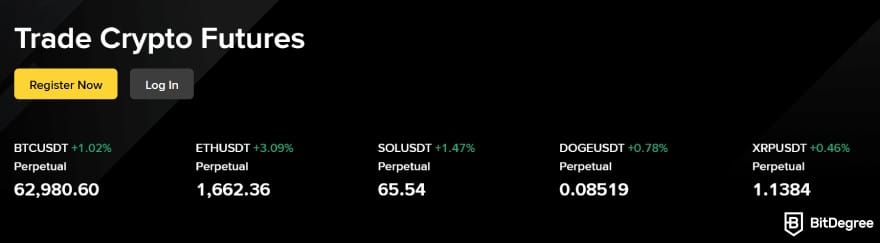
- Binance futures for leveraged crypto contracts.
- Options trading for more complex positioning and hedging.
- API and algorithmic trading with robust documentation.
Binance gives you a lot, and that is both the strength and the headache. The platform has collected years' worth of trading features, so the interface can be dense at first. Lite mode helps soften the landing for newer users, while the full experience is there when you're ready for it.
Verdict
When it comes to trading capabilities, Binance has the edge. Its advantage is most noticeable in automation and market coverage. Crypto.com is more than capable for spot and perpetual traders, though it's designed around a more focused set of needs.
Binance vs Crypto.com – Fees
For most active traders, Binance usually comes out cheaper. Standard spot fees typically start at 0.10% maker and 0.10% taker, with further discounts available when users pay fees with BNB. That kind of fee setup is a big part of its appeal for frequent traders.
With Crypto.com, the fee depends on the product you use. The App is easier for quick buys, but spreads and payment-method costs may be baked in. The Exchange gives you a proper maker-taker structure, although its entry-level spot fees can be higher than Binance's.
Account opening | Free | Free |
|---|---|---|
Crypto deposit fees | Usually free (some exceptions depending on asset) | Free |
Crypto withdrawal fees | Varies by blockchain/network | Varies by blockchain/network |
Fiat deposit fees | Varies by method and currency | Varies by method and currency |
Fiat withdrawal fees | Varies by method and currency | Varies by method and currency |
Spot - maker fees | Starts at 0.1%, can drop to 0.00825% | Starts at 0.25%, can drop to 0% |
Spot - taker fees | Starts at 0.1%, can drop to 0.01725% | Starts at 0.5%, can drop to 0.022% |
Futures - maker fees | Starts at 0.02%, can drop to 0% | Starts at 0.02%, can drop to 0% |
Futures - taker fees | Starts at 0.05%, can drop to 0.0153% | Starts at 0.04%, can drop to 0.0132% |
Options trading | Starts at 0.024% maker Starts at 0.024% taker | - |
P2P trading | 0.35% maker & taker | - |
Table: Comparison of Binance and Crypto.com fees
At the standard fee level, Binance has the edge because most traders get a cheaper starting rate. After applying VIP benefits and native token discounts (BNB on Binance and CRO on Crypto.com), the numbers begin to spread out more. Both platforms offer solid fee structures, though Binance still comes out slightly ahead.
📚 Read More: Binance Fees Explained
One interesting detail is that the CRO balance discount is a bit higher than the BNB discount. CRO gives a 12% fee reduction, while BNB offers 10%. That means, at the standard level, Crypto.com’s regular 0.5% taker fee can drop to 0.44% when you hold CRO in your balance.
📚 Read More: Crypto.com Fees Explained
$1,000 Spot Trade Example
Let's say you place a $1,000 BTC/USDT market buy order.
On Binance at the standard 0.1% taker rate:
$1,000 × 0.1% = $1.00
With the BNB fee discount applied:
$1,000 × 0.075% = $0.75
On Crypto.com at the standard 0.5% taker rate:
$1,000 × 0.5% = $5.00
With the CRO fee discount applied:
$1,000 × 0.44% = $4.40
For standard spot trading fees, Binance has the advantage. A few dollars here and there might not seem huge on a single trade, but they can pile up if you trade quite often. However, if you genuinely prefer Crypto.com’s interface, the slightly higher fee may be a fair trade-off for casual use.
$1,000 Futures Trade Fee Comparison
As a simple example, let’s say you enter a $1,000 BTCUSDT perpetual position through a market order:
On Binance, using the regular 0.05% taker fee example:
$1,000 x 0.05% = $0.5
With the BNB fee discount applied:
$1,000 x 0.045% = $0.45
On Crypto.com, using the standard 0.04% taker fee:
$1,000 x 0.04% = $0.40
With the CRO fee discount applied:
$1,000 x 0.0352% = $0.352, or about $0.35
Looking at the futures trading example, Crypto.com comes out a little cheaper. The gap isn’t massive, but futures trading often involves more frequent entries and exits, so even a small difference can become noticeable over time.
That said, trading fees are only one part of the real cost. You also need to consider:
- Bid-ask spread;
- Slippage;
- Funding rates;
- Liquidation risk;
- Order execution quality;
- Deposit and withdrawal fees;
- Whether you are using market or limit orders.
If you mainly use limit orders, maker fees can be more important. If you often use market orders, taker fees deserve more attention. For standard futures maker fees, both platforms sit at the same 0.02%, while higher tiers can unlock zero maker fees on both sides.
Verdict
Binance comes out cheaper for spot trading, especially at the entry level. Futures fees are much closer, and Crypto.com may even be slightly cheaper in the taker example.
Binance vs Crypto.com – Liquidity & Execution
Binance handles a larger share of global centralized spot volume than Crypto.com. For major pairs like BTC/USDT and ETH/USDT, that often translates into tighter bid-ask spreads, lower slippage on market orders, and more reliable pricing when volatility spikes.
Liquidity can have a meaningful impact on the final price at which your trade is executed.
For standard retail-sized trades on major pairs, Crypto.com holds its own reasonably well. Buying or selling BTC and ETH in typical amounts should give you acceptable execution quality. The difference becomes clearer when you move off major pairs or start placing larger trades.
The key point is that matching fees don't necessarily translate into matching costs. Wider spreads and higher slippage can make a trade more expensive in practice, which is why fee tables only tell part of the story.
Verdict
Binance has stronger liquidity across both spot and derivatives. Crypto.com is still fine for typical retail trades on major pairs, but the former scale advantage becomes harder to ignore once trade size or frequency goes up.
Binance vs Crypto.com – Security & Trust
At the account level, both Binance and Crypto.com offer strong security measures and comparable protection features for users.
Crypto.com | Binance | |
|---|---|---|
Two-factor authentication | ✓ | ✓ |
Passkeys | ✓ | ✓ |
Anti-phishing code | ✓ | ✓ |
Withdrawal address whitelist | ✓ | ✓ |
Proof of Reserves | ✓ | ✓ |
24/7 customer support | ✓ | ✓ |
User protection reserve / fund | Security Reserve | SAFU |
Self-custody wallet | Crypto.com Onchain | Binance Wallet |
Table: Crypto.com and Binance security features
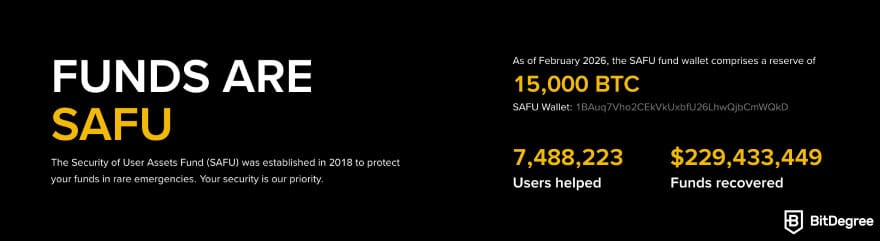
Binance's SAFU (Secure Asset Fund for Users) is one of its most prominently cited protection features. It's an emergency reserve that the platform has built over the years with the stated purpose of covering user assets in the event of an extreme platform-level incident.
Crypto.com also supports transparency through published Proof of Reserves (PoR) and a dedicated security reserve. It states that customer assets are fully backed 1:1, safely stored, and available for redemption at any time.
Proof of Reserves is an audit-based system designed to prove that a platform has enough reserves to cover all user deposits.
At the account level, both platforms provide very similar security features. The bigger difference is at the platform level, where Binance's SAFU fund offers a larger protection buffer, while Crypto.com's security reserve is somewhat smaller, though it's by no means insignificant.
Note
Binance and Crypto.com are both strong on user account protection. The difference is that Binance has a more established platform-level safety net through SAFU, along with a longer track record. Crypto.com has faced some bumps in the past, but its current security setup looks stronger than before.
Binance vs Crypto.com – Broader Ecosystem
Trading is only part of the story. Both platforms have expanded into broader ecosystems, and this is where Crypto.com starts to stand apart. Its product lineup differs from Binance's in meaningful ways and, in certain areas, feels more mature.
Binance's Broader Ecosystem
There's little debate that Binance has one of the most comprehensive non-trading ecosystems in the crypto space:
1
Earn products
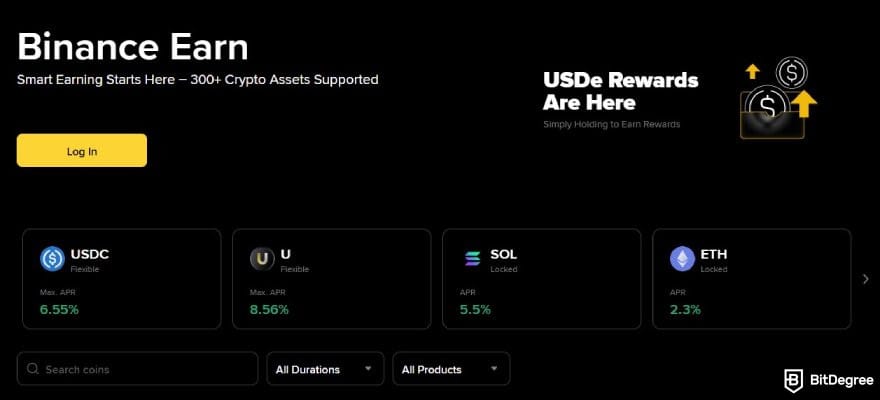
Binance Earn is a big part of why Binance feels so broad outside of trading. You get Simple Earn, flexible and locked products, ETH and SOL staking, Dual Investment, plus on-chain yield options. Binance claims 300+ supported cryptocurrencies, but as always, availability depends on where you are and what product you're using.
2
Launch and reward products
Binance gives users a few ways to access new tokens and campaign-based rewards.
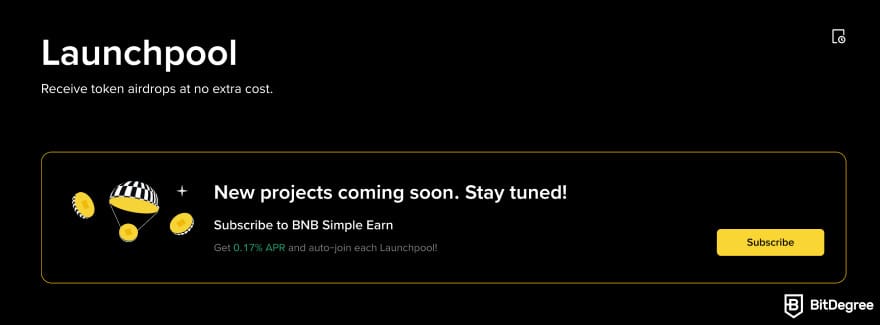
Launchpool allows users to lock supported assets for token airdrops, while Megadrop blends Simple Earn with Binance Wallet quests to offer early access to selected Web3 projects.
3
Payments and spending
Binance extends into everyday crypto use through Binance Pay, gift cards, crypto payment tools, and the Binance Card. These features help users spend, send, or gift crypto without treating it purely as a trading asset.
4
Web3 features
Binance Wallet works as the platform's gateway to DeFi, dApps, swaps, and multi-chain Web3 activity. Binance describes it as a keyless, seedless, multi-chain wallet using MPC technology, but that doesn’t magically remove the separate risks that come with Web3 activity outside the centralized exchange.
5
Education, research, and community
Binance also includes Binance Academy, Binance Research, Binance Square, Charity, and other products built around content, education, and community. They don't directly affect trading fees or execution, but they make the platform more useful for users who want news, learning resources, and ecosystem updates in one place.

That connected ecosystem is Binance’s main strength. A user can buy crypto, earn yield, join token campaigns, use a wallet, send payments, read market research, and explore Web3 tools all within a single place. The downside is that the platform can become visually and functionally busy, and product availability still varies by country.
Crypto.com's Broader Ecosystem
Crypto.com's non-trading ecosystem is more consumer-focused, and in a few areas, more developed than Binance's:
1
Earn products
Crypto Earn lets users place deposits across more than 21 tokens, covering major crypto assets, stablecoins, and several less familiar coins. It's easy to access through the app and straightforward enough for beginners, which is always nice when crypto products decide not to be a maze.
2
Predictions
Crypto.com has also added Prediction Trading to its wider set of products. Rather than buying or selling crypto, you trade contracts linked to real-world event outcomes across politics, economics, finance, culture, and sports. You choose an event, take a position, and receive payment after the outcome is resolved.
3
Payments
Crypto.com Visa Card is easily one of the platform’s most recognizable features and one of the reasons some users gravitate toward the brand. Unlike a regular debit card tied to your bank account, it functions as a prepaid card that must be topped up before spending.
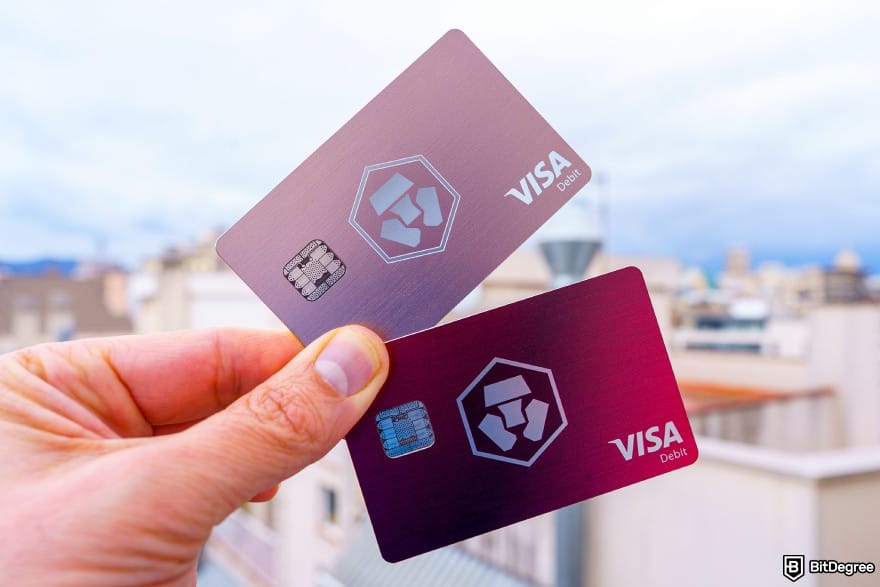
Its rewards program is the real hook. Eligible purchases can earn CRO, but reward rates vary depending on your card tier and region. The lineup stretches from entry-level cards to premium metal tiers, with the top tiers advertising up to 5% rewards.
4
Wallet
Crypto.com provides a separate self-custody wallet app outside the main exchange account, known as Crypto.com Onchain. It has its own seed phrase, gives users control over their own keys, supports dApp connections on Cronos and other chains, and lets them take real custody of their assets.
5
Cronos chain
Cronos is Crypto.com’s own EVM-compatible Layer 1 blockchain, with CRO as its native token. This gives the platform more than a standard exchange product suite: it also supports a real on-chain ecosystem with DeFi protocols, bridges, and community-built applications.
Verdict
Binance offers the broader ecosystem for education, research tools, and trading-adjacent features. Crypto.com, meanwhile, is more developed on the consumer side, especially with its card tier structure, payment infrastructure, and self-custody wallet.
Binance vs Crypto.com – Fiat Deposits and Withdrawals
Fiat access often gets overlooked in reviews until the exact moment you need it and it's not there. The good news is that both platforms support multiple deposit and withdrawal methods. Still, it should be made clear upfront that the experience can vary a lot depending on your country.
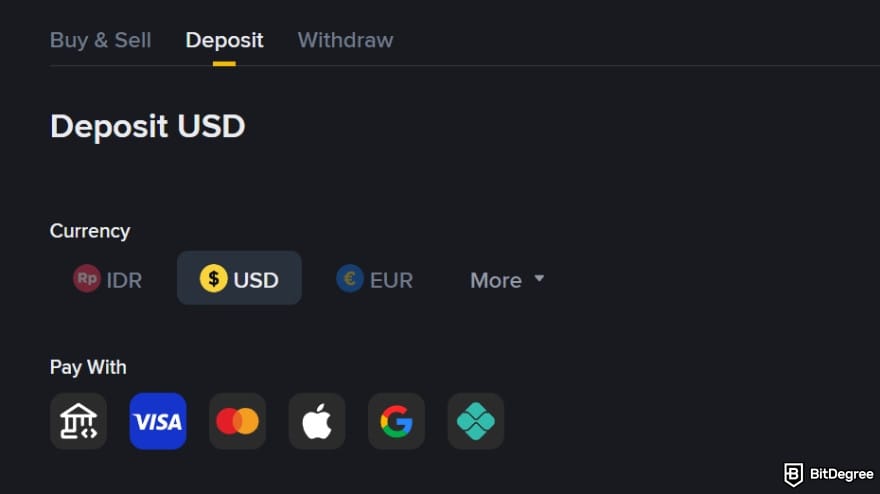
Binance offers broad fiat access. Depending on where they live, users can deposit through bank transfers, debit or credit card purchases, P2P trading, and several third-party payment providers. Its global scale means Binance often has more local payment integrations in emerging markets than many competing platforms.
The caveat is that Binance’s regulatory history has resulted in meaningful access restrictions in some countries. The US is the clearest example, where users are served through a separate Binance.US entity with a much more limited product range.
Crypto.com also offers pretty broad fiat support. Users can fund their accounts through bank transfers, card purchases, and P2P, where available. In certain countries, Crypto.com’s banking partnerships help make deposits surprisingly smooth.
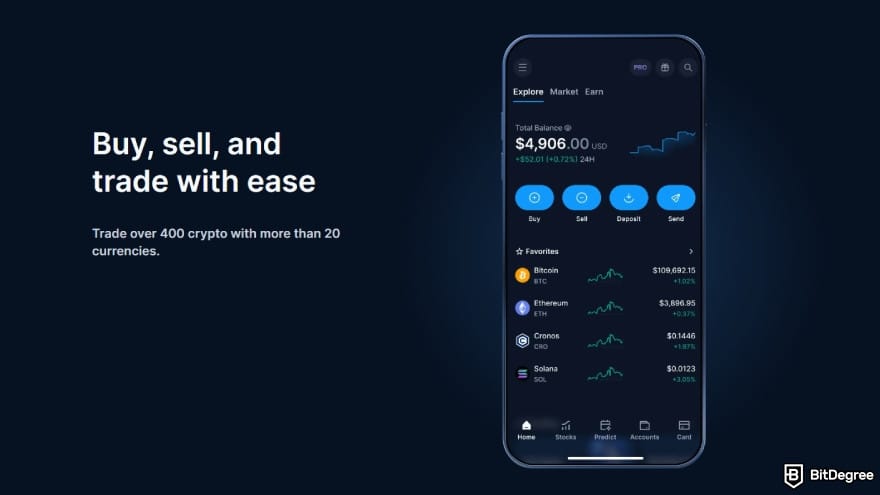
The more interesting angle, though, is the card itself. Once you have crypto on your account, you can spend it as fiat at any Visa terminal worldwide using your Crypto.com Card. That changes the practical meaning of “fiat withdrawal”: for everyday purchases, conversion to fiat may not even be necessary.
Fiat methods on both platforms may incur costs that aren't always front and center. Card purchases may involve a spread or service fee. Bank transfers are usually cheaper, though not exactly instant. P2P costs depend on individual seller pricing, so the cheapest route varies by region, method, and timing.
Verdict
Binance may have the edge in global fiat coverage, though the difference isn't night and day. Crypto.com’s card makes the comparison more interesting for everyday spenders: you may not need a fiat withdrawal if you are spending directly from your balance.
Crypto.com Trading Walkthrough
For most beginners, the Crypto.com App is the obvious place to start. Here’s a simplified walkthrough of the journey toward making your first crypto trade:
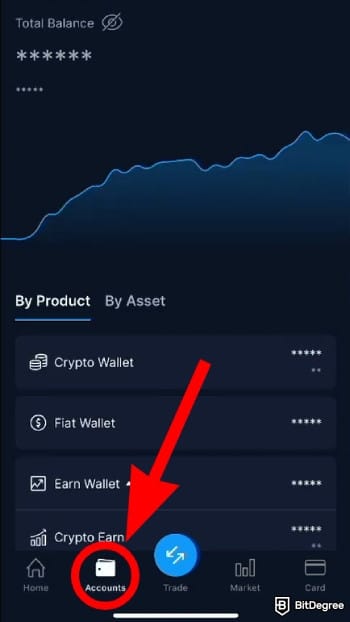
Make sure that your account is already verified.
![Binance vs Crypto.com: tap on [Buy].](https://assets.bitdegree.org/images/binance-vs-cryptocom-buy-crypto.jpg "Binance vs Crypto.com: tap on [Buy].")
If you haven't funded your account yet, you can also tap [Transfer] and select [Deposit] to add some funds to your wallet.
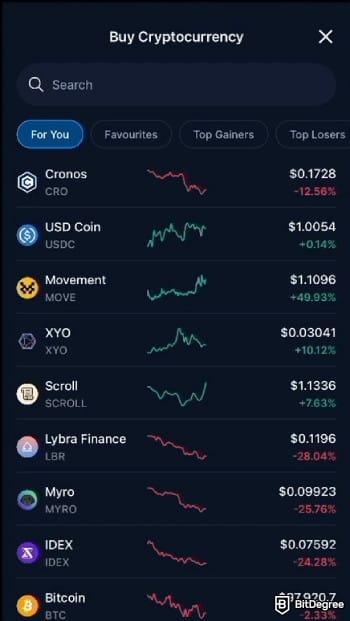
For this example, I'm choosing Cronos (CRO).
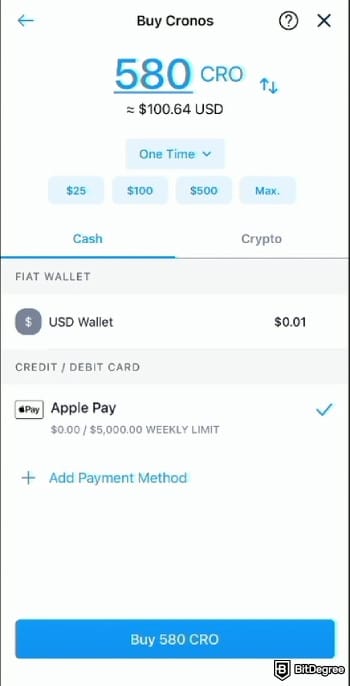
- The amount of crypto you’ll receive;
- The payment method;
- Any visible fee;
- The final exchange rate;
- Whether the quote includes spread;
- Whether there is a processing cost.
Once you’ve checked the order details, tap [Buy CRO] to proceed with confirmation.
The App is better for convenience. The Exchange is better for control. Understanding that simple distinction can save you a fair bit of confusion.
Binance Trading Walkthrough
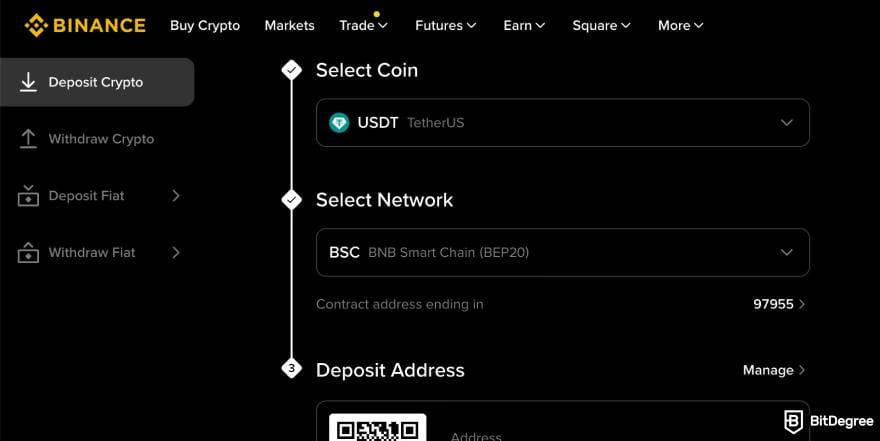
Binance’s spot market is one of the main places users trade. Here’s a quick walkthrough of how to buy BTC using USDT on the spot market.
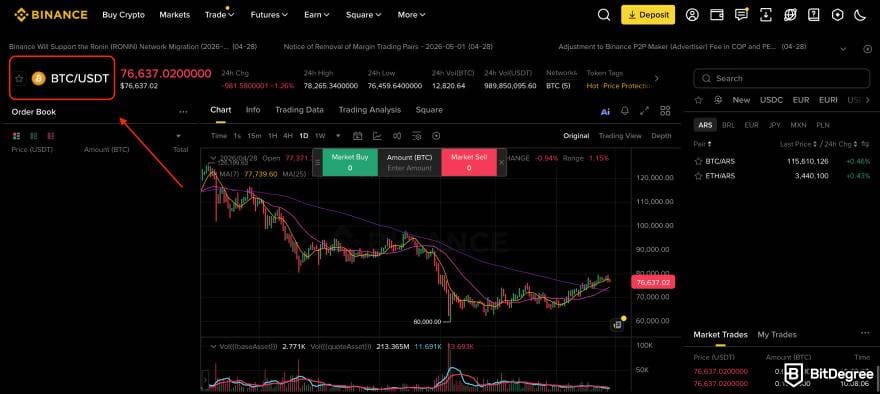
This is the point where Binance begins to look more advanced. You will see the price chart, order book, recent trades, and order panel.
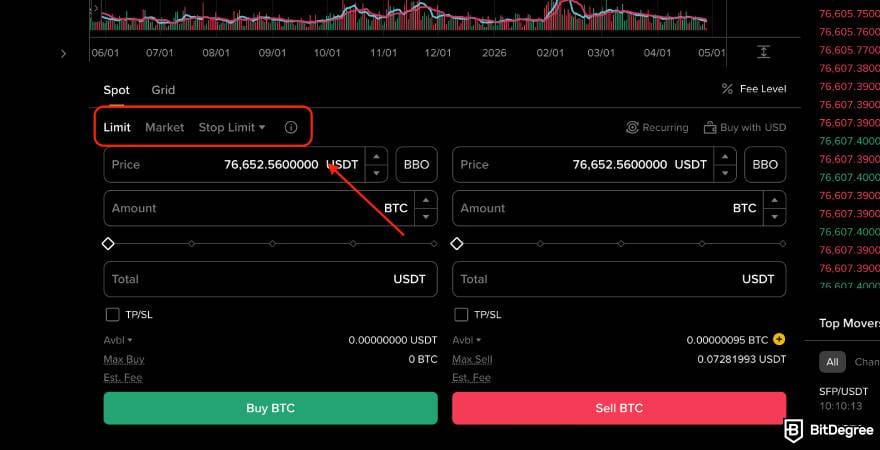
Market order is for buying immediately at the best available price. Limit order is for choosing the price you are willing to pay before the trade goes through.
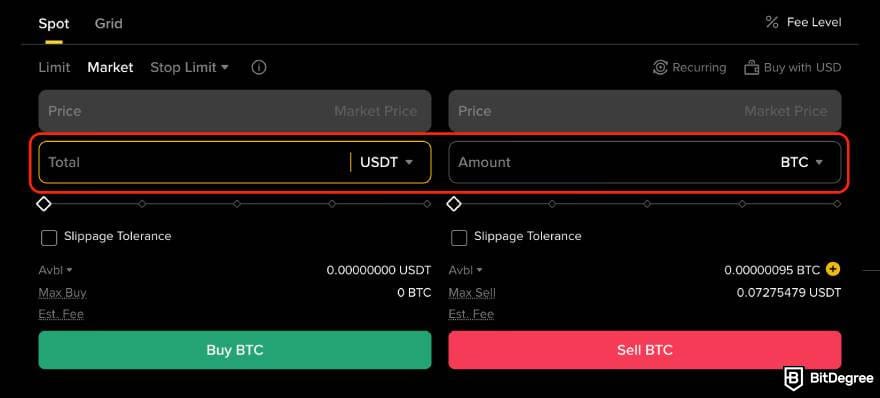
Once the order is confirmed, you should be able to find it in your order history, and the BTC you purchased should appear in your spot wallet.
Binance vs Crypto.com for Beginners
The Crypto.com App offers one of the more beginner-friendly experiences in the space. The interface is clean, the buying flow is short, and the card makes crypto more practical and tangible. For someone who doesn’t yet know what a futures contract is and has no reason to care, this is a sensible first stop.
Binance is also usable for beginners, particularly with its "lite" mode and the learning materials in Binance Academy. The platform is still more complex overall, but it gives users a clearer growth path if they want to improve as traders and start using advanced features as their understanding grows.
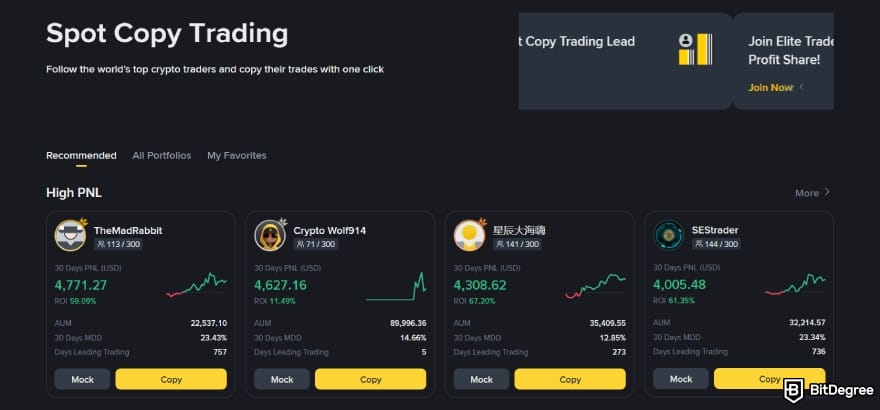
With Binance, you have more control over whether you keep the process simple or start using more advanced features, which can be a bit much for someone starting from zero. On the other hand, the Crypto.com App pretty much hands you the easy mode from the get-go.
Another key difference, I’d say, is intent. Crypto.com is better if you want to get into crypto quickly and start using it. Binance is better if you want to learn how to trade and eventually move into more sophisticated products.
Verdict
Crypto.com App is friendlier for beginners who want to buy crypto and use it in daily life. Binance is better for beginners who know from the start that active trading is where they're headed.
Binance vs Crypto.com for Active Traders
For active traders, Binance is generally the stronger platform across most key trading features. Crypto.com can still work for certain users, but it may not compete as well as a primary trading platform for those who need deeper tools and more advanced execution.
An active trader leaning toward Binance would likely value:
- Deeper order book depth across both spot and derivatives markets;
- A full derivatives suite (futures, perpetuals, and options) in one place;

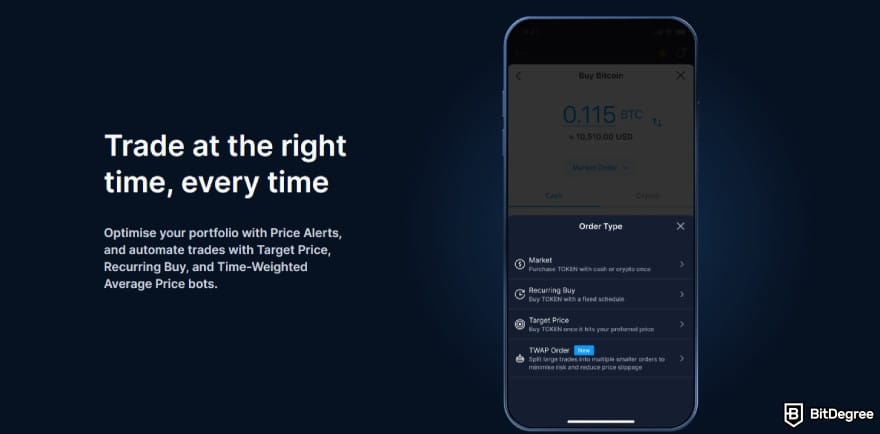
- Copy trading and a mature bot ecosystem for automated strategies;
- BNB fee discounts that compound meaningfully at high trading volumes;
- More trading pairs, including smaller altcoins not listed on Crypto.com;.
An active trader who might still consider Crypto.com would be someone who:
- Primarily trades BTC and ETH perpetuals, where the Exchange has adequate depth;
- Values a cleaner interface and doesn't need the full product surface;
- Prefers a simple card for using their trading revenue in real life;
- Is already a Crypto.com card user and would rather consolidate to one platform;
- Wants to place trades from their phone using a mobile trading interface.
Crypto.com can handle straightforward spot and perpetuals trading, but it has a more limited advanced trading setup. The lack of an options market, fewer automation tools, and narrower pair selection make Binance the stronger fit for users who need more trading depth.
Verdict
Binance is the more capable choice for active traders, especially when it comes to derivatives breadth, automation features, and liquidity depth. Crypto.com is still functional for spot and perpetuals, but it offers a more streamlined trading environment.
Binance vs Crypto.com for Passive Users
Passive users are basically people who buy crypto periodically, hold it, and want it to do something useful while it sits there. That could mean earning yield, staying available for spending, or sitting in a self-custody wallet without much management work.
In that case, Binance has a pretty strong set of passive features. Its Earn products cover many assets with both flexible and fixed-term options. The broader ecosystem also means users can explore multiple passive activities, including staking, dual investment, and on-chain yield, without moving funds off the platform.
That said, Crypto.com’s card ecosystem changes the equation for passive users who also spend money regularly. If you hold enough CRO stake to qualify for mid-tier card status, you can get cashback on everyday purchases, streaming service reimbursements, and practical perks.
The DeFi Wallet gives Crypto.com another advantage for passive users who want self-custody without the hardware-wallet learning curve. The NFT marketplace also fits passive holders who want access to digital collectibles without making NFT trading their new personality.
Note
Binance gives users yield products and a deep ecosystem, which is great for passive users who want more options. That said, if the goal is to make crypto useful in everyday financial life, Crypto.com’s card infrastructure, self-custody wallet, and spending rewards do more of the heavy lifting.
Final Verdict: Is Binance or Crypto.com Better?
Binance makes more sense if trading is the main reason you are using the platform. It has deeper liquidity across spot and derivatives markets, capable copy trading and automation tools, a larger trading-pair selection, and stronger infrastructure for serious market activity.
Crypto.com, on the other hand, is the better platform if you want crypto to play a functional role in your daily life. Its card tier structure is one of the most developed among crypto exchanges, offering real cashback, streaming perks, and lounge access that translate into practical everyday value.
The short version: Binance is the better fit for trading depth, liquidity, and ecosystem scale. Crypto.com is the better fit for consumer experience, card infrastructure, and everyday crypto use. Neither platform wins for everyone because the best choice depends on how you use crypto.
Choose Binance if you want efficiency, market access, and a broader product range. Choose Crypto.com if you want to spend crypto in daily life with plenty of real-world perks.