



Binance vs Gemini – In-Depth Comparison
Choosing between Binance and Gemini isn't really about which one is the "better" exchange. They're built with different users in mind, and that philosophy shows up in pretty much every decision they've made, from their fee structures to how many coins they list.
Binance is one of the world’s largest crypto exchanges by several metrics: user base, trading volume, asset selection, and the sheer number of products packed into a single platform. Gemini, by contrast, is a smaller regulated US-based exchange that’s built its reputation around security, compliance, and a more approachable entry point for people still getting used to crypto.
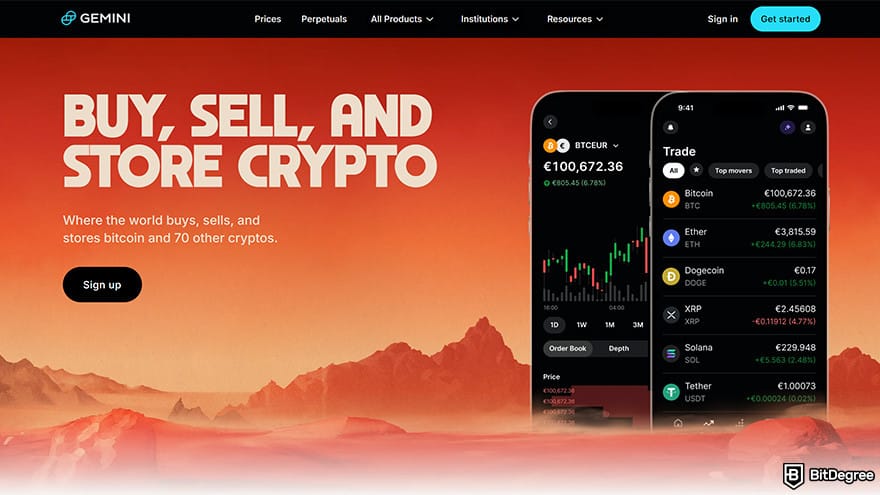
The better question isn’t “which one’s better?” It’s "which platform that lines up with how you want crypto to fit into your life".
If you want the giant crypto supermarket version of an exchange, with hundreds of coins, advanced tools, staking, and copy trading all in one place, Binance is probably your first stop. If you’re after something more structured, more compliance-focused, and easier to navigate, with FDIC insurance for USD deposits, Gemini makes a strong case.

As of 2026, Binance reports over 321 million registered users and more than $66 billion in 24-hour trading volume. Gemini’s clearly smaller, but it operates in over 150 countries, including all 50 US states, and it’s one of the few exchanges regulated by the New York Department of Financial Services (NYDFS).
Here’s a quick comparison table to help frame the difference:
Best for | Users who want comprehensive crypto ecosystems and tools | Security-conscious users, beginners, and US-based traders |
|---|---|---|
Main strength | Liquidity, trading depth, and ecosystem breadth | Regulatory compliance, security, and simplicity |
Spot fees | Very competitive across all user levels | Competitive on the advanced platform; higher for basic instant orders |
Futures fees | Slightly on the cheaper side for standard taker orders | Competitive for active traders where accessible |
Asset selection | 90+ cryptocurrencies | 600+ cryptocurrencies |
Beginner experience | Good, though the sheer number of features can be quite overwhelming | Very strong, with a simplified interface and a low-stress entry path |
Advanced trading | Very strong across derivatives, bots, copy trading, API, and more | Strong via ActiveTrader; narrower scope due to a smaller asset selection |
Regulatory protection | SAFU fund; Proof of Reserves (varies by region) | NYDFS regulation; FDIC insurance on USD deposits |
Overall verdict | Better for scale, liquidity, and access to a wide crypto ecosystem | Better for users who prioritize compliance, security, and a focused experience |
Table: Binance vs Gemini quick comparison
To sum it up: Binance wins on scale, variety, and trading depth. Gemini wins on regulatory clarity, security certifications, and a more focused user experience. Neither is the wrong choice. It just depends on what you're looking for.
Binance vs Gemini - Market Position
Binance’s scale is one of its clearest advantages. With over 321 million users, more than $134 billion in reported customer assets, and over $66 billion in daily trading volume, it’s operating at a level most exchanges can't reach. In practice, that can mean deeper order books, tighter spreads on major pairs, and better execution quality for larger trades.
Gemini operates on a different scale. It's available in more than 150 countries, is regulated in the US, and was built with a strong emphasis on institutional-grade security and compliance. Rather than trying to list every token or appeal to every type of trader, Gemini focuses on doing fewer things with more care. For a specific group of users, that's a genuine selling point.

Gemini has brought in $423.9 million in total funding, with the standout round being a $400 million raise in November 2021 led by Morgan Creek Digital. The money helped Gemini grow globally, expand its staking products, and build more around NFTs through Nifty Gateway.
The two exchanges aren't really competing for the same users. Binance is trying to be the one-stop shop for global crypto trading. Gemini is positioning itself as the compliant, trustworthy on-ramp for users who want to stay well within the lines, especially in regulated markets like the US.
Verdict
Binance leads by a wide margin on a global scale, liquidity, and market depth. Gemini doesn't try to out-muscle it on those fronts. Instead, it competes on trust, regulatory standing, and user experience, especially for US-based users.
Binance vs Gemini - Trading Features
Both exchanges let you buy, sell, and trade crypto, but the difference shows up once you go beyond the basics. Gemini is more focused, with two clean trading interfaces and a curated asset selection. Binance is broader by design, offering a trading environment that covers most of what retail and professional traders would expect.
Gemini Trading Features
Gemini offers two trading interfaces side by side, and the distinction is pretty useful. There’s a simplified version for users who just want to buy and hold, and there’s ActiveTrader for users who want tighter control over execution.
For basic trading, Gemini offers:
- Instant orders for quick market buys directly from the simplified web or mobile UI.
- Spot trading for buying and selling 70+ cryptocurrencies in a streamlined interface.
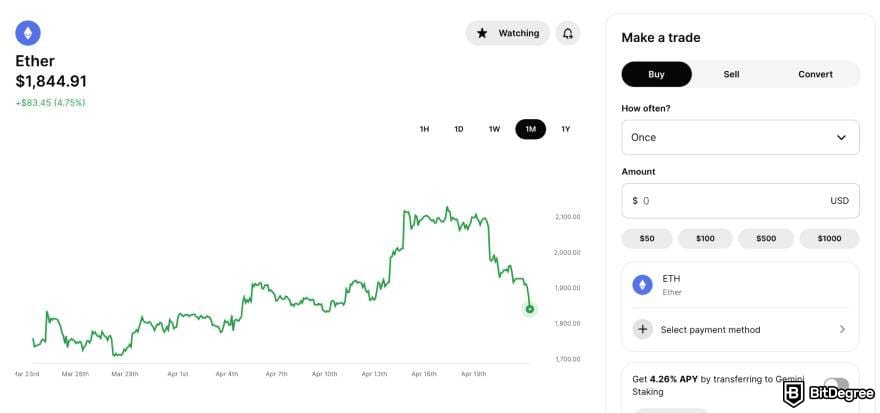
- Convert for swapping between supported crypto assets without opening the order book.
- Recurring buys for automated investing on daily, weekly, or monthly schedules.
- Price alerts so you can monitor markets without staring at charts all day.
For advanced trading, Gemini supports:
- ActiveTrader with TradingView candlestick charts, a detailed order book, and advanced order types.
- Derivatives trading with perpetual contracts priced in GUSD and up to 100x leverage.
- Exotic trading pairs, like DOGE/ETH, offer cross-crypto exposure beyond the standard USD pairings.
Gemini's trading setup is neat and well-organized. The platform doesn't try to offer 50 different order types or dozens of bot strategies. What it does, it does thoughtfully.
Binance Trading Features
Binance covers most trading formats a retail or institutional trader would reasonably need. It doesn’t leave those products hanging without liquidity or infrastructure either.
For basic trading, Binance offers:
- Spot trading across 600+ cryptocurrencies and more than 6,000 trading pairs.
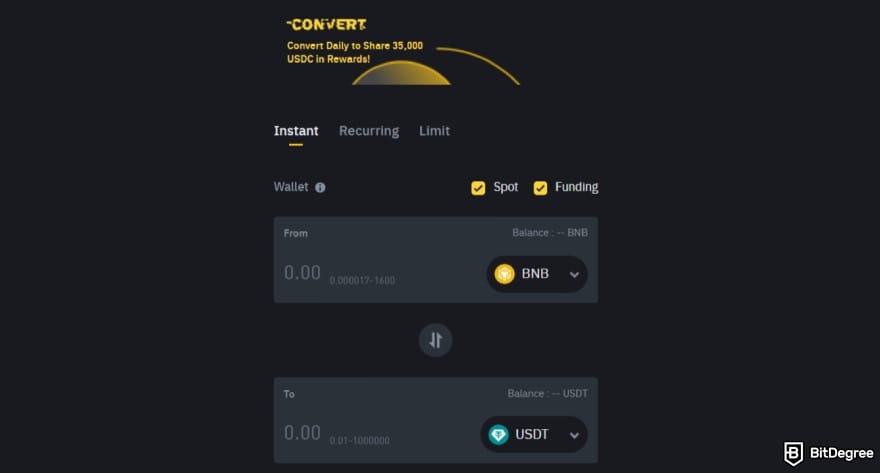
- Convert for quick crypto swaps without needing to use the full trading interface.
- P2P trading for direct user-to-user transactions using 800+ local payment methods worldwide.
- Demo trading for practicing strategies with virtual funds and zero financial risk.
For advanced trading, Binance supports:
- Margin trading with both cross and isolated margin options.
- Futures trading for leveraged crypto contracts settled in stablecoin or crypto.
- Options trading for more complex directional and hedging strategies.
For automated and strategy-based trading, Binance includes:
- Trading bots, including Grid, DCA, and other automated strategy tools.
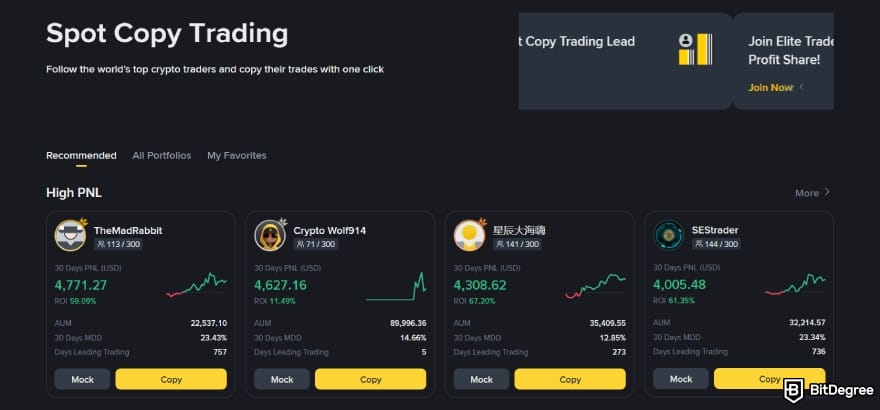
- Copy trading for automatically following other traders' positions.
- API trading for algorithmic and custom strategy execution.
For institutional and large-scale users, Binance also offers:
- OTC and block trading for high-volume orders that need private, customized execution.
- VIP and institutional services, including portfolio margin, financing solutions, and custody.
The biggest advantage of Binance isn’t simply that it offers more features. It’s those features that are backed by deeper liquidity, stronger execution quality, and broader market access than most exchanges can offer.
Verdict
Gemini and Binance don’t really treat trading the same way. Gemini’s more focused, which works nicely for users who want a cleaner setup. Binance covers more ground, with deeper markets and a wider range of instruments.
Binance vs Gemini – Fees
This is one of those parts where Gemini makes the comparison less tidy, because its fees depend on which trading route you take. And there isn’t one universal fee answer here; there are two pricing modes living on the same platform.
Here's a simplified breakdown of fees for regular users:
Spot fees (basic / instant) | Varied (calculated at order placement) | 0.10% maker / 0.10% taker |
|---|---|---|
Spot fees (ActiveTrader / limit) | 0.60% maker / 1.20% taker | 0.10% maker / 0.10% taker |
Spot fees (with native discount) | - | 0.075% maker / 0.075% taker (with BNB fee discount) |
Futures fees | 0.02% maker / 0.07% taker | 0.02% maker / 0.05% taker |
Future fees (with native discount) | - | 0.018% maker / 0.045% taker (with BNB fee discount) |
Options fees | - | 0.024% maker / 0.024% taker |
Table: Binance vs Gemini fee comparison
The main thing to understand about Gemini’s fees is the two-mode setup. On the Gemini Mode interface, fees aren’t presented as one fixed percentage. They’re calculated at the time of the order, based on your payment method, order size, market conditions, and jurisdiction. Thankfully, you can see them on the trade review screen before you confirm.
Gemini Mode orders also have a price spread built into the quote, which adds another cost layer on top of the explicit fee
ActiveTrader is the more transparent side of Gemini’s pricing. At the base tier, spot fees start at 0.600% for makers and 1.200% for takers. The rates then drop across 13 tiers as your 30-day combined spot and derivatives volume or total asset balance increases.
📚 Read More: Gemini Fees Explained
Binance’s standard spot trading fees start at 0.1% for makers and 0.1% for takers. With the 25% BNB fee discount, that can drop to 0.075% when applicable. Its futures fees are 0.02% for makers and 0.05% for takers for regular users, and USDⓈ-M futures users can also get a 10% discount when paying with BNB. The higher the account level, the lower the fees can go.
📚 Read More: Binance Fees Explained
$1,000 Spot Trade Fee Comparison
Say you place a $1,000 BTC spot market order on each platform.
On Binance, using the standard 0.10% taker fee:
$1,000 x 0.10% = $1.00
With the BNB discount applied:
$1,000 x 0.075% = $0.75
On Gemini’s ActiveTrader, at the base-tier taker rate (1.20%):
$1,000 x 1.200% = $12.00
The fee difference between Gemini and Binance is significant on ActiveTrader. At the base tier, Gemini’s 1.200% taker rate is twelve times higher than Binance’s 0.10%. That difference starts to shrink as your trading volume moves through the tiers, but for most traders who aren’t doing $10K or more in monthly volume, Binance remains the cheaper option.
$1,000 Derivatives Trade Fee Comparison
Now let's look at a $1,000 perpetual or derivatives position using market orders.
On Binance, using the standard 0.05% taker fee:
$1,000 x 0.05% = $0.50
On Gemini, using the 0.07% taker fee:
$1,000 x 0.07% = $0.70
On its own, the fee difference is easy enough to brush off. The picture changes once you’re placing hundreds of trades a month, because small cost differences can start compounding over time. Also note that bid-ask spreads, slippage, funding rates, and native discounts aren’t included in the calculation.
Entry Fee | Exit Fee | Approx. Round-Trip Fee | |
|---|---|---|---|
Binance futures | $0.50 | $0.50 | $1.00 |
Gemini derivatives | $0.70 | $0.70 | $1.40 |
Table: Binance vs Gemini market entry + exit comparison
That said, the lowest listed fee doesn’t automatically give you the lowest real cost. It’s also worth looking at:
- Bid-ask spread;
- Slippage;
- Funding rates;
- Liquidation risk;
- Order execution quality;
- Deposit and withdrawal fees;
- Whether you are using market or limit orders.
A trader paying 0.05% on Binance can still end up with a better deal than someone paying 0.04% elsewhere if Binance offers tighter spreads and better fills. And when one platform doesn’t even list the coin you want, tiny fee differences stop being the main consideration.
Verdict
Binance has the lower spot trading fees. Gemini’s ActiveTrader base taker rate is significantly higher than Binance’s, and the gap doesn’t really close until higher volume tiers. For derivatives, the base rates are more competitive, but Binance still keeps an edge.
Binance vs Gemini – Liquidity & Execution
Liquidity is where Binance’s scale becomes easier to see in practice. With hundreds of millions of users and billions in daily trading volume, its order books on major pairs like BTC/USDT and ETH/USDT are among the deepest in the market. That usually means tighter spreads, less slippage on larger orders, and more stable execution when markets get volatile.
Gemini’s liquidity is enough for most traders working with major assets. If you’re buying or selling a few hundred to a few thousand dollars of BTC or ETH, you probably won’t notice much difference in practice. The gap becomes clearer when you’re moving larger sizes or trading assets outside the top coins by market cap.
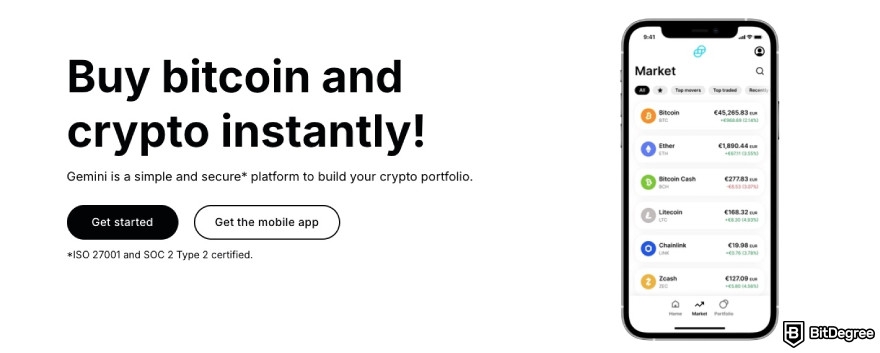
There’s one detail that works in Gemini’s favor: its smaller and more curated asset list means there’s less room to accidentally wander into illiquid markets. Every coin on the platform is vetted before listing, so the liquidity that does exist tends to be more dependable for supported assets.
The practical takeaway is that Gemini should handle most retail-sized trades on major pairs seamlessly. But if execution quality and order book depth really matter to your strategy, especially when trades get larger, Binance is the stronger environment.
Verdict
Binance comes out ahead on liquidity across the board, particularly for larger trades and major trading pairs. Gemini’s execution is solid enough for retail-sized trades on the assets it supports, but it doesn’t match Binance’s depth or market scale.
Binance vs Gemini - Security & Trust
Both exchanges take security seriously, just not in the same way. Gemini puts more emphasis on regulatory compliance and institutional-grade certifications. Binance places greater emphasis on broad account-level protections and a substantial emergency fund.
Binance | Gemini | |
|---|---|---|
Two-factor authentication | ✓ | ✓ |
Withdrawal address whitelist | ✓ | ✓ |
Anti-phishing code | ✓ | ✓ |
Passkeys | ✓ | ✓ |
24/7 customer support | ✓ | ✓ |
Proof of Reserves | ✓ | ✓ |
User protection fund | SAFU | FDIC insurance |
Table: Binance vs Gemini security features
Gemini has a strong security profile compared with many exchanges. It was among the first exchanges in the industry to achieve both SOC 1 Type 2 and SOC 2 Type 2 certifications, which are also used in traditional finance. USD deposits are FDIC-insured up to $250,000, and the platform is fully regulated by the NYDFS.
Binance’s security setup includes the SAFU fund (Secure Asset Fund for Users), which has supported more than 7.4 million users in emergency situations. The platform also publishes Proof of Reserves and claims to keep user assets backed 1:1. User-side protections include 2FA, passkeys, anti-phishing codes, device management, and withdrawal address controls.

The important difference is the type of protection being offered. Gemini’s regulatory compliance and FDIC insurance are tied to a legally defined framework backed by US financial regulation. Binance’s SAFU can still be a meaningful safety net, but it isn’t the same as government-backed deposit insurance.
Verdict
Gemini has the edge on regulatory clarity and institutional security credentials. Binance is still a safe platform, backed by broader account-level protections, security at scale, and a long-standing trust perception.
Binance vs Gemini – Broader Ecosystem
This is one of the biggest areas where the two exchanges start to look very different. Binance has built a wide crypto ecosystem with a lot of products under one roof. Gemini, on the other hand, has a smaller range of non-trading features, but some of them are distinctive and well-executed for its target audience.
Binance's Other Features
Binance has a pretty broad non-trading ecosystem. Some of its main extra features include:
1
Earn products
Binance Earn supports 300+ crypto assets across a wide range of products, including Simple Earn (flexible and locked terms), ETH and SOL staking, Dual Investment, Smart Arbitrage, On-Chain Yields, Discount Buy, and more. Binance also offers various loan products, including flexible rate loans, fixed rate loans, and VIP loans for institutional users.
2
Launch and reward products
Binance Launchpool allows users to lock BNB or supported assets to earn new token allocations as airdrops. Megadrop takes a slightly different route by combining BNB locking in Simple Earn with Web3 Wallet tasks for extra points and larger airdrop rewards.

There are also HODLer Airdrops, which use historical balance snapshots to reward BNB holders. For long-term holders, that means passive exposure to new token launches.
3
Payments and spending
Binance Pay supports over 100 cryptocurrencies for peer-to-peer payments, merchant transactions, bill splitting, and gift cards. It works without credit cards or bank accounts and processes transactions 24/7 via QR code, payment link, or Binance User ID. Most transactions are free, with small fees only above certain monthly volume thresholds.
4
Web3 features
Binance Wallet is a non-custodial MPC-based wallet built directly into the Binance app. It supports cross-chain token swaps via Binance Bridge, access to DeFi protocols and dApps, and on-chain yield generation. Binance Alpha gives users early access to Web3 opportunities before tokens are listed on the main exchange.
5
Research, education, and community
Binance Academy is a free educational hub with structured courses, articles, tutorials, and multilingual content (available in 10+ languages). Users can even earn cryptocurrency by completing quizzes through the Learn and Earn program.

Binance Research provides institutional-grade market analysis and project deep dives. Binance Square is a social content platform where creators can earn USDC through a write-to-earn program, and users can access real-time market news and community discussions.
The main strength of Binance is that it pulls all of these features into one large ecosystem. You can buy crypto, earn yield, join token campaigns, use a wallet, send payments, read market research, and explore Web3 tools without wandering off-platform. The downside is predictable enough: it can get crowded, and not every product’s available everywhere.
Gemini's Other Features
Gemini has a sizable non-trading ecosystem too, though it doesn’t cover quite as much ground as Binance. Its main extra features include:
1
Earn products
Gemini lets users stake Ethereum, Solana, and Polygon with no minimum staking amount. It also handles the technical backend work, including validator node management and reward distribution, so users don’t need to get into the weeds.
2
Payments and spending
The Gemini Credit Card (issued by WebBank) is one of Gemini’s more distinctive features because it makes crypto rewards part of normal spending, not just for trading.
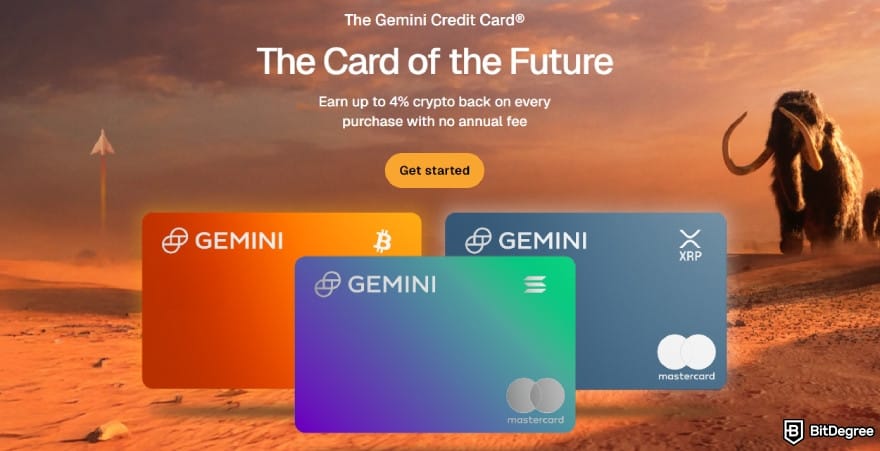
It offers bonus rewards in everyday categories like gas, EV charging, dining, and groceries, with a standard rate on everything else. Rewards are deposited into your Gemini account in a supported cryptocurrency of your choice.
3
Predictions
Gemini Predictions lets users trade outcome contracts tied to real-world events, with contract prices reflecting the market's collective probability estimate. It's regulated by the CFTC and operates within a compliance-driven framework, making it one of the few regulated prediction markets available in the US.
4
Stablecoin
GUSD is Gemini's fully regulated stablecoin, pegged 1:1 to the US dollar and built as an ERC-20 token on Ethereum. The dollar reserves backing GUSD are held in FDIC-insured bank accounts or US Treasury securities, and Gemini publishes monthly third-party audit attestations to confirm the reserve backing.
5
Web3 features
Gemini Wallet is the platform's self-custody web wallet, built around passkey authentication rather than a seed phrase. Your keys are managed by your own devices, which means the funds are entirely under your control without relying on the platform to hold them.
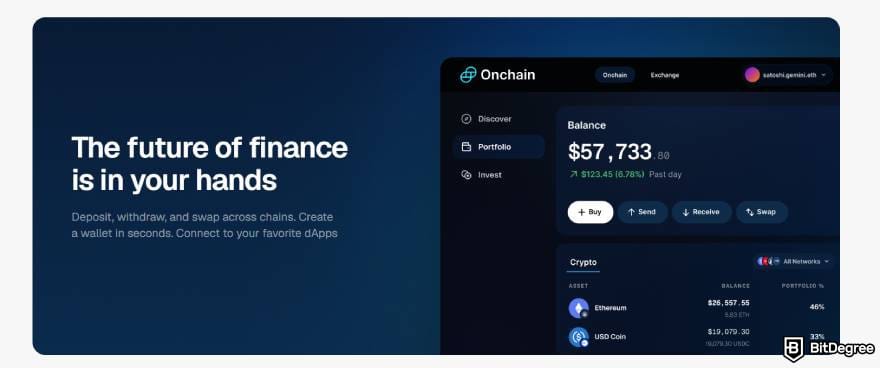
The wallet connects to the Gemini Onchain App, which gives you a UI for interacting with DeFi protocols like Morpho, browsing curated Web3 protocols via the Discover tab, and managing tokens across Ethereum, Arbitrum, Base, Polygon, and Optimism.
Verdict
It’s not surprising that Binance’s ecosystem is broader. Gemini offers fewer extra features, but some of them are genuinely distinctive and useful for the right kind of user.
Binance vs Gemini – Fiat Deposits and Withdrawals
Fiat access is easy to overlook when comparing exchanges, but it can make a big difference in the actual user experience. A platform with great trading tools isn’t all that useful if moving money in or out is slow, expensive, or needlessly complicated.
Gemini’s fiat access is clean and well-integrated, especially for users in the US. It supports common funding methods like bank transfers, debit cards, wire transfers, Apple Pay, PayPal, and instant electronic payments, with fees depending on the method used.
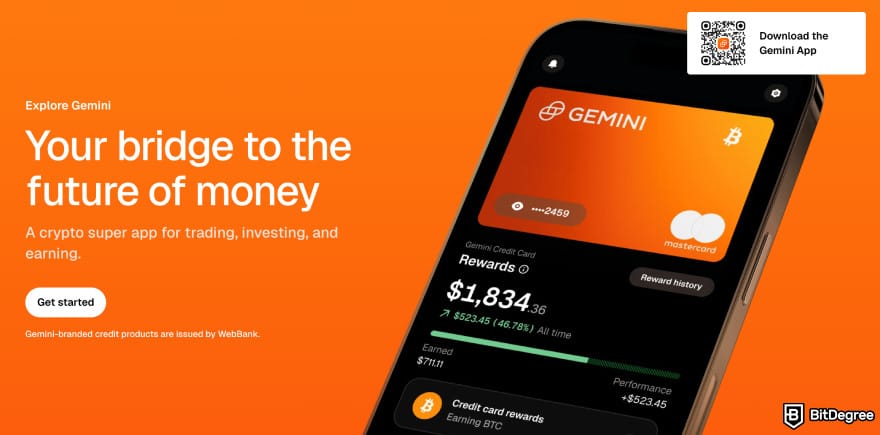
The standout point is that USD balances are eligible for FDIC insurance through Gemini’s banking partners. That gives Gemini a practical advantage over many exchanges, especially for users who care about the boring-but-important part of getting money in and out safely.
Binance has broader fiat coverage globally, though the experience isn’t the same everywhere. Depending on the region, users may be able to use bank transfers, card purchases, P2P trading, and third-party payment providers. The variety is strong, but availability, fees, and processing times differ quite a bit by country.
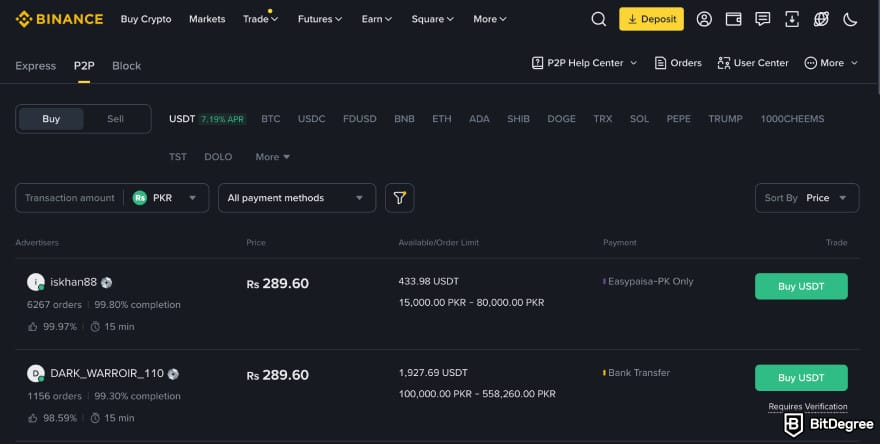
It’s worth noting that fiat costs aren’t always fully captured on the fee page. Card deposits often involve extra processing fees. P2P rates depend on counterparty pricing. Bank withdrawals may have minimum amounts or processing delays. So a simple fee-table comparison between the two exchanges doesn’t always tell the whole story.
Verdict
Gemini offers the simpler fiat bridge for users who want a bank-linked experience with FDIC-insured USD balances. Binance has broader global fiat coverage, but getting the best cost may require checking different payment routes based on where you’re located.
Gemini Trading Walkthrough
Gemini’s basic trading interface, available across both mobile and web, gives beginners one of the most straightforward ways to make their first trade on the platform. Here’s how it works:
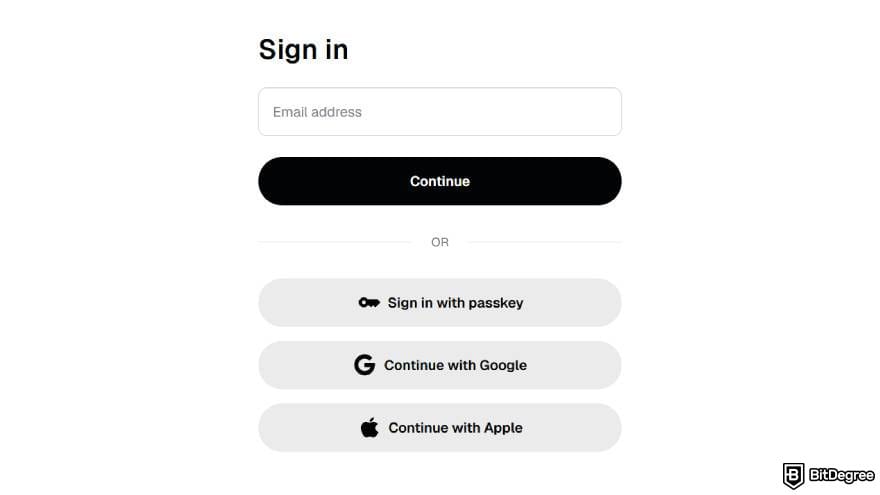
Gemini lets you use wire and bank transfers, ACH transfers, Apple Pay and Google Pay, debit card purchases, and crypto transfers.
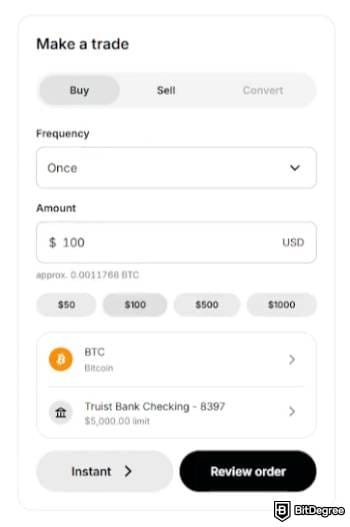
That's it! Your Bitcoin purchase is complete.
Binance Trading Walkthrough
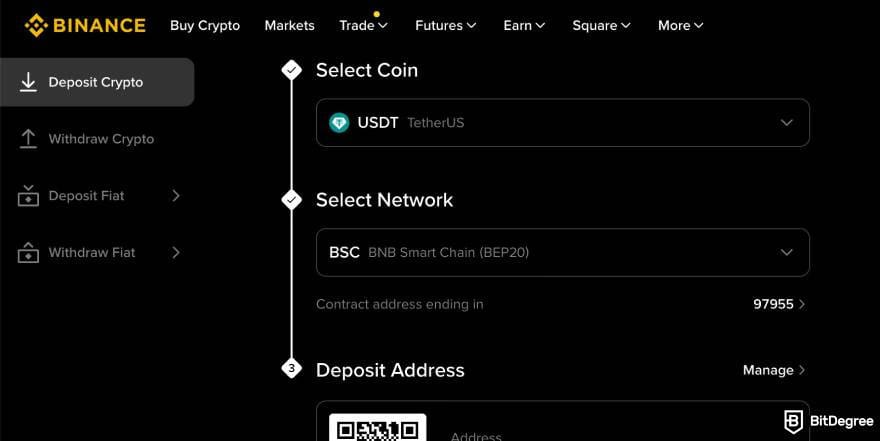
Binance's spot market is where most day-to-day crypto trading happens. To see how it works, let's do a quick walkthrough of buying BTC with USDT:
![Gemini vs Binance: select [Spot].](https://assets.bitdegree.org/images/binance-vs-kucoin-spot.jpg "Gemini vs Binance: select [Spot].")
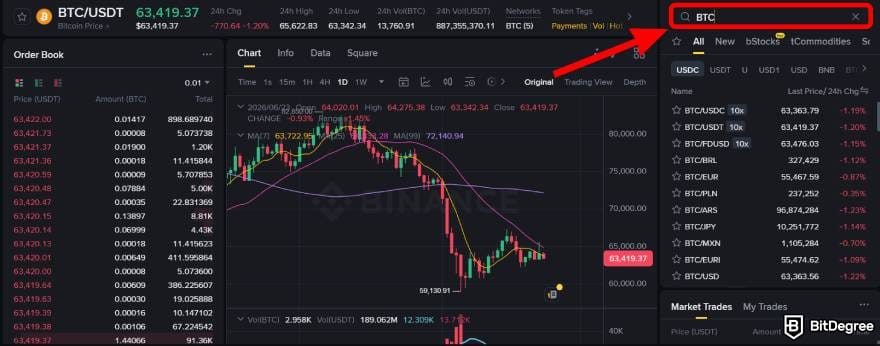
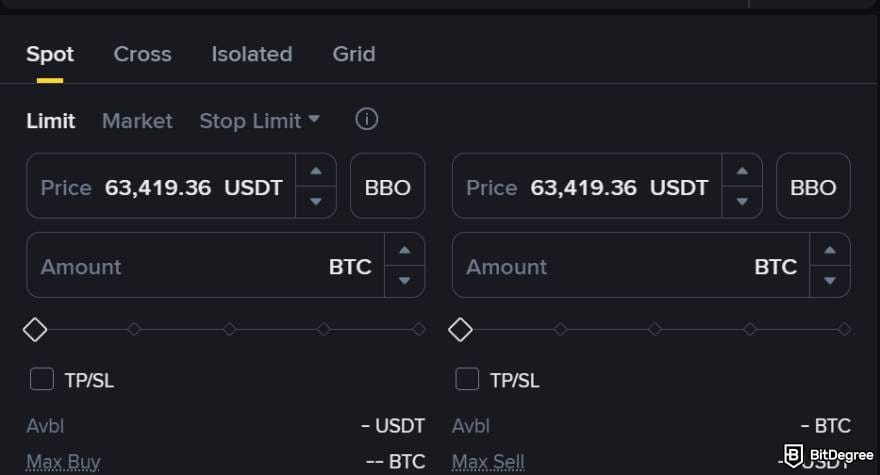
- Trading pair;
- Order type;
- Estimated price;
- Amount;
- Fees;
- Whether you are using BNB for fee discounts;
- Whether the order will execute instantly.
Click [Buy] to confirm. A market order fills immediately; a limit order stays open until the market hits your price. Check your order history to confirm execution and view your BTC balance in the spot wallet.
Binance vs Gemini for Beginners
Gemini has the edge for beginners. Its simplified trading interface is designed for users who don't know their way around order books or trading terminology, and the entire process from creating an account to making a first purchase is pretty straightforward.
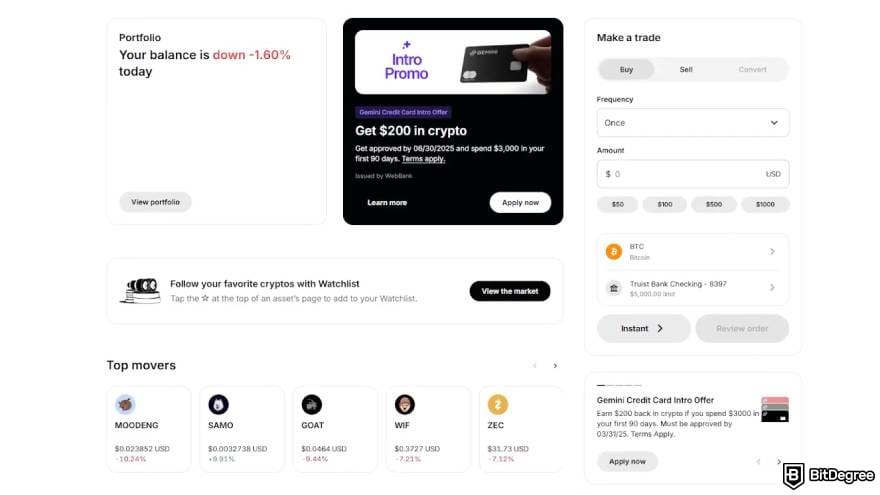
Gemini’s regulatory setup adds another layer of reassurance. For a newer user who’s hesitant about putting real money into a crypto exchange for the first time, FDIC insurance on USD deposits and NYDFS regulation can help take some of the edge off.
Binance gives beginners more to work with from day one, which can be both helpful and overwhelming. There’s convert for simple swaps without touching the order book, demo trading for risk-free practice, and Binance Academy, one of the best free crypto education libraries out there.

The catch is that Binance gives users a lot to look at, maybe too much at first. Between all the features, tabs, and product categories, someone who just wants to buy their first Bitcoin may end up wondering why crypto needs this many buttons.
For beginners, the key difference comes down to scope and comfort. If you’re just starting out and want to buy a few major coins, Gemini is the easier place to begin. If you want to take trading more seriously from day one, Binance gives you more space to grow.
Verdict
Gemini is the easier starting point for most beginners. Binance is the better fit for those who want to dive deeper into crypto from day one and use a more complete ecosystem.
Binance vs Gemini for Active Traders
For active traders, this comparison gets less balanced once you look past the headline features. Gemini has a capable ActiveTrader interface for more advanced trading, but its smaller asset selection, higher standard spot fees, and limited instrument range put it behind Binance.
An active trader might prefer Gemini if they:
- Are based in the US and need a regulated environment with NYDFS oversight.
- Trade primarily in major assets where the 70+ coin limit isn't a constraint.
- Value ActiveTrader's clean TradingView integration and professional order types for technical analysis
- Want to earn crypto passively via the Gemini Credit Card alongside their active trading
- Prioritize the peace of mind that comes from FDIC-insured USD balances on the same platform
An active trader might prefer Binance if they:
- Trade frequently across many assets, including mid-cap and smaller tokens.
- Use copy trading, trading bots, or algorithmic strategies regularly.
- Want access to leveraged futures, options, margin trading, or derivatives at scale.
- Care about execution quality and liquidity for larger order sizes.
- Use BNB fee discounts to reduce trading costs.
For active traders, Binance is the stronger platform by most practical measures. It has deeper markets, broader instrument coverage, lower standard spot fees, and a more complete toolkit for automation and strategy.
Verdict
Most active traders will probably lean toward Binance. Gemini’s advanced trading setup is solid, but it’s better suited to traders who need a more compliant environment for major-coin trading.
Binance vs Gemini for Passive Users
Binance Earn is built around variety, supporting more than 300 assets through products like Flexible and Locked Savings, Staking, Dual Investment, Smart Arbitrage, and more. If you've got idle crypto spread across different assets, it's one of the easiest ways to put it to work without actively managing every position.
Gemini’s passive income features are more limited, but they’re put together thoughtfully. Staking is available for ETH, SOL, and POL with no minimum amount, and the process is about as simple as it gets: click a button, then let the platform handle the rest.
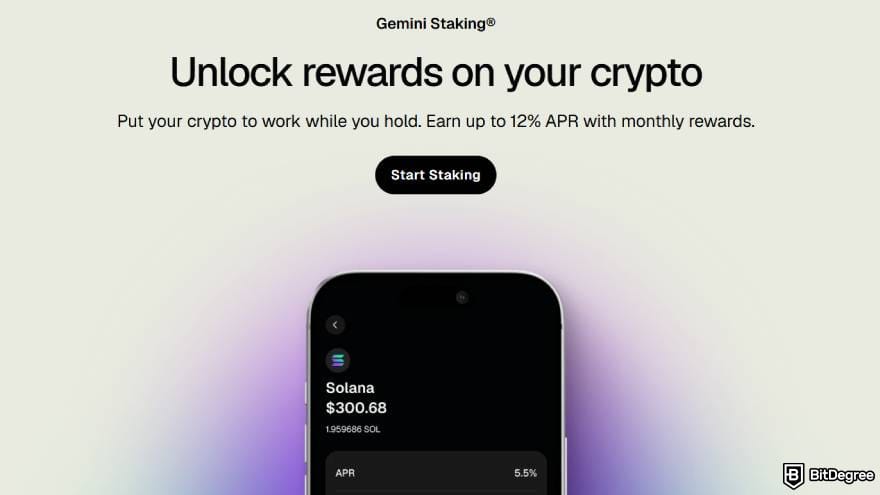
The Gemini Credit Card is another interesting piece here. You spend as usual, and crypto rewards show up in your account. GUSD also gives users a stable, compliant, and regularly audited option for parking funds.
Verdict
Binance wins on passive earning variety and asset coverage. Gemini is more limited, but its passive features are practical, simple, and built around its intended users.
Final Verdict: Is Binance or Gemini Better?
Gemini is the better choice if you care about regulatory clarity, FDIC-insured USD balances, a cleaner user experience, and standout features like the crypto-backed credit card. It’s also a strong fit for US-based users who want a compliant exchange and mostly plan to stick with major, established coins.
Binance makes more sense if you want the broadest possible crypto ecosystem in one place. You get more coins, more trading instruments, lower spot fees, deeper liquidity, plus a wide range of advanced tools and services. In terms of scale and product depth, it’s operating in a different category.