





KuCoin vs Bybit — In-Depth Comparison
KuCoin and Bybit are two of the most widely used crypto exchanges outside the United States, but they serve their users from very different starting points.
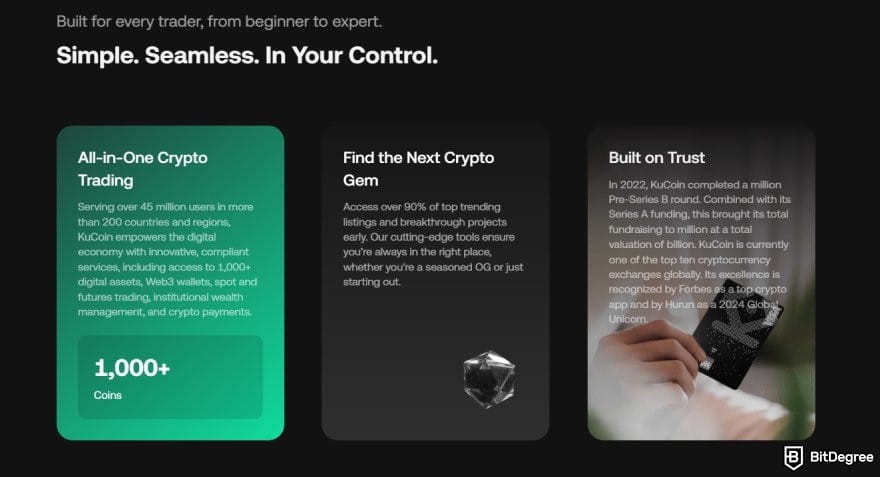
KuCoin was founded in 2017 and is headquartered in Seychelles. Known as "The People's Exchange", it built its reputation around wide altcoin access and early token listings, making it a popular destination for traders looking beyond major cryptocurrencies. It currently serves over 45 million users across 200+ countries.
Bybit was founded in 2018 and is headquartered in Dubai. It built its reputation among active traders through a derivatives-first product suite and strong execution quality. It serves over 85 million users across 160+ countries.
Neither platform is available in the United States, though each arrived at that restriction differently, which is a distinction covered in detail in the sections ahead.
KuCoin | Bybit | |
|---|---|---|
Best for | Altcoin traders, wide token selection, spot-focused users | Active traders, derivatives users, copy trading |
Main strength | Largest altcoin selection among major exchanges | Derivatives depth, copy trading, Unified Trading Account |
Spot trading fees | 0.1%/0.1% (Class A pairs), varies by asset class | 0.1%/0.1% flat across all spot pairs (base) |
Futures fees | 0.02% maker/0.06% taker (base) | 0.02% maker / 0.055% taker (base) |
Overall user experience | Moderate. Feature-rich but can feel complex for newcomers | Moderate. Powerful tools but steeper learning curve |
Registered users | 45 million+ | 85 million+ |
Overall verdict | Better for altcoin breadth and early token access | Better for active trading, derivatives, and copy trading |
Table: Quick KuCoin vs Bybit comparison
Both platforms have a lot to offer depending on your trading style and priorities. The sections below break down each category in detail to help you decide which one is the better fit for you.
KuCoin vs Bybit — Market Position
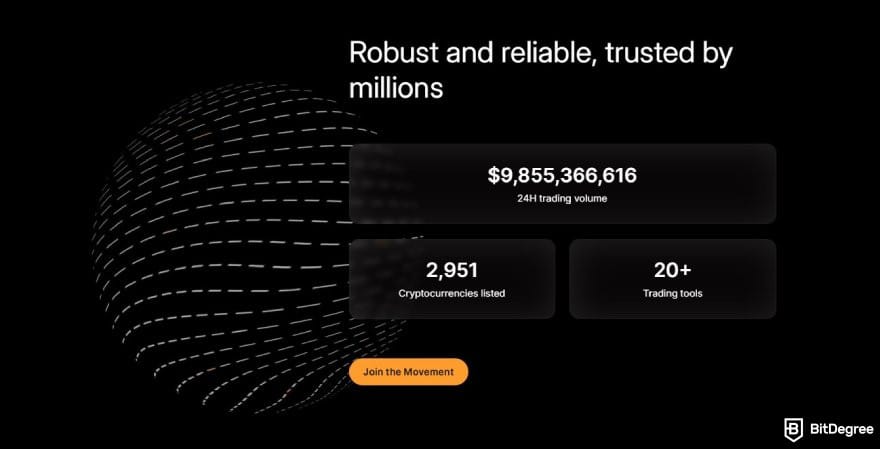
KuCoin entered the market in 2017 with a clear identity: broad altcoin access for everyday traders. Its "People's Exchange" branding reflected a genuine product philosophy of listing early-stage and lower-cap tokens before they reached larger venues, making it a go-to platform for traders seeking assets unavailable elsewhere.
That positioning has defined how KuCoin is perceived within the trading community to this day, even as the platform has since expanded into derivatives, bots, and institutional products.
Bybit entered in 2018 with a narrower but more focused identity: a derivatives exchange built for active traders. It earned its reputation through execution quality and a clean trading interface rather than asset breadth, and has grown that core identity into a broader platform over time. Among experienced traders in particular, Bybit is consistently regarded as one of the most capable non-US exchanges currently operating.
KuCoin's advantages:
- Established identity as the leading destination for altcoin discovery and early token listings;
- Strong community presence, particularly among retail traders who follow emerging projects;
- Long operating history since 2017, with a loyal user base across emerging markets in Asia, MENA, and Latin America.
Bybit's advantages:
- Well-regarded among active and professional traders for derivatives execution and product depth;
- Larger registered user base at 85 million, reflecting faster recent growth;
- Stronger and more advanced regulatory standing, with MiCA and UAE SCA licenses secured in 2025.
Verdict
KuCoin owns the altcoin-first, retail-community positioning. It is the platform traders think of first when looking for early token access. Bybit owns the active trader positioning, with a larger user base and stronger regulatory credentials. Both are well-established platforms, but they are known for different things among different types of users.
KuCoin vs Bybit — Trading Features
Both platforms cover the full active-trading stack, including spot, derivatives, copy trading, and bots. The differences are in what each platform has gone deeper into and where its respective strengths lie. Take a look at these lists:
KuCoin Trading Features
For basic trading, KuCoin offers:
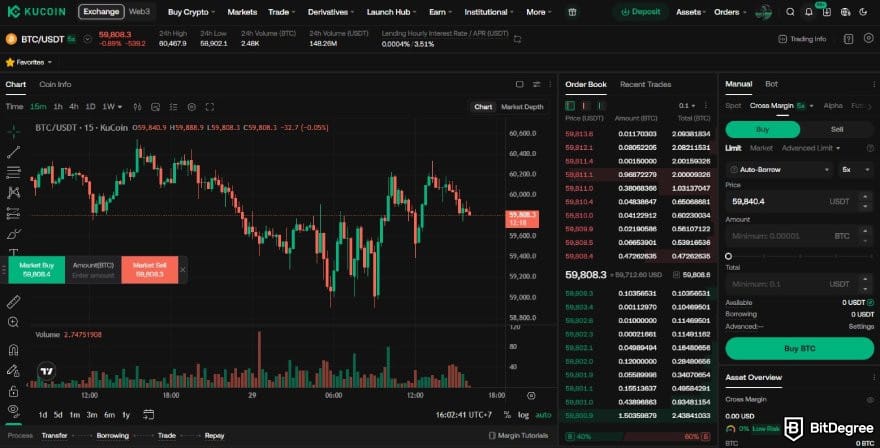
- Spot trading across 1,000+ assets with TradingView-powered charting;
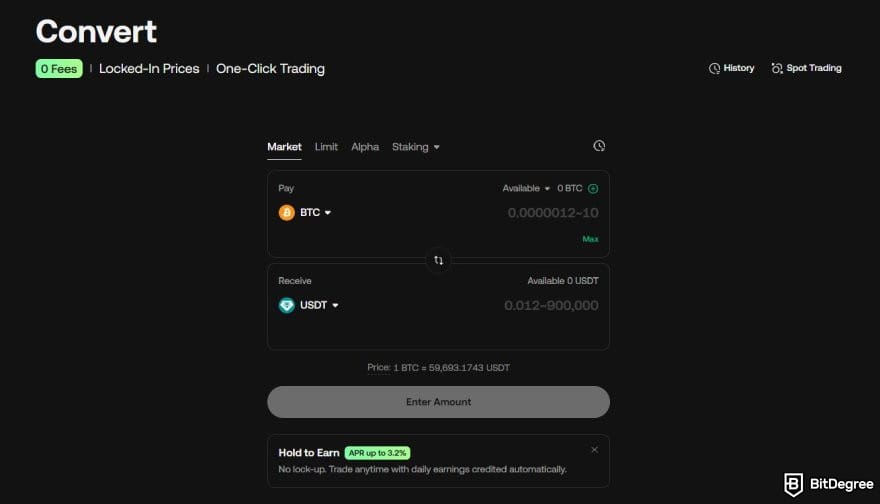
- Convert for zero-fee swaps between assets;
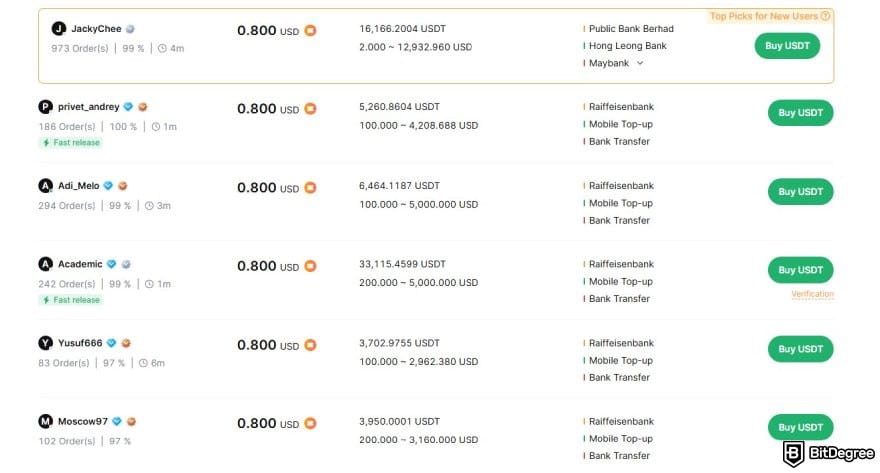
- P2P trading for direct user-to-user transactions in local currencies;
- KuCoin Lite, which is a simplified interface for users who want a less complex experience;
- KuCoin Alpha supports an on-chain early token discovery feature for accessing emerging projects before they reach the main spot market.
For advanced trading, KuCoin supports:
- USDT-margined and Coin-margined perpetual futures across hundreds of pairs;
- Margin trading with up to 10x leverage on the spot market;
- Leveraged tokens that offer tokenized leverage without liquidation risk (e.g. BTC3L for 3x long exposure);
- Up to 100x leverage on select futures contracts;
- Unified Trading Account (UTA) for managing spot, margin, futures, and options under shared collateral;
- Futures Trial Fund, a free demo balance with live market conditions for practicing futures without real capital at risk.
For automated and strategy-based trading, KuCoin offers:
- Copy trading for both spot and futures;
- Native trading bots, including Spot Grid, Futures Grid, DCA, Spot Martingale, Futures Martingale, Infinity Grid, Smart Rebalance, Margin Grid, AI Futures Trend Bot, and DualFutures AI Bot. All of which are free with no subscription required;
- Stock Index Perpetual Contracts for trading major global indices within the futures interface;
- API trading for algorithmic strategies.
Bybit Trading Features
For basic trading, Bybit offers:
- Spot trading with TradingView charting integration;
- Convert for quick swaps between assets;
- P2P trading for direct user-to-user transactions;
- Pre-market trading for select tokens ahead of official listing;
- Demo trading for practicing spot and derivatives strategies with simulated funds.
For advanced trading, Bybit supports:
- USDT-margined, USDC-margined, and Inverse perpetual contracts across hundreds of pairs;
- Dated futures alongside perpetuals;
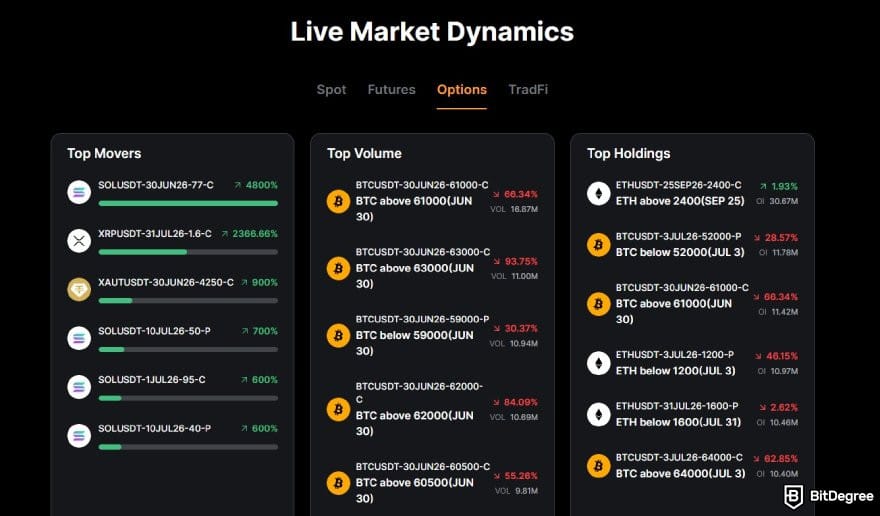
- Options trading with European-style, cash-settled USDC options;
- Leveraged tokens available within the Unified Trading Account;
- Up to 100x leverage on select perpetual contracts;
- Unified Trading Account (UTA) consolidating spot, margin, derivatives, and options with shared collateral.
For automated and strategy-based trading, Bybit offers:
- Copy trading across three modes: Classic, Pro, and TradFi
- Native trading bots, including Spot Grid, Futures Grid, DCA, Futures Martingale, Futures Combo, and Auto-Invest
- TradFi access to 380+ global stock CFDs and forex via MT5-style integration
- AI Skills platform allowing AI agents to execute trades via API
- API trading for algorithmic strategies
Verdict
Both platforms offer comparable trading feature sets at a high level. KuCoin's edge is its unmatched altcoin selection and the depth of its bot library, the widest range of native bot types of the two. Bybit's edge is its copy trading infrastructure. With three distinct modes, including TradFi copy trading, and generally stronger derivatives liquidity on major pairs. Both have a Unified Trading Account, but Bybit's is more mature and widely used among active traders.
KuCoin vs Bybit — Fees
Both platforms use a maker-taker model with tiered discounts through native tokens and VIP levels. The differences are meaningful, particularly for spot traders dealing in altcoins, and for futures traders comparing token discount coverage.
KuCoin | Bybit | |
|---|---|---|
Spot fees (base) | 0.10% maker / 0.10% taker | 0.10% maker / 0.10% taker |
Futures fees (base) | 0.02% maker / 0.06% taker | 0.02% maker / 0.055% taker |
Native token spot discount | 20% via KCS (spot and margin only) | 25% via MNT |
Native token futures discount | ✗ | 10% via MNT (select contracts, non-API) |
Table: KuCoin vs Bybit base fee comparison
At a glance, the spot fees look identical. Both platforms charge 0.10% for makers and takers at the base level. However, KuCoin's fee structure is more complex than the headline rate suggests. KuCoin assigns every tradable asset to one of three fee classes based on the token's market standing.
- Class A covers major established assets (BTC, ETH, SOL, XRP, USDT, and others) and trades at the 0.10%/0.10% base rate.
- Class B covers mid-tier tokens at 0.20%/0.20%;
- Class C covers smaller and newer assets at 0.30%/0.30%, up to three times higher than Bybit's flat rate for the same trade size.
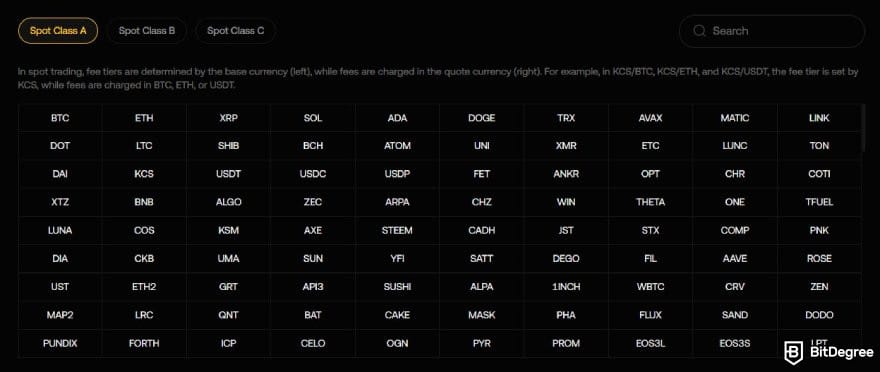
This matters particularly given KuCoin's identity as an altcoin-first exchange. Users trading the smaller, early-stage tokens that KuCoin is specifically known for are often trading Class B or C assets, meaning they may be paying significantly more than they would on Bybit, despite KuCoin's 0.10% headline fee. Before trading on KuCoin, it's worth checking which class your intended asset falls under.
On futures, Bybit has a marginal edge at the base level of 0.055% taker versus KuCoin's 0.06%. The difference is small per trade but compounds for high-frequency futures traders.
The native token comparison also favors Bybit. KuCoin's KCS gives a 20% discount on spot and margin fees, but does not apply to futures at all. Bybit's MNT gives 25% off spot and 10% off select futures contracts, making it the more broadly applicable discount of the two.
$1,000 Spot Trade Fee Comparison
A $1,000 market (taker) order on BTC/USDT (Class A), no token discount:
KuCoin: $1,000 × 0.10% = $1.00
Bybit: $1,000 × 0.10% = $1.00
With native token discount applied:
KuCoin (KCS, 20% off): $1,000 × 0.08% = $0.80
Bybit (MNT, 25% off): $1,000 × 0.075% = $0.75
The same trade on a Class B altcoin on KuCoin, no discount:
KuCoin: $1,000 × 0.20% = $2.00
Bybit: $1,000 × 0.10% = $1.00
$1,000 Futures Trade Fee Comparison
A $1,000 BTC/USDT perpetual, round trip (open + close), taker on both legs, no discount:
Open | Close | Total | |
|---|---|---|---|
KuCoin | $0.60 | $0.60 | $1.20 |
Bybit | $0.55 | $0.55 | $1.10 |
Table: KuCoin vs Bybit futures trade fee comparison
With MNT discount on Bybit (10% off):
Bybit: $1.10 × 0.90 = $0.99
KuCoin has no equivalent native token discount for futures.
Beyond trading fees, also factor in:
- Asset class assignment. Check whether the specific token you plan to trade falls under Class A, B, or C on KuCoin before assuming the 0.10% headline rate applies;
- Funding rates on perpetual positions are market-driven, not set by either exchange;
- Withdrawal fees vary by asset and network on both platforms;
- VIP tier thresholds on both platforms reduce fees significantly at higher tiers; check each platform's live fee schedule for current breakpoints.
Verdict
For major asset spot trading, fees are equal at the base level. But Bybit's flat fee structure is simpler and cheaper for altcoin trading, where KuCoin's Class B and C rates can be significantly higher. On futures, Bybit has a small edge on both the base taker fee and native token discount coverage. KuCoin's KCS discount is spot and margin only, while Bybit's MNT covers both spot and select futures.
KuCoin vs Bybit — Liquidity & Execution
Both platforms generate significant daily trading volume, but their liquidity profiles are shaped by different user bases and product focuses.
KuCoin is a strong venue for spot liquidity on major pairs. Independent testing confirms that spreads on BTC/USDT and ETH/USDT remain tight under 0.02% during normal market conditions, and order fills on major pairs execute quickly with minimal slippage. Its daily spot volume consistently sits in the $1.5-2B range, and its futures market adds a comparable volume on top of that.

Where KuCoin's liquidity weakens is in its altcoin-heavy long tail, the same wide token selection that makes it attractive for altcoin discovery comes with wider spreads and thinner order books on lower-cap assets. For traders entering or exiting smaller positions in micro-cap tokens, limit orders are advisable over market orders to avoid unnecessary slippage.
Bybit is more competitive in derivatives liquidity, specifically. Its perpetuals market, particularly for major USDT-margined pairs like BTC and ETH, benefits from a large, active derivatives-focused user base that keeps order books consistently deep. For spot trading on major pairs, Bybit is similarly liquid to KuCoin, but its strength concentrates in derivatives rather than altcoin spot breadth.
For retail-sized orders on major pairs, both platforms execute reliably. The practical difference in liquidity becomes more relevant for larger position sizes in derivatives, where Bybit's deeper perpetuals order books give it an advantage, and for small-cap altcoin spot trading, where KuCoin has more pairs available but thinner books on the less active ones.
Verdict
KuCoin is the stronger spot venue for major pairs and has broader altcoin coverage, but liquidity thins out significantly on smaller assets. Bybit leads on derivatives liquidity, particularly for perpetuals on major pairs. For standard retail order sizes, both platforms execute cleanly on BTC and ETH markets.
KuCoin vs Bybit — Security & Trust
Both platforms carry significant security events in their histories, but they are different in type, scale, and how each platform has responded over time.
KuCoin | Bybit | |
|---|---|---|
Two-factor authentication | Google Authenticator, SMS, app-based | TOTP, passkeys, YubiKey, biometric |
Anti-phishing code | ✓ | ✓ |
Withdrawal address whitelist | ✓ | ✓ |
Trade/fund password | ✓ | ✓ |
Cold storage | 95%+ offline, multi-sig, geographically distributed | majority of assets, multi-sig |
Hardware Security Module (HSM) | NIST FIPS 140-2 Level 3 certified | TEE/TSS |
Proof of Reserves | Monthly, Merkle tree, third-party audited, 100%+ since 2022 | Monthly, Merkle tree, attested by Hacken |
Security certifications | SOC 2 Type II, ISO 27001, ISO 27701 | Not publicly confirmed |
Insurance fund | ✓ | ✓ |
Table: KuCoin vs Bybit security feature comparison
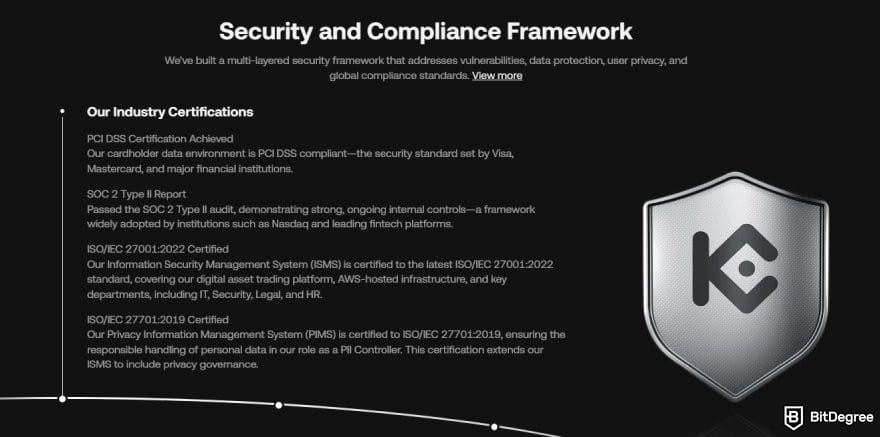
KuCoin has built one of the more transparent security frameworks among major exchanges. Over 95% of user funds are held in offline cold wallets with multi-signature requirements and geographic distribution. Key management uses a Hardware Security Module certified to NIST FIPS 140-2 Level 3, with all sensitive data processed within a Trusted Execution Environment.
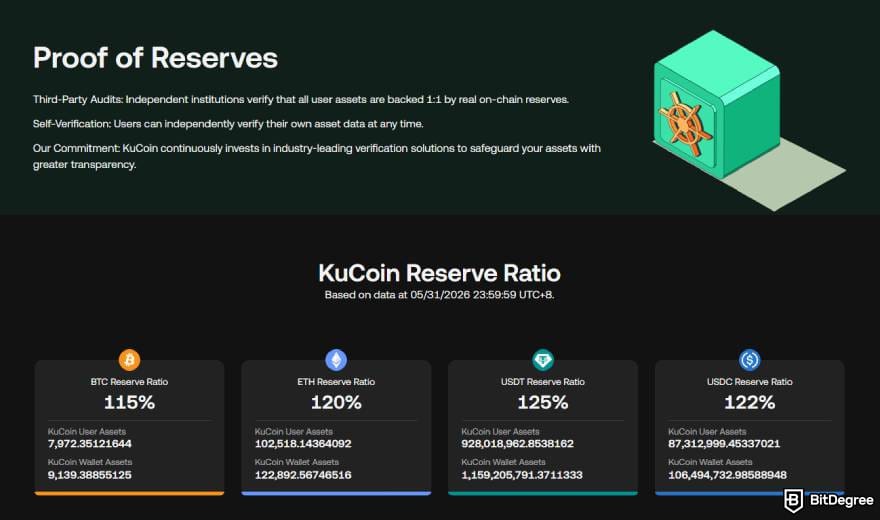
KuCoin has published monthly Proof of Reserves using Merkle tree verification with third-party auditing consistently since 2022, one of the longest unbroken PoR track records among major exchanges. Reserve ratios for major assets have consistently exceeded 100%. The platform also holds SOC 2 Type II, ISO 27001, and ISO 27701 certifications, which subject it to external information security auditing standards that Bybit has not publicly confirmed equivalent certifications for.
KuCoin's defining security event is the September 2020 hack, in which attackers, later attributed to the Lazarus Group, stole approximately $281 million from its hot wallets. KuCoin reimbursed all affected users through its insurance fund and insurance partners, implemented enhanced cold storage protocols, and strengthened its monitoring systems in the aftermath.
No client funds were permanently lost. In 2023, KuCoin's X (Twitter) account was also compromised in a social engineering attack, a smaller incident that resulted in additional controls being put in place.
In early 2026, KuCoin announced a $2 billion multi-year investment (2026-2028) focused on security upgrades, reserve transparency, compliance expansion, and product innovation, signaling a deliberate shift toward institutional-grade trust infrastructure under CEO BC Wong's leadership.
Bybit's security profile and its February 2025 breach have been covered in detail in earlier sections of this comparison. In brief: the Lazarus Group exploited a third-party wallet provider vulnerability to steal approximately $1.4–1.5 billion in Ethereum, the largest crypto exchange hack on record.
Bybit restored reserves to a 1:1 ratio within 72 hours, processed over 350,000 withdrawals in the first 12 hours, and reported zero client fund losses. Since then, Bybit has conducted over 50 security upgrades following nine external audits and has advanced its regulatory standing with MiCA and UAE SCA licenses.
The regulatory dimension of this comparison also matters for the trust assessment. KuCoin's January 2025 DOJ guilty plea, $297 million settlement, and subsequent CFTC-confirmed permanent bar from the US market represent a regulatory trust deficit that its technical security improvements have not yet fully offset, particularly for users in jurisdictions where KuCoin's compliance status remains unclear. Bybit's regulatory trajectory is moving in the opposite direction, with active tier-one licenses rather than outstanding enforcement actions.
Verdict
Both platforms have major security incidents on their records, KuCoin's 2020 hack and Bybit's 2025 breach, and both resolved them without permanent client fund losses. KuCoin has a stronger technical security certification stack (SOC 2 Type II, ISO 27001, ISO 27701) and a longer unbroken PoR track record. Bybit's breach was more recent and significantly larger in scale, but its crisis response was swift, and its post-incident security hardening has been substantial. On regulatory trust, Bybit currently holds the stronger position, while KuCoin's DOJ settlement and US market bar remain material considerations for risk-conscious users.
KuCoin vs Bybit — Broader Ecosystem
Both platforms have expanded well beyond trading into earn products, Web3 tools, and spending features. Their ecosystems reflect their respective platform identities. KuCoin leans into community, discovery, and altcoin-adjacent features, while Bybit leans into structured trading tools and institutional-grade products.
KuCoin's Ecosystem
Here are some of KuCoin's additional features:
1
KuCoin Earn
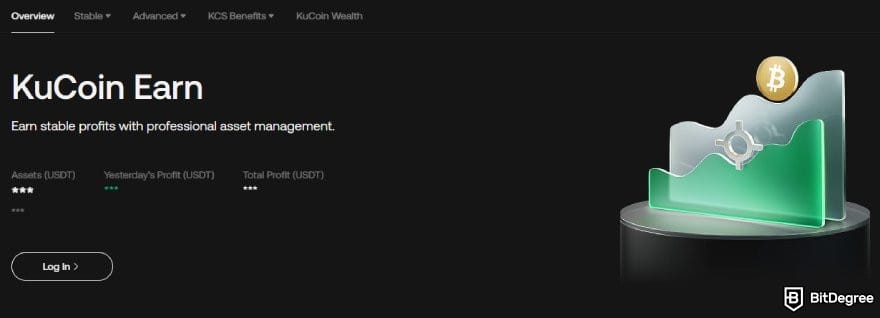
KuCoin Earn covers flexible and fixed-term savings, staking, and lending products that let users generate yield on idle assets. The platform also runs structured products for users seeking more tailored return profiles across different market conditions.
2
Spotlight Launchpad
KuCoin Spotlight is its primary token launch platform, giving users early access to vetted projects before they reach broader markets. KuCoin has a long track record of early-stage listings, an extension of its core identity as the altcoin discovery platform, and Spotlight reinforces that role by giving existing users first-mover access to new tokens.
3
KuCoin Web3 Wallet
KuCoin officially launched its Web3 Wallet in January 2026. The self-custodial wallet supports 20 major blockchain networks, offers access to 1,000+ DApps, includes a cross-chain swap aggregator, a built-in airdrop hub, and Smart Money tools for early opportunity discovery. Its most distinctive feature is native in-wallet perpetual futures trading powered by Hyperliquid's infrastructure, allowing users to trade with CEX-level execution speeds while retaining full custody of their keys. The wallet is available on mobile, browser extension, and web.
4
KuCard and KuCoin Pay
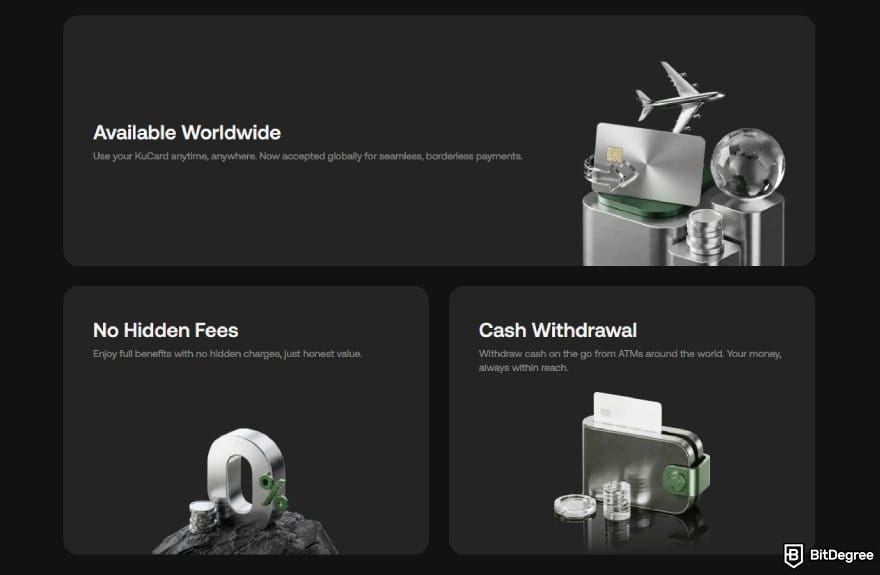
KuCard is a crypto debit card supporting real-time crypto-to-fiat conversion for BTC, ETH, XRP, KCS, USDT, and USDC, with up to 3% cashback rewards. It integrates with Apple Pay and Google Pay for spending at millions of merchants worldwide. KuCoin Pay enables instant peer-to-peer crypto transfers across 50+ supported assets with minimal fees.
5
KCS and KCS PulseDrop
KuCoin's native token KCS, provides fee discounts, daily revenue-sharing bonuses for holders staking at least six tokens, and access to Spotlight token sales. KCS PulseDrop, launched in March 2026, is a points-based engagement system that rewards users for trading, staking, and platform activity, converting routine platform use into redeemable rewards.
Bybit's Ecosystem
Bybit also offers additional features aside from its trading functions:
1
Bybit Earn
Bybit Earn spans Easy Earn (flexible and fixed-term savings), On-Chain Earn (simplified DeFi staking with gas fees handled by the platform), Liquidity Mining via an AMM model, Shark Fin (a structured principal-protected product), and Launchpool for staking to earn new tokens.
2
Launchpad
Bybit Launchpad has hosted 110 projects and facilitated over $1.817 billion in funds raised as of March 2026. It operates across three formats: Launchpad (token sales), Launchpool (staking-based distribution), and Wednesday Airdrop (weekly task-based campaigns). KYC Level 1 is required for all three.

3
Bybit Seed Phrase Wallet
Bybit's self-custody option is its Seed Phrase Wallet, integrated within the Bybit ecosystem and supporting multiple EVM and non-EVM networks with dApp connectivity. Following a 2025 streamlining of its Web3 suite, which saw its NFT Marketplace and cloud/keyless wallet types discontinued, the Seed Phrase Wallet is the platform's primary self-custody offering.
4
Bybit Card and Pay
The Bybit Card is a Mastercard accepted at over 90 million merchants worldwide with cashback rewards in eligible regions. Bybit Pay supports crypto and fiat payments via QR-based merchant transactions.
5
MNT Token
Bybit's native token MNT provides fee discounts (25% on spot, 10% on select futures), Launchpad subscription access, and VIP tier benefits. It is the central incentive token across the Bybit ecosystem.
Verdict
Both ecosystems cover the same core categories. KuCoin's Web3 Wallet pulls ahead with native perpetual trading, broader chain support, and a built-in airdrop hub, while its card offers a higher cashback ceiling. Bybit counters with a more structured Earn suite and a stronger Launchpad track record by funds raised.
KuCoin vs Bybit — Fiat Deposits & Withdrawals
Neither platform has Coinbase-level banking integration, and both rely on a mix of direct transfers, P2P, and third-party providers. However, KuCoin's direct fiat infrastructure is notably narrower than it first appears.
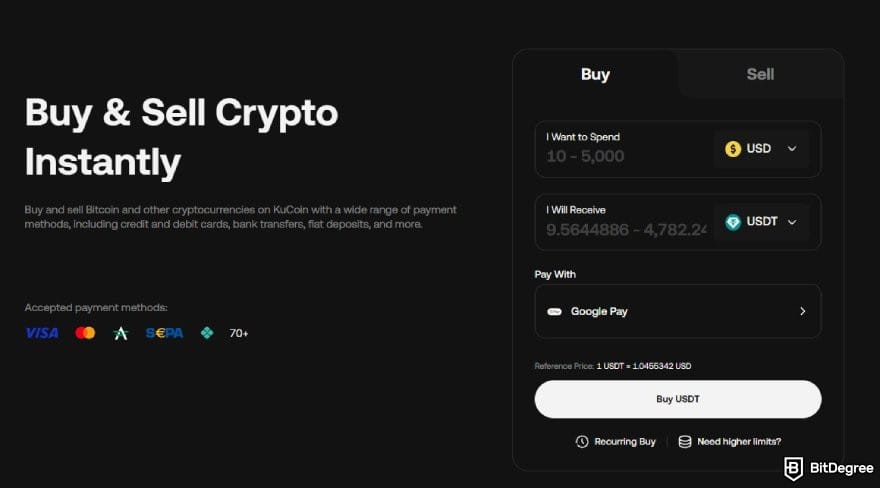
KuCoin supports over 60 fiat currencies for crypto purchases through its One-Click Buy feature and P2P marketplace, but its direct fiat deposit and withdrawal options are considerably more limited. Direct bank deposits are supported primarily for EUR via SEPA Open Banking, with deposits credited quickly once processed.
For direct fiat withdrawals, KuCoin currently supports only EUR (via SEPA, flat fee of 1 EUR) and BRL (via PIX). USD withdrawals via SWIFT are available but carry a flat fee of $80, making them impractical for smaller amounts. Users needing to cash out in other currencies, like GBP, AUD, JPY, and others, typically need to convert to crypto first and transfer to another exchange.
KuCoin does not support direct credit or debit card fiat deposits. Card-based purchases are handled through its One-Click Buy feature via third-party providers, which carry provider fees typically ranging from 1-5% depending on the method and region.
P2P trading remains the most flexible fiat on-ramp for users outside directly supported currencies, with the P2P marketplace supporting 54+ fiat currencies and payment methods, including Revolut, Wise, and local bank transfers across multiple regions.
Bybit covers a broader fiat deposit landscape. Direct bank transfers are available for a wider list of currencies, including EUR, USD, BRL, and several others, with SEPA available for EU users. P2P trading supports 60+ fiat currencies with over 80 payment methods.
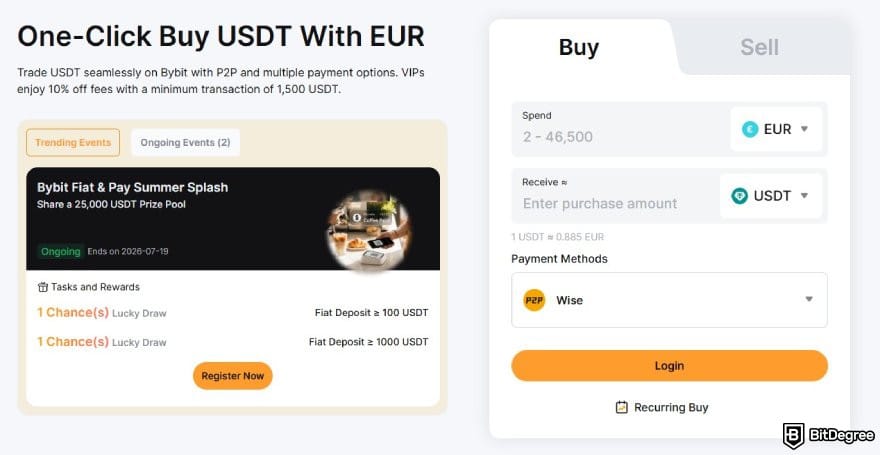
Card purchases via Visa, Mastercard, Google Pay, and Apple Pay are supported through third-party providers. Like KuCoin, card withdrawals are not supported, fiat exits go through bank transfer or P2P.
For both platforms, the actual available methods and supported currencies depend on the user's country and KYC level. Always verify the specific options available in your region directly on each platform's deposit page before assuming a particular method is accessible.
Verdict
Bybit has the broader and more practical fiat infrastructure of the two. KuCoin's direct bank transfer support is limited to EUR and BRL withdrawals, with USD SWIFT withdrawals carrying a high flat fee. P2P remains the most flexible fiat access route on both platforms for users in regions without direct bank support.
KuCoin Trading Walkthrough
One of the easiest ways to trade on KuCoin is by using the spot feature. It gives you enough control over your orders while still being fairly simple to navigate. Here is how you can do it:
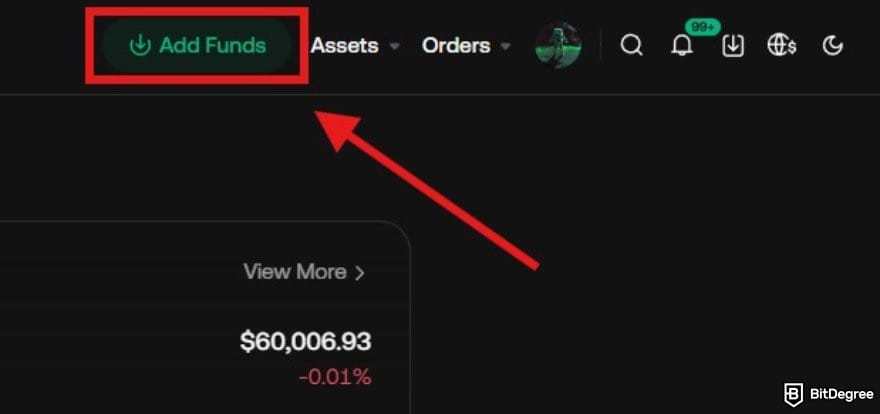
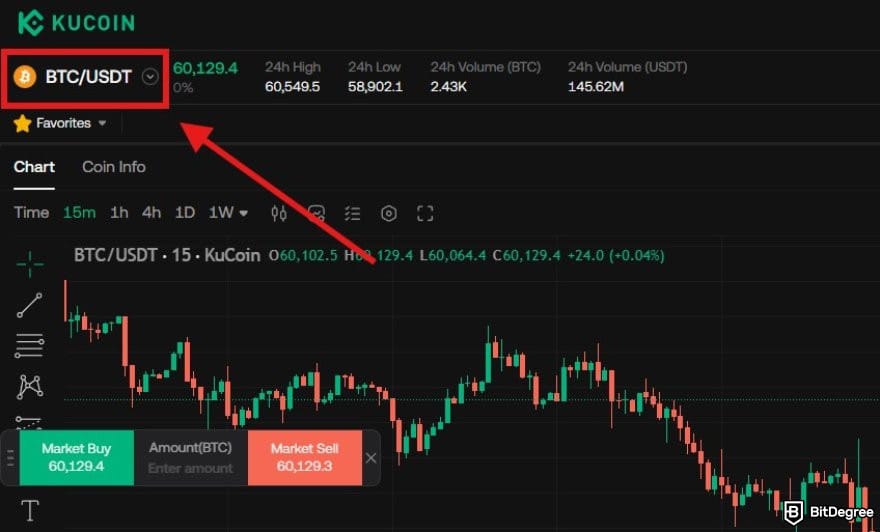
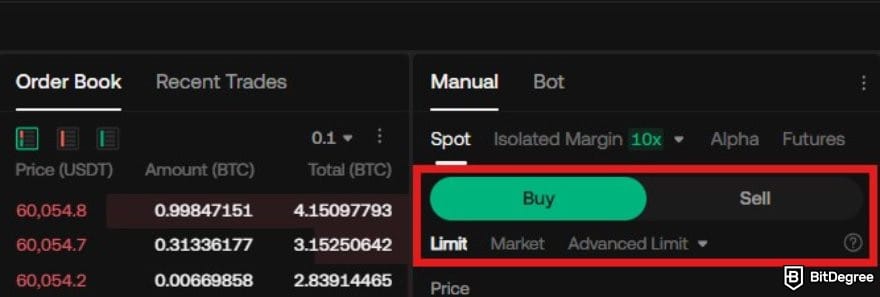
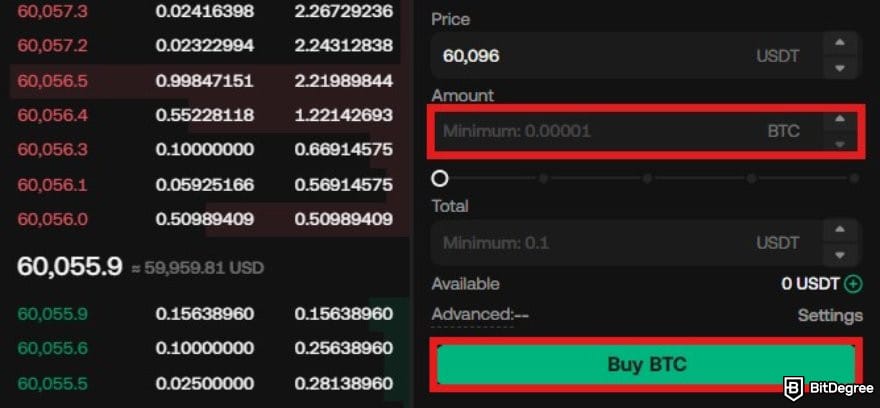
Once your order is filled, the BTC will be deposited directly into your KuCoin spot wallet, where it will be available for trading, transfer, or movement to an external wallet at any time.
Bybit Trading Walkthrough
One of Bybit’s most popular trading features is perpetual futures, so let’s look at how opening a BTCUSDT perpetual contract works.
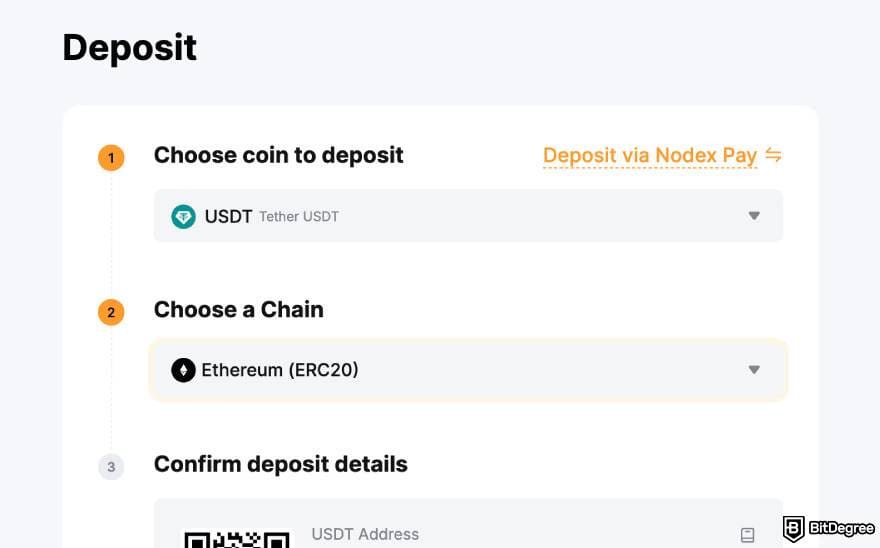
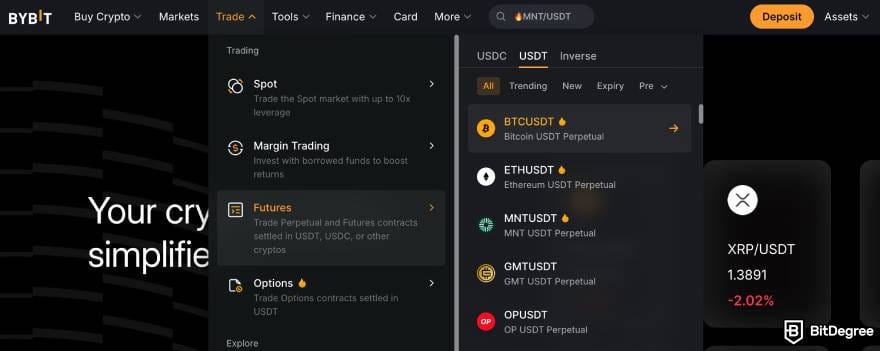
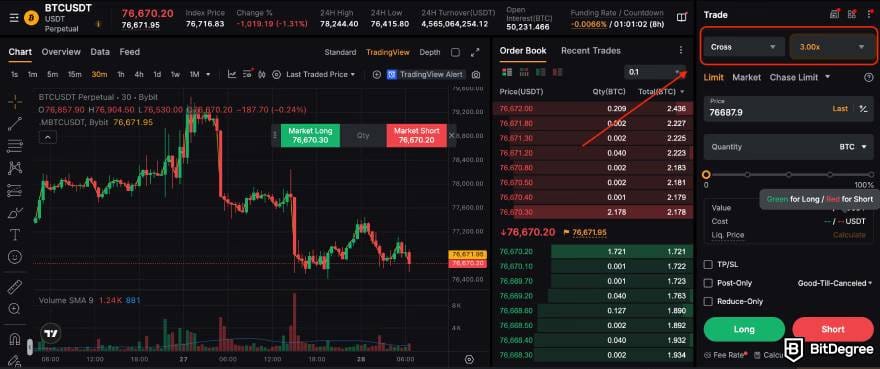
Beginners often misunderstand leverage and assume it simply “boosts profit”. In reality, it also reduces the margin of error.
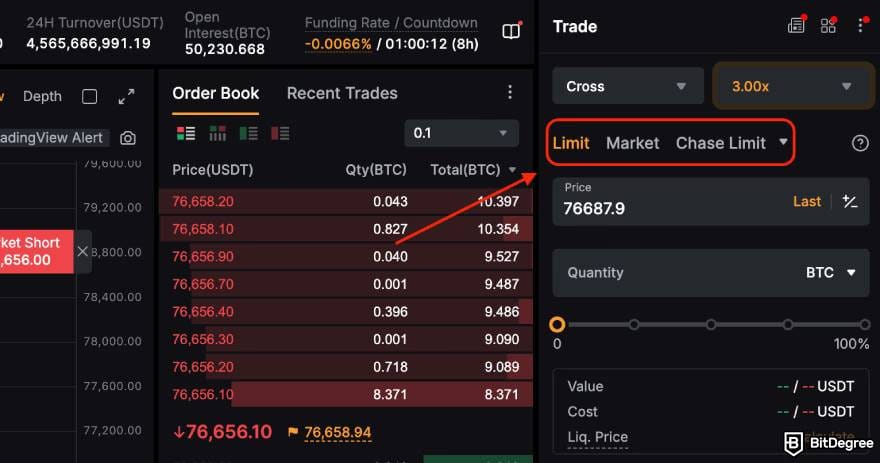
Other order types are available as well, but market and limit orders are the simplest ones to understand first.
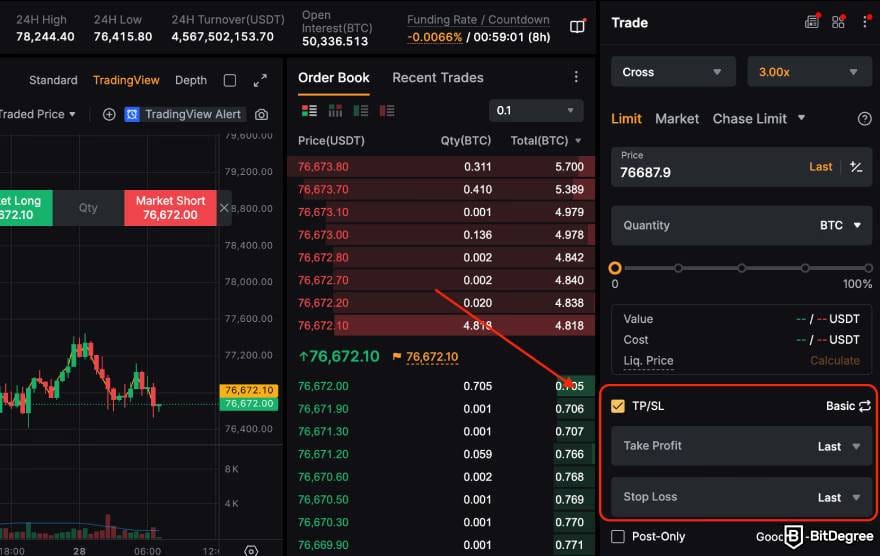
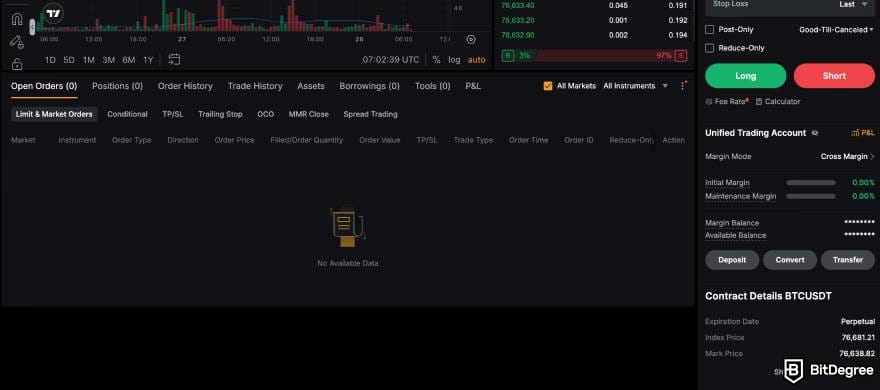
After confirming the trade, you should monitor:
- Entry price;
- Mark price;
- Liquidation price;
- Unrealized P&L;
- Funding fee;
- Margin ratio;
- Stop-loss and take-profit status.
This is where futures trading differs heavily from spot trading. With spot, the value of the asset can fall, but the user still owns the asset unless they sell. With leveraged perpetuals, the position can be liquidated if the market moves too far against them.
KuCoin vs Bybit For Beginners
Neither platform is built primarily with complete beginners in mind; both are feature-rich, pro-grade exchanges that assume some baseline familiarity with crypto trading. That said, there are meaningful differences in how each handles the beginner experience.
Bybit is the more accessible starting point of the two. Its interface is consistently praised across independent reviews for its clean layout and logical navigation. Menus are well-organized, features are easy to locate, and the overall experience feels less cluttered than KuCoin's despite covering a broad product range.

Bybit's demo trading account is particularly valuable for beginners. It lets users practice spot and derivatives trading with simulated funds under real market conditions before committing real capital, with no time limit or risk. Customer support on Bybit is also generally rated more highly than KuCoin's for response speed and resolution quality, which matters for new users who encounter issues early on.
KuCoin's depth is both its strength and its beginner-facing weakness. Its dashboard packs a large number of products, menus, and features into a single interface, valuable for experienced users who want everything in one place, but potentially overwhelming for someone placing their first trade.
KuCoin does offer a Lite Mode, a simplified interface that strips back the complexity for users who want a more straightforward experience, which partially addresses this. KuCoin also has demo trading via its Futures Trial Fund, giving beginners a way to practice futures specifically before going live.
A beginner might lean toward Bybit if they:
- Want a cleaner, less overwhelming interface to start with
- Plan to use demo trading to learn spot and derivatives mechanics before risking real funds
- Value responsive customer support during the learning phase
A beginner might lean toward KuCoin if they:
- Are primarily interested in altcoin discovery and want access to a wider token selection from day one
- Are comfortable using Lite Mode as a simplified entry point before exploring the full platform
- Want to practice futures specifically via the Futures Trial Fund
Note
Bybit is the more beginner-friendly platform of the two, with a cleaner interface, better-rated support, and a demo account covering both spot and derivatives. KuCoin's Lite Mode helps lower the barrier, but its full interface remains more complex. Both platforms are best approached with demo trading before committing real funds.
KuCoin vs Bybit For Active Traders
Both platforms are built for active traders, but they reward different trading styles. The right choice here depends on whether your edge comes from derivatives execution and copy trading, or from altcoin access, automation breadth, and cost efficiency at volume.
Bybit is the stronger fit for traders whose focus is on derivatives. Its perpetuals order books are deeper on major pairs, its execution engine handles high throughput reliably, and its Unified Trading Account lets experienced traders manage spot, margin, derivatives, and options positions under shared collateral without moving funds between sub-accounts.
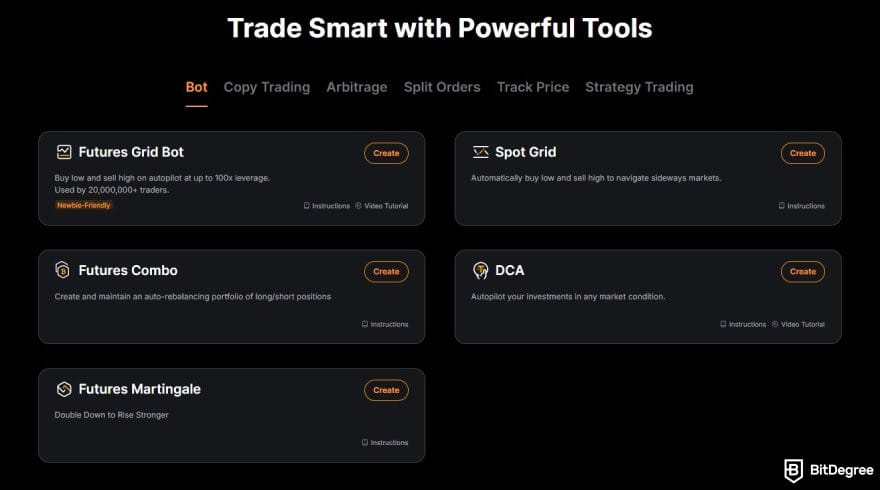
Copy trading on Bybit is also more developed as an active trading tool. The three-mode structure (Classic, Pro, and TradFi) gives experienced users more strategic options than KuCoin's copy trading implementation. Bybit's base futures taker fee of 0.055% also edges out KuCoin's 0.06% at the entry level, and its MNT discount applies to futures as well as spot. For traders who also want exposure to stock CFDs and TradFi instruments alongside crypto derivatives, Bybit's 380+ stock CFD offering, accessible from the same account, is a further draw.
KuCoin is the stronger fit for active spot traders and altcoin-focused strategies. With 1,000+ listed assets, including early-stage and micro-cap tokens, it gives traders access to a wider opportunity set than Bybit's spot market covers. Its native bot library is also the more extensive of the two, covering spot grid, futures grid, DCA, martingale, infinity grid, smart rebalance, margin grid, AI futures trend, and DualFutures AI Bot. All bots are free without requiring third-party integrations.
KuCoin also supports up to 125x leverage on select futures contracts versus Bybit's 100x, and its fee structure at higher VIP tiers, particularly with KCS discounts applied, can result in lower effective spot fees for high-volume traders. For traders who want pre-market access to new tokens before official listing, KuCoin's OTC pre-market trading and KuCoin Alpha provide earlier entry points than Bybit typically offers.
Verdict
Bybit is the stronger platform for derivatives-focused active traders who prioritize execution depth, copy trading, and a unified account structure. KuCoin is the stronger platform for altcoin-heavy strategies, bot automation breadth, and cost efficiency at high spot volumes. Both are capable platforms; the decision comes down to whether you trade more in major derivatives markets or in the wider altcoin spot universe.
KuCoin vs Bybit For Passive Users
Neither platform is built primarily for passive users, but both have invested enough in their Earn suites to make idle asset management a viable use case. Between the two, KuCoin has the more developed passive income offering.
KuCoin's Earn suite is one of the more comprehensive among major exchanges. It covers flexible and fixed-term savings, staking across 50+ Proof-of-Stake tokens, ETH liquid staking via ksETH, Crypto Lending 2.0 for lending to borrowers, KCS Staking with a fee discount and revenue-sharing benefits, GemPool for earning new token airdrops by staking existing assets, and limited-time Promotion products offering elevated yields.
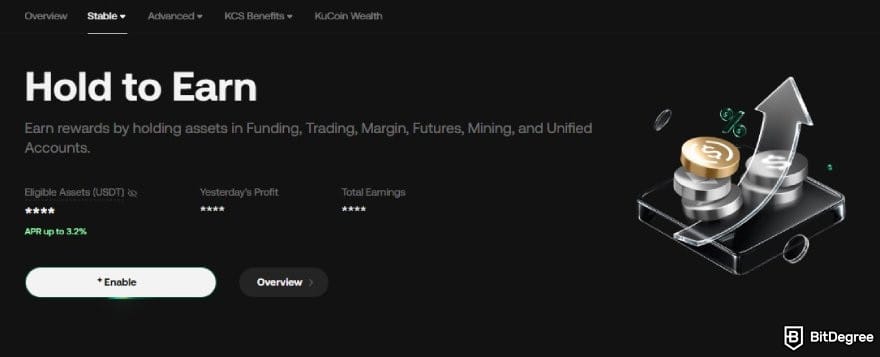
Its most passive-friendly feature is Hold to Earn, enabled once from account settings. It automatically generates yield on supported tokens held across your KuCoin accounts (funding, trading, margin, and futures) without requiring manual subscriptions or lock-ups. For a passive user who simply wants their holdings to generate something without actively managing products, this removes most of the friction.
Bybit's Earn suite is competitive but somewhat narrower in product variety. Easy Earn covers flexible and fixed-term savings, On-Chain Earn simplifies DeFi staking by handling gas fees and validator operations on the user's behalf, Liquidity Mining via AMM pools provides yield from trading fee revenue, and Shark Fin offers a structured principal-protected product that generates returns regardless of market direction.
Bybit's Launchpool lets passive users earn new tokens by staking existing ones. There is no equivalent to KuCoin's Hold to Earn; Bybit's products generally require manual subscription and fund allocation.
For entirely passive users, those who want to hold, earn, and occasionally check their balance, KuCoin's broader product menu and Hold to Earn feature give it a practical edge. That said, both platforms require navigating a trading-heavy interface that is not specifically designed with passive users in mind, and neither is as purpose-built for passive holding as more consumer-focused platforms.
Verdict
KuCoin has a stronger passive income suite, with a wider range of Earn products and the convenience of Hold to Earn for hands-off yield. Bybit's Earn offering is solid, particularly its structured products and On-Chain Earn, but is narrower in variety. Both platforms are best treated as trading platforms first, with Earn as a secondary feature.
Final Verdict: Is KuCoin or Bybit Better?
This comparison is defined as much by each platform's recent history as by its current feature set, and for risk-conscious users, that history matters.
Bybit is the stronger choice if derivatives trading, execution quality, and regulatory standing are your priorities. Its perpetuals order books are deeper on major pairs, its Unified Trading Account provides the cleanest multi-product trading structure available on either platform, and its copy trading infrastructure is more developed with three distinct modes.
At the base level, Bybit's futures taker fee is marginally lower, and its MNT discount covers both spot and futures, a broader cost reduction tool than KuCoin's KCS discount. The February 2025 hack was a significant event, but Bybit's crisis response, reserves restored within 72 hours, zero client losses, and over 50 subsequent security upgrades, was transparent and effective.
More importantly, Bybit's regulatory trajectory is clearly forward-moving: MiCA and UAE SCA licenses in place, with active compliance expansion ongoing. For experienced derivatives traders who want a polished, well-regulated trading environment, Bybit is the stronger platform.
📚 Read More: Full Bybit Review
KuCoin is the stronger choice if altcoin access, passive income breadth, and spot trading variety are what matter most to you. With 1,000+ listed assets, it remains the most accessible venue for early-stage and lower-cap token discovery among major exchanges. Its Earn suite, particularly the Hold to Earn feature, Crypto Lending 2.0, and GemPool, is broader and more varied than Bybit's. For high-volume spot traders, KuCoin's fee structure at advanced VIP tiers with KCS discounts can result in lower effective costs than Bybit.
Its security certifications (SOC 2 Type II, ISO 27001, ISO 27701) and unbroken 36-month Proof of Reserves track record are genuine strengths. That said, KuCoin's regulatory situation, including the January 2025 DOJ guilty plea, $297 million settlement, and the CFTC-confirmed permanent bar from the US market, remains a material consideration for users in jurisdictions where legal certainty matters. Its MiCA license, while obtained, is currently restricted from onboarding new EU customers. These are not minor footnotes.
📚 Read More: Full KuCoin Review
Choose Bybit if you are a derivatives-focused trader who values execution depth, copy trading, and a platform with advancing tier-one regulatory credentials. Choose KuCoin if you are an altcoin trader, passive income seeker, or high-volume spot trader who accepts the platform's regulatory baggage in exchange for its breadth and cost advantages.