




Binance vs KuCoin – In-Depth Comparison
Saying Binance is one of the biggest exchanges on the planet is pretty much stating the obvious at this point. The better question is whether being the “biggest” makes it the right choice for you. That depends on what you do with your crypto, which is where KuCoin turns this into a more interesting discussion.
Since 2017, KuCoin has been quietly building its reputation as “The People’s Exchange” by listing a broad mix of tokens, especially smaller and newer projects that often take longer to show up on other exchanges. If KuCoin is where you first found that obscure token, well, that’s not an accident.
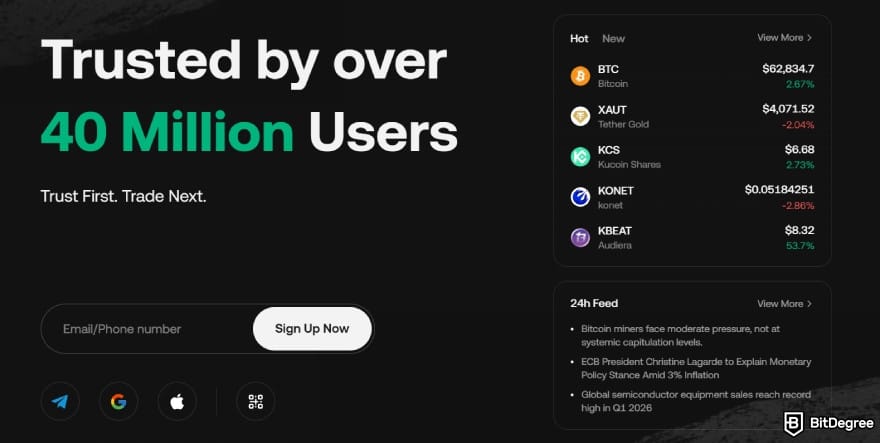
Binance, on the other hand, is still the center of gravity for global crypto trading. It has more users, more customer assets, more trading volume, deeper order books, and more products. It’s designed to serve just about everyone, from first-time buyers to professional derivatives traders.
Binance was named in CNBC's World's Top Fintech Companies 2025 ranking under the Digital Assets category.
So comparing Binance and KuCoin to crown the “stronger” platform isn’t really the most useful exercise. A better question would be: "Which exchange better supports the way you trade, manage your assets, and navigate the crypto market?"
Before we start poking through the details, here’s a quick comparison table to give you the gist of how both platforms stack up:
Best for | Traders who want a full-scale crypto ecosystem | Traders who want more altcoin variety and built-in trading bots |
|---|---|---|
Main strength | Liquidity, ecosystem depth, and product breadth | Altcoin variety, trading bots, and KCS perks |
Spot trading fees | 0.1% maker / 0.1% taker (standard) | 0.1% maker / 0.1% taker (standard) |
Futures fees | Slightly cheaper on standard taker orders (0.05%) | Slightly higher standard taker fee (0.06%) |
Passive earning | Binance Earn (flexible and fixed earnings, Dual Investment, Smart Arbitrage, and others) | KuCoin Earn (flexible and fixed earnings, staking, Dual Investment, Shark Fin, Snowball, and others) |
Beginner experience | Strong, with educational resources and a clearer entry path | Decent, though altcoin variety can overwhelm new users |
Advanced trading | Very strong for liquidity, futures, API, and broad market access | Strong for bots, altcoin access, and leveraged tokens |
Overall verdict | Better for scale, liquidity, and one-stop crypto access | Better for scale, liquidity, and one-stop crypto access |
Table: Binance vs KuCoin quick comparison
To sum it up: if you’re after a widely trusted, all-in-one platform with some of the deepest liquidity around, Binance is still probably your default. But if you care more about altcoin variety, automated bot trading, or finding newer tokens early, KuCoin is very much worth considering.
Binance vs KuCoin – Market Position
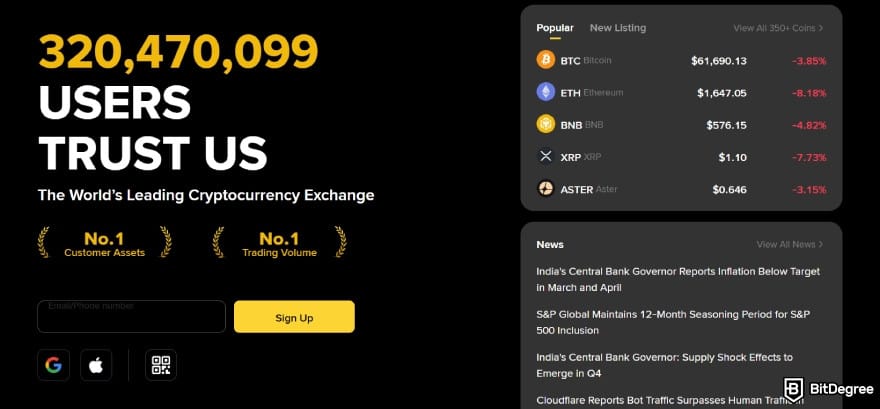
When it comes to sheer scale, Binance operates in a different league. With over 320 million users, more than $65 billion in reported daily trading volume, and upwards of $130 billion in disclosed user assets (as of writing), it enjoys network effects that few exchanges can realistically match.
Those numbers do translate into something practical, too. More active users can mean tighter spreads, better order matching, quicker execution, and more fiat options in regions where Binance supports them.
KuCoin is smaller by comparison (to be fair, almost every exchange is compared to Binance), but that doesn’t make it irrelevant. It has built a niche around faster listings and broader altcoin access. The platform is often among the first major CEX to list newly launched tokens, sometimes weeks ahead of others.
KuCoin lists 900+ trading pairs and has historically been one of the better places to find smaller-cap tokens that still have decent liquidity. Its daily spot volume is nowhere near Binance’s, but for most major and mid-cap assets, it remains practical and competitive.
It’s also worth noting that both have large global user bases. The difference is that availability varies by region. Binance generally has a wider international presence and stronger fiat support, while KuCoin is better known as a global altcoin-focused exchange with meaningful reach outside the US.
Verdict
Binance is ahead on scale, liquidity, and global reach. KuCoin doesn’t fight that battle head-on; it competes by offering faster access to newer tokens and a more trader-friendly setup, with a smaller but still meaningful global presence.
Binance vs KuCoin – Trading Features
At a feature-list level, both exchanges look remarkably similar: spot trading, margin, futures, copy trading, bots, and P2P are all there. The more interesting difference is how each platform approaches those products and the experience built around them.
KuCoin Trading Features
As mentioned earlier, KuCoin stands out most for altcoin access and automated trading. It offers one of the widest ranges of tradable tokens among major CEXs, plus a bot ecosystem that’s fairly approachable even if you have zero coding experience.
For basic trading, KuCoin has:
- Spot trading across 900+ pairs, including a large range of smaller-cap tokens.
- Convert for quick one-click crypto swaps.
- P2P trading for buying and selling with other users using local payment methods.
- KuCoin Pay for seamless, secure, and cost-effective cryptocurrency transactions.
For advanced trading, KuCoin supports:
- Margin trading with cross and isolated margin modes.
- USDT-margined and coin-margined perpetual futures.
- Leveraged tokens for simplified leveraged exposure without liquidation mechanics.
- Options trading (limited availability).
For automated and pro-level trading, KuCoin includes:
- Trading bots (spot grid, futures grid, DCA, Infinity Grid, Smart Rebalance, and Arbitrage Bot).
- Copy trading for automatically following other traders.
- API trading for custom algorithmic strategies.
- Institutional-grade services, including liquidity programs, secure custody solutions, financing products, and OTC trading, for professional traders and firms.
Based on the points above, KuCoin clearly brings a lot to the table with a full suite of features built for casual users, active traders, and even institutional players. Not many exchanges can make that claim without squinting a little.
Binance Trading Features
Binance covers the same ground but with deeper markets and more mature infrastructure. The main advantage isn't feature variety — it's execution quality and liquidity depth.
For basic trading, Binance offers:
- Spot trading across 1,500+ trading pairs.
- Convert for fast crypto swaps without the full trading interface.
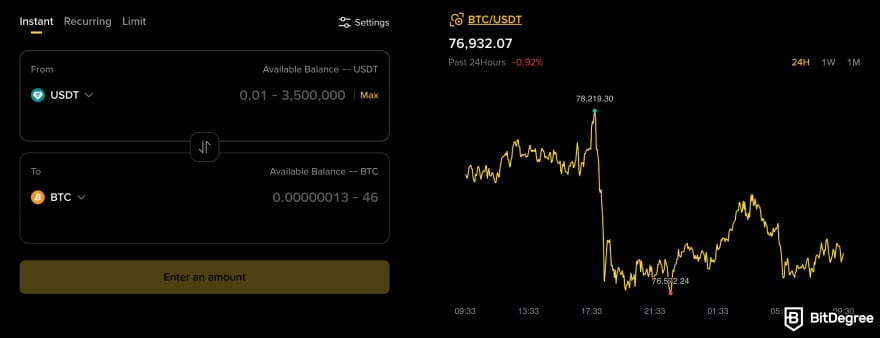
- P2P trading for direct fiat-to-crypto transactions with other users.
- Demo trading for practicing with virtual funds.
For advanced trading, Binance supports:
- Margin trading with cross and isolated margin.
- Futures trading with USDT-M and COIN-M perpetual contracts.
- Options trading for more complex strategies.
For automated and strategy-based trading, Binance includes:
- Trading bots with Grid, DCA, and other automated tools.
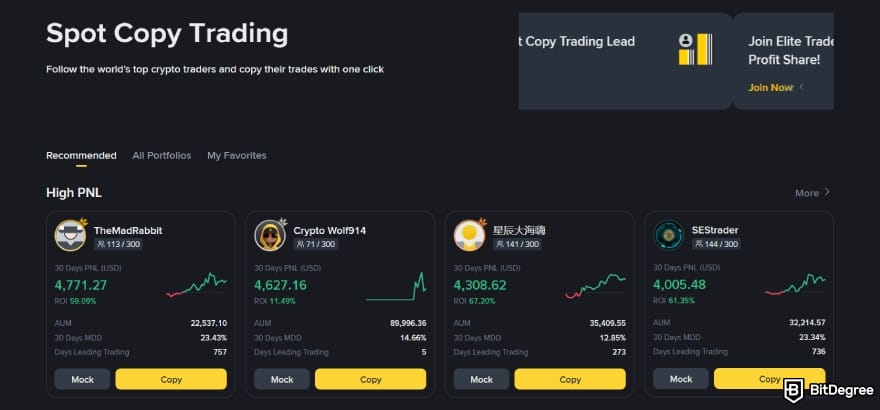
- Copy trading for following more experienced traders.
- API trading for algorithmic strategies.
For larger or institutional traders, Binance also offers:
- OTC and block trading for large-volume orders needing private execution.
- Execution services for high-volume traders requiring advanced order handling.
The main strength of Binance isn’t only how much it offers, but how deep those products go. Beginners can start with convert or spot trading, while experienced traders can move into margin, futures, options, bots, or API-based trading with stronger liquidity and execution support.
Verdict
Both platforms give traders a near-complete toolkit, whether they’re beginners or professionals. KuCoin stands out for its bot variety and altcoin access. Binance, meanwhile, has the edge in liquidity, market depth, and execution quality, especially for larger-sized trades.
Binance vs KuCoin – Fees
Binance and KuCoin both compete as low-fee exchanges. On standard pricing, they appear nearly identical at first glance. The differences become more noticeable, though, once you start trading more frequently at higher volumes.
Here’s a quick breakdown of how the fees compare for regular users:
Account opening | Free | Free |
|---|---|---|
Deposit fees | Usually free (some exceptions depending on asset) | Free |
Withdrawal fees | Varies by method and currency | Varies by method and currency |
Spot fees | Starts at 0.1% maker Starts at 0.1% taker | Starts at 0.1% maker Starts at 0.1% taker |
Spot fees with native discount | 0.075% (with BNB fee discount) | 0.08% (with KCS fee discount) |
Futures fees | 0.02% maker 0.05% taker | 0.02% maker 0.06% taker |
Futures fees with native discount | 0.018% maker 0.045% taker (with BNB fee discount) | - |
Options fees | 0.024% maker 0.024% taker | - |
Table: Comparison of Binance & KuCoin fees
Both platforms follow a broadly similar fee structure. Use the native token to pay trading fees (KCS on KuCoin or BNB on Binance), and you get a discount. Binance’s spot trading discount is slightly higher at 25%, compared with KuCoin’s 20%, although KuCoin doesn’t extend that benefit to futures.
📚 Read More: Binance Fees Explained
That detail matters more when you look at futures fees. KuCoin’s standard futures taker fee is 0.06%, compared with Binance’s 0.05%. It’s not a dramatic gap, but for active futures traders, small differences can stack up over time.
📚 Read More: KuCoin Fees Explained
$1,000 Spot Trade Example
Say you place a $1,000 BTC/USDT market order on each platform:
On KuCoin at the standard 0.1% taker rate:
$1,000 × 0.1% = $1.00
With the KCS fee discount applied:
$1,000 × 0.08% = $0.80
On Binance at the standard taker rate
$1,000 × 0.1% = $1.00
With the BNB fee discount applied:
$1,000 × 0.075% = $0.75
If you’re only trading spot casually, this fee gap isn't exactly life-changing. A smoother interface, easier navigation, or just liking Binance more can matter more than squeezing every last decimal out of the fee table.
$1,000 Futures Trade Example
For a more practical comparison, let’s look at what happens when you open and close a $1,000 BTCUSDT perpetual position with market orders on both platforms:
On Binance, using the regular 0.05% taker fee example:
$1,000 x 0.05% = $0.50
On KuCoin, using the regular 0.06% taker fee:
$1,000 x 0.06% = $0.60
On its own, a $0.20 difference per round trip is easy to dismiss. The picture changes when you're placing hundreds of trades a month, because small cost differences tend to compound over time. Also note that bid-ask spreads, slippage, funding rates, and native discount aren't included in the calculation.
Entry Fee | Exit Fee | Approx. Round-Trip Fee | |
|---|---|---|---|
Binance futures market entry + exit | $0.50 | $0.50 | $1.00 |
KuCoin futures market entry + exit | $0.60 | $0.60 | $1.20 |
Table: Binance vs KuCoin market entry + exit comparison
That said, the lowest fee doesn’t automatically mean the lowest real cost. Make sure you also consider:
- Bid-ask spread;
- Slippage;
- Funding rates;
- Liquidation risk;
- Order execution quality;
- Deposit and withdrawal fees;
- Whether you are using market or limit orders.
A trader paying 0.05% on Binance can still do better than someone paying 0.04% elsewhere if Binance offers better fills via tighter spreads. And when the coin you want isn’t even available on one platform, arguing over tiny fee differences becomes a bit pointless.
Note
For spot trading, the standard fees are nearly identical. Binance has the stronger case on futures taker fees, where its base rate is lower, and its native token discount adds another advantage.
Binance vs KuCoin – Liquidity & Execution
Liquidity is where Binance has one of its strongest edges, and not by a tiny margin. On major pairs like BTC/USDT and ETH/USDT, its order books are deeper than KuCoin’s, and frankly, deeper than what most other exchanges can offer.
For most retail traders buying major cryptocurrencies, the liquidity difference is rarely obvious. If you’re purchasing $500 of ETH, you probably won’t notice much. The gap starts to matter when order sizes increase, volatility spikes, or you’re trading mid-cap tokens with shallower order books.
There’s an interesting exception to the Binance liquidity story, though. For newer tokens that hit KuCoin before they reach larger exchange coverage, liquidity can concentrate heavily on the platform. If a coin is only available on a few CEXs, and KuCoin is one of them, then it may not be the “less liquid” choice at all.
Note
Binance leads in liquidity across major pairs, especially for larger trades. KuCoin can outperform on specific altcoin pairs where it’s the primary listing exchange, though that’s more of a targeted advantage than a broad one.
Binance vs KuCoin – Security & Trust
Both platforms cover the standard account-level security essentials. That said, their overall security offerings are stronger than what most people would consider the baseline for a major exchange.
Binance | KuCoin | |
|---|---|---|
Two-factor authentication | ✓ | ✓ |
Passkeys | ✓ | ✓ |
Anti-phishing code | ✓ | ✓ |
Withdrawal address whitelist | ✓ | ✓ |
Privacy Protection | ✓ | ✓ |
Proof of reserves | ✓ | ✓ |
ISO/IEC 27001 certification | ✓ | ✓ |
User protection fund | KuCoin Insurance Fund | SAFU |
Table: Binance vs KuCoin security features
At the account level, the two exchanges are broadly comparable. Both offer 2FA, anti-phishing codes, withdrawal whitelists, Proof of Reserves, and identity protection measures. The more meaningful difference comes from their respective platform-level track records.
📚 Read More: Is Binance Safe?
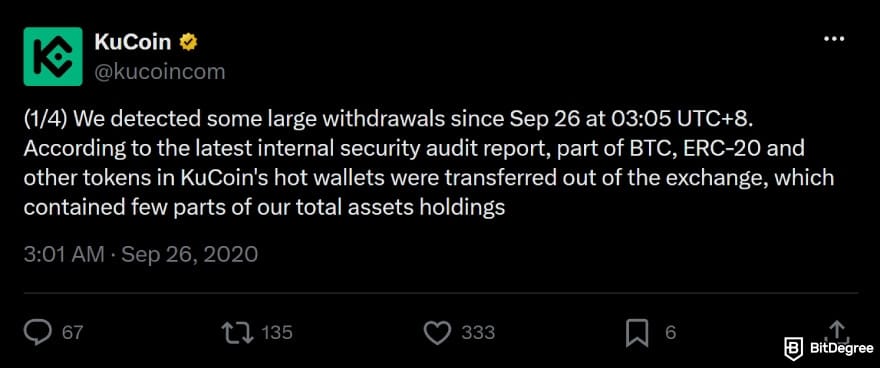
In September 2020, KuCoin suffered a major security breach that affected roughly $275 million in user assets. Most of the funds were recovered through a combination of insurance reserves, assistance from partners, and on-chain asset recovery. Users didn't bear the loss, but the incident remains an important part of the platform’s history.
After the incident, KuCoin moved to strengthen its security and restore user trust. The exchange has continued improving its risk controls and operational safeguards since then. It even announced a $2 billion investment plan for 2026–2028 focused on security, compliance, product innovation, and ecosystem development.
📚 Read More: Is KuCoin Safe?
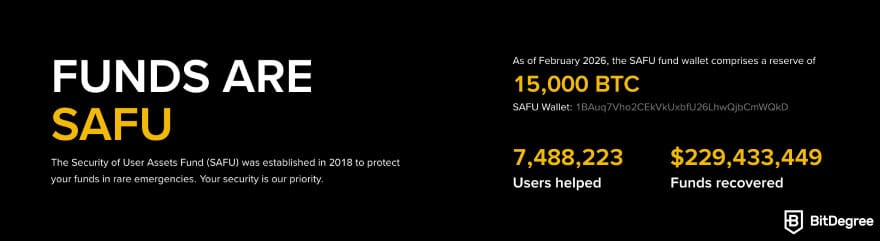
Binance’s SAFU fund (Secure Asset Fund for Users) is designed as a financial backstop for extraordinary situations. The company says it has already supported more than 7.4 million users through the program. Binance also publishes proof of reserves and claims to maintain 1:1 backing of user assets.
KuCoin’s Insurance Fund primarily applies to leveraged trading scenarios, where liquidations close at a worse price than the bankruptcy price. Compared with Binance’s SAFU fund, it’s a narrower protection mechanism.
Regulatory history is also part of the picture. During 2023–2024, Binance agreed to a $4.3 billion DOJ settlement and saw significant leadership changes, while KuCoin reached a settlement that ultimately led to its withdrawal from the US market.
Note
From an account security perspective, Binance and KuCoin are comparable. However, Binance has a better security track record, while KuCoin’s past security breaches remain an important piece of context for anyone weighing overall reliability.
Binance vs KuCoin – Broader Ecosystem
At this point, neither exchange can be described as just a trading platform. Both have expanded into earning products, token launches, payment services, and Web3 tools. Let’s look at how they compare beyond buying and selling crypto.
Binance's Other Features
Binance’s non-trading ecosystem is pretty extensive. Some of its main extra features include:
1
Earn products
Binance Earn covers a wider range of products, including Simple Earn (flexible and locked), ETH and SOL staking, Dual Investment, on-chain yield products, and 300+ supported cryptocurrencies across different earning options. For users who want to put a broader set of assets to work, it offers greater flexibility.
2
Launch and reward products
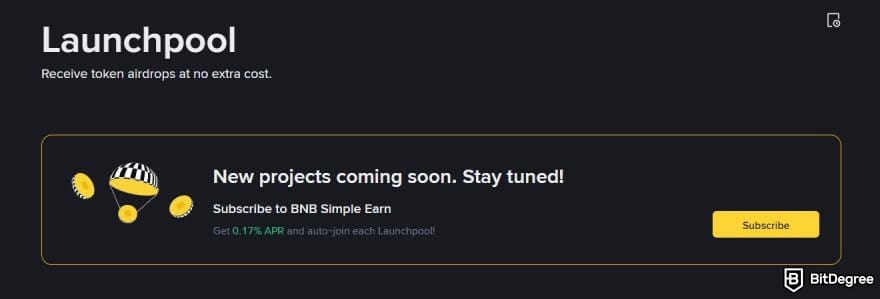
Binance Launchpool lets users stake BNB or other supported assets to earn new token allocations.
Megadrop ties together Earn participation and Web3 tasks, offering early access to selected projects for users willing to engage in a more hands-on participation model.
3
Payments and spending
Binance Pay supports P2P payments, merchant transactions, and gift card functionality across a wider network than most competitors. Binance Card also has stronger regional coverage than many similar card products from other exchanges.
4
Web3 features
Binance Wallet gives users access to DeFi, dApps, swaps, and multi-chain Web3 activity without leaving its ecosystem. It’s described by Binance as a keyless, seedless, multi-chain wallet using MPC technology, although users should remember that Web3 comes with its own risks beyond centralized exchange use.
5
Education, research, and community
Binance Academy, Binance Research, and Binance Square provide project analysis, market data, educational content, and a community layer that most other exchanges don't offer at the same depth. For users who want to understand what they're trading, not just execute, these resources are genuinely useful.

Binance’s non-trading feature set is one of the most extensive in the industry. It offers more Earn assets, more developed Web3 tools, better fiat payment support, and a wider range of research and educational resources. Taken together, it goes beyond what most exchanges can provide.
KuCoin's Other Features
KuCoin also has a sizable non-trading ecosystem, and it’s quite close to Binance’s in scope. Its main extra features include:
1
Earn products
KuCoin Earn is quite broad in scope, covering flexible savings, fixed-term deposits, on-chain staking, lending markets, and more advanced products like Dual Investment and mining. Its asset coverage is also comparable enough to put it in the same conversation as Binance.
2
Launch and reward products
KuCoin Launchpad gives users early access to various new token projects, with KCS usually required for participation. The exchange has launched several tokens that later gained meaningful market interest.

It also has an active rewards section that occasionally offers users a chance to earn different rewards for free.
3
Payments and spending
KuCoin Pay brings Web3 payments into its ecosystem, backed by a global cryptocurrency exchange with more than 40 million users. It supports secure and seamless crypto transactions for both payers and merchants with zero gas fees on off-chain payments.
4
Web3 features
KuCoin Wallet gives users a secure and user-friendly way to manage multi-chain assets in a decentralized Web3 wallet. It also supports competitive cross-chain trading and airdrop claiming from popular projects in one place.

The Wallet is easy to access on mobile, with downloads available through the App Store and Android APK. The mobile experience is polished, and the interface feels right at home on a smartphone.
5
Education, research, and community
For newer users, KuCoin Learn provides a solid place to build knowledge, with topics ranging from the basics to more advanced crypto concepts. The Research section also adds timely insights on the latest news and trends shaping the crypto market.
Note
KuCoin’s ecosystem is built well for active traders, with some of its strongest offerings found in passive earning and launchpad products. That said, Binance still comes out ahead in terms of ecosystem depth and overall maturity.
Binance vs KuCoin – Fiat Deposits and Withdrawals
People tend to spend a lot of time comparing trading fees, but fiat access often has a bigger impact on the overall experience. The cheapest exchange in the world isn’t particularly useful if getting money in or out is expensive, slow, or unnecessarily complicated.
KuCoin offers several fiat access routes, including credit/debit card purchases through third-party providers, P2P trading, and bank transfers in some regions. Its active P2P market is a clear strength for users in emerging markets or places where direct fiat-to-exchange rails are limited.
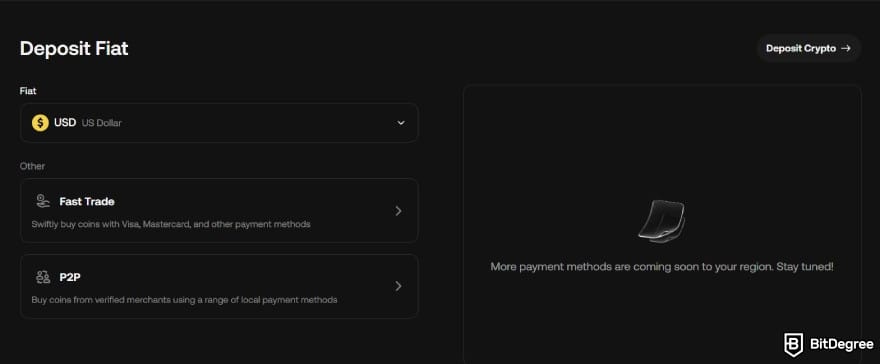
Binance’s fiat coverage is generally broader, thanks to wider currency support, more bank transfer routes, and stronger relationships with payment processors. For users in countries with a reliable banking infrastructure, it often provides a more convenient and cost-effective way to move money in.
It’s worth remembering that fiat fees aren’t always shown in one neat little box. Card purchases may include third-party processing fees. P2P rates depend on seller activity. Bank withdrawals can involve minimum amounts and delays. So the same-looking method on two exchanges can end up costing very different amounts.
Note
Binance tends to be stronger on direct fiat access. KuCoin’s P2P market can be a practical workaround in regions where direct fiat options are limited, but users should compare local payment methods before deciding which exchange is cheaper.
KuCoin Trading Walkthrough
The Spot Grid Bot is one of KuCoin’s signature features, so it’s worth seeing how it works in practice:
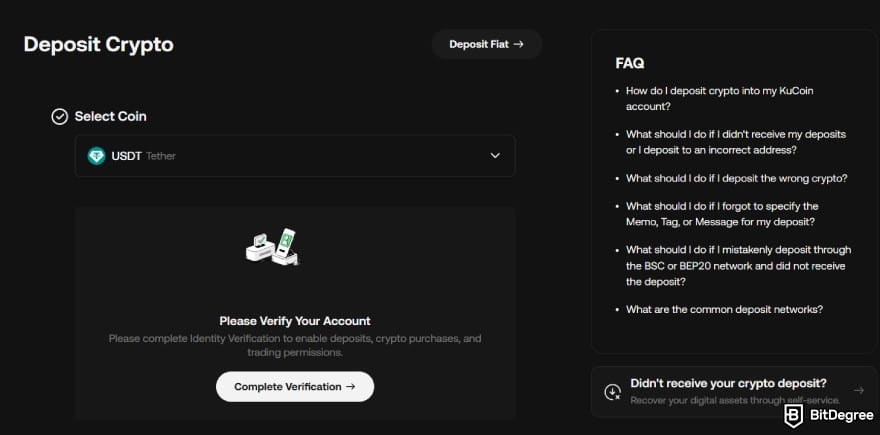 Before proceeding, ensure that identity verification is complete so you can access crypto deposits and purchase features without restrictions.
![Binance vs KuCoin: open [Trading Bot].](https://assets.bitdegree.org/images/binance-vs-kucoin-bot.jpg "Binance vs KuCoin: open [Trading Bot].")
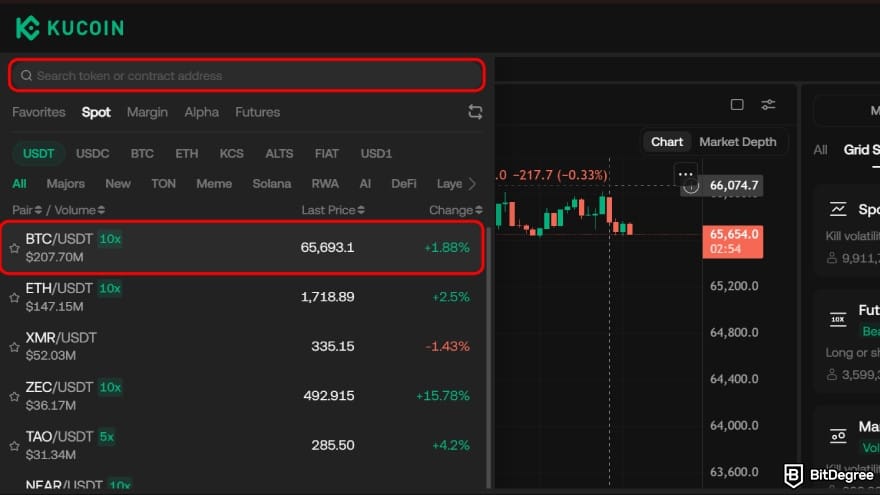
![Binance vs KuCoin: choose [Spot Grid].](https://assets.bitdegree.org/images/binance-vs-kucoin-spot-grid.jpg "Binance vs KuCoin: choose [Spot Grid].")
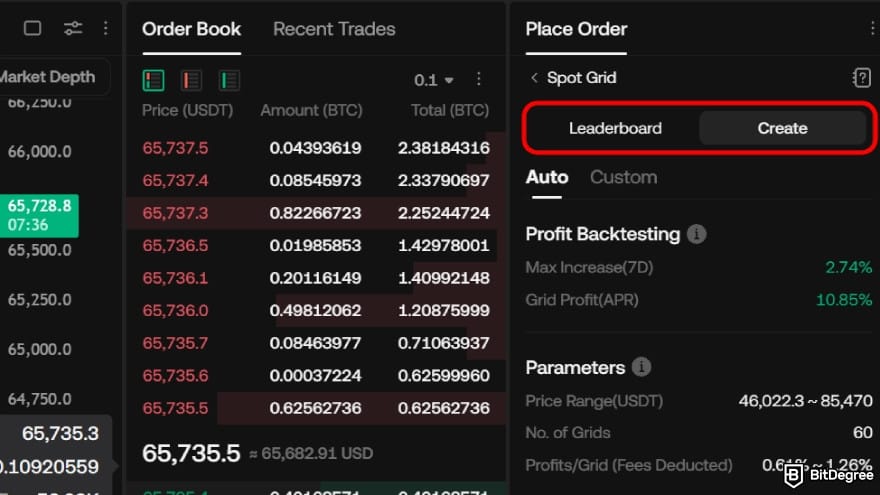
If you'd prefer more control over your strategy, you can switch to [Custom] mode instead.
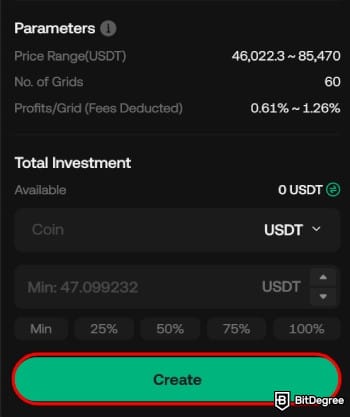
Once you're satisfied with the configuration, click [Create] to launch the bot.
After launching the bot, keep an eye on your grid profits, the asset’s price position, and whether the bot remains active.
Binance Trading Walkthrough
Here’s a simple example of a spot trade on Binance: buying BTC with USDT.
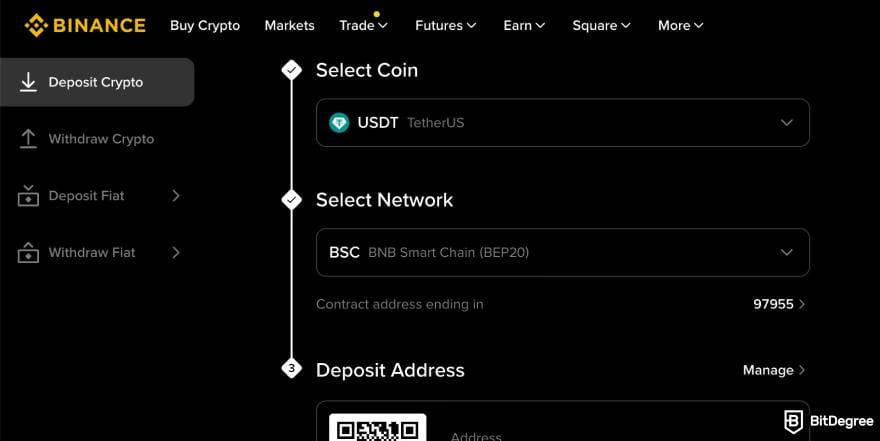
![Binance vs KuCoin: select [Spot].](https://assets.bitdegree.org/images/binance-vs-kucoin-spot.jpg "Binance vs KuCoin: select [Spot].")
![Binance vs KuCoin: choose [BTC/USDT] pair.](https://assets.bitdegree.org/images/binance-vs-kucoin-btcusdt.jpg "Binance vs KuCoin: choose [BTC/USDT] pair.")
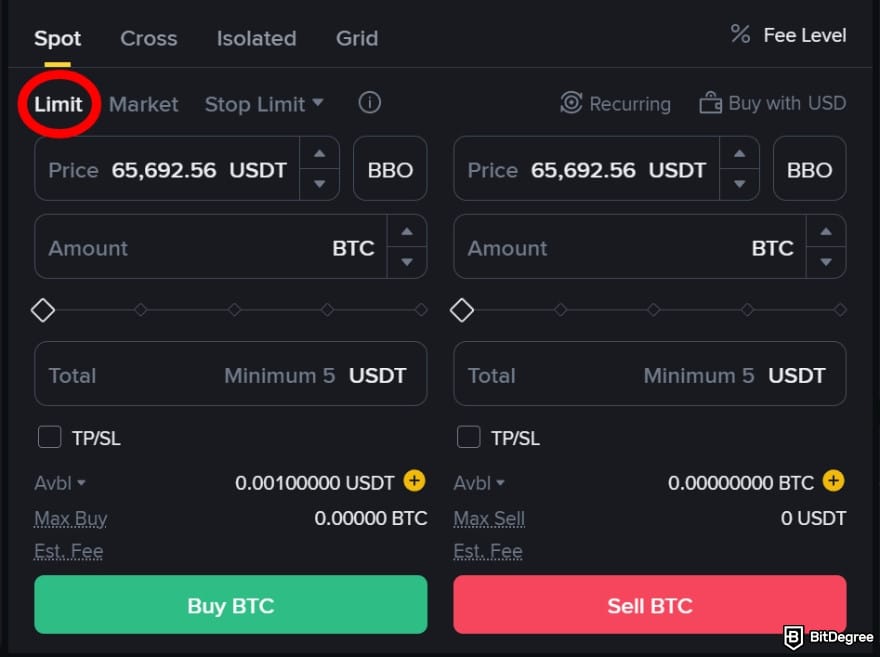
You can click "% Fee Level" to review the trading fees that apply to your account before placing an order.
- Trading pair;
- Order type;
- Estimated price;
- Amount;
- Fees;
- Whether you are using BNB for fee discounts;
- Whether the order will execute instantly.
After you confirm the trade by clicking [Buy BTC], a market order fills immediately. A limit order, on the other hand, stays open until the market reaches your chosen price. You can confirm execution by checking your order history and spot wallet.
Binance vs KuCoin for Beginners
There’s a reason Binance appears so often in beginner recommendations. Its Academy gives new users access to one of the most comprehensive free crypto education libraries available, while the platform itself offers a clear path from simple buying tools to more advanced products.
On top of that, Binance’s reputation gives it a level of built-in credibility. When you say you’re using it, friends or family are less likely to question the choice. Its deep liquidity and robust security features also make it easier to trade efficiently while keeping unexpected risks more manageable.
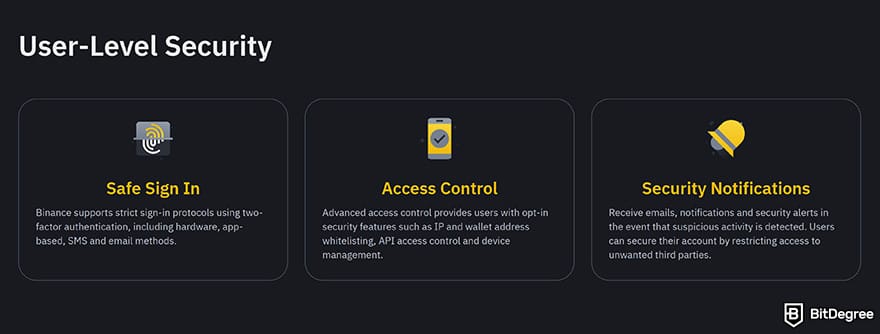
One thing worth keeping in mind is that Binance’s size comes with a trade-off. The platform packs so many products into one interface that first-time users can easily feel overwhelmed by the number of choices available.
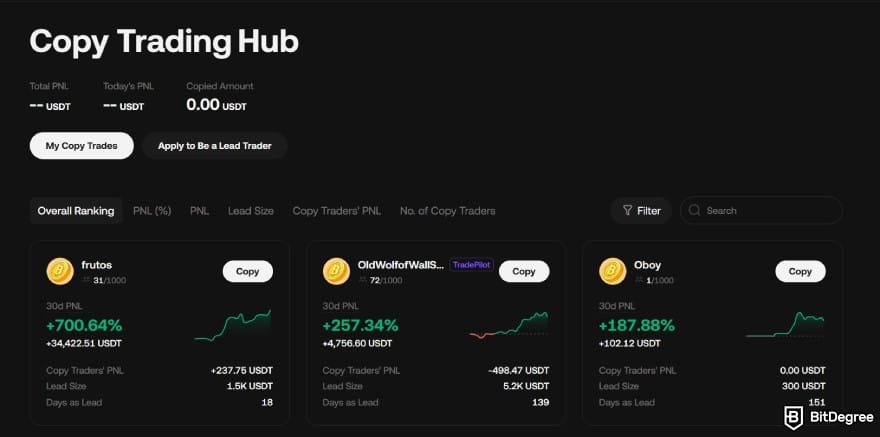
Interface-wise, KuCoin is cleaner in certain ways. Spot trading and token conversion are familiar enough if you’ve used Binance, but the platform can be slightly easier to scan. For beginners, the surprising edge is its grid bot and copy trading setup, which lets users mirror experienced traders or automated strategies while they learn the ropes.
The main risk for beginners on KuCoin, I'd say, is altcoin FOMO. With so many smaller and newer tokens available, it’s easy to start speculating on projects that haven’t been independently vetted deeply. That isn’t necessarily the platform's fault, but it’s something new users should keep in mind.
Verdict
Binance is generally the better starting point for most beginners, with better learning resources, broader recognition, and a clearer path into the platform. KuCoin is still a good fit for beginners drawn to automated trading or altcoin discovery, but newer tokens should be approached carefully.
Binance vs KuCoin for Active Traders
If you're an active trader, this comparison is tighter than the headline numbers imply. The user-count gap is enormous, but the actual trading experience is often much closer.
An active trader may prefer KuCoin if they:
- Run grid bots, DCA strategies, or other automated approaches regularly;
- Frequently trade newer tokens that haven't been listed on most major exchanges yet;
- Want an extensive suite of earning features, from staking and savings to crypto lending;
- Find KuCoin’s spot and futures interface easier to navigate for everyday trading.
An active trader may prefer Binance if they:
- Trade large size and care about execution quality, slippage, and order book depth;
- Run high-frequency futures strategies where the 0.01% fee difference compounds significantly;
- Want access to the widest possible range of markets and trading infrastructure in one place;
- Use BNB fee discounts to lower trading costs, then benefit further from the VIP ladder as volume increases.
On futures, Binance pulls slightly ahead with a lower taker fee and deeper order books, which matters more for high-frequency execution. KuCoin’s futures market is still competitive for most users, but thinner contracts make the volume difference easier to notice.
Verdict
Binance is better suited to active traders who need deep liquidity, smooth large-order execution, and strong major-pair futures markets. KuCoin may work better for those running trading bots or chasing altcoins before they land on Binance.
Binance vs KuCoin for Passive Users
Here, passive users refer to people who buy, hold, stake, and occasionally rebalance their portfolios instead of trading daily. Both platforms work well for this kind of user, but the experience leans in slightly different directions.
Binance Earn has wider coverage across assets and product types: flexible savings, locked staking, staking, on-chain yield, and 300+ supported tokens across different products. If you want to put idle crypto to work without managing everything manually, the exchange offers plenty of ready-made options.
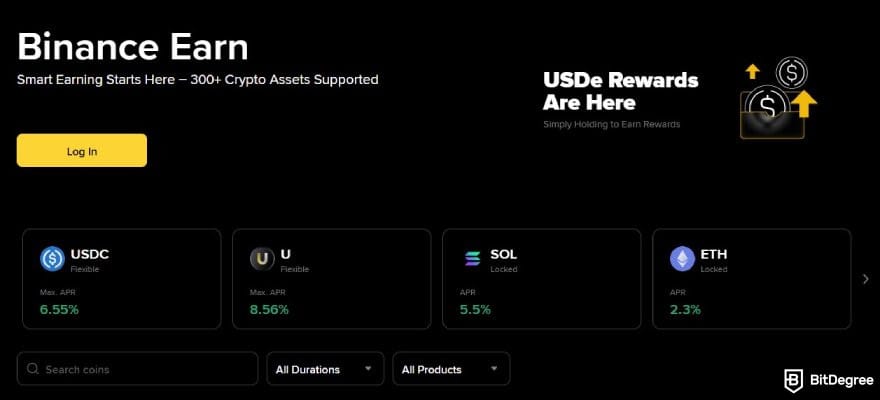
That said, KuCoin Earn shouldn’t be dismissed. It offers flexible savings, fixed products, a wide range of advanced features, and a lending market where users can earn yield. That gives KuCoin a product type Binance doesn’t highlight as prominently, along with extra staking benefits for KCS holders.
Note
Binance has a slight edge for users who want broader passive earning access and a more developed passive crypto ecosystem. KuCoin is still competitive, with a strong Earn selection that keeps the comparison closer than it might seem.
Final Verdict: Is KuCoin or Binance Better?
KuCoin is the more compelling choice if you’re hunting for altcoins and leaning on automation. Between faster token listings, built-in trading bots, and solid Earn and Launchpad products, it gives active traders a practical home outside the mainstream coin aisle.
Binance is the default pick for almost everything else. Deeper liquidity, a bigger ecosystem across earning, Web3, payments, education, and research, and a massive user base all work in its favor.
The quick takeaway: KuCoin wins on altcoin selection, bot functionality, and early token listings. Binance wins on liquidity, ecosystem scale, and trust infrastructure. Neither exchange is objectively superior; it’s really a question of whether you want a specialist or a platform that does a bit of everything.