




Bybit vs Binance - In-Depth Comparison
Choosing between Binance and Bybit is not as simple as asking which exchange is “better”. Both are major crypto trading platforms, both offer low trading fees, and both are built for users who want more than basic buy-and-sell functionality. However, they are not identical.
Binance is the larger platform in terms of user base, liquidity, and global brand recognition. Bybit, meanwhile, has grown into a highly competitive all-in-one exchange, with a stronger focus on active trading, derivatives, copy trading, automation, and practical crypto features.
So, when comparing Binance vs Bybit, the better question is this: Which exchange fits the way you actually trade?
If you mostly want to buy crypto, hold it, use Earn products, explore launchpad-style features, or access a large global crypto ecosystem, Binance will usually look like a more complete platform. If you are more interested in futures, copy trading, chart-based execution, or a streamlined trading experience, Bybit may be more direct and less cluttered.
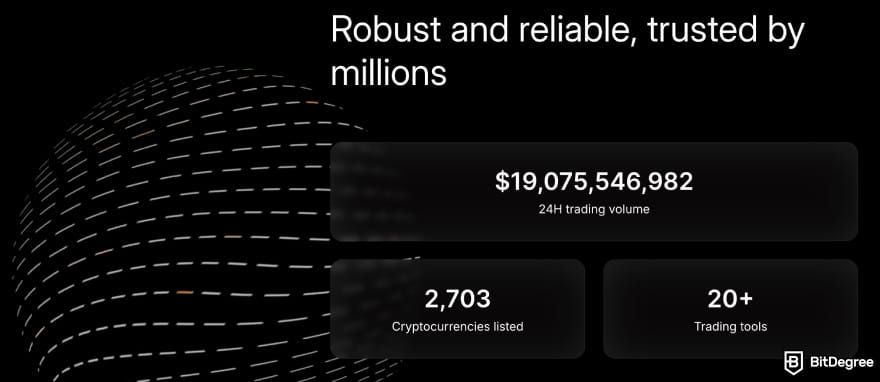
As of 2026, Binance reports over 316 million users globally, which gives it a major advantage in scale and liquidity. Bybit, on the other hand, has grown into one of the strongest Binance competitors, reporting over 80 million registered users and more than $23 billion in daily average trading volume.
Bybit | Binance | |
|---|---|---|
Best for | Active traders, futures users, and copy trading users | Users who want an all-in-one crypto platform |
Main strength | Trading interface, derivatives, and trader-focused tools | Liquidity, ecosystem, and product variety |
Spot trading fees | Very competitive | Very competitive |
Futures fees | Competitive, but standard taker fee is slightly higher | Slightly cheaper for standard taker orders |
Beginner experience | Good for beginners who want a cleaner path into trading, especially with demo trading | Good for beginners who want a broader all-in-one crypto platform |
Advanced trading | Very strong, especially for derivatives, copy trading, bots, and UTA | Very strong, especially for liquidity, market access, futures, options, and API trading |
Copy trading | One of Bybit’s stronger selling points | Available, but not the main identity of the platform |
Overall verdict | Better for focused trading, copy trading, automation, and practical active-user features | Better for scale, liquidity, and large ecosystem access |
Table: a quick Bybit vs Binance comparison
Summing it up, Binance is stronger if you want maximum scale, liquidity, and a large crypto ecosystem. Bybit stands out if you want a more focused platform built around active trading, copy trading, automation, and practical crypto use.
Bybit vs Binance - Market Position
Binance remains the bigger name in the Binance vs Bybit comparison. Its biggest advantage is scale. With hundreds of millions of users, large reserves, and a huge global presence, Binance benefits from network effects that are hard for smaller exchanges to match. This matters more than many beginners realize. A larger exchange often has:
- More active buyers and sellers;
- Better liquidity on major pairs;
- Tighter spreads;
- Faster order matching;
- More stable execution during busy market periods;
- More fiat options in supported regions;
- More third-party integrations and ecosystem products.
Binance also claims approximately $150 billion in user assets and around 30% of global spot volume across centralized exchanges, based on its own disclosed data and Binance Research figures. That does not automatically mean Binance is perfect, but it shows why the platform is still treated as one of the main liquidity hubs of the crypto market.

Bybit is smaller, but it is not small. Its rise has been impressive because it has managed to compete in the areas where Binance is traditionally strong, especially derivatives and active trading. Bybit has also expanded beyond its original derivatives-first identity to include spot trading, copy trading, crypto cards, Earn products, Web3 tools, and even TradFi-style trading products in select regions.
Verdict
Binance leads in size, liquidity, and global reach, while Bybit competes by being sharper, more focused, and highly competitive for traders and active crypto users.
Bybit vs Binance - Trading Features
Both exchanges cover the basics well. You can buy crypto, sell crypto, trade spot pairs, use margin or futures products, and access mobile apps. However, the experience is different.
Bybit Trading Features
Bybit offers a strong trading suite, but its biggest strength is active trading. The platform is especially polished for users who trade often and want a clean, execution-focused interface.
For basic trading, Bybit offers:
- Spot trading for direct crypto trades.
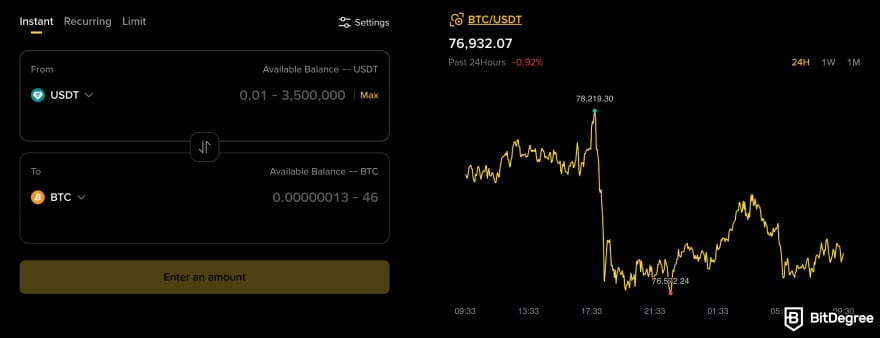
- Convert for quick swaps.
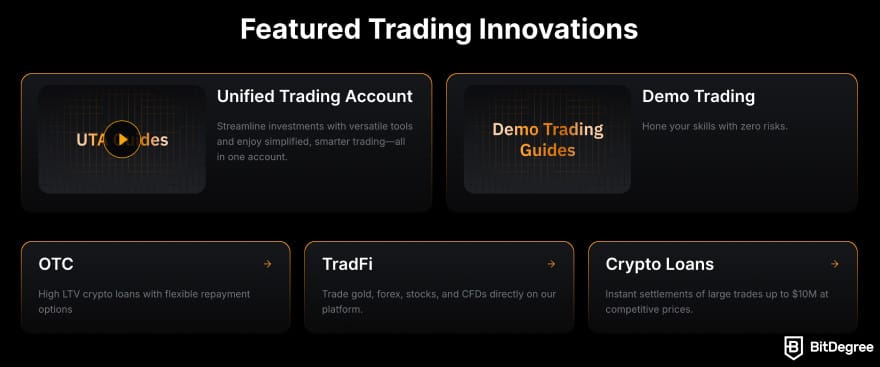
- Demo trading for practicing before using real funds.
- P2P trading for selling and buying from other traders.
For advanced trading, Bybit supports:
- Spot margin trading for larger spot positions through the Unified Trading Account.
- USDT and USDC perpetual contracts for leveraged trades without expiry dates.
- Inverse futures contracts for crypto-settled derivatives trading.
- Options trading, including USDC options, for advanced trading strategies.
For automated and strategy-based trading, Bybit includes:
- Copy trading for copying other traders (one of its strongest features).
- Trading bots, including spot grid, futures grid, DCA, and martingale-style bots.
- API trading for automated strategies.
For larger or multi-market traders, Bybit also offers:
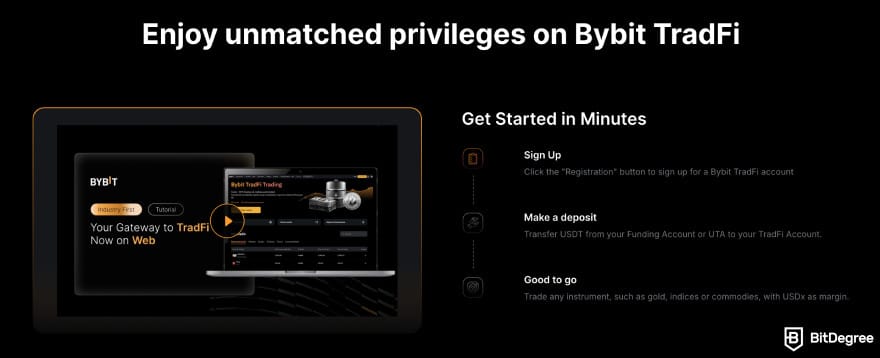
- MT5/TradFi trading for accessing selected traditional markets, such as forex, commodities, indices, and stocks.
- RFQ and block trading for larger or more complex trades that need customized pricing and reduced market impact.
Bybit is more streamlined than Binance for active traders. Its derivatives tools, copy trading setup, bots, and Unified Trading Account make it especially appealing to users who already understand trading. However, users who want a very broad crypto portal with research, education, community features, and many ecosystem tools may still prefer Binance.
Binance Trading Features
Binance covers almost every major crypto trading format, from simple swaps to advanced derivatives.
For basic trading, Binance offers:
- Spot trading for buying and selling crypto directly.
- Convert for quick crypto swaps without using the full trading interface.
- P2P trading for direct user-to-user fiat and crypto transactions.
- Demo trading for trading with virtual funds and zero risk.
For advanced trading, Binance supports:
- Margin trading with cross and isolated margin options.
- Futures trading for leveraged crypto contracts.
- Options trading for more complex strategies.
For automated and strategy-based trading, Binance includes:
- Copy trading for following other traders.
- Trading bots, including grid and automated strategy tools.
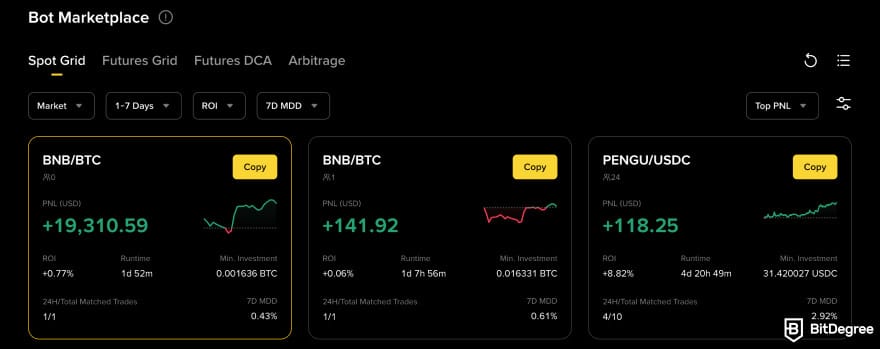
- API trading for algorithmic traders.
For larger traders, Binance also offers:
- OTC trading for large trades that need more private, customized execution.
- Block trading for placing high-volume orders with reduced market impact.
- Execution services for high-volume traders who need more advanced order handling.
The main strength of Binance is variety. A beginner can start with Convert or spot trading, while an experienced trader can move into margin, futures, options, bots, or API-based trading.
Verdict
Binance and Bybit are fairly equal in overall trading depth, but they focus on different users. Binance might be stronger for users who want broad crypto-native market access, deep liquidity, and many trading routes in one place. Bybit is stronger for users who want a sharper active-trading setup, with derivatives, copy trading, RFQ tools, demo trading, UTA, and MT5/TradFi access in supported regions.
Bybit vs Binance - Fees
Both Binance and Bybit are known for their low fees. At first glance, the difference looks small. In real trading, though, the difference can matter, especially for active traders. Here is a simplified fee comparison for regular users:
Bybit | Binance | |
|---|---|---|
Spot fees | 0.1% maker 0.1% taker | 0.1% maker 0.1% taker |
Spot fees with native discount | 0.075% (with MNT fee discount) | 0.075% (with BNB fee discount) |
Futures fees | 0.02% maker 0.055% taker | 0.02% maker 0.05% taker |
Futures fees with native discount | 0.018% maker 0.0495% taker (with MNT fee discount) | 0.018% maker 0.045% taker (with BNB fee discount) |
Options fees | 0.02% maker 0.03% taker | 0.024% maker 0.024% taker |
Table: fee comparison
Binance's regular spot trading fees start at 0.1% for makers and 0.1% for takers, with a 25% BNB fee discount reducing them to 0.075% when applicable. Binance’s futures fees are 0.02% for makers and 0.05% for takers for regular users, but USDⓈ-M futures users can also receive a 10% discount when paying with BNB. Plus, the fees get smaller as the user's account level grows.
📚 Read More: Binance Fees Explained
Bybit has also set its non-VIP spot trading fees at 0.1% for makers and 0.1% for takers, while its non-VIP perpetual and futures trading fees are 0.02% for makers and 0.055% for takers. Similar to BNB usage on Binance, you can get a discount by paying your fees in MNT. Also, as you increase your VIP level, which depends on either 30-day trading volume or total asset balance, you can progressively reduce fees.
📚 Read More: Bybit Fees Explained
$1,000 Spot Trade Fee Comparison
Let’s say you place a $1,000 BTC/USDT spot market order.
On Binance, with the standard 0.1% spot taker fee, the fee would be around:
$1,000 x 0.1% = $1
If the BNB fee discount applies, the effective fee could be around:
$1,000 x 0.075% = $0.75
On Bybit, with the standard 0.1% spot taker fee, the fee would also be around:
$1,000 x 0.1% = $1
For a casual spot trader, this difference is not huge. If you trade once in a while, Binance and Bybit are both cheap enough that the final decision should not be based only on the basic spot trading fee. Instead, you should also look at spreads, fiat deposit costs, withdrawal costs, available pairs, and how comfortable you are with the interface.
$1,000 Futures Trade Fee Comparison
Now, let’s say you open a $1,000 BTCUSDT perpetual position using a market order.
On Binance, using the regular 0.05% taker fee example:
$1,000 x 0.05% = $0.50
On Bybit, using the 0.055% taker fee:
$1,000 x 0.055% = $0.55
That is only a $0.05 difference on a $1,000 position. However, futures traders often open and close positions many times. They also pay fees on entry and exit. So, if you open and close a $1,000 futures position using market orders, the rough trading fee cost would be:
Entry Fee | Exit Fee | Approx. Round-Trip Fee | |
|---|---|---|---|
Binance futures market entry + exit | $0.50 | $0.50 | $1 |
Bybit perpetual market entry + exit | $0.55 | $0.55 | $1.10 |
Table: Bybit vs Binance market entry + exit comparison
Again, the difference is small for one trade. But if a trader makes hundreds of trades per month, even small differences can compound.
That said, trading fees are only one part of the real cost. You also need to consider:
- Bid-ask spread;
- Slippage;
- Funding rates;
- Liquidation risk;
- Order execution quality;
- Deposit and withdrawal fees;
- Whether you are using market or limit orders.
A trader using limit orders may care more about maker fees. A trader who uses market orders often should pay closer attention to taker fees. For standard futures taker fees, Binance has a slight numerical edge. For maker-based strategies, there is no difference.
Verdict
Binance and Bybit are both low-fee exchanges, especially for spot trading, where their standard and discounted fees are the same. Binance still has a slight edge on standard futures taker fees, while Bybit remains extremely competitive, especially for active traders using MNT discounts, limit orders, or higher VIP levels.
Bybit vs Binance - Liquidity & Execution
Liquidity is one of Binance’s strongest advantages. For large-cap pairs like BTC/USDT and ETH/USDT, both Binance and Bybit are strong. However, Binance’s larger user base and reported market share give it an edge, especially for users who place larger orders or trade during volatile market periods.
Liquidity affects the real price you get.
For example, let's take two exchanges that both advertise a 0.1% trading fee. If one exchange has a tighter spread and less slippage, it may still be cheaper in practice, even if the official fee is the same.
This is why looking only at the fee table can be misleading. A trading fee indicates what the platform charges, but it does not always reflect the full execution cost.
Verdict
Binance has the edge for very large spot trades and overall market depth. Bybit remains highly competitive for active derivatives traders, especially on major perpetual pairs where execution quality and trading workflow matter just as much as raw size.
Bybit vs Binance - Security & Trust
Both Binance and Bybit offer strong account-level security tools, including two-factor authentication, passkeys, anti-phishing codes, device management, and withdrawal address controls.
Bybit | Binance | |
|---|---|---|
Two-factor authentication | ✓ | ✓ |
Passkeys | ✓ | ✓ |
Anti-phishing code | ✓ | ✓ |
Withdrawal address whitelist | ✓ | ✓ |
Proof of Reserves | ✓ | ✓ |
User protection fund | Bybit Insurance Fund | SAFU |
Table: Bybit's and Binance's security features
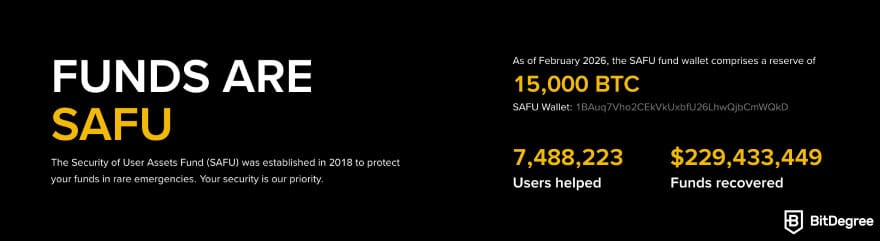
One of the standout features among Binance's extensive security measures is SAFU, a broad emergency user-protection fund that has already helped over 7,4 million users. Binance also publishes Proof of Reserves, stating that user assets are backed 1:1, plus additional reserves.
Bybit also has strong security measures. It offers account protections such as Google 2FA, passkeys, fund passwords, secure transaction approval, anti-phishing codes, trusted device management, new-address withdrawal locks, and withdrawal address management.
Bybit also publishes Proof of Reserves and has the Bybit Insurance Fund, which is designed to help cover losses when liquidated leveraged positions close worse than the bankruptcy price.
The difference is mainly in how the protection funds work. Binance’s SAFU is broader user protection for extreme cases, while Bybit’s Insurance Fund is more specifically tied to derivatives trading risk.
Verdict:
Binance has a broader user-protection profile because of SAFU, scale, and long-standing trust perception. Bybit is also strong on account protection and trading-risk controls, especially for derivatives users. However, its Insurance Fund is more specifically tied to leveraged trading risk and should not be treated as the same type of protection as Binance’s SAFU.
Bybit vs Binance - Broader Ecosystem
Outside of trading, Binance and Bybit both offer much more than basic exchange services. This is where the comparison becomes closer than many people expect. Binance is known for its large crypto ecosystem, but Bybit has also built a strong set of non-trading features around Earn products, payments, cards, rewards, token access, and Web3 tools.
Binance's Other Features
Binance has a very large non-trading ecosystem. Its main extra features include:
1
Earn products
Binance Earn is one of Binance’s biggest advantages. It includes products such as Simple Earn, flexible and locked products, ETH staking, SOL staking, Dual Investment, and on-chain yield options. Binance claims Earn supports 300+ cryptocurrencies, though availability depends on the product and region.
2
Launch and reward products
Binance also has several features for users who want access to new tokens or reward-based campaigns.
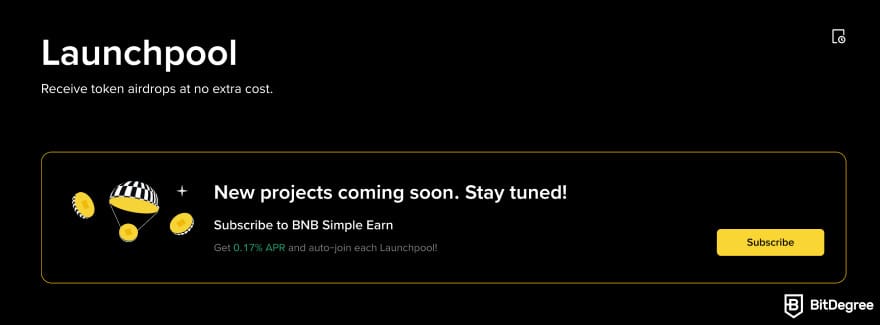
These include Launchpool, where users can lock supported assets to receive token airdrops, and Megadrop, which combines Simple Earn with Binance Wallet quests for early access to selected Web3 projects.
3
Payments and spending
Binance offers Binance Pay, crypto payment tools, gift cards, and the Binance Card. These features make Binance more useful for users who want to spend, send, or gift crypto, not just trade it.
4
Web3 features
Binance Wallet gives users a way to access DeFi, dApps, swaps, and multi-chain Web3 activity from inside the Binance ecosystem. Binance describes it as a keyless, seedless, multi-chain wallet using MPC technology, though users should still understand that Web3 activity carries separate risks from using the centralized exchange.
5
Education, research, and community
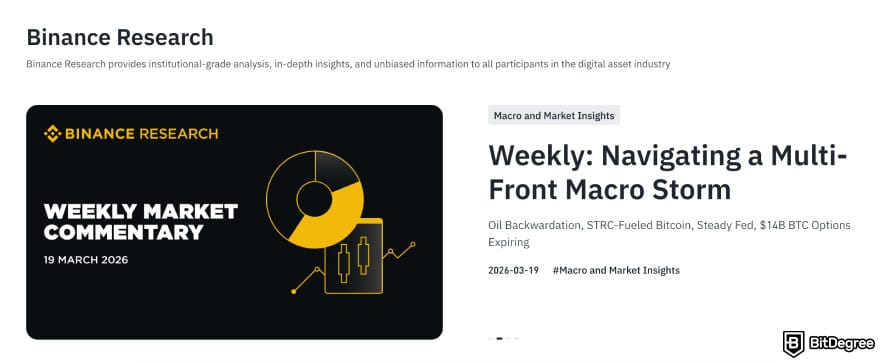
Binance also has Binance Academy, Binance Research, Binance Square, Charity, and other content/community products. These do not directly affect trading fees or execution, but they make Binance more complete for users who want news, education, project research, and ecosystem updates in one place.
The main strength of Binance is that these features are connected into one large ecosystem. A user can buy crypto, earn yield, join token campaigns, use a wallet, send payments, read market research, and explore Web3 tools without leaving Binance. The downside is that the platform can feel crowded, and not every product is available in every country.
Bybit's Other Features
Bybit’s non-trading ecosystem is also huge and actually quite similar to Binance's. Its biggest extra features include:
1
Earn products
Bybit Earn includes Easy Earn, On-Chain Earn, and Advanced Earn. Easy Earn is positioned as a beginner-friendly way to earn from idle crypto assets, while On-Chain Earn simplifies staking by handling things like gas fees, node operations, and reward distribution.
2
Launchpad and token access
Bybit Launchpad gives users early access to selected token projects. Users can participate with MNT for token sale subscriptions or use USDT for allocation lotteries, depending on the campaign structure.
3
Payments and card products
Bybit has Bybit Card and Bybit Pay. Bybit Card is designed for crypto spending and offers cashback in supported regions, while Bybit Pay is built for crypto and fiat payments, QR payments, and merchant-style payment use cases.
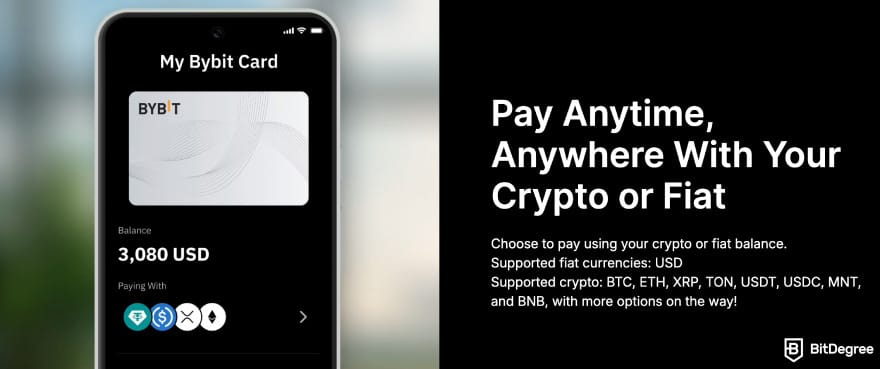
Bybit also connects Pay with Easy Earn through Auto-Earn, letting users earn on idle balances while still using them for payments.
4
Web3 features
Bybit offers Web3 tools through Bybit Wallet, mainly for users who want access to on-chain activity without fully leaving the Bybit ecosystem. Its Seed Phrase Wallet lets users create or import a self-custody wallet, manage assets through a browser extension, and connect the wallet to dApps. Bybit’s Web3 section also includes access to airdrop campaigns, staking opportunities, and decentralized applications.
5
Rewards and education
Bybit has a Rewards Hub, Bybit Learn, campaigns, bonuses, and user education resources. These features are useful for onboarding and engagement, especially for newer users, but they might feel more attached to Bybit’s trading and finance ecosystem than to a broad “crypto super-app” structure.
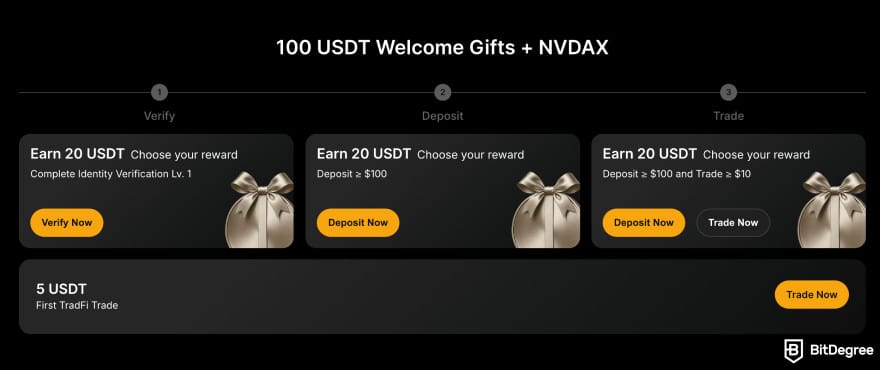
Bybit’s main strength is that its extra features are practical and closely connected to active crypto use. Its Earn products, Bybit Card, Bybit Pay, Launchpad, Rewards Hub, and Web3 tools all support users who want to do more than just trade, without making the platform feel too scattered.
Verdict
Binance is broader if you value education, research, community, and a larger crypto super-app environment. Bybit is just as competitive, and sometimes more practical, if you care about earning, spending, rewards, token access, Web3 activity, and trading-adjacent tools in one cleaner ecosystem.
Bybit vs Binance - Fiat Deposits and Withdrawals
Fiat deposits and withdrawals are easy to overlook, but they matter a lot in real use. A platform may have great trading tools, but if it is difficult or expensive to deposit and withdraw money in your local currency, the overall experience becomes weaker.
Binance generally offers a wide range of fiat options, though availability depends heavily on the user’s country. Depending on the region, users may be able to deposit or buy crypto using bank transfers, debit or credit cards, P2P trading, third-party payment providers, and local currency balances. Binance’s large global presence can be useful here, as it supports many currencies and payment methods.
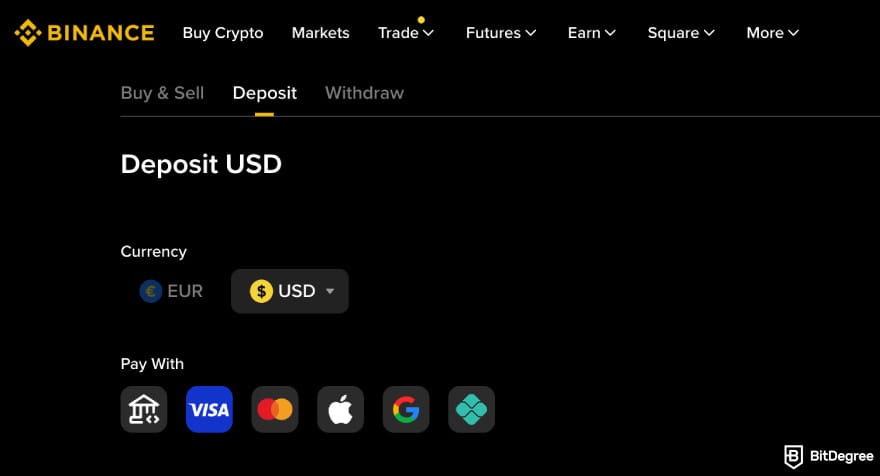
However, Binance’s fiat access is not the same everywhere. Some users may have many options, while others may see limited methods or higher fees. Bank transfer support, card payments, P2P access, withdrawal methods, and processing times can all vary by location. This is why users should check their own region before assuming Binance will be the cheapest or easiest option.
Bybit also has solid fiat support. Users in supported regions can buy crypto with cards, use bank transfer methods, access P2P trading, and use third-party providers. Bybit also supports fiat-related products such as Bybit Card and Bybit Pay in selected regions, which makes the platform useful outside of trading.
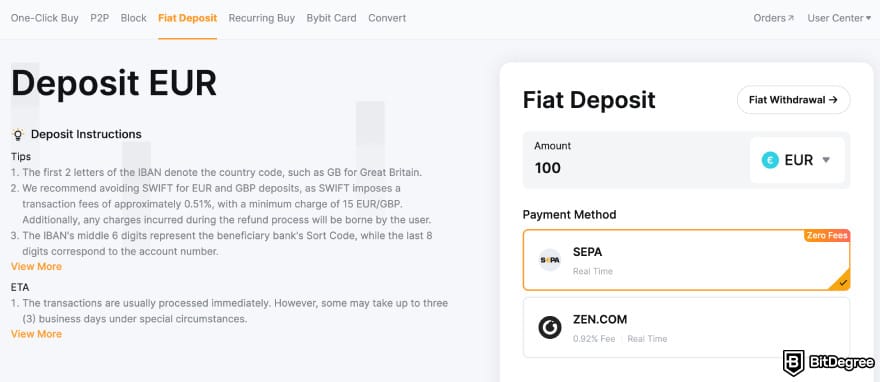
The practical difference is that Binance may still have broader fiat coverage overall, while Bybit can be very competitive depending on the region. In some countries, Binance may have more local payment methods. In others, Bybit’s card purchases, P2P marketplace, or third-party payment options may be wider.
Users should also remember that fiat fees are not always shown in the same way as trading fees. A card purchase may include a provider fee. A third-party payment route may include a spread. A P2P transaction may depend on seller rates. A bank withdrawal may have processing times or limits. So, the cheapest option is not always obvious from the exchange’s main fee page.
Verdict
Binance may offer broader fiat access overall, but Bybit is competitive in many regions and continues to build practical payment options. Before choosing either exchange, you should compare local deposit methods, withdrawal options, card fees, P2P rates, supported currencies, and processing times.
Bybit Trading Walkthrough
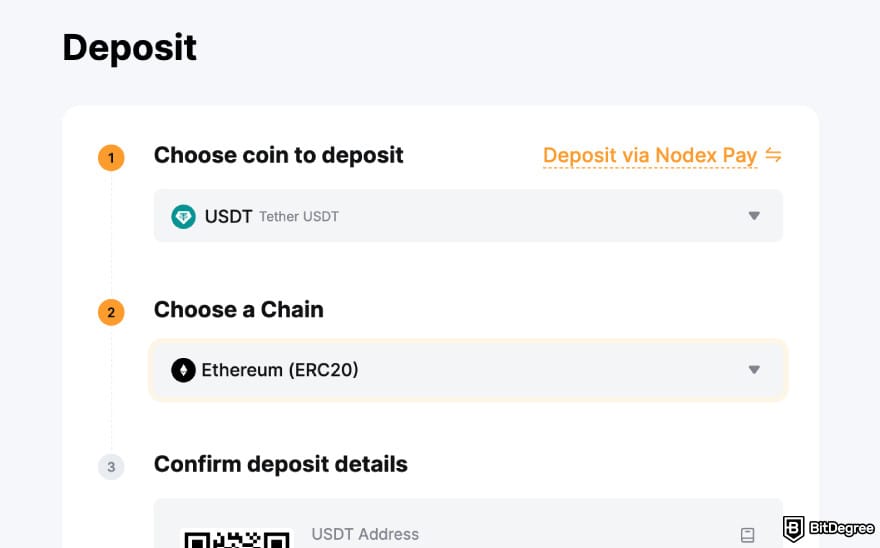
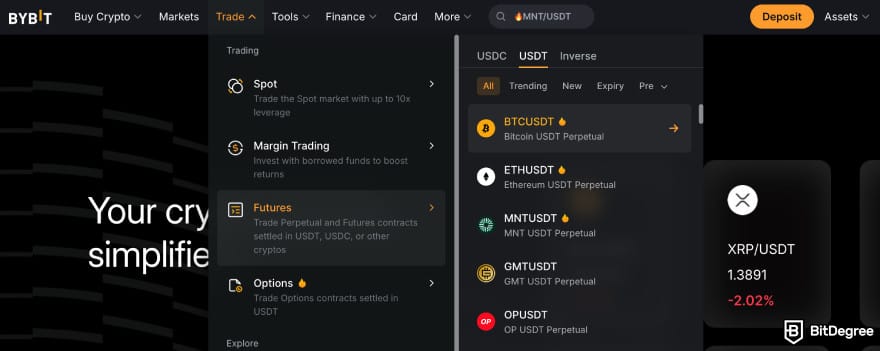
One of Bybit’s most popular trading features is perpetual futures, so let’s look at how opening a BTCUSDT perpetual contract works.
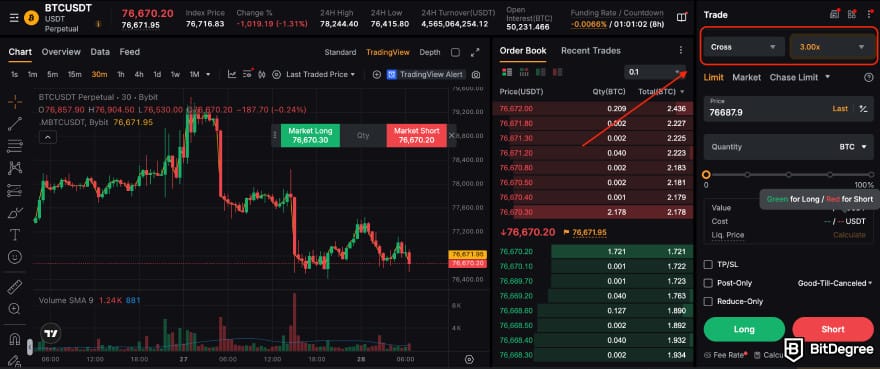
Beginners often misunderstand leverage and assume it simply “boosts profit”. In reality, it also reduces the margin of error.
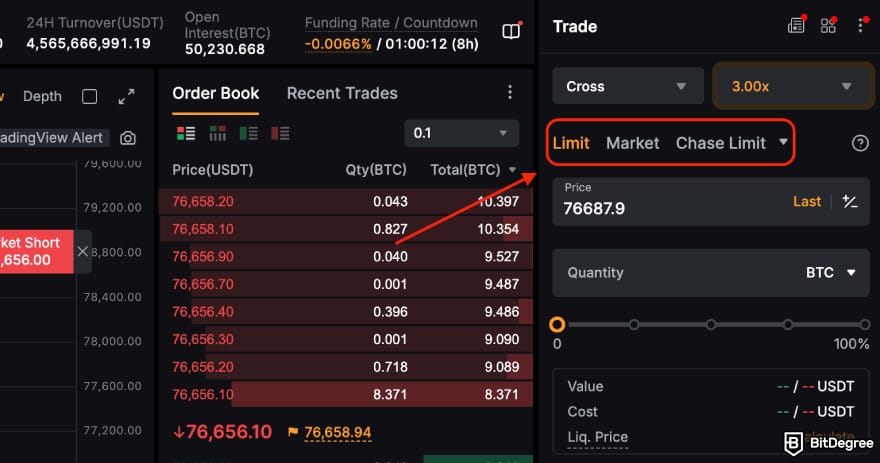
Other order types are available as well, but market and limit orders are the simplest ones to understand first.
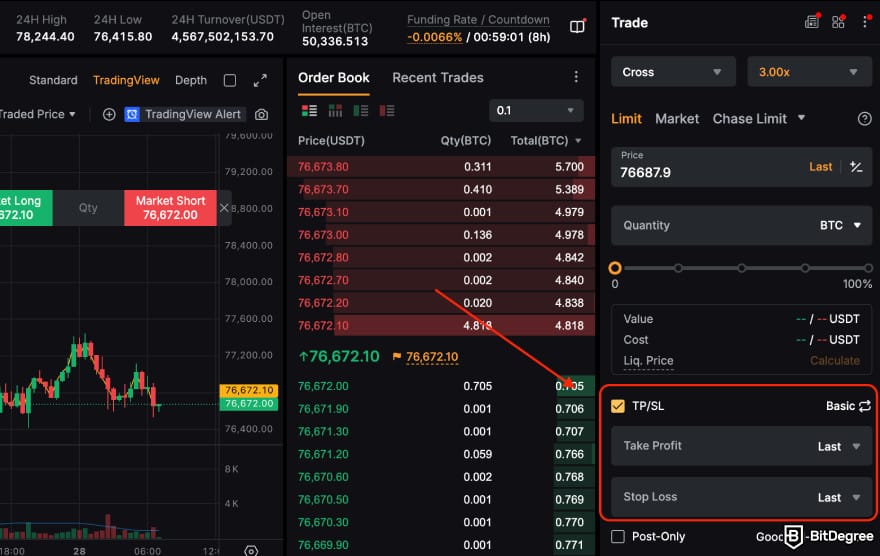
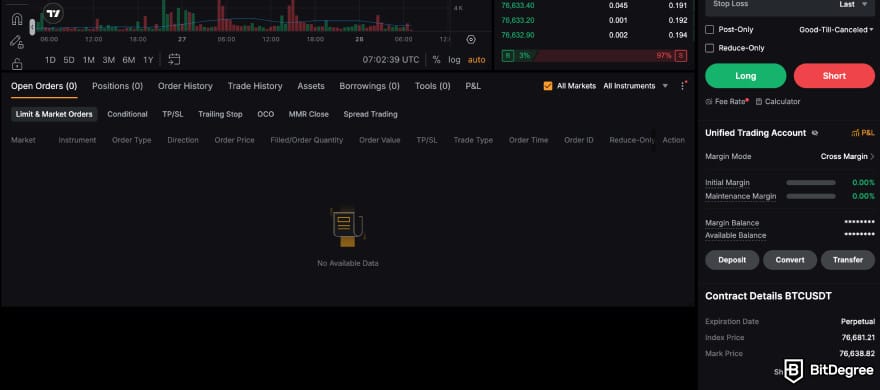
After confirming the trade, you should monitor:
- Entry price;
- Mark price;
- Liquidation price;
- Unrealized P&L;
- Funding fee;
- Margin ratio;
- Stop-loss and take-profit status.
This is where futures trading differs heavily from spot trading. With spot, the value of the asset can fall, but the user still owns the asset unless they sell. With leveraged perpetuals, the position can be liquidated if the market moves too far against them.
If you close with a market order, remember that this usually means paying taker fees again. This is why the round-trip cost matters. You pay when entering and exiting the position, and funding rates may also apply while the position is open.
Binance Trading Walkthrough
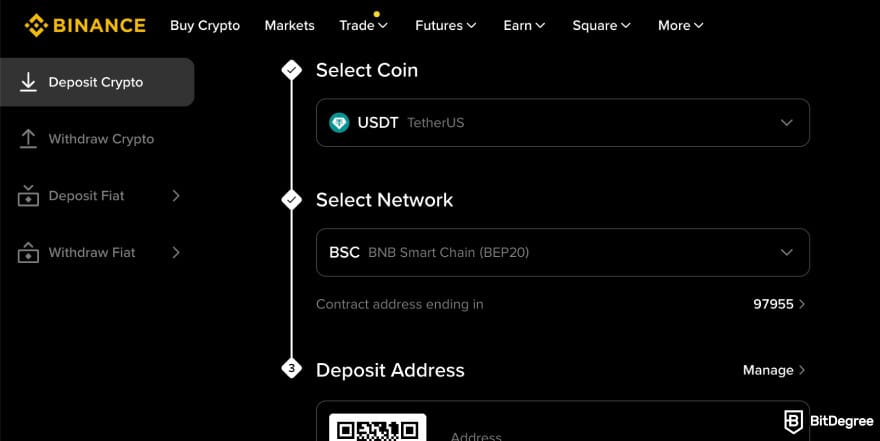
One of the most common trading features on Binance is the spot market. Let's have a quick walkthrough of buying BTC using USDT on the Binance spot market.
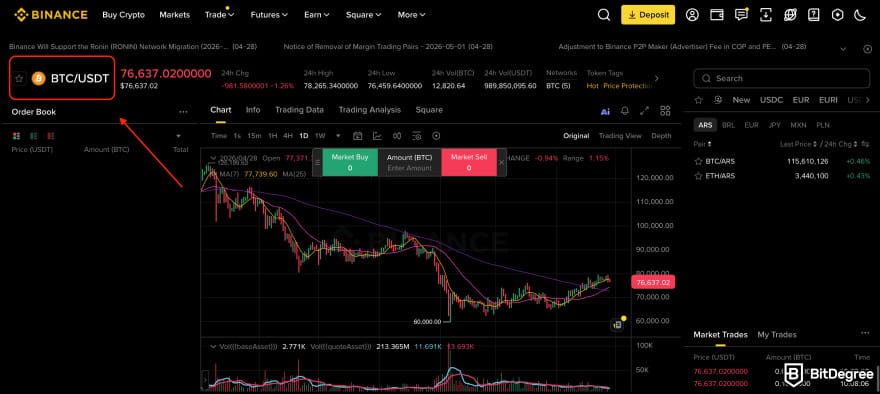
This is where Binance starts to look more advanced. You will see a price chart, order book, recent trades, and order panel.
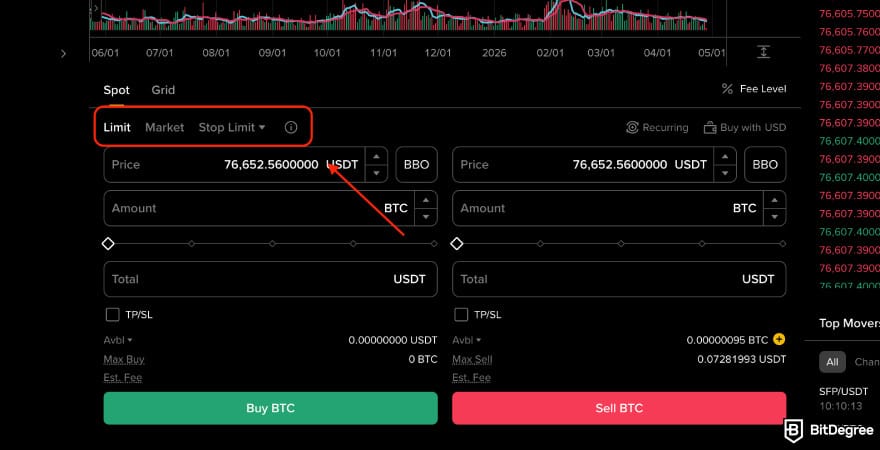
A market order buys instantly at the best available price. This is faster, but it usually counts as a taker order. A limit order lets you choose the price you are willing to pay. If the order does not fill immediately and sits on the order book, it may count as a maker order.
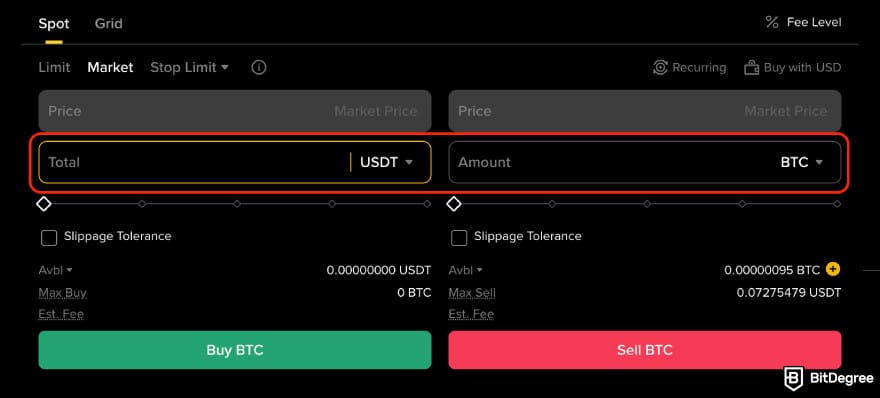
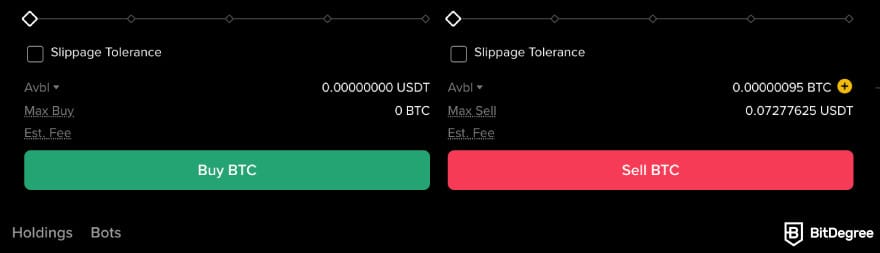
Before confirming, check:
- Trading pair;
- Order type;
- Estimated price;
- Amount;
- Fees;
- Whether you are using BNB for fee discounts;
- Whether the order will execute instantly.
After confirmation, the order should appear in your order history, and the purchased BTC should appear in your spot wallet.
Bybit vs Binance for Beginners
For beginners, Binance and Bybit are both valid starting points, but they approach beginners differently.
Bybit is more competitive for beginners than many people assume. It offers simple entry points such as spot trading, Convert, crypto deposits, buying crypto, Earn products, and beginner guides.
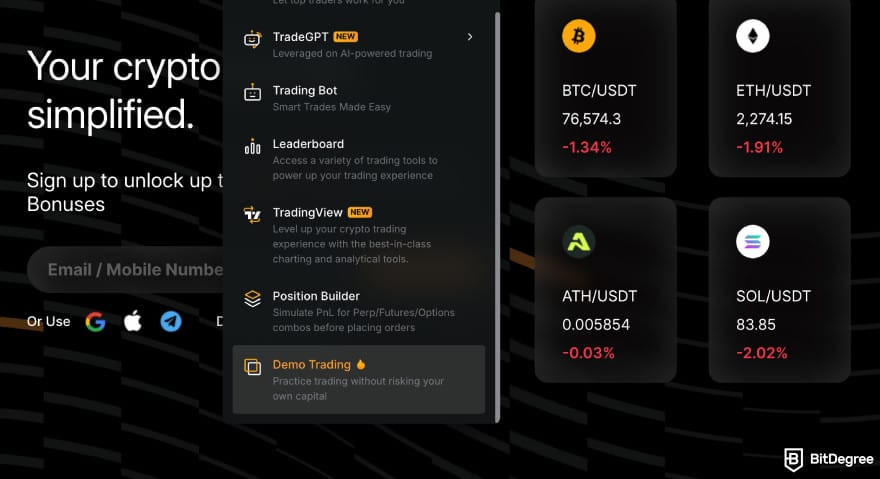
Also, its demo trading feature is especially useful because users can practice trading with simulated funds before risking real money. This makes Bybit a strong option for beginners who want to learn trading step by step, not just buy and hold crypto.
Binance gives beginners a broad crypto environment as well. Users can start with simple buy/sell tools, Convert, spot trading, basic wallet features, Earn products, and extensive educational content. This makes Binance useful for someone who wants to explore crypto slowly and try different products over time.
The downside is that Binance can look crowded because there are so many features, menus, and product categories in one place.
The main difference is focus. Bybit may be better for beginners who want a cleaner path into trading, especially if they plan to eventually use spot trading, copy trading, bots, or derivatives. Binance may be better for users who want a wider crypto ecosystem from day one.
Verdict
Binance is better for beginners who want the easiest all-round start in crypto. Bybit is better for beginners who specifically want to learn trading and prefer a cleaner, more focused platform
Bybit vs Binance for Active Traders
For active traders, the comparison is very close. Bybit has a cleaner trading workflow, strong derivatives products, copy trading, bots, demo trading, and a Unified Trading Account that can make portfolio management more efficient. Binance has scale, liquidity, deep market access, and strong infrastructure.
An active trader might prefer Bybit if they:
- Trade perpetual futures often;
- Want a cleaner derivatives-focused interface;
- Use copy trading or trading bots;
- Want to practice strategies with demo trading;
- Want access to spot, margin, perpetuals, futures, and options from one connected account setup.
An active trader might prefer Binance if they:
- Trade large spot positions;
- Care about very deep liquidity;
- Use BNB fee discounts;
- Want access to a large crypto-native ecosystem;
- Prefer having many trading and non-trading products under one account.
Bybit’s Unified Trading Account is a major advantage for active users because it reduces the need to constantly switch between different account types. Binance is also good for active traders, especially because of liquidity and market access.
Verdict
Bybit is better suited for users who want a focused active-trading environment with robust derivatives, copy trading, bots, demo trading, and a more unified account structure. Binance offers greater liquidity, scale, and overall market access. For active traders, this category is close to a draw, with the better choice depending on trading style.
Bybit vs Binance for Passive Users
Passive users are those who do not trade every day. They may buy crypto, hold it, occasionally rebalance, use Earn products, join launch campaigns, or spend crypto through card and payment tools.
Binance is strong for passive users because of its large ecosystem. Binance Earn, Convert, Pay, Wallet, Launchpool-style campaigns, education, research tools, and community features make it useful for users who want a broad crypto account that covers many different activities in one place.
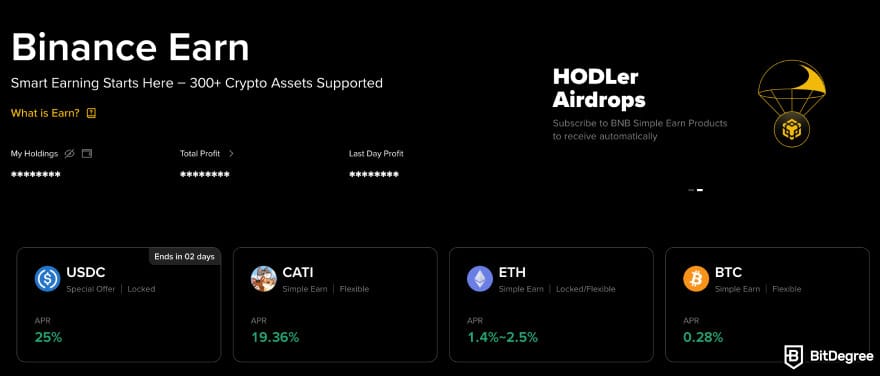
Bybit is more competitive in this aspect than its trading-first reputation suggests. It offers Earn products, giving users different ways to put idle assets to work. It also has Launchpad, Bybit Card, Bybit Pay, Rewards Hub, Bybit Learn, and Web3 tools. So, even if you are not actively trading every day, Bybit gives you plenty of practical features.
Verdict
The difference is mostly about structure. Binance is broader, with more ecosystem layers around trading, education, research, and community. Bybit is more focused and practical, with extra features that connect closely to earning, spending, rewards, and Web3 activity.
Final Verdict: Is Bybit or Binance Better?
Bybit and Binance are both strong exchanges, but they are built around different priorities.
Bybit is the stronger pick if trading is your main focus. Its derivatives offering is genuinely competitive, copy trading is one of the better implementations in the space, and the Unified Trading Account makes managing positions less of a headache than it sounds. Of course, there's also a decent suite of extras (Earn, Card, Pay, TradFi), so it's not purely a trading terminal.
📚 Read More: Full Bybit Review
Binance is the stronger pick if you want breadth. It has deeper liquidity across more markets, a wider product range, more developed Web3 tools, research and education resources, and a significantly larger global footprint. If you're doing something niche or want everything under one roof, Binance is more likely to have it.
📚 Read More: Full Binance Review
The short version: Binance wins on scale and ecosystem depth; Bybit wins on trading focus and usability for active users. Neither is objectively better, it just depends on whether you'd rather have a sharp tool or a full toolkit.