Donald Trump Targets 'Freedom of Speech' in AI, Limits Federal Support

Last Updated: July 24, 2025
✓ Fact Checked
Key Takeaways
- Trump’s AI plan aims to boost open-source use, local chipmaking, and “freedom of speech” rules;
- Data centers will get faster approval by easing environmental review requirements;
- Federal contracts will be awarded only to select "frontier" LLM developers, despite their open-source focus.
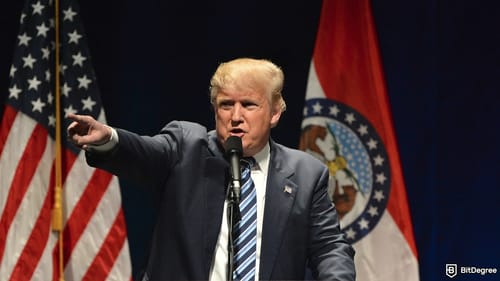
The Trump administration has introduced a new plan to boost artificial intelligence (AI) in the United States.
The proposal outlines three main goals. First, it promotes the use of open-source AI tools across areas like education, medicine, law, defense, manufacturing, and science.
Second, it seeks to bring semiconductor production, needed for AI hardware, back to the US.

Did you know?
Want to get smarter & wealthier with crypto?
Subscribe - We publish new crypto explainer videos every week!
How to Store NFTs in 2023 (3 Most Secure Ways Explained)


Third, the proposal sets guidelines for what AI models can include to support "freedom of speech" in digital systems.
A central part of the plan is the expansion of infrastructure for AI, which calls for building more data centers and streamlining the approval process for them. This would involve changing how these centers are classified under environmental law.
To help power these new facilities, the strategy includes support for alternative energy sources, especially nuclear fission and fusion. The idea is to keep the current energy grid stable while preparing for increased demand from AI-related computing.
Although the plan promotes open-source AI development, it also includes a limit on who can receive government support. Contracts would go only to developers working on so-called "frontier" large language models (LLMs).
Another important part of the plan is a shift in how federal agencies will guide AI content. The Department of Commerce, along with the National Institute of Standards and Technology, will lead efforts to remove references to misinformation, Diversity, Equity, and Inclusion (DEI), and climate change from AI guidance.
Meanwhile, the UK government recently signed a deal with OpenAI to explore the use of AI in health, law, defence, and education. What did UK Science and Technology Secretary Peter Kyle say about it? Read the full story.
Loading...
The Most Liked Crypto News Findings
Looking for more latest crypto news on related topic? We have gathered similar news articles for you to spare your time. Take a look!



Latest Crypto News & Videos







Trending Crypto News

You're Invited: ChangeNOW's Retrofuture Soiree Lands at TOKEN2049 Sing...

ChangeNOW and CoinRabbit Release Joint Research on Financial Privacy i...

Polygon's $250M Bet on Stablecoin Payments: Is Blockchain Coming for T...

Bybit Card Launches 10% Cashback Boost for New Cardholders