


Coinbase vs Binance – In-Depth Comparison
Coinbase and Binance come up in almost every “which crypto exchange is best?” discussion, and it’s not by accident. Both platforms handle massive trading volume and attract millions of users who rely on them every day.
Once you get past that shared status, though, the experience starts to split. Coinbase leans toward a more guided, straightforward setup, while Binance opens the door to a wider and more feature-heavy environment.
So when comparing Coinbase vs Binance, a better question to ask would be: Which exchange suits the way I trade crypto?
Coinbase makes more sense if you mainly want to buy crypto, hold it, use staking where available, and keep the whole experience closer to a normal finance app. Binance fits better if you care about lower trading fees, deeper markets, futures, bots, launch products, and a wider crypto ecosystem.
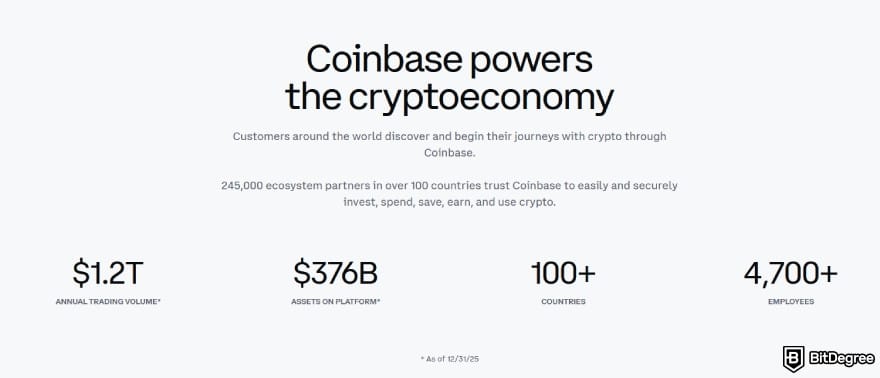
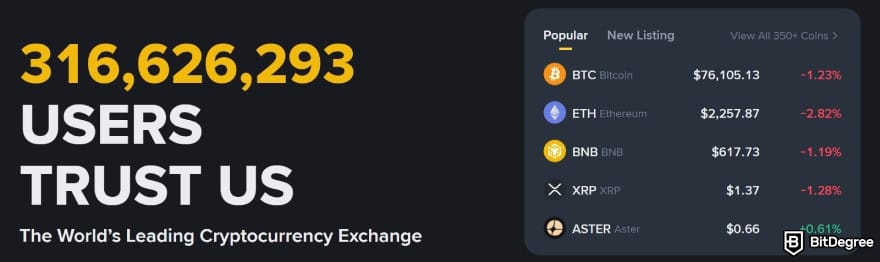
As of 2026, Coinbase has over 100 million active users and handles roughly $1.2T in trading volume, putting it firmly among the top global exchanges. Binance, meanwhile, states it has 310+ million registered users across 180+ countries and claims leadership in both customer assets and trading volume.
Coinbase | Binance | |
|---|---|---|
Best for | Users who want a simple crypto platform | Traders who prefer a complete crypto ecosystem |
Main strength | Simple interface, fiat access, and regulatory clarity | Deep liquidity with a wide product range |
Spot trading fees | Higher than Binance for most users | Keeps up with industry standards |
Futures fees | Limited and not a major focus | A bit cheaper for standard taker orders |
Beginner experience | Easier for basic buying, selling, and holding | Good starting point for a full-platform exposure platform |
Advanced trading | Available, but more limited in tools and markets | Strong across futures, options, and API tools |
Copy trading | Not a major Coinbase feature | Included, though not a key feature |
Overall verdict | Better for ease of use, fiat access, and regulated-market confidence | Best for size, liquidity, and platform access |
Table: a quick Coinbase vs Binance comparison
To put it plainly, Coinbase is easier to start with, while Binance gives you more room to grow. The better pick depends on whether you care more about simplicity or a deeper set of crypto tools.
Coinbase vs Binance - Market Position
As previously discussed, Coinbase and Binance are major crypto exchanges. Still, when it comes to scale, Binance takes the lead. With hundreds of millions of users (and still growing), deep reserves, and a wide global footprint, it benefits from network effects that smaller platforms struggle to replicate. This is something many beginners tend to overlook. A larger exchange often has:
- More active buyers and sellers;
- Stronger liquidity across major markets;
- Tighter spreads on many pairs;
- Wider choice of coins and trading pairs;
- More product lineup;
- Broader payment coverage;
- Better infrastructure for high-volume users.
Binance states that it holds around $150 billion in user assets and represents about 30% of global spot volume across centralized exchanges, according to its own data and Binance Research. That doesn’t guarantee perfection, but it does explain why the platform is widely treated as a central liquidity hub in the crypto space.
Coinbase operates on a different scale, but calling it small would miss the point. Its growth stands out because it has carved a strong position around accessibility and regulation. Rather than focusing heavily on derivatives, Coinbase has built out spot trading, a crypto card, earn products, a wallet, and other features across supported regions.
Verdict
Binance leads in scale, trading volume, liquidity, and ecosystem breadth. Coinbase stands out for simplicity, regulatory visibility, fiat access, and a cleaner experience for beginners.
Coinbase vs Binance - Trading Features
Both Coinbase and Binance let you do the basic stuff: buy crypto, sell crypto, trade spot markets, send assets, receive assets, and use mobile apps. Once you go beyond that, the difference becomes more transparent.
Coinbase Trading Features
Coinbase has moved far beyond the old “buy Bitcoin with a card” image. It now offers simple buying tools, Coinbase Advanced, staking, derivatives products in supported markets, Coinbase Wallet, DEX access, and products connected to its broader Everything Exchange plan.
For basic crypto activity, Coinbase has:
- Simple buy and sell for quick crypto purchases.
- Wallet for storing your cryptocurrencies.
- Staking for earning rewards.
- Card for everyday spending.
For advanced trading, Coinbase supports:
- Crypto futures supporting leveraged trading.
- Coinbase Advanced for chart-based trading with advanced order books.
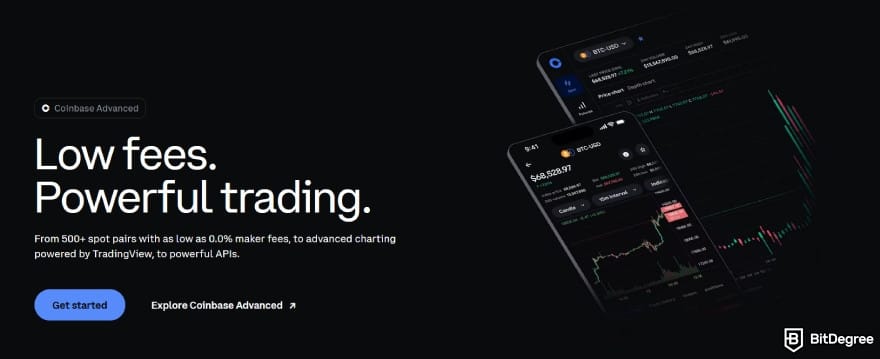
- API trading for automation and integrations.
- NFT access covering digital collectibles trading.
For companies and crypto projects, Coinbase provides:
- Coinbase Business for startups and SMBs needing trading and payment tools.
- Coinbase Payments for platforms and merchants that want to accept stablecoin payments.
- Asset listings for crypto projects that want to list their tokens on Coinbase.
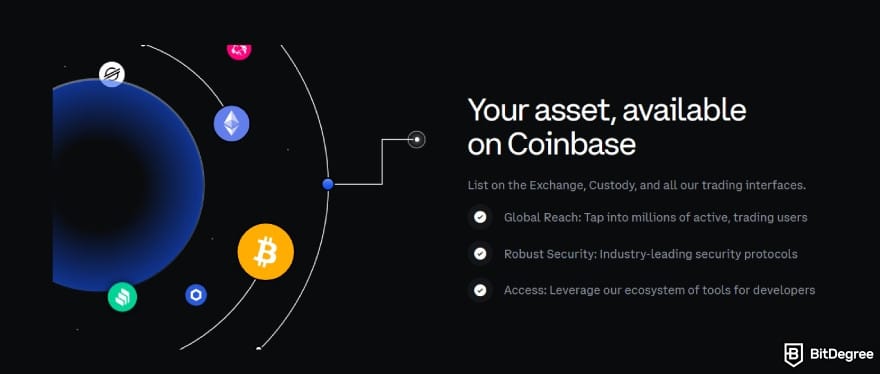
- Token manager for managing distributions, vesting, and lockups.
- Prime for institutions that need custody, trading, financing, and portfolio tools.
The main appeal of Coinbase is how it keeps things manageable from the start. Beginners can stick to simple buy/sell and gradually move into more advanced trading tools when they’re ready (or expand into business use if they choose). It doesn’t feel overwhelming at all. The limitation is that some of Coinbase’s advanced features are only accessible in certain regions.
Binance Trading Features
Binance covers almost every major crypto trading format. If something is commonly traded in crypto, there is a decent chance Binance has a product for it or something close to it.
For basic trading, Binance offers:
- Spot trading for easy crypto buying and selling.
- P2P trading for direct fiat and crypto transactions between users.
- Convert for quick swaps without using the full trading interface.
- Demo trading for practicing with virtual funds and no real risk.
For advanced trading, Binance supports:
- Margin trading with cross and isolated margin options.
- Futures trading for leveraged crypto positions.
- Options trading for more advanced strategies.
For automated and strategy-based trading, Binance includes:
- Copy trading for following other traders.
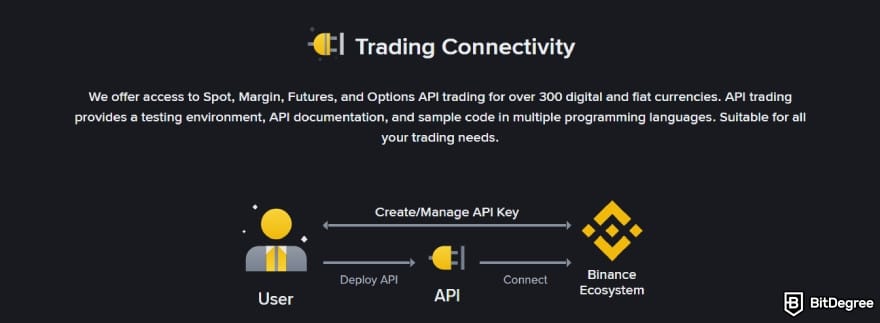
- API trading for building and running algorithmic strategies.
- Trading bots with grid and automated strategy tools.
For larger traders, Binance also provides:
- OTC trading for large orders with private, customized execution.
- Block trading for high-volume orders with reduced market impact.
- Execution services for advanced order handling at scale.
The key strength of Binance is its range of features. Beginners can start with convert or spot trading, while experienced users can move into margin, futures, options, bots, or API-based trading.
Verdict
Binance wins on trading depth, market variety, and advanced tools. Coinbase is better if you want a cleaner path from simple buying into more advanced trading without dealing with the chaos of a giant crypto ecosystem from day one.
Coinbase vs Binance - Fees
This is one of the easiest areas to compare because the gap isn’t hard to spot. Binance is generally cheaper for standard spot trading, while Coinbase tends to be more expensive, particularly for smaller-volume users.
That said, fees don’t come down to just one figure. You need to account for maker fees, taker fees, spreads, deposit fees, withdrawal fees, card purchase costs, subscription benefits, and whether you’re using a basic buy/sell flow or an advanced trading interface. Here’s a simplified comparison:
Coinbase | Binance | |
|---|---|---|
Spot Fees | 0.40% maker 0.60% taker | 0.1% maker 0.1% taker 0.075% (with BNB fee discount) |
Table: fee comparison
With Binance, standard spot trading fees start at 0.1% for both makers and takers. That sits right at the industry norm, but you can reduce it to 0.075% by using the 25% BNB discount where available.
📚 Read More: Binance Fees Explained
Coinbase, by contrast, comes in with higher fees, starting at 0.60% for takers and 0.40% for makers for regular users. Since there’s no native token discount to bring those down, the gap becomes quite clear.
📚 Read More: Coinbase Fees Explained
$1,000 Spot Trade Fee Comparison
Let’s say you place a $1,000 BTC/USDT spot market order.
On Binance, with the standard 0.1% spot taker fee, the fee would be around:
$1,000 x 0.1% = $1
If the BNB fee discount applies, the fee could be around:
$1,000 x 0.075% = $0.75
On Coinbase, using a 0.60% taker fee as the lower-volume reference, the fee could be somewhere around:
$1,000 x 0.60% = $6
For casual spot traders, the price gap is hard to ignore. It’s bigger than most beginners would expect. On a $1,000 trade, Binance could cost roughly $1 before discounts, while Coinbase might be closer to $6. If you only buy and hold, it may not matter much. But if you trade regularly, the cost difference can add up fast.
Verdict
Overall, Binance comes out ahead on standard trading fees, particularly for spot traders focused on keeping costs low. Coinbase can still be a good fit if you care more about simplicity, fiat access, or a cleaner experience than squeezing out the lowest fee.
Coinbase vs Binance - Liquidity and Execution
Liquidity doesn’t sound exciting at all until it starts costing you money. It refers to how easily you can buy or sell an asset without pushing the price around too much. A liquid market has plenty of buyers and sellers, which usually leads to tighter spreads, better execution, and lower slippage.
Liquidity affects the real price you get.
In this case, Binance has the stronger global liquidity profile. In fact, it’s one of the leading platforms when it comes to market depth and trading activity. As of 2026, Binance claims around $65 billion in average daily volume, with 24-hour spot trading volume at about $6.66 billion.
For major pairs like BTC/USDT or ETH/USDT, both Coinbase and Binance can offer strong execution. Coinbase isn’t some tiny exchange, mind you. It’s still one of the biggest names in the industry and reported around $5.2T in total trading volume for 2025.
Still, Binance’s global scale gives it an edge in market depth, asset variety, and trading routes. It supports hundreds of coins and a large number of trading pairs, while Coinbase tends to be more selective.
Verdict
Binance leads when it comes to liquidity, especially for active traders, larger positions, and broader altcoin availability. Coinbase still handles major assets pretty well, but the latter generally offers deeper market access.
Coinbase vs Binance - Security & Trust
Coinbase and Binance offer robust account protection, with features such as two-factor authentication, passkeys, anti-phishing codes, device management, and withdrawal address controls.
Coinbase | Binance | |
|---|---|---|
Two-Factor Authentication | ✓ | ✓ |
Passkeys | ✓ | ✓ |
Anti-Phishing Code | ✓ | ✓ |
Withdrawal Address Whitelist | ✓ | ✓ |
Proof of Reserves | ✓ | ✓ |
User Protection Fund | Coinbase's crime insurance | SAFU |
Table: Coinbase's and Binance's security features
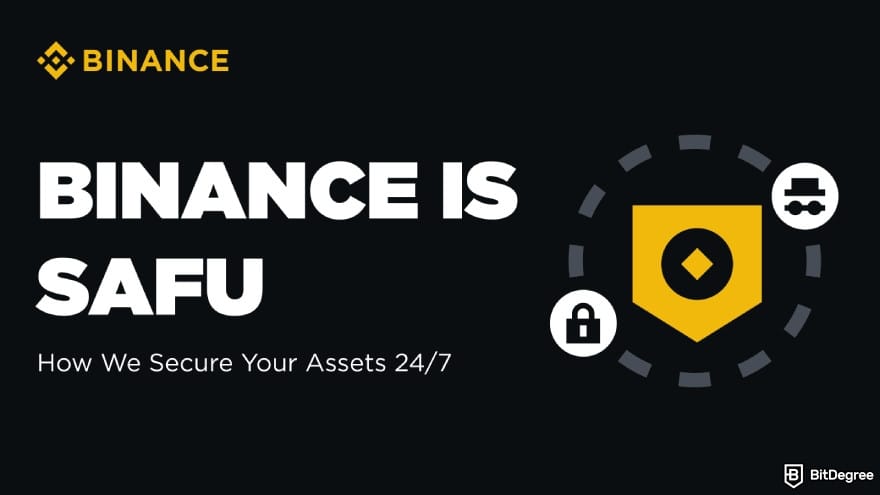
A key feature within Binance’s security measures is SAFU, an emergency user-protection fund that has already supported more than 7.4 million users. Binance also shares its Proof of Reserves, stating that user assets are backed 1:1 with extra reserves on top.
Coinbase benefits from being a public company, operating with audited financial statements, investor disclosures, and public reporting. It also provides account security tools such as two-factor authentication, security key support, password protection, and Coinbase Vault features with multi-approval withdrawals.
At the end of the day, Coinbase is the safer pick for users who care about transparency, US presence, and a cleaner regulatory approach. Binance often feels stronger for those who look at Proof of Reserves, SAFU, and the size of its operations. Either way, crypto risk doesn’t go anywhere; you’re still the one holding most of it.
Verdict
Coinbase offers a more traditional trust setup, driven by public reporting, regulatory visibility, and a compliance-first image. Binance focuses on crypto-native transparency with Proof of Reserves, plus SAFU and its large-scale security infrastructure. Both platforms are strong options for everyday users, though the trust approach behind them differs a bit.
Coinbase vs Binance – Broader Ecosystem
Both exchanges have moved well past simple crypto trading. The ecosystems built around their core platforms deserve a closer look. At first glance, Binance looks like a "Swiss army knife" of the crypto world, packed with a wide range of features. Still, Coinbase has its own set of tools that can pull in users without needing to match that scale.
Coinbase's Other Features
Coinbase has branched out into multiple product areas outside of buying and selling crypto:
1
Earn products
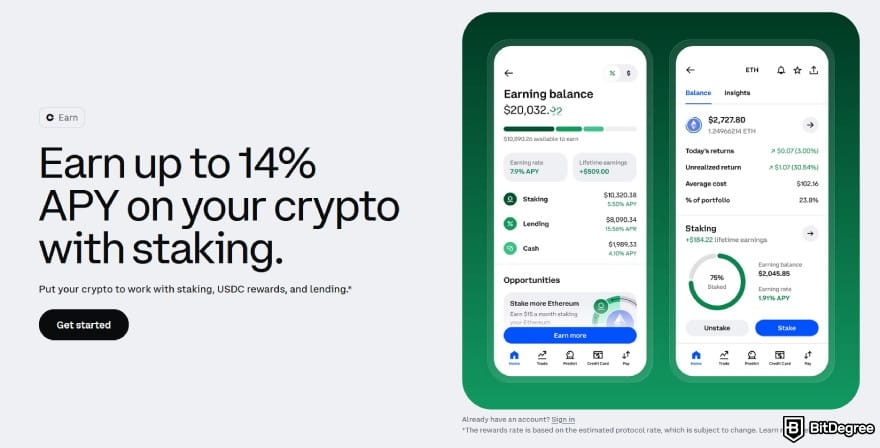
With Coinbase, you can earn by staking your assets directly within the platform. The yields are competitive, sometimes climbing to around 14% depending on the asset. Everything is streamlined, so there’s no need to handle validators or get into technical details.
2
Institutional services
Where Coinbase starts to pull ahead is in its institutional-grade offerings. With Coinbase Prime, ultra-high-net-worth individuals, family offices, and professional advisors can tap into secure custody, deep liquidity, and a full infrastructure stack under one roof.
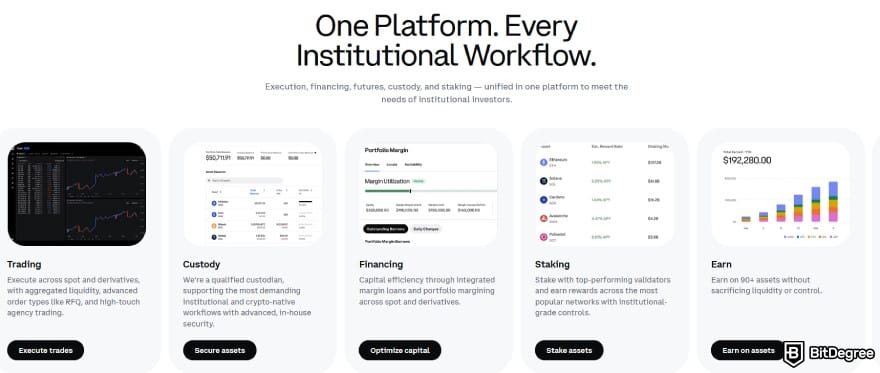 There’s also the Coinbase Developer Platform, which serves as an infrastructure layer for businesses building on-chain products. It offers tools for payments, trading, wallets, stablecoins, and integrations, and is suited for banks, payment firms, brokerages, and startups. It’s already been adopted by companies like Anthropic, Shopify, Stripe, Solana, and Uniswap.
3
Payments and spending
Coinbase also provides both crypto debit and credit cards. It’s designed to make crypto easier to use in everyday life, whether you’re spending it, sending it, or using it for more than just trading.
4
Web3 features
Coinbase Wallet is built for users who want to tap into on-chain activity without stepping outside the ecosystem. It supports multiple chains, dApps, NFTs, and DeFi. You can use it as a browser extension or mobile app, and it works even if you don’t keep funds on the exchange.
5
Education materials
Coinbase has a fairly extensive learning section. It features a wide range of articles, starting from the basics and moving into more advanced concepts, plus guides and tutorials to help you make sense of the market. It also runs Coinbase Bytes, a weekly newsletter focused on crypto-related news.

One of Coinbase’s biggest strengths is how far it reaches beyond retail users. It caters not just to high-net-worth individuals but also to businesses and institutions, offering products like Coinbase Prime, Coinbase Wealth, and asset listing and management tools designed for larger-scale crypto operations.
Binance's Other Features
Binance offers a broad non-trading ecosystem alongside its core exchange. Its main extra features include:
1
Earn products
Binance Earn is easily one of Binance’s key advantages. It brings together products like Simple Earn, flexible and locked offerings, ETH staking, SOL staking, Dual Investment, and on-chain yield features. According to Binance, it supports 300+ cryptocurrencies, though what’s available depends on the product and region.
2
Launch and reward products
Binance also offers a set of features for users looking to access new tokens or join reward-based campaigns.

This includes Launchpool, where you lock supported assets to earn token airdrops, and Megadrop, which blends Simple Earn with Binance Wallet quests for early access to selected Web3 projects.
3
Payments and spending
Binance also comes with Binance Pay, crypto payment tools, gift cards, and the Binance Card. This makes it more useful for anyone looking to spend, send, or gift crypto.
4
Web3 features
Binance Wallet lets users access DeFi, dApps, swaps, and multi-chain Web3 activity without leaving the Binance ecosystem. It’s described as a keyless, seedless, multi-chain wallet built on MPC technology, but it’s still worth keeping in mind that Web3 activity comes with different risks compared to using a CEX.
5
Education, research, and community
Binance has Binance Academy, Binance Research, Binance Square, Charity, and other content and community offerings. These don’t directly impact fees or execution, but they make Binance more complete for users who want to follow news, learn, explore research, and keep up with ecosystem updates all in one place.

Binance’s main advantage is how all its features are connected into a single ecosystem. You can buy crypto, earn yield, join token campaigns, use a wallet, send payments, check market research, and explore Web3 tools without switching platforms. That said, it can come across as crowded, and not every feature is accessible in every region.
Verdict
Coinbase has the edge when it comes to institutional-grade products. Binance has the edge in depth, offering more yield options, broader token access, and a stronger DeFi presence. For passive users in the US, Coinbase is cleaner and more compliance-friendly. For users operating globally who want maximum reach, Binance covers more ground.
Coinbase vs Binance - Fiat Deposits and Withdrawals
For a lot of users, the ease of moving money in and out of an exchange is just as important as the trading features. In this case, both platforms manage fiat fairly well, though each has its own strengths.
Coinbase is especially strong on this front for US users. It supports USD deposits through ACH and wire transfers, debit cards, and PayPal in certain regions. Its banking integration is one of the smoother ones in the industry. Withdrawals back to a bank account tend to be straightforward and dependable, which isn’t always true for less-regulated platforms.

In Europe, Coinbase supports SEPA transfers for EUR deposits and withdrawals, along with a range of other fiat currencies depending on the region. The experience is generally smooth, and in countries where the platform is fully available, fiat transactions rarely cause issues.
Binance's global fiat access is broader in sheer geographic coverage, but the experience varies far more depending on where you are. In regions where Binance operates fully, users can deposit via bank transfer, card, P2P, and third-party payment providers in local currencies.
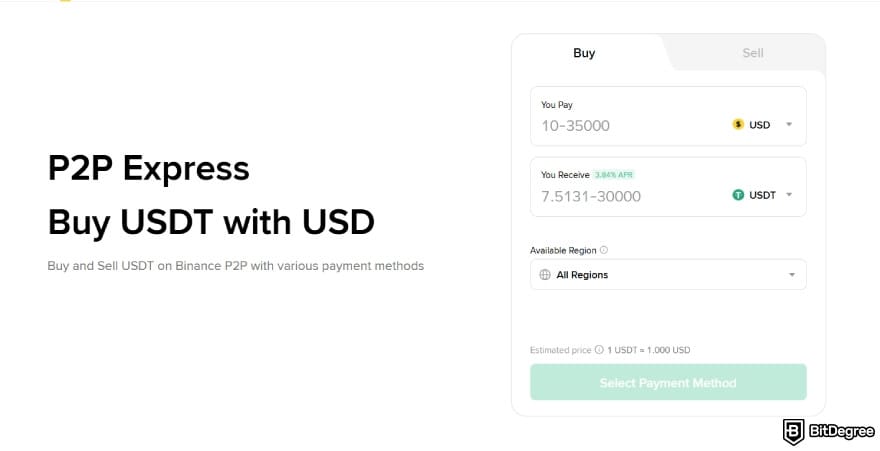
P2P trading on Binance deserves a separate mention. In regions where traditional banking options are limited or costly, its P2P marketplace becomes one of the more practical ways to move fiat in and out, letting users deal directly with each other at market-driven rates.
A quick note for both platforms: fiat fees don’t always show up as clearly as trading fees. Card purchases typically come at a higher cost than bank transfers, and third-party providers may add a spread. Withdrawal fees and processing times change depending on the method, so it’s worth checking the current fee schedule before assuming the cheapest route.
Verdict
Coinbase has a more seamless fiat experience for US users, with pretty solid European coverage as well. Binance has a broader geographic reach and a stronger P2P offering for markets where traditional banking is less convenient.
Coinbase Trading Walkthrough
A common Coinbase flow is to begin with simple crypto purchases and later move to Coinbase Advanced for more control. Let’s take buying BTC as an example:
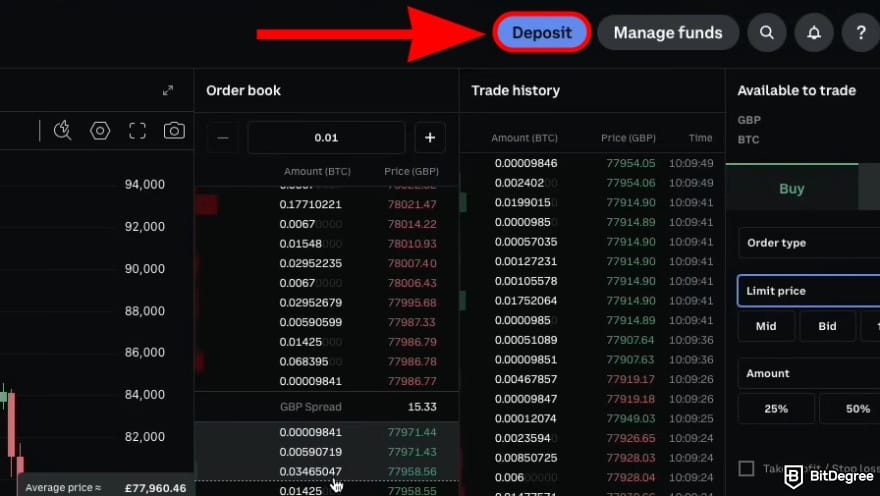
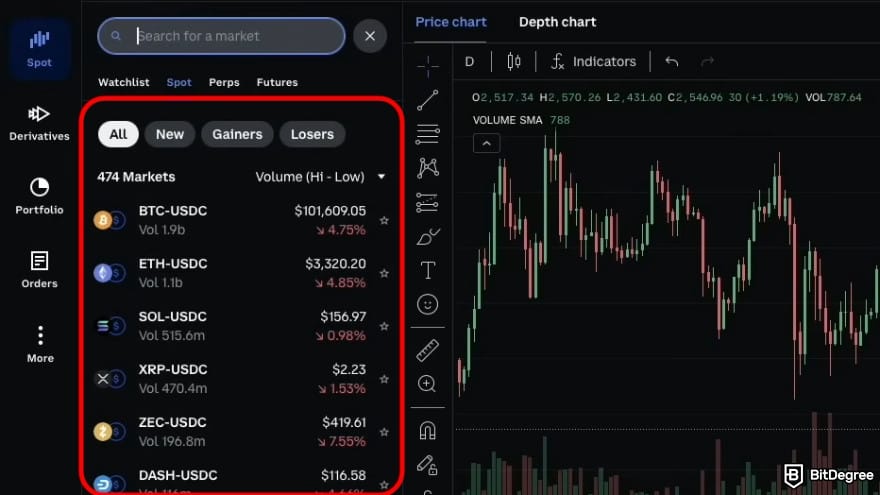
- Market Order. Executes immediately at the current market price with instant order fulfillment.
- Limit Order. Lets you set a specific price, executing only when the market reaches that level.
- Stop Limit Order. Activates a limit order once a predefined trigger price is reached.
- TWAP: Splits a large order into smaller trades and executes them gradually over time.
Once you’ve reviewed the order details, confirm the trade using the [Buy] button.
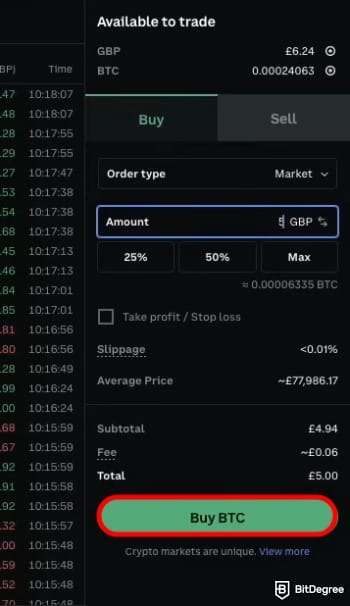
After confirming, Coinbase will send a receipt for each purchase. You can monitor your position from the portfolio tab, which shows your current holdings, average buy price, and approximate gain or loss.
Binance Trading Walkthrough
Binance’s spot market is one of its most widely used trading features. Let’s go through a quick example of buying ETH with USDT on the spot market.
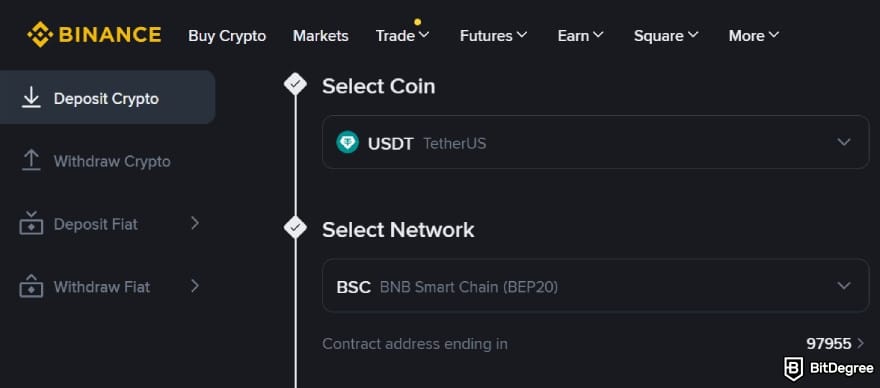
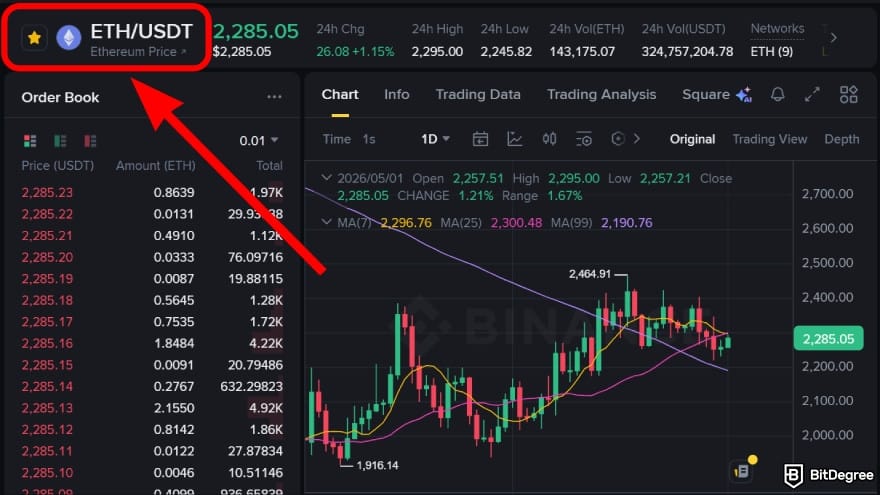
Here’s where Binance starts to show its more advanced side. You’ll be looking at a price chart, order book, recent trades, and the order panel.
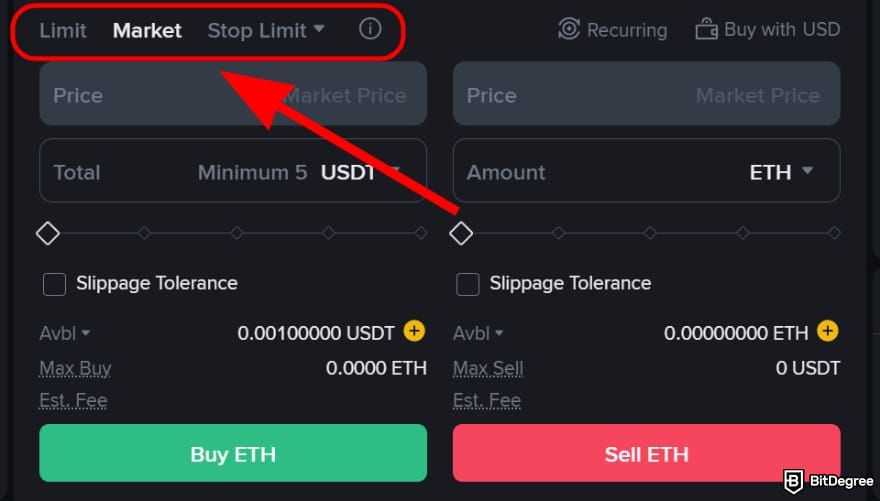
There are other order types available, but if you’re new, it’s better to stick with market or limit orders.
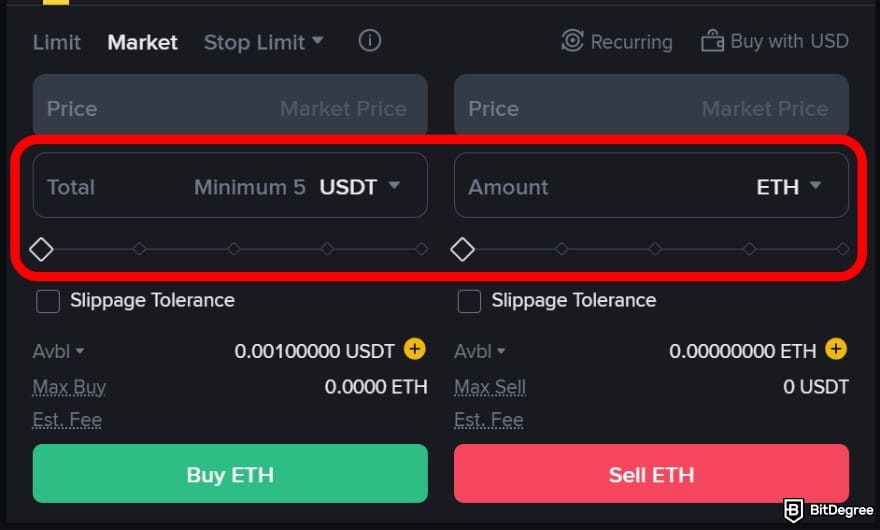
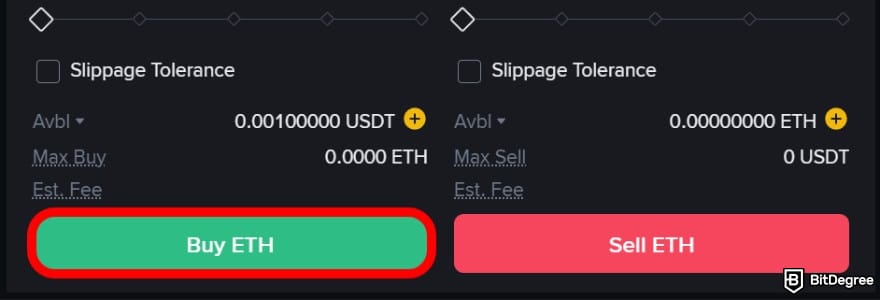
Before confirming, make sure to check:
- Trading pair;
- Order type;
- Estimated price;
- Amount;
- Fees;
- Whether you are using BNB for fee discounts;
- Whether the order will execute instantly.
After confirmation, you’ll find the order in your order history, and the ETH will be added to your spot wallet.
Coinbase vs Binance for Beginners
If you’re just getting into crypto, this is probably the most important part of the article. That said, both platforms try to accommodate beginners in their own way, but Coinbase has a slight edge here.
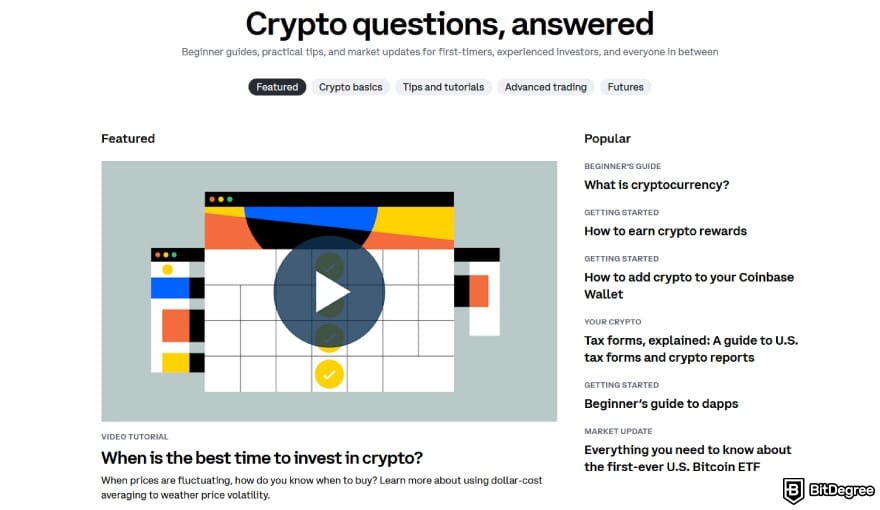
The onboarding flow on Coinbase is straightforward, with an interface that cuts down on unnecessary complexity for new users. Fiat deposits tend to work reliably, and the extra educational content (Coinbase Learn) helps explain what you’re getting into.
Binance isn’t beginner-unfriendly, but it does ask for a bit more patience. You still get simple entry points like vonvert, basic buy tools, and beginner-friendly app modes. On top of that, Binance Academy covers almost everything, so you’re not short on learning resources.
The difference shows up in how the platform feels. Binance packs in a lot more features from the start, which can make the interface look crowded. Once you get through that phase, though, it becomes a great place to grow.
Verdict
Coinbase is easier to start with. It’s simpler, more approachable, and removes a lot of early friction. Binance also works for beginners, but it makes more sense if you’re willing to spend time learning the platform and plan to grow into more advanced features.
Coinbase vs Binance for Active Traders
For users who trade regularly, whether that’s spot, derivatives, or automated strategies, the comparison tends to lean more toward Binance.
An active trader might prefer Binance if they:
- Place large spot trades;
- Prioritize strong market depth;
- Take advantage of BNB fee discounts;
- Seek access to a broad crypto ecosystem;
- Like having everything in one account.
An active trader might prefer Coinbase if they:
- Located in the US and prefer a regulated trading environment;
- Mainly trade BTC and ETH on spot or regulated futures;
- Prefer a simpler interface with less clutter;
- Benefit from the Coinbase One taker fee structure;
- Need institutional-grade services within the same platform.
There’s been progress on Coinbase over the past few years. The interface is cleaner, and the fee structure has become more competitive. But the derivatives gap hasn’t closed much, and active traders who need perpetuals, a broader options market, or more advanced bot tools will hit limitations sooner rather than later.
Verdict
Binance is better suited for active traders, especially those using derivatives or automated strategies. Coinbase is still a viable choice for US-based traders who prioritize regulatory comfort and focus on spot markets.
Coinbase vs Binance for Passive Users
Passive users, or what you might call the "set it and forget it" crowd, are those who buy crypto, hold it, maybe stake it or park it in an earn product, and don't really log in every day. This type of user has a different set of priorities compared to active traders, and both platforms have a solid case to make here.
For this group, Coinbase is pretty well-suited. The recurring buy feature makes it easy to dollar-cost average into an asset on autopilot (weekly, bi-weekly, monthly, whatever works). Add simple staking and a clean portfolio view, and you have a platform that doesn't require much hands-on attention.
On the other hand, Binance brings more firepower. Its earn suite covers more assets, more product structures, and generally more competitive APYs. Launchpool and Megadrop can be appealing for passive holders, letting you accumulate early token allocations simply by holding supported assets, with no real active participation required.
A passive user shouldn’t focus only on which platform pays more. It comes down to risk tolerance and whether they value simplicity over yield. In this situation, both choices can make sense depending on the situation.
Verdict
Coinbase tends to be the go-to option for passive holders, especially in parts of the US where it benefits from regulatory advantages. Still, Binance deserves a closer look if you care more about maximizing yield and accessing a wider range of assets.
Final Verdict: Is Coinbase or Binance Better?
The main takeaway here is that Coinbase and Binance don’t go after the same kind of user. They’re designed with different priorities, and once you see that, picking between them becomes easier.
If trust, simplicity, and regulatory clarity matter most, Coinbase comes out ahead. It provides a clean entry point into crypto for US users, backed by its track record as a publicly listed and regulated platform.
For institutions, it’s a fairly easy pick. Coinbase Prime, Custody, and the Base network all add to its credibility at the top end of the market.
📚 Read More: Full Coinbase Review
Binance is the better option if you’re looking for more depth and don’t mind dealing with a more complex platform. You get lower fees, stronger liquidity, extensive derivatives, built-in bot tools, copy trading, and one of the widest asset selections in the space.
At the same time, it’s a good fit for beginners who already know they want to get into active trading. The platform offers plenty of learning resources and reward systems that can help you progress more quickly.
📚 Read More: Full Binance Review
The short version is this: Coinbase leads in compliance and accessibility. Binance leads in fees, trading strength, and product depth. Neither is objectively better. It all comes down to who you are and how you use crypto.