



Binance vs Uphold – In-Depth Comparison
Binance and Uphold are an unusual comparison because they’re designed with different priorities in mind. It’s a bit like comparing a freight train to a Swiss Army knife: both are useful, but for very different reasons. The point of this comparison isn’t to crown a winner, but to determine which platform is a better fit for your particular needs.
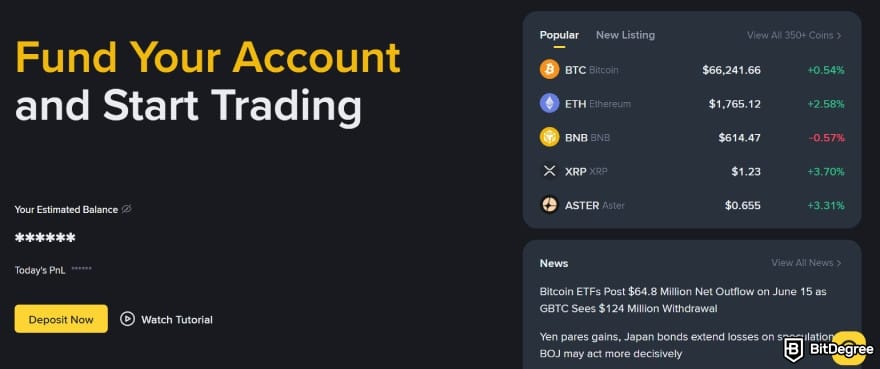
Binance barely needs an introduction. It’s probably the first platform that comes to mind when someone says “crypto exchange”. It offers a marketplace with deep liquidity built for everything from a first Bitcoin purchase to fully leveraged derivatives trading.
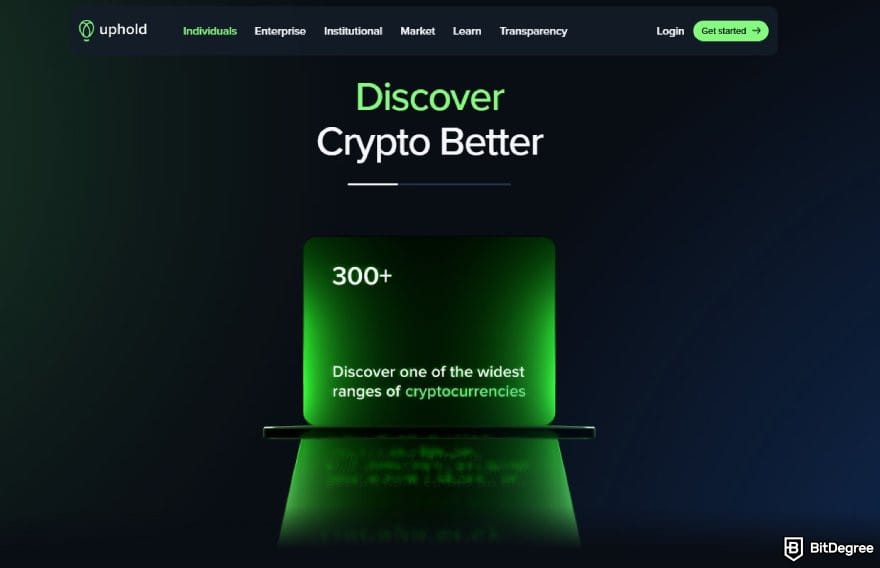
Uphold approaches things quite differently. Instead of trying to beat trading platforms at their own game, it positions itself as a multi-asset hub where you can hold crypto, foreign currencies, and even gold or silver in one place. It also has a noticeably easier learning curve than most exchanges.
Once you get that, the matchup stops being about “which platform wins”. A much better question is the one you should ask yourself: “What are you trying to do with your crypto?”
If you’re after deep order books, ultra-low fees, and just about every trading tool you could ask for, Binance is the natural place to start. If you’d rather keep several asset types in one place without bouncing between brokerage, forex, and crypto accounts, Uphold starts to look more practical.
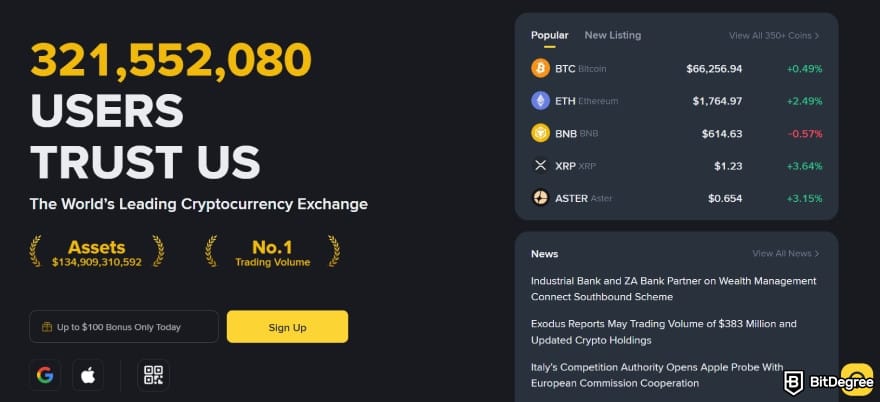
To put that into perspective (as of writing), Binance reports more than 320 million registered users and upwards of $134 billion in customer assets. Those numbers place it in a league most exchanges can’t realistically match.
Uphold runs a more compact, focused operation. It serves more than 10 million users across over 150 countries, and its pitch is less about chasing trading volume and more about giving people one straightforward place to hold crypto, cash, and metals together.
Best for | Users who want a comprehensive crypto platform with deep liquidity, advanced tools, and a broad ecosystem | Users who want one simple multi-asset app for trading crypto, stocks, commodities, and forex |
|---|---|---|
Main strength | Scale, fees, liquidity, trading depth, and advanced features | Ease of use, transparency, and multi-asset access |
Assets | 600+ cryptocurrencies, plus select TradFi assets for eligible users | 300+ digital assets, selected fiat currencies, precious metals, and other commodities |
Trading tools | Spot, margin, P2P, Convert, futures, options, bots, copy trading, APIs, OTC, and institutional tools | One-step swaps, recurring buys, limit orders, take-profit orders, and trailing stop orders |
Spot trading fees | Competitive fees, with standard spot fees starting at 0.1% | Spread-based pricing, often higher for frequent trading |
Security angle | Proof of Reserves, account security features, SAFU emergency fund, and large security infrastructure | 100%+ reserve transparency, real-time assets/liabilities, and assisted self-custody via Vault |
Overall verdict | Better as a full trading and crypto ecosystem platform | Better as a casual multi-asset platform with strong transparency |
Table: Binance vs Uphold quick comparison
To put it simply: Binance is the better pick if trading, in almost any form, is what you’re really here for. Uphold makes more sense if you’d rather hold a diversified mix of assets in one place, without overthinking every step, and you’re okay paying a bit more for that convenience.
Binance vs Uphold – Market Position
Binance's footprint is hard to overstate. The exchange reports more than 320 million users across over 180 countries. It also lists roughly $134.8 billion in customer assets, alongside a 24-hour trading volume of more than $66 billion.
Numbers like that aren’t just there for bragging rights. They can turn into practical advantages, because a bigger and busier exchange tends to offer:
- Deeper order books and tighter spreads on major trading pairs;
- Faster order matching when markets get volatile;
- More fiat on-ramps in the countries where it operates directly;
- A wider net of both trading and non-trading products tied to a single account.
Binance has also been moving beyond pure crypto. The exchange opened access to more than 7,000 US-listed stocks and ETFs, allowing users to buy fractional shares from a low entry point and trade 24 hours a day, five days a week, inside the same app they already use for crypto.

Uphold isn’t chasing that same numbers game, though, and it doesn’t really need to. Launched in 2014 as Bitreserve (founded by Halsey Minor, who also started CNET) before rebranding as Uphold a year later, the platform has grown to serve more than 10 million users across over 150 countries.
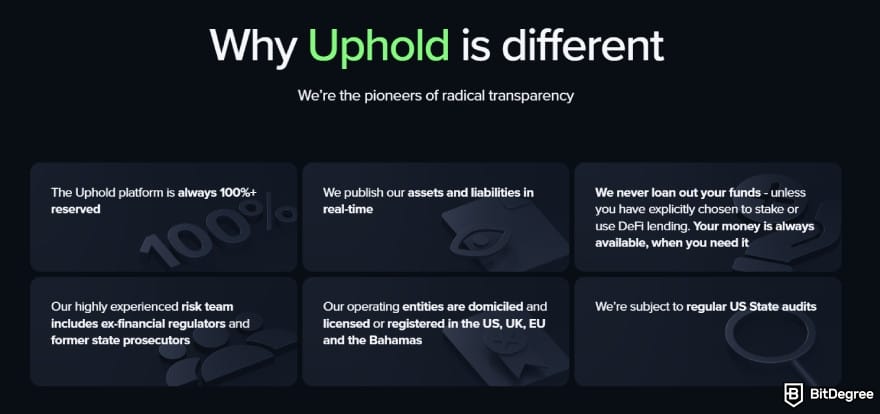
Instead of trying to win the liquidity race, Uphold has built its identity around being a transparent, multi-asset bridge. Users can keep crypto, foreign currencies, and precious metals side by side, while the platform regularly publishes its reserves and liabilities for the public to see.
Its value proposition isn’t “we have the deepest order book on earth”. It’s more like: “you can move between crypto, fiat, and metals without needing a manual and three extra accounts”.
That's what makes this comparison a little less black and white. Binance wins on sheer exchange scale. Uphold wins on multi-asset convenience. For active crypto traders, Binance sits much closer to the heart of the market. For users who want convenient multi-asset trading and management, Uphold often makes more sense.
Verdict
Binance leads when it comes to market scale, liquidity, and crypto infrastructure. Uphold carves out its own useful niche for users who want a regulated, transparent, beginner-friendly multi-asset platform instead of a full trading terminal.
Binance vs Uphold – Trading Features
On paper, both platforms check the same box: buying and selling assets. In reality, they're approaching that goal from two different directions, with different ideas about what a trading platform should be.
Uphold Trading Features
Uphold’s main trading hook is what it calls anything-to-anything trading: the ability to convert directly between any two supported assets in a single step, even when the pairing seems a little odd on paper.

Want to swap Bitcoin into gold, or euros into Solana, without taking the scenic route? Uphold treats it as one trade, quietly routing the order across roughly 30 connected venues, including centralized exchanges, decentralized exchanges, and Layer-2 networks, to source pricing.
For everyday trading, Uphold offers:
- Anything-to-anything swaps across 300+ crypto assets, major foreign currencies, and precious metals like gold and silver.
- Crypto Baskets, pre-built bundles of assets grouped around themes such as "The Big Three" or AI-related tokens, for one-click diversification.
- Recurring Transactions, which automatically repeat a trade daily, weekly, or monthly, making dollar-cost averaging close to effortless.
For managing risk and timing, Uphold supports a few order types beyond a basic market buy:
- Limit orders for setting the exact price you're willing to trade at.
- Take-profit orders which close a position automatically once it hits a target price.
- Trailing stop orders which follow a rising price and lock in gains by selling if it pulls back by a set percentage.
What’s missing from Uphold says just as much as what’s included. There’s no margin trading, no futures, no perpetual contracts, and no options. That’s a deliberate design choice, because the platform is built more around buying, holding, swapping, and diversifying, not leveraged speculation.
Binance Trading Features
Binance, by contrast, is built to cover essentially every trading style under one login.
For everyday trading, Binance offers:
- Spot trading across thousands of pairs.
- Convert for quick swaps without touching the full order book.
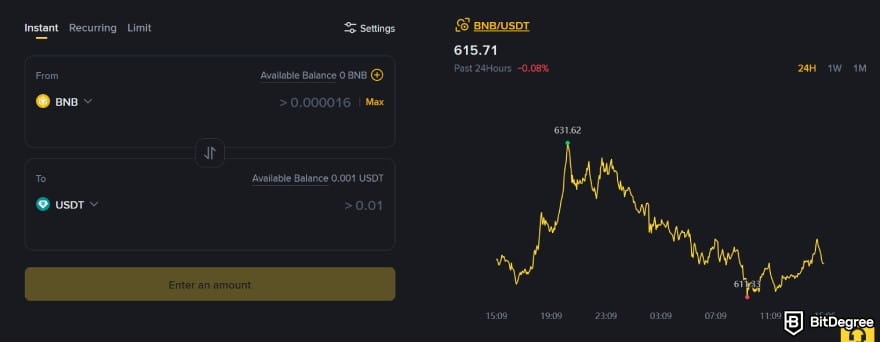
- P2P trading for direct fiat-to-crypto deals with other users.
- Demo Trading to help newcomers practicing with virtual funds.
For traders who want more control, Binance supports:
- Margin trading for amplifying spot positions.
- Futures trading for leveraged exposure without owning the underlying asset.
- Options trading for more complex strategies.
For automation and hands-off strategies, Binance includes:
- Trading Bots covering grid, DCA, and other automated approaches.
- Copy trading for mirroring more experienced traders.
- API access for anyone running custom strategies.
And as mentioned earlier, Binance has been adding US stocks and ETFs alongside its usual crypto markets. That means the “trade everything” side of this comparison is starting to move closer to Uphold’s multi-asset territory. Uphold still comes out ahead, though, when it comes to convenience and keeping things less cluttered.
Verdict
Binance stretches across nearly the whole trading spectrum, from basic spot trading to leveraged derivatives. Uphold takes a different route, focusing instead on straightforward swaps, diversification, and automation across various asset classes.
Binance vs Uphold – Fees
Both platforms tell you what you'll pay, but they arrive at those costs differently. Binance uses a maker/taker fee model that rewards higher trading volume with lower fees, while also offering discounts through its native token:
Binance Fees | |
|---|---|
Spot fees | Starts at 0.1% maker Starts at 0.1% taker |
Spot fees with native discount | 0.075% (with BNB fee discount) |
Futures fees | 0.02% maker 0.05% taker |
Futures fees with native discount | 0.018% maker 0.045% taker (with BNB fee discount) |
Options fees | 0.024% maker 0.024% taker |
Table: Binance fees
By comparison, Uphold's pricing is based more heavily on the asset being traded:
Uphold Fees | |
|---|---|
Major cryptocurrencies (BTC, ETH) | 2.05% – 2.20% |
Stablecoins | < 0.25% |
Altcoins | 2.85% – 3.80% |
Forex | 0.30% |
Precious metals | 2.35% – 3.40% |
Table: Uphold fees
Binance keeps its standard spot fee at 0.1% for both makers and takers, reduced to 0.075% when fees are paid with BNB. Futures fees start at 0.02% for makers and 0.05% for takers, while options start at 0.024% for both sides, with further cuts available through BNB discounts and higher VIP levels.
📚 Read More: Binance Fees Explained
Uphold takes a different approach to fees. Typical trading costs are less than 0.25% for most stablecoins, 0.3% for major-market FX, 2.05%–2.20% for BTC and ETH, 2.85%–3.80% for altcoins, and 2.35%–3.40% for precious metals. Those figures aren't set in stone, though, so it's worth checking Uphold’s official fee page for the latest pricing.
📚 Read More: Uphold Fees Explained
There’s no native-token discount to chase, but the published rate already includes Uphold’s margin, so the trade preview stays close to what you’ll actually pay.
$1,000 Trade Fee Comparison
Say you're putting $1,000 into Bitcoin on each platform.
On Binance, with the standard 0.1% spot taker fee, the fee would be around:
$1,000 x 0.1% = $1
With the BNB discount applied, the effective fee could be around:
$1,000 x 0.075% = $0.75
On Uphold, using the lowest end of its BTC fee range (2.05%):
$1,000 x 2.05% = $20.50
Now compare a smaller-cap altcoin instead. Binance's spot fee stays the same no matter which coin you're trading:
$1,000 x 0.1% = $1
On Uphold, using the lowest end of its altcoin range (2.85%):
$1,000 x 2.85% = $28.50
For the same dollar amount, that’s a meaningful pricing gap. Active traders will notice it because fees have a habit of quietly stacking up over time. If you're on Uphold, though, chances are you're not placing dozens of trades a week, so the difference may end up being less important than it looks on paper.
Even so, trading fees don't tell the whole story. It's also worth looking at:
- Bid-ask spread;
- Slippage;
- Funding rates;
- Liquidation risk;
- Order execution quality;
- Deposit and withdrawal fees;
- Whether you are using market or limit orders.
So yeah, strip everything else away and look only at the fees, and Binance takes this one pretty comfortably. The more often you trade and the more money you move, the more that advantage starts to matter.
Verdict
Binance is noticeably cheaper for pure crypto trading. Uphold’s fees are higher across the board, but that extra cost reflects what you’re getting: one account that can also handle forex and precious metals in a simple, easy-to-navigate platform.
Binance vs Uphold – Liquidity & Execution
Binance runs on a traditional order book, and a pretty deep one at that. For major pairs like BTC/USDT, the large number of active buyers and sellers means tighter spreads, lower slippage, and execution that holds up even when markets get messy.
Liquidity affects the real price you get.
Uphold’s execution model doesn’t work like a traditional order book. Instead of directly matching buyers and sellers, it sources pricing through roughly 30 connected venues, including centralized exchanges, decentralized exchanges, and Layer-2 networks, then gives users a single all-in rate.
Once the rate is shown, there’s only a short confirmation window before it refreshes. If the spread on a particular asset widens past 4%, Uphold warns you before the trade goes through, a small but useful transparency detail most platforms don’t bother with.

That’s worth keeping in mind because it makes the fee gap look a little less simple. Part of what you’re paying on Uphold isn’t a traditional “fee” exactly; it’s the cost of sourcing liquidity from many smaller venues instead of operating one deep, self-contained order book the way Binance does.
Verdict
Binance offers deeper, cheaper liquidity for crypto-to-crypto trading. Uphold gives up some of that depth in exchange for a simpler, no-order-book experience, with a built-in warning system when spreads get unusually wide.
Binance vs Uphold – Security & Trust
Security isn't a single feature you can tick off a checklist. It's a combination of account controls, custody practices, transparency, regulatory history, reserve practices, and how much risk you're comfortable leaving with a platform. Binance and Uphold tackle those responsibilities in noticeably different ways.
Binance | Uphold | |
|---|---|---|
Two-factor authentication | ✓ | ✓ |
Anti-phishing code | ✓ | ✓ |
Proof of Reserve | ✓ | ✓ |
ISO/IEC 27001 certification | ✓ | ✓ |
SOC 2 examination | ✓ | ✓ |
User protection fund | SAFU | FDIC insurance |
Table: Binance's and Uphold's security features
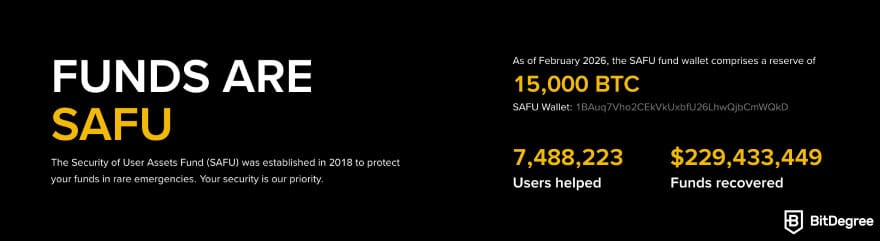
Binance brings strong account-level security features and a serious security operation to the table. It publishes Proof of Reserves, says user assets are backed 1:1 with additional reserves, and maintains SAFU (Secure Asset Fund for Users) as an emergency protection fund.
Still, Binance’s regulatory history is worth mentioning. Its 2023 US settlement was a major event, and it remains part of the trust conversation around the platform. The balanced version is this: Binance has one of the strongest products and security infrastructures, but it also brings a heavier regulatory history than a simpler platform might.
📚 Read More: Is Binance Safe?
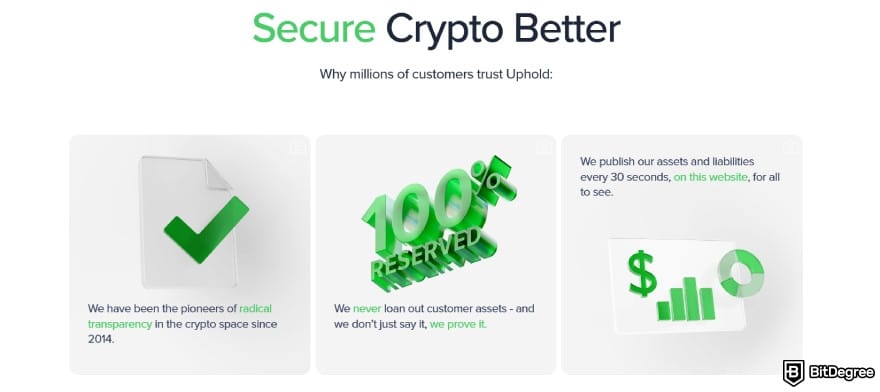
Uphold puts more emphasis on transparency. It publishes assets and liabilities in real time, while saying customer assets are always 100%+ reserved. The platform also states that it doesn’t loan out customer funds unless the user has specifically chosen staking or DeFi lending.
Vault is another standout feature. It’s an assisted self-custody system built around three keys, with any two required to authorize asset transfers. The user controls two keys, while Uphold keeps the third for co-signing and key recovery support. In practice, it bridges the gap between self-custody and the convenience of using an exchange.
📚 Read More: Is Uphold Safe?
Uphold’s regulatory setup also spans three jurisdictions: the FCA in the UK, FinCEN in the US, and the FCIS in Europe. On top of that, its risk team includes former financial regulators and state prosecutors, which isn't a casual staffing choice and says something about its compliance focus.
Verdict
Binance has more exchange-grade security infrastructure and a broader protection toolkit. Uphold makes the better case on transparency, regulatory oversight, and assisted self-custody through Vault.
Binance vs Uphold – Broader Ecosystem
Neither platform is just a “press buy and move on” app anymore. Binance has turned into a sprawling crypto ecosystem. Uphold has become a cleaner multi-asset finance app. Both have moved past basic trading, just not in the same direction.
Uphold's Other Features
Uphold's extra features are tightly built around its multi-asset, lower-maintenance identity. The main ones include:
1
Vault
Vault is Uphold’s approach to self-custody for Bitcoin and XRP. It uses a 2-of-3 multi-signature setup, where users keep two keys and Uphold holds the third, while a key-replacement service helps recover access if a key is ever lost.
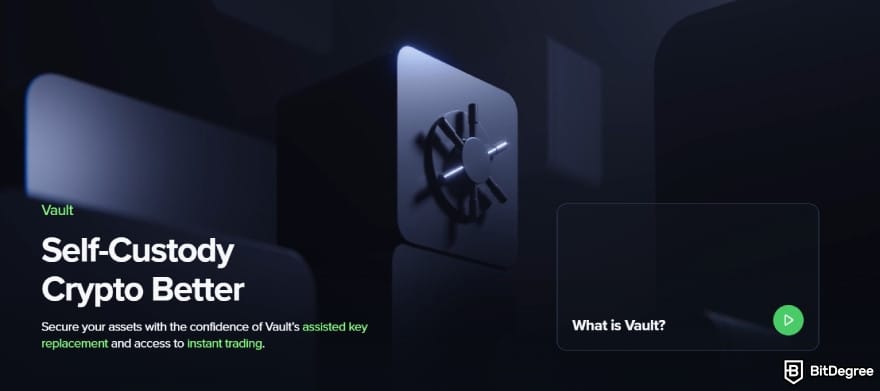
The idea is to give users more flexibility. They can keep assets fully custodial inside Uphold’s wallet or choose assisted self-custody through Vault. Either way, Vault does come with a subscription cost, available through monthly or annual plans.
2
USD Interest Account
Available to US users, this account offers up to 5% APY on balances over $1,000 (2% below that threshold). There are no lockups, minimum deposits, or monthly fees, and balances are FDIC-insured up to $2.5 million, making it a solid option for idle cash.
3
Staking
Uphold supports staking on more than 15 digital assets, including ADA, DOT, and SUI. It offers two staking options: flexible staking, where rewards are paid automatically each week and assets can be sold anytime, and boosted staking, which offers higher rewards but includes lockup periods.
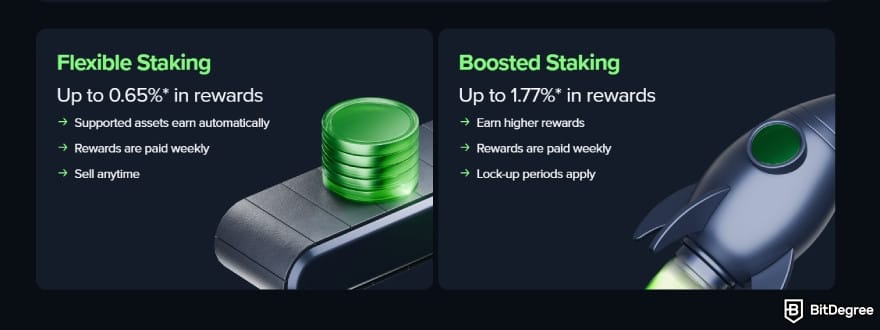
Just note that staking isn’t available in several regions, potentially including the US, UK, EU, or Canada, which limits its usefulness quite a bit. Uphold also takes a commission from staking rewards, depending on the asset being staked.
4
Wallet and Card
Uphold also offers a self-custody, multichain Web3 wallet that supports BTC, ETH, XRP, ERC-20 tokens, and NFTs, with WalletConnect for plugging into DeFi apps. In certain regions, users can also apply for the Uphold Card, a Mastercard debit card with cashback rewards and no foreign transaction fees.
5
Uphold for Business
Uphold for Business targets companies that want crypto financial tools without taking on the fun little project of building everything themselves. It supports use cases like accepting crypto payments, paying vendors or employees in crypto, and managing treasury balances across multiple asset types.
Binance's Other Features
Binance's ecosystem is, unsurprisingly, much larger in scope. Its main extra features include:
1
Earn products
Binance Earn is one of the industry’s broadest passive crypto hubs. It includes Simple Earn, locked products, staking options, Advanced Earn, Dual Investment, On-chain Yields, and other structured products. If you want access to more than 300 supported assets, that range of coins is a major plus.
2
Launch and reward products
Binance goes a step further with several features aimed at users who want exposure to new token launches and reward-based campaigns.
Launchpool lets users lock supported tokens and receive airdrops from new projects, while Megadrop combines Earn participation with Web3 tasks for early access to selected token launches. HODLer Airdrops reward existing BNB holders based on their historical balances.
3
Payments and spending
Binance Pay adds another practical layer to the ecosystem. It supports more than 100 cryptocurrencies for peer-to-peer transfers, QR payments, and merchant transactions, with most everyday personal use remaining fee-free.
4
Web3 features
Binance Wallet is the ecosystem’s doorway into DeFi, dApps, swaps, and multi-chain Web3 activity. Binance describes it as a keyless, seedless, multi-chain wallet built with MPC technology, but users should still understand that Web3 comes with its own risks outside the centralized exchange.
5
Education, research, and community
Binance Academy offers free structured courses in more than 10 languages, complete with a learn-and-earn quiz feature, while Binance Research and Binance Square round things out with market analysis and a social, write-to-earn content layer.

Binance also has a few extras worth mentioning: an NFT marketplace, a mining pool for combining hashrate, and even an AI-assisted trading agent that lets users describe a strategy in plain language. These won’t matter to most users, but they show how far the platform has expanded beyond a typical exchange.
Verdict
Binance’s non-trading ecosystem is massive (and still expanding). Uphold’s is smaller and more focused, but its features line up neatly with what its core audience is looking for.
Binance vs Uphold – Fiat Deposits and Withdrawals
Fiat access matters more than people sometimes admit. A platform can have great trading tools, but if getting money into your account is slow, expensive, or not supported where you live, the feature list gets a lot less exciting.
Binance generally has the broader fiat infrastructure, though it depends a lot on the region. In supported countries, users may have access to bank transfers, cards, P2P markets, and local payment options. When those rails are available, the platform becomes much easier to use.
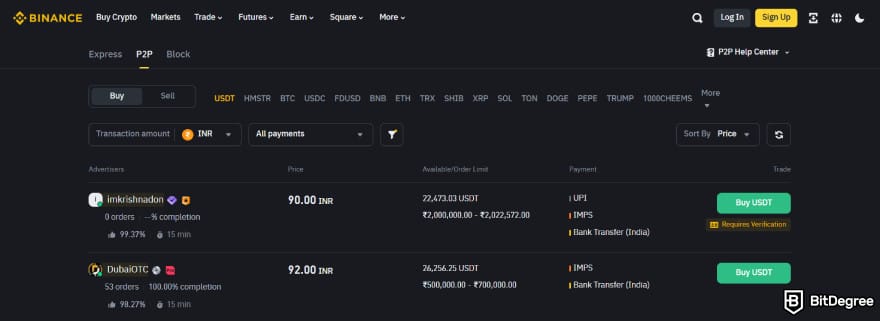
Uphold keeps the funding process simple, though the cost depends on your location and method. Card and digital wallet payments can be convenient, but they’re sometimes the pricier option. Bank transfers are usually the cheaper route, though they may take longer to process.
The same logic applies to withdrawals: check the method available in your place. A bank withdrawal, card withdrawal, and crypto withdrawal can each have different fees and processing times. The cheapest route in one country isn’t automatically the cheapest route in yours.
Verdict
Uphold’s fiat fees are usually easier to predict since they’re published as fixed rates. Binance’s costs vary more by region and method, often coming in cheaper where support is strong but less consistent overall.
Uphold Trading Walkthrough
Anything-to-anything trading is one of Uphold’s most distinctive features. To show how that works in practice, here’s what it looks like when you convert your money into Bitcoin:
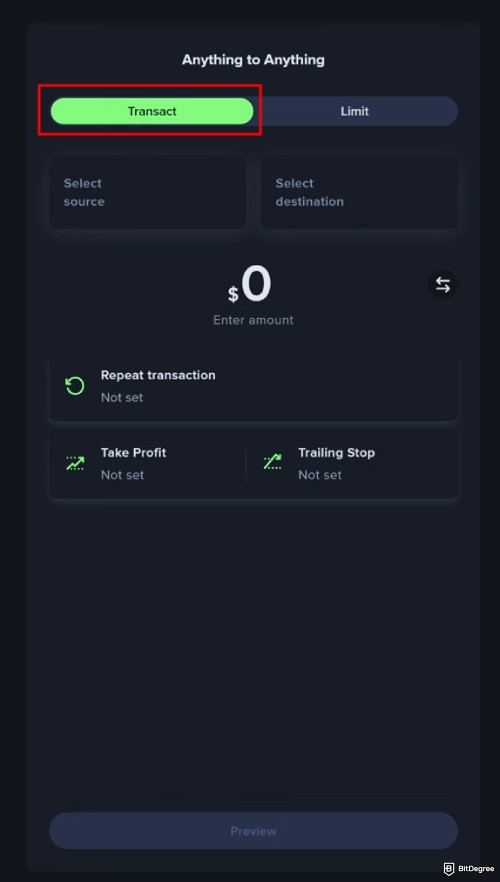
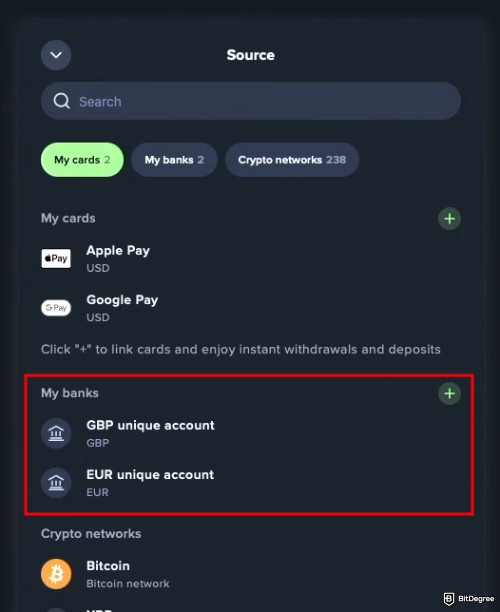
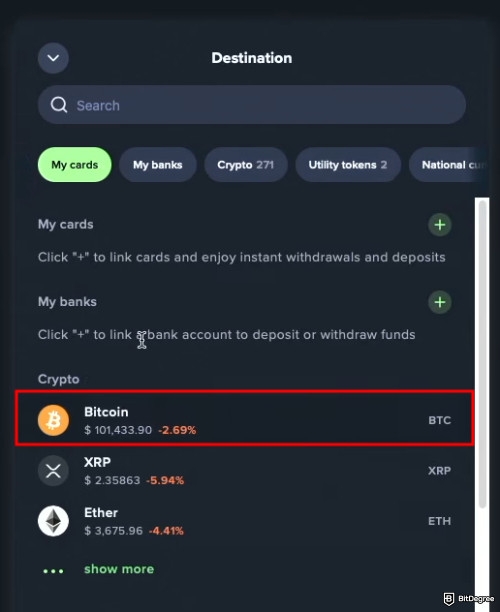
Uphold will preview the estimated BTC you'll receive and display the current exchange rate before you confirm the transaction.
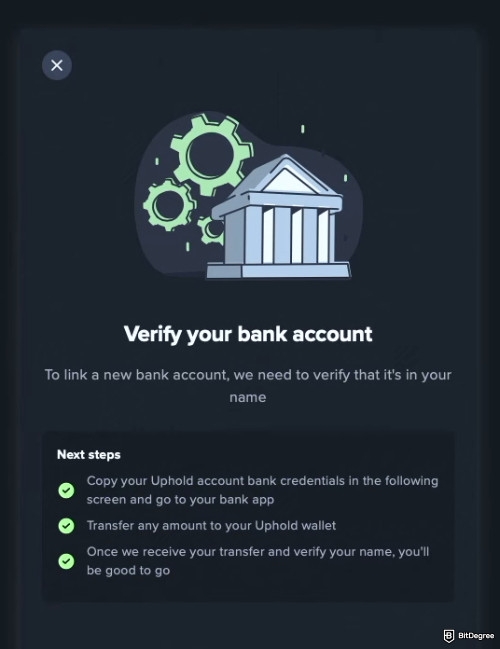
After sending the payment, Uphold will process the transaction. Funds are usually credited to your balance within 2-3 business days, depending on your bank’s processing time.
Binance Trading Walkthrough
Here's a simple look at a standard spot trade on Binance: buying Bitcoin with USDT:
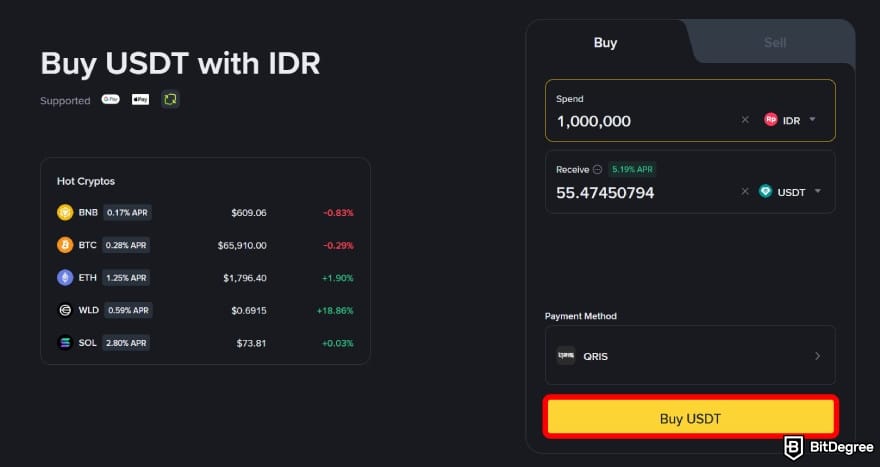
In this example, I'm using the "Quick Buy" option to purchase USDT using fiat currency.
![Binance vs Uphold: select [Spot].](https://assets.bitdegree.org/images/binance-vs-kucoin-spot.jpg "Binance vs Uphold: select [Spot].")
![Binance vs Uphold: choose [BTC/USDT] pair.](https://assets.bitdegree.org/images/binance-vs-kucoin-btcusdt.jpg "Binance vs Uphold: choose [BTC/USDT] pair.")
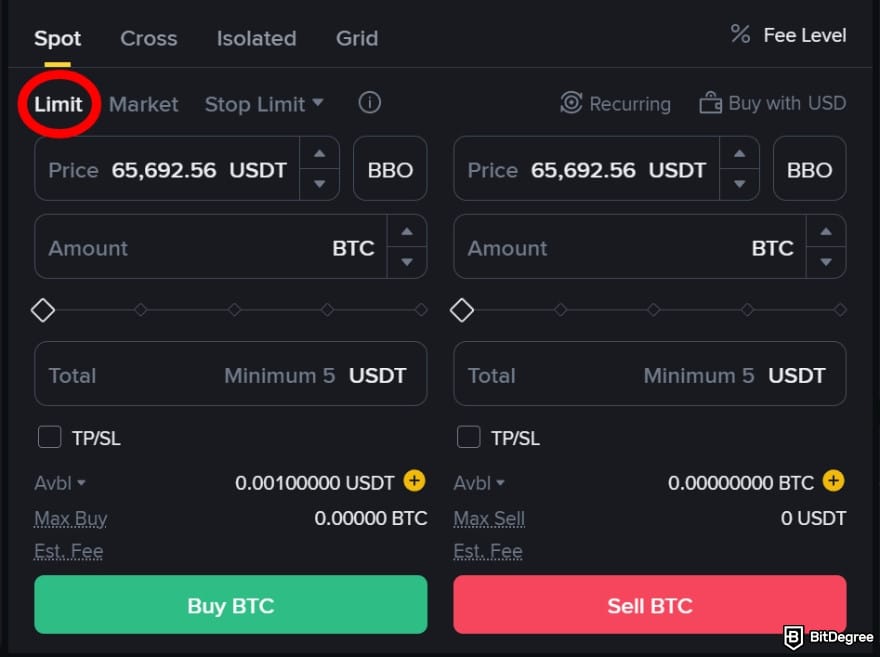
You can also use the percentage slider to automatically allocate 25%, 50%, 75%, or 100% of your available balance.
- Trading pair;
- Order type;
- Estimated price;
- Amount;
- Fees;
- Whether you are using BNB for fee discounts;
- Whether the order will execute instantly.
After you click [Buy BTC] to confirm the trade, a market order fills immediately. A limit order, meanwhile, remains open until the market reaches your selected price. You can check whether it was executed by reviewing your order history and your spot wallet.
Binance vs Uphold for Beginners
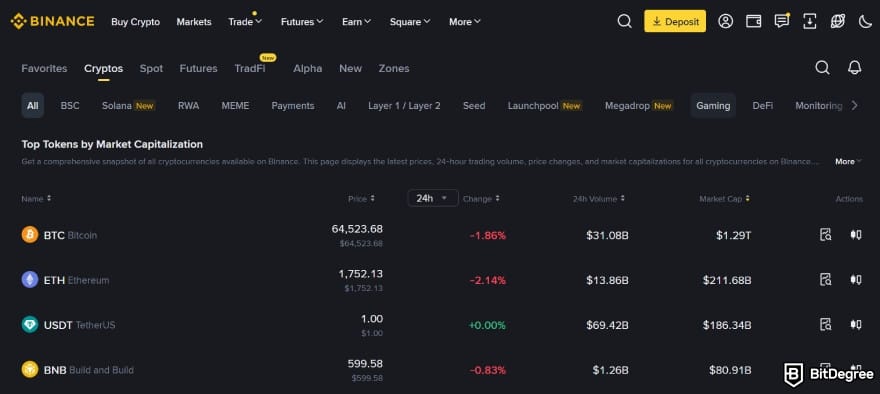
Binance takes a "grow into it" approach for beginners. Its Academy offers one of the largest free crypto education libraries around, and the platform provides a fairly natural progression from basic purchases to more advanced trading tools as users become more comfortable.
That depth comes with a trade-off, though. Binance gives users access to a huge range of products from the same platform, but the navigation can look busy once you start opening menus for feartres spot trading, futures, bots, Earn, and Web3 tools, which can get scary for beginner
Uphold takes a simpler route. Onboarding is usually quick, often wrapped up in around five minutes, and the dashboard is uncluttered. That friendlier design helps make the first-trade experience less intimidating, which matters more than people admit.
Recurring transactions make dollar-cost averaging almost automatic. The trade-offs are basic charting, no deep technical analysis tools, and noticeably higher trading fees than Binance. Still, for beginners who aren’t making many trades, that cost gap may not matter much.
VERDICT
Binance is the better pick if you’re planning to level up into advanced trading and don’t want high fees following you around from day one. Uphold is the better fit if you want the easiest starting point and a cleaner way to diversify assets.
Binance vs Uphold for Active Traders
If you're an active trader, this is probably the least controversial part of the comparison. Binance has the edge with lower fees, deeper liquidity, more order types, better market infrastructure, futures, options, margin, bots, APIs, and a broader professional toolkit.
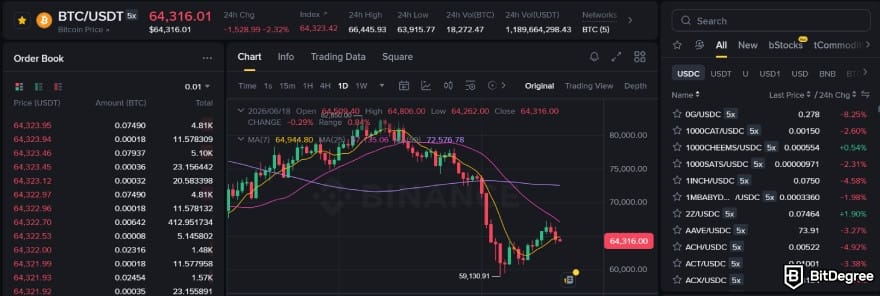
Those advantages aren't just there to make the feature list look busy. If you trade often, they can make a real difference to cost, execution quality, and overall flexibility. An active trader would likely lean toward Binance if they:
- Rely on margin, futures, or options to express a view on price movement;
- Want trading bots or copy trading to automate part of their strategy;
- Trade frequently enough that tight spreads and deep liquidity meaningfully affect returns;
- Plan to scale up volume and want fees to drop accordingly through VIP tiers or BNB discounts.
An active trader might still find a use for Uphold if they:
- Want to diversify into forex or precious metals without opening a separate brokerage account;
- Prefer leaning on take-profit and trailing-stop automation over constantly watching charts;
- Trade infrequently enough that Uphold's higher per-trade fee doesn't meaningfully add up.
That said, it depends on what kind of “active” user we’re talking about. If you’re actively managing a broader portfolio across crypto, equities, metals, and forex, Uphold’s Anything to Anything feature can remove a lot of the friction you’d normally get from moving between separate platforms.
Note
Binance is where active traders are more likely to land. Uphold can still help if you want occasional exposure to non-crypto assets, but it’s not built for the speed, leverage, or low-cost grind that frequent trading usually demands.
Binance vs Uphold for Passive Users
For passive users, the buy-and-hold, occasional rebalancing crowd, this comparison becomes much closer.
Binance Earn has the advantage in raw coverage, with flexible and locked products, Dual Investment, and on-chain yield options spanning more than 300 supported assets. For users who want lots of crypto-specific ways to earn on idle assets, there’s just more available here.
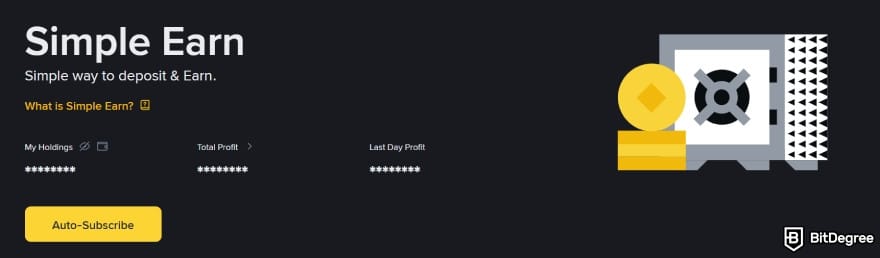
Uphold’s appeal is a little different. Its USD Interest Account offers FDIC-insured, fee-free returns, and recurring transactions take care of the “invest regularly without overthinking it” part. If you want exposure beyond crypto, without turning your finances into an account-juggling routine, the platform structure makes a lot of sense.
Verdict
Binance gives users more crypto-specific earning products to choose from. Uphold’s counter is a useful insured cash option and an easier path to multi-asset diversification.
Final Verdict: Is Binance or Uphold Better?
If trading is the goal, in pretty much any form, Binance is the stronger pick. It offers deeper liquidity, lower fees, and a product range that stretches from simple spot trades to leveraged derivatives. For anyone who wants the most complete crypto-native toolkit, Binance is difficult to look past.
Uphold is the better choice for anyone who’d rather use one account for crypto, cash, and precious metals without constantly watching fees. It costs more per trade, and it isn’t built to compete with dedicated trading platforms, but for diversified, low-maintenance investing, it does its job well.
It’s worth keeping in mind that this doesn’t have to be an either-or choice. Plenty of people use Binance for active crypto trading and Uphold as a simpler account for managing multiple assets. For some readers, that split may make more sense than forcing one platform to do everything.