Key Takeaways
- BTCC offers perpetual futures trading across 380+ pairs with leverage of up to 250x on major pairs, including BTC/USDT and ETH/USDT;
- Futures trading fees start at 0.02% for makers and 0.06% for takers, with discounts available through the VIP program;
- BTCC futures trading is available to users worldwide, including traders in the US and Canada.

What do knowing your future and predicting Bitcoin's price have in common? Not much, except that both are equally uncertain, expensive, and somehow, always the topic that kills the mood at dinner. The good news, though, is that figuring out how to trade crypto futures is much more manageable as long as you start on the right platform.
Founded in 2011, BTCC is one of the longest-running crypto exchanges still active today. Built for both beginners and seasoned traders, it offers hundreds of futures contracts, high leverage options, and availability across many countries, including the US and Canada.
So, if you've been curious about it but never quite knew where to start, my crypto futures trading tutorial should help. We'll start with the basics and work our way toward opening a live position without making it weirdly complicated. Let's get into it!

Did you know?
Subscribe - We publish new crypto explainer videos every week!
Remittance Explained: Will This Newcomer Change the Game? (ANIMATED)

Table of Contents
- 1. Before You Start Trading Crypto Futures
- 1.1. Creating an Account
- 1.2. Completing Identity Verification (Optional)
- 1.3. Funding BTCC Account
- 2. How to Trade Crypto Futures on BTCC: Step-by-Step
- 2.1. Opening a Futures Position (USDT-M)
- 2.2. Opening a Futures Position (Coin-M)
- 2.3. Closing a Futures Position
- 3. BTCC Futures Trading Fees
- 4. Crypto Futures Explained
- 4.1. What Is Crypto Futures Trading
- 4.2. Crypto Futures VS Spot Trading
- 4.3. Understanding Margin and Leverage
- 5. Key Considerations Before Trading Futures
- 6. Conclusions
Before You Start Trading Crypto Futures
As tempting as it’d be to get straight to business and start learning how to trade crypto futures on BTCC, there are a few things you’ll want to prepare first. That said, if you’ve already set up and funded your account, you can skip this part and go straight to the trading steps.
Latest Changelly Coupon Found:Creating an Account
Every crypto futures trading for beginners guide has to start with creating an account, and this one’s no different. The process is fairly simple and shouldn’t take more than a few minutes.
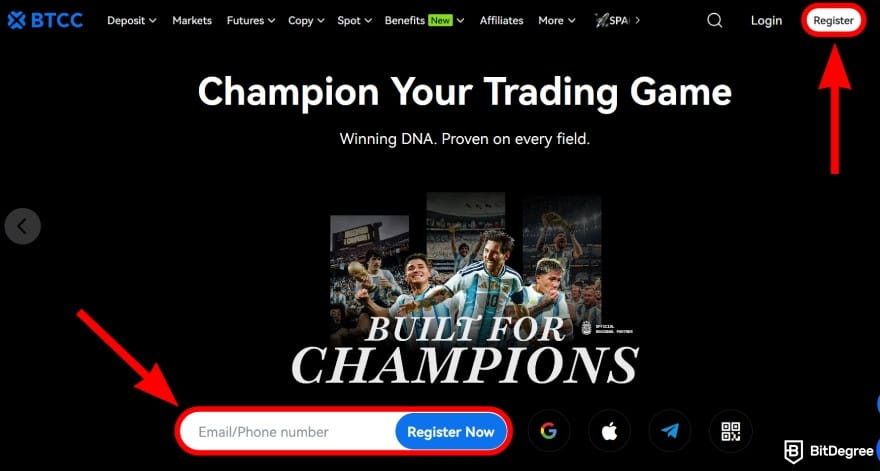
Alternatively, type your email or phone number into the registration box and click [Register Now] to continue.
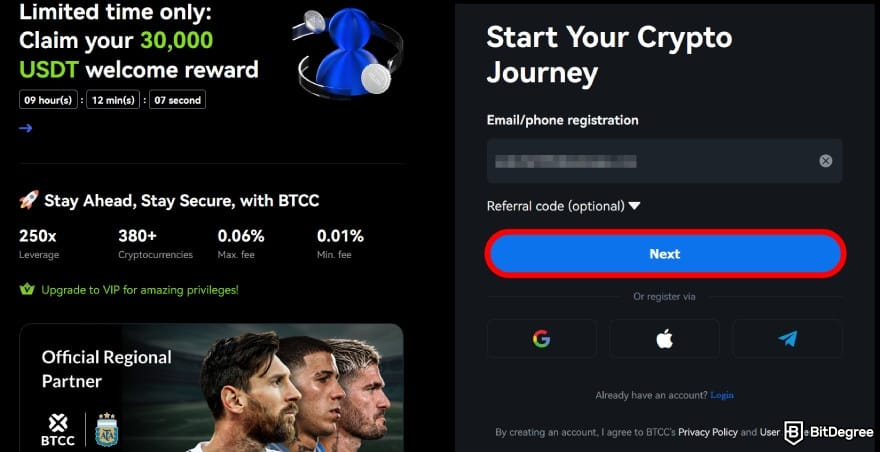
If you’ve got a referral code, add it to the provided field. Once that’s done, click [Next] to move forward.
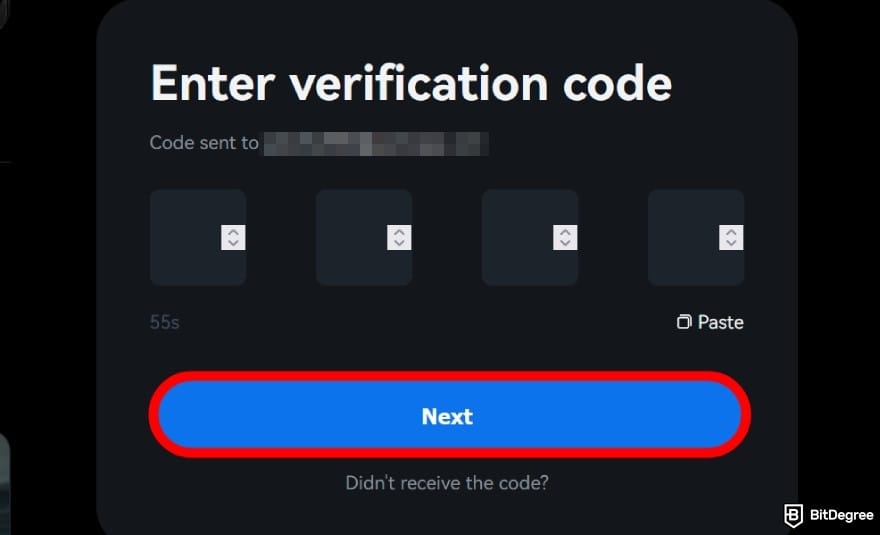
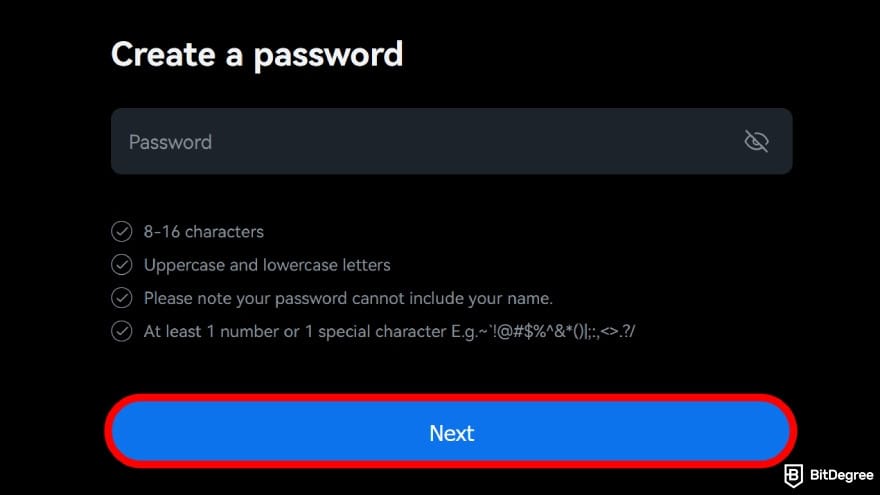
Once done, click [Next] to proceed.
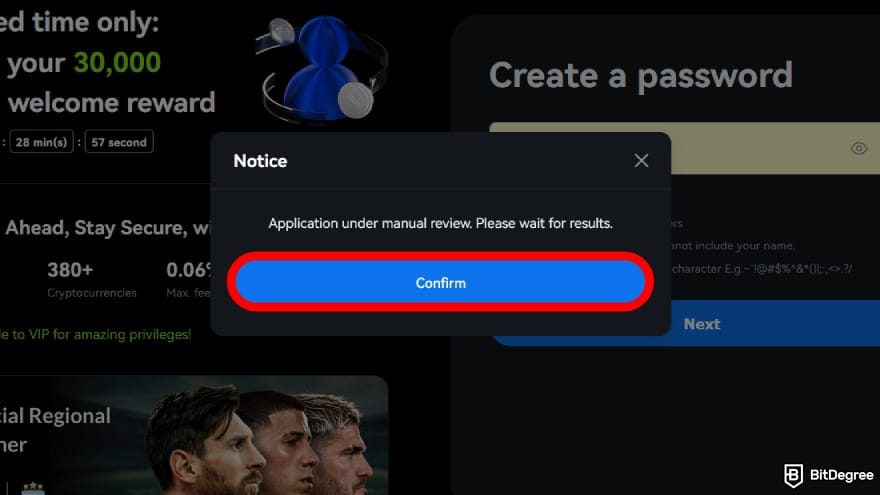
That’s it, your account’s ready to go!
Personally, I’d set up the optional security features straight away, including 2FA, withdrawal whitelists, and a fund password so you can focus on learning crypto futures trading without leaving your account wide open.
Completing Identity Verification (Optional)
BTCC is one of the few exchanges that lets you start trading without KYC verification. So yes, you can deposit funds and access the platform without having to prove your identity.
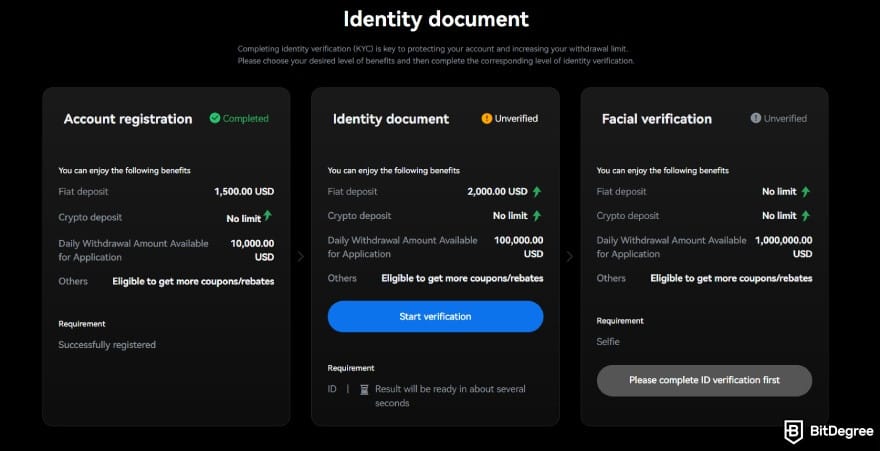
Still, I’d highly recommend completing KYC when you can. It unlocks additional account features, improves access to certain services, and enhances the security of your account.[1]
By completing identity verification on BTCC, you can unlock higher daily crypto withdrawal limits, gain access to fiat services, and qualify for referral bonuses or promotional campaigns.
At the time of writing this crypto futures trading for beginners guide, BTCC separates its identity verification process into two levels: document verification and facial verification. Before moving to facial verification, you’ll first need to pass the identity document check.
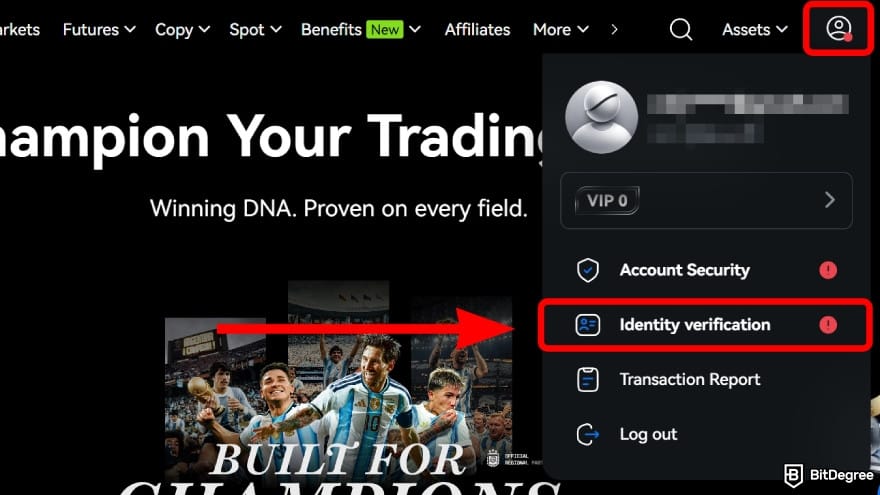
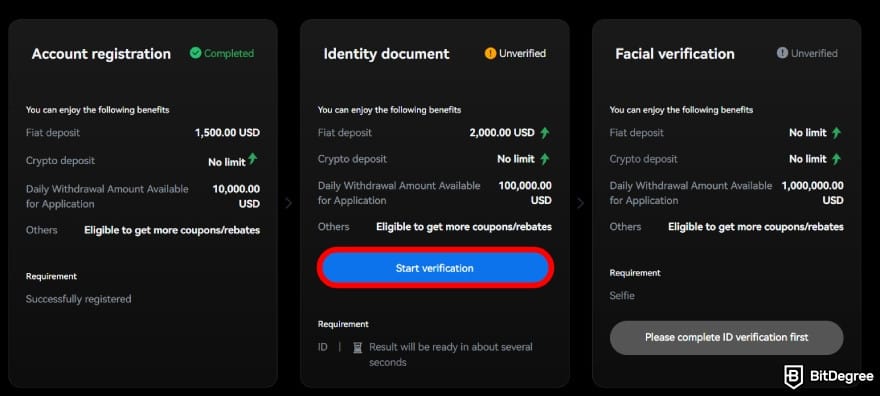
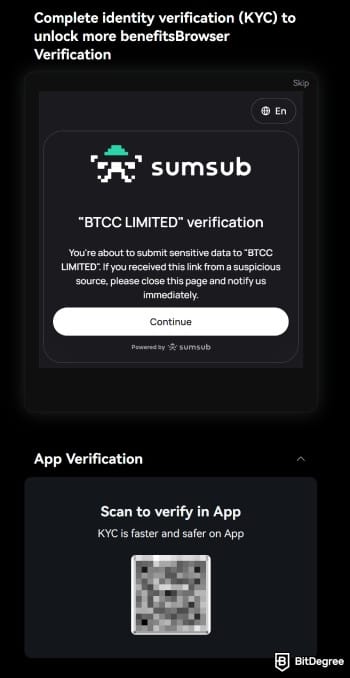
Personally, I’d recommend using your phone for the process because it’s usually faster and a bit more secure.
- Driver’s license
- ID card
- Residence permit
- Passport
Make sure the image is clear and that all information on the document can be read properly.
When the status updates to "Verified", it means you’ve successfully finished the entire process.
In most cases, the identity document and facial verification processes can be completed within a few seconds. If yours takes more than 5 minutes, it’s best to contact BTCC support via [Live Chat] and have them check what’s going on.
Funding BTCC Account
Before getting into how to trade crypto futures, you’ll first need to put some money into your account. The platform supports multiple deposit methods, including credit cards, debit cards, crypto, and bank transfers.
BTCC recommends depositing a minimum of 200 USDT to give yourself a more comfortable trading balance and help you level up to VIP 1.
For this tutorial, let’s buy some crypto using a credit card and then move it into your BTCC account:
![How to trade crypto futures: access [Fiat Deposit].](https://assets.bitdegree.org/images/how-to-trade-crypto-futures-fiat.jpg "How to trade crypto futures: access [Fiat Deposit].")
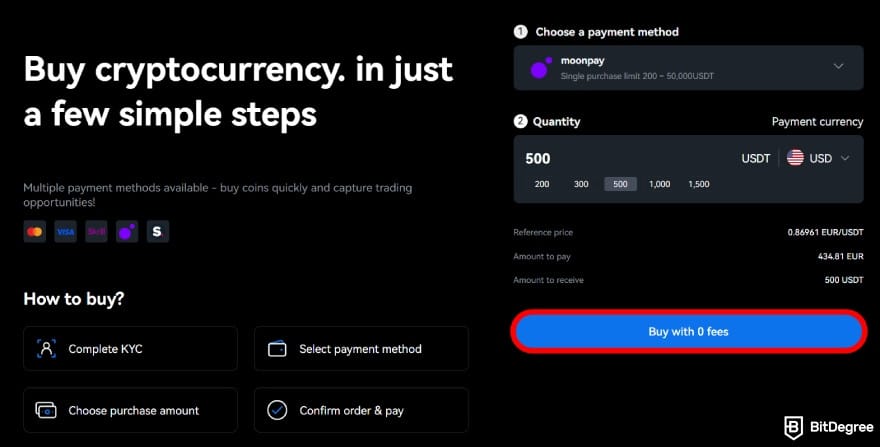
Once everything looks good, click the payment button to proceed with the transaction.
After the purchase goes through, your funds should arrive in your account within 2 to 30 minutes.
With the tokens now available in your account, you’re officially ready to start learning how to trade futures on the crypto exchange!
📚 Check Out: How to Use BTCC Exchange for Beginners?
Looking for more in-depth information on related topics? We have gathered similar articles for you to spare your time. Take a look!


How to Trade Crypto Futures on BTCC: Step-by-Step
There’s a reason BTCC often gets mentioned as one of the best crypto futures trading platforms for beginners. The interface stays clean and easy to navigate (whether you’re on desktop or mobile). It also gives you plenty of helpful guides to lean on when something doesn’t quite click.
BTCC offers a free demo trading mode with over 100,000 USDT in virtual funds, and I’d suggest trying it before putting any real money on the line.
On top of that, BTCC gives you access to more than 380 trading pairs, with new ones being added on a weekly basis. That includes all the major pairs you’d expect to find, such as BTC/USDT, ETH/USDT, SOL/USDT, XRP/USDT, and DOGE/USDT.
The platform also offers leverage of up to 250x, giving you more room to open larger positions with less upfront capital. And for traders in the US or Canada, BTCC is fully accessible and supports both USD and CAD.
Unlike traditional futures contracts that come with expiration dates, BTCC futures are perpetual. Your position stays active until you either close it manually or get liquidated.[2] You can choose between two types:
- USDT-M Perpetual Futures use USDT as collateral, settlement currency, and the basis for profit or loss calculations, which makes them easier for most beginners to follow.
- Coin-M Perpetual Futures use crypto (like BTC or ETH) as collateral, so your balance and profit or loss can move along with the asset’s price.
The steps below will walk you through both, starting with USDT-M.
Opening a Futures Position (USDT-M)
For anyone still getting familiar with crypto futures trading, opening a position simply means entering a trade. You choose an asset, decide whether you think the price will go up or down, and enter your position.

The easiest way to understand all this is probably to stop talking about theory and try it live. So let’s walk through how to trade BTC futures as an example.
![How to trade crypto futures: choose [USDT-M].](https://assets.bitdegree.org/images/how-to-use-crypto-exchange-for-beginners-futures.jpg "How to trade crypto futures: choose [USDT-M].")
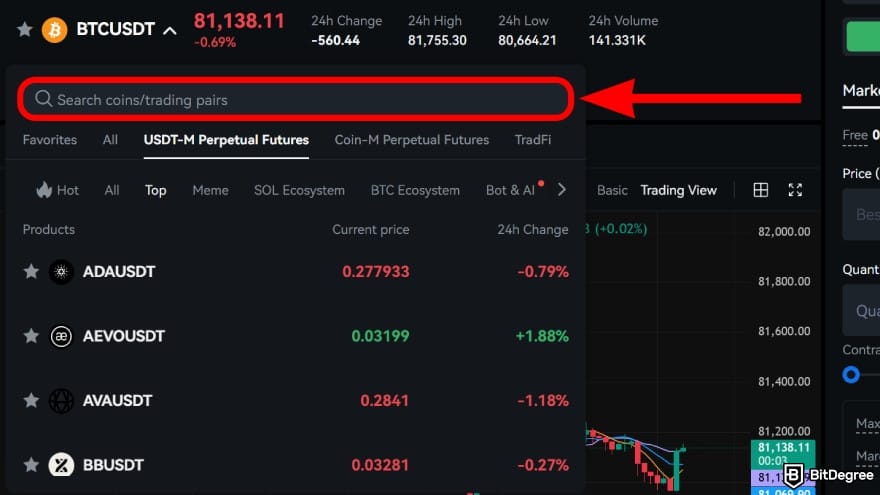
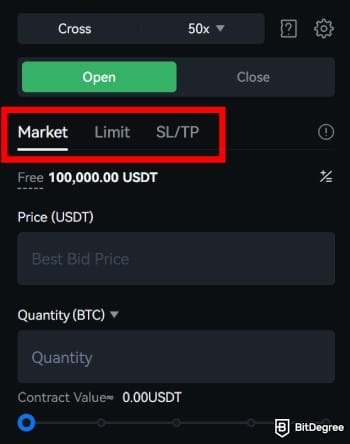
- Market Order executes immediately using the best available market price.
- Limit Order lets you set a specific price where you want the trade to execute.
- SL/TP Order helps automate trade entries or exits once certain price conditions are met.
For this example, choose [Market Order].
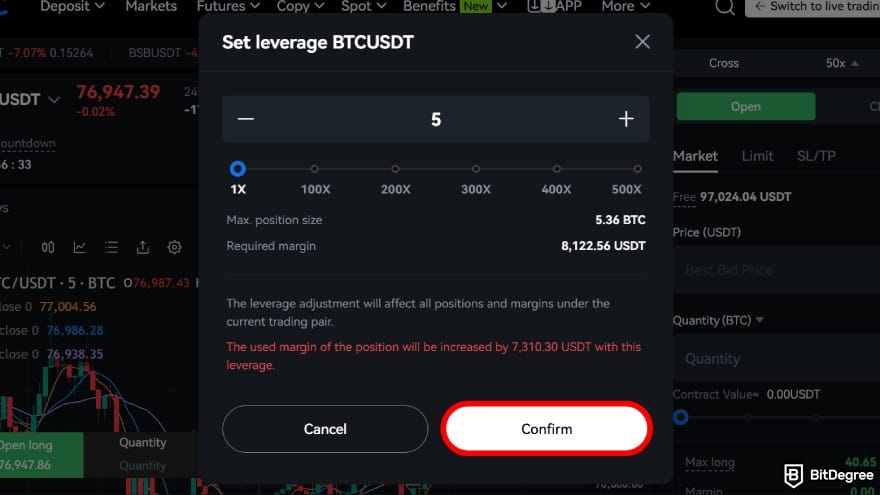
BTCC supports leverage of up to 250x, but if you’re still new, I wouldn’t recommend pushing anywhere near the extreme end. After choosing your leverage level, click [Confirm] to continue.
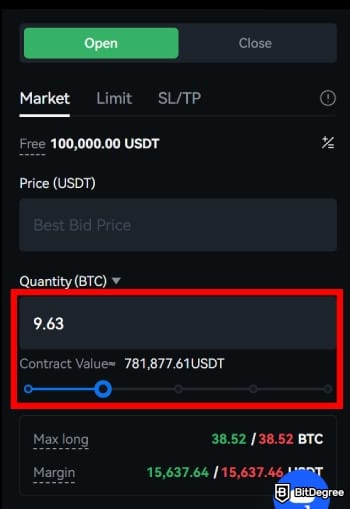
The contract value and required margin will change automatically based on the amount you set.
- Choose [Open Long] if you think the price will go up.
- Choose [Open Short] if you think the price will go down.
You can also set [TP/SL] so the platform can help secure profits or cut losses automatically.
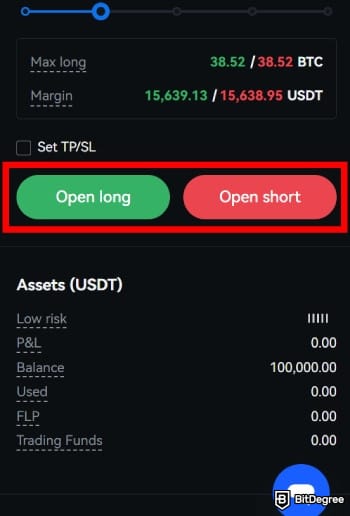
That’s it, now you understand how to trade BTC futures on BTCC with confidence!
Did you know?
Subscribe - We publish new crypto explainer videos every week!
What is a Crypto Mining Pool? Is it Worth it? (Beginner-Friendly)

Opening a Futures Position (Coin-M)
The process of opening a Coin-M position on BTCC follows roughly the same steps as USDT-M. Here’s how:
![How to trade crypto futures: open [Coin-M Perpetual Futures].](https://assets.bitdegree.org/images/how-to-trade-crypto-futures-coin-m.jpg "How to trade crypto futures: open [Coin-M Perpetual Futures].")
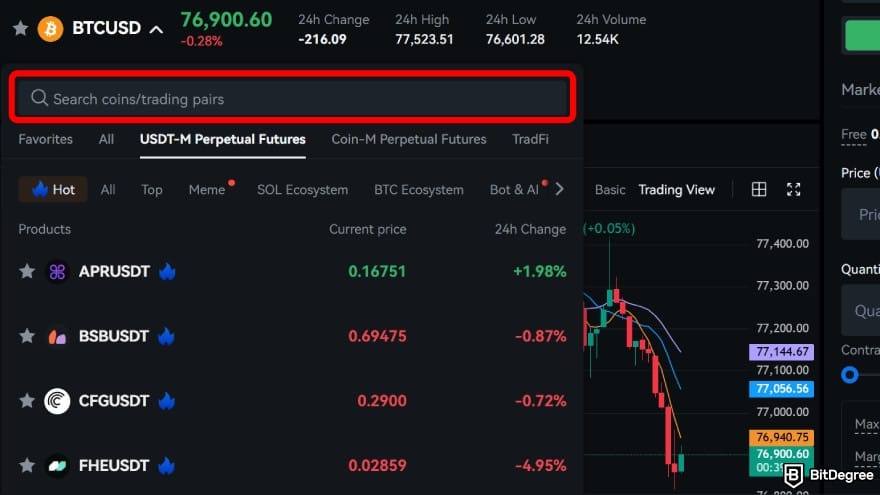
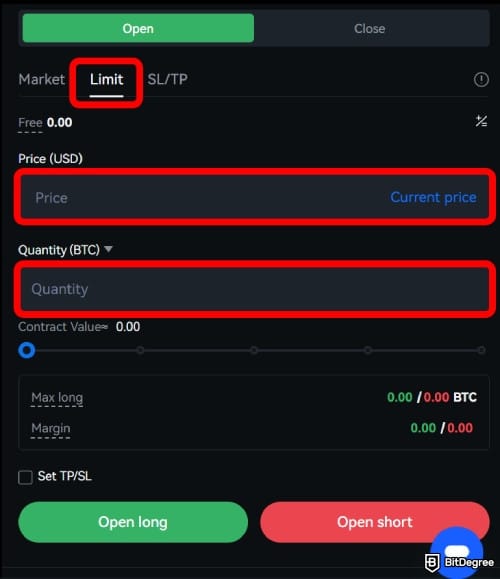
Once you’ve set your price and position size, you can proceed with either a long or short position based on your market outlook.
There you have it! Now that you know how Coin-M perpetual orders work, you’re getting closer to fully understanding how to trade crypto futures on BTCC.
Closing a Futures Position
Closing a position simply means completing the trade. When the timing makes sense, whether you’re securing profit, limiting a loss, or just done staring at the chart, you exit the contract and accept the outcome at that point.
![How to trade crypto futures: look for [Positions].](https://assets.bitdegree.org/images/how-to-trade-crypto-futures-history.jpg "How to trade crypto futures: look for [Positions].")
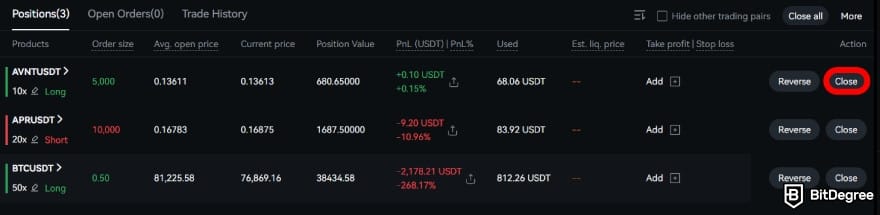
If you want to exit everything at once, use the [Close all] button at the top right of the "Positions" panel.
After closing, your completed trades move to the [Trade History] tab, where you can review the outcome, fees, and settlement details.
BTCC Futures Trading Fees
Fees are another important part to understand when you’re figuring out how to trade crypto futures. They aren’t always shown in the most obvious way, and some only appear in certain situations.
Here are some of the fees you may run into when trading futures on BTCC:
Fee Type | Rate |
|---|---|
Deposit fee | Free |
Maker fee | 0.02% (VIP 0) down to 0.010% (VIP 7) |
Taker fee | 0.06% (VIP 0) down to 0.015% (VIP 7) |
Funding rate | Variable, every 8 hours |
Liquidation fee | 1% (major pairs) or 1.2% (all others) |
Withdrawal fee | Varies by asset, network, and method |
Table: BTCC futures trading fees
Here’s a more detailed breakdown:
- Deposit fee. BTCC doesn't charge anything to deposit funds into your account, whether you are transferring crypto from an external wallet or funding via card or bank transfer.
- Maker fee. This applies when you place a "Limit Order" that doesn't fill immediately. Because you are adding liquidity to the market, you are considered the "maker" and get the lower of the two trading fee rates.
- Taker fee. This applies when you place a "Market Order" that executes immediately against existing orders on the book. You are "taking" liquidity rather than adding it, which is why the rate is higher.

- Funding rate. It's an amount exchanged between traders holding long and short positions every 8 hours. Its purpose is to keep the perpetual futures price anchored to the spot market. Depending on market conditions, you either pay it or receive it.
- Liquidation fee. This only comes into play if your position gets forcibly closed by the platform. For major pairs like BTC/USDT, ETH/USDT, SOL/USDT, and XRP/USDT, the rate is 1%. For all other products, it's 1.2%.
- Withdrawal fee. The amount depends on the method, asset, and blockchain network you choose.
Also, your maker and taker fees on BTCC can get lower over time through the platform’s VIP program. You qualify for higher tiers based on either your account balance or trading volume, whichever target you reach first.
VIP Level | Account Value (USDT) | 30D Futures Trading Volume (USDT) | Futures (Taker / Maker) |
|---|---|---|---|
0 | 0 | 0 | 0.060% / 0.020% |
1 | 200 | 0 | 0.060% / 0.020% |
2 | 10,000 | 5,000,000 | 0.042% / 0.018% |
3 | 50,000 | 30,000,000 | 0.040% / 0.017% |
4 | 200,000 | 100,000,000 | 0.030% / 0.016% |
5 | 1,000,000 | 300,000,000 | 0.025% / 0.015% |
6 | 2,000,000 | 500,000,000 | 0.020% / 0.012% |
7 | 3,000,000 | 1,000,000,000 | 0.015% / 0.010% |
Table: BTCC VIP Program
As your VIP level improves, you don’t just get lower futures trading fees. BTCC also gives you additional perks, including larger daily withdrawal limits, stronger coupon coverage rates, and discounted withdrawal fees.
Crypto Futures Explained
By this point, you should have a solid picture of how to trade crypto futures on BTCC from a practical standpoint. But if you’re starting from zero or need the concepts cleaned up a bit, here’s a quick refresher.
What Is Crypto Futures Trading
Futures trading is a type of financial contract that lets you speculate on the future price of a token without owning or storing the asset in a wallet. In simple terms, you’re not buying the asset itself, but entering a contract based on where you think its price is headed.

These contracts create an agreement to buy or sell the asset at a predetermined price in the future. For example, if Bitcoin is sitting at $80,000 today and you open a futures contract expecting it to rise, you’ll profit if it does and lose money if it doesn’t.
If you’re still new, that concept can sound a bit strange at first. After all, why bother with a contract based on Bitcoin’s price when you could just buy BTC itself?
That is a fair point. But let’s say you were convinced Bitcoin’s price was about to drop. Maybe a regulatory announcement just shook the market, or broader conditions suddenly started looking unstable. Buying BTC at that moment would be walking straight into a loss.
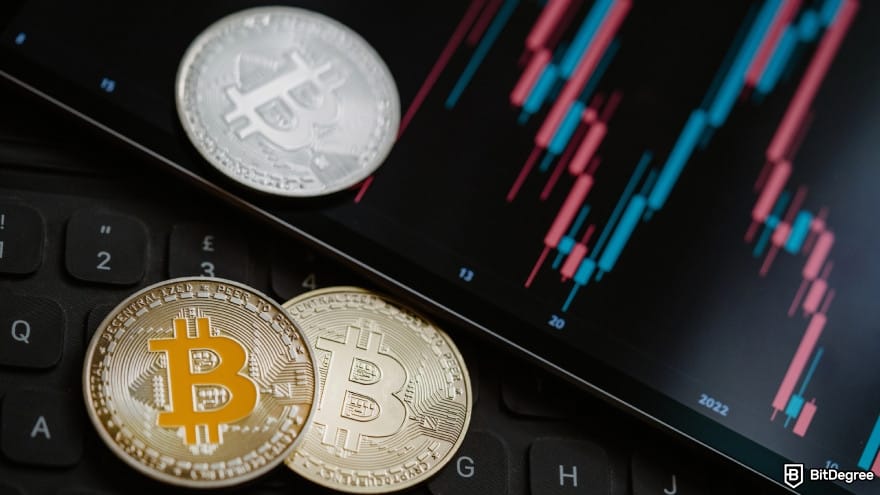
With futures, you can act on that prediction. By opening a short position, you are essentially betting that the price will fall. If it does, you profit from the decline even though the asset itself lost value.
Futures can also work as a hedging tool. If you already hold a decent amount of Bitcoin and you’re worried about a short-term price drop, opening a short futures position can help offset potential portfolio losses.
Some traders use futures to earn funding payments without taking a strong bet on whether the price goes up or down.
Crypto Futures VS Spot Trading
Another thing beginners constantly ask about is the difference between crypto futures vs spot trading. Both give you exposure to the crypto market, but the mechanics and risks behind them are quite different.
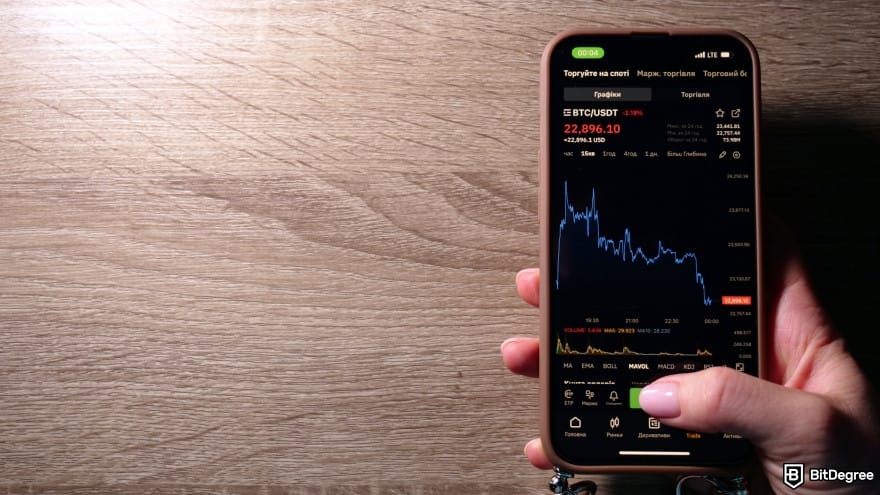
Spot trading is the more intuitive starting point. You buy the crypto directly on the market at its current price, the asset transfers to your ownership, and you hold it in your wallet for as long as you want.
With futures, you’re not buying the crypto outright. You’re entering a contract that follows its price, so you can gain exposure to the asset’s movement without holding it. No ownership changes hands, no wallet storage is needed, and settlement happens in cash or a stablecoin.
To make the differences easier to understand quickly, here’s a summary table comparing crypto futures vs spot trading:
Spot | Futures | |
|---|---|---|
What you own | The actual crypto asset | A price contract, no asset ownership |
Capital required | Full purchase price upfront | Margin only, rest borrowed via leverage |
Leverage | Not available | Available |
Storage | Self-custody or exchange wallet | Collateral held by the exchange |
Risk level | Lower risk, losses limited to what you put in | Higher risk due to leverage and potential liquidation |
Use Case | Long-term holding, payments, portfolio building | Hedging, shorting, short-term speculation |
Table: Spot trading vs futures trading
In short, spot trading is the more straightforward option. You buy the asset, it transfers to you, and you hold it. There are no margin calls, no leverage, and no risk of a forced liquidation.
That said, neither approach is objectively better than the other. It comes down to your goals, your risk appetite, and your time horizon. Plenty of experienced traders use both at the same time, holding spot positions for the long run while using futures to hedge against short-term volatility.

- Accepts fiat currencies
- Simple to use
- Supports only trusted cryptocurrencies
- A leading cryptocurrency exchange platform
- Best for all type investors
- Accepts fiat currencies

- Industry-leading security
- Accepts fiat currencies
- Advanced trading tools
- Industry-leading security
- Strong regulatory reputation
- Advanced trading tools

- Wide range of tradable assets
- Robust copy trading feature
- Flawless security record
Understanding Margin and Leverage
Before you place your first futures trade, there are two terms you’ll keep running into: margin and leverage. They’re connected, but they aren’t the same thing, and understanding the difference matters a lot when you’re learning crypto futures trading as a beginner.

Margin is the amount of your funds you put up to open and hold a position. Think of it less like a payment and more like a security deposit. You’re not spending it immediately, but the exchange keeps it locked as collateral to help cover possible losses during the trade.
BTCC futures uses a cross-margin system, meaning your entire account balance works as shared collateral for all active positions.
Another topic that regularly confuses newcomers is how leverage works in crypto futures.
Basically, leverage lets you trade positions that are much larger than your actual account balance. You provide a portion of the funds as margin, and the exchange fills in the remaining exposure.
Let’s say you’re trading with 100 USDT at 10x leverage. Instead of only controlling 100 USDT worth of exposure, you’d be controlling a 1,000 USDT position (10 x 100 USDT). On BTCC, leverage goes as high as 250x on major pairs, which means 100 USDT could theoretically scale into a 25,000 USDT trade.

The appeal is obvious: bigger position, bigger potential profit from the same price movement. But the reverse is just as true. A 1% move against a 250x leveraged position doesn’t gently trim your balance.
Key Considerations Before Trading Futures
Before wrapping up this crypto futures trading tutorial for beginners, there are a few important things I want to add:
- Check your local regulations. BTCC is registered with FinCEN in the US and FINTRAC in Canada. However, crypto regulations can change depending on your state or province, so don’t skip the boring but important part: make sure futures trading is allowed in your location.
- Account for fees before you trade. Taker fees, funding rate payments, and withdrawal costs can seem pretty modest at first glance. But once leverage gets involved, those percentages are calculated against your full position value, not just your margin.

- Keep leverage within your risk tolerance. Just because the platform offers up to 250x leverage doesn’t mean you should treat it as an invitation. Most experienced traders stay well below that level because higher leverage means even smaller price moves can trigger liquidation.
- Know your collateral type. USDT-M positions use USDT as collateral, so your margin value stays stable regardless of market movement. Coin-M positions use the underlying crypto as collateral, which means your margin balance fluctuates alongside the asset price. Definitely consider this beforehand.
- Be careful with low-liquidity pairs. Popular pairs like BTC/USDT and ETH/USDT usually come with deep order books and tight spreads. Less popular pairs tend to be thinner, which can result in slippage, slower order execution, or even the possibility of delisting.
Now that BTCC futures have been explained in practical terms, you can approach the platform with a clearer understanding and better strategies.
📚 Check Out: BTCC Review
Browse our collection of the most thorough Crypto Exchange related articles, guides & tutorials. Always be in the know & make informed decisions!



Conclusions
And that is pretty much everything you need to get started. Hopefully, I’ve helped make crypto futures trading a lot easier to understand and avoid at least a few beginner mistakes along the way.
BTCC gives you a genuinely good place to start your futures trading prep and improve over time. You get a clean interface, a generous rewards structure, and a useful demo mode loaded with 100,000 USDT.
As for whether it’s truly the best crypto futures trading platform out there, I suppose there’s only one way to find out!
The content published on this website is not aimed to give any kind of financial, investment, trading, or any other form of advice. BitDegree.org does not endorse or suggest you to buy, sell or hold any kind of cryptocurrency. Before making financial investment decisions, do consult your financial advisor.
Scientific References
1. Thommandru A., Chakka D. B.: ‘Recalibrating the Banking Sector with Blockchain Technology for Effective Anti-Money Laundering Compliances by Banks’;
2. Neubert M., Rams W., Gruhn P.: ‘Cryptocurrency Perpetual Futures and Swaps: A Systematic Literature Review’.
About Article's Experts & Analysts