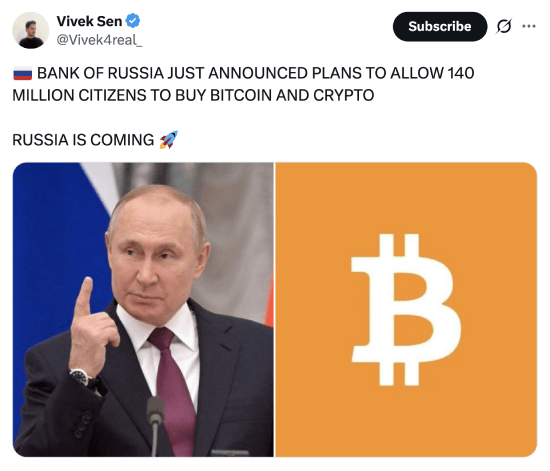
| You know when something's technically "not allowed," but everyone's been doing it for years anyway? At first, authorities ignore it. Then they warn about it. Eventually, they stop pretending and show up with rules. That's the phase crypto just entered in Russia. Bank of Russia put forward a framework that would allow regular people - not just wealthy or 'qualified' investors - to legally buy cryptocurrency inside Russia. That's new. Crypto has existed in Russia for years, but mostly in a gray zone. Not fully legal. Not fully banned. Now the central bank is saying: "We're gonna formalize this." Not in a wild, open-door way. More like: 👉 There will be rules. 👉 There will be limits. 👉 There will be checks on who's buying what. But still - this is the first time the door is being opened on purpose for everyday people. Now, Russia didn't wake up one morning and suddenly fall in love with crypto. What changed is pressure. Sanctions, restricted access to parts of the global financial system, and tighter controls on money flows have forced policymakers to rethink tools they used to treat as inconvenient or risky. Translation: crypto became useful to them. And when something becomes useful enough, governments stop arguing about whether it should exist and start deciding how they want it to exist. On the surface, this sounds like progress - and in some ways, it is. Bringing crypto into a regulated framework can mean: 👉 Clearer rules instead of rumors; 👉 Fewer shady intermediaries; 👉 Less "am I about to accidentally break the law?" anxiety. But there's another side to this coin. When a central bank designs the on-ramps, it also designs the visibility. Who buys. How much. Where it goes. What's allowed and what's not. So yes, crypto becomes more accessible, but it also becomes more contained. Zoom out a bit, and this story stops being about Russia and starts being about crypto's next phase globally. 👉 Crypto used to live in the "ignore it / mock it / ban it" stage. 👉 Now it's entering the "fine, we'll regulate it" stage. And regulation is a sign that something has become too real to dismiss. When central banks start designing retail rules, crypto becomes infrastructure. Not fully trusted. Not fully embraced. But officially acknowledged. Overall, this development doesn't mean crypto is free, safe, or endorsed. It means the era of pretending it's not there is ending. |