





Bybit vs Bitget — In-Depth Comparison
Bybit and Bitget are direct competitors in a way few exchange comparisons truly are. Both launched in 2018, both built their early identity around derivatives trading, both lean heavily on copy trading as a flagship feature, and both are unavailable to users in the United States. Unlike a comparison between a compliance-first platform and a trading-first one, this matchup is between two exchanges chasing the same active-trader audience with very similar toolkits.
Bybit is headquartered in Dubai and has garnered over 85 million registered users by June 2026. It has built a reputation as one of the top crypto exchanges by trading volume, with particular strength in derivatives trading and a growing emphasis on regulatory licensing.
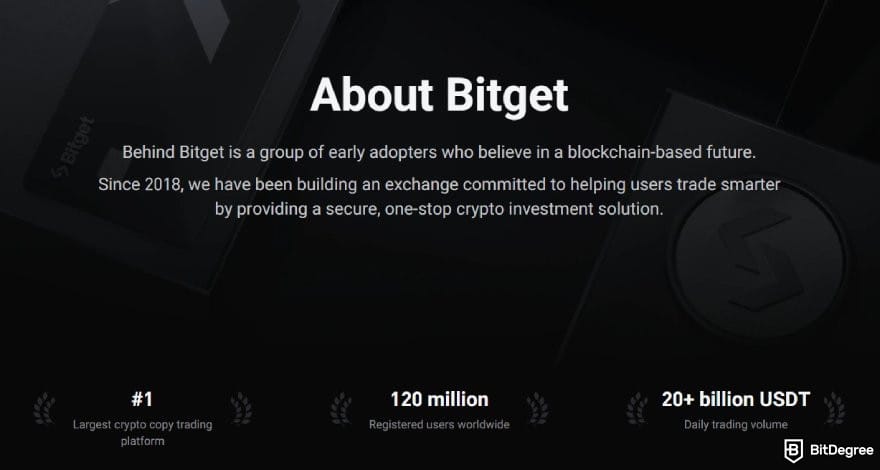
Bitget is headquartered in Seychelles and reported over 120 million registered users as of its most recent official figures. It is also one of the top crypto exchanges by trading volume, and has become especially known for the scale of its copy trading system and its push into tokenized stocks and multi-asset trading.
Bybit | Bitget | |
|---|---|---|
Best for | Active traders, derivatives users, copy trading | Active traders, copy trading, multi-asset traders |
Main strength | Derivatives depth, Unified Trading Account | Copy trading scale, tokenized stock access |
Headquarters | Dubai, UAE | Seychelles |
Registered users | 85 million+ | 120 million |
Available countries | 160+ | 150+ |
Table: Quick Bybit vs Bitget comparison
Because these two platforms target nearly identical users, the real differences in this comparison show up less in "who is this for" and more in execution detail.
Bybit vs Bitget — Market Position
Bybit entered the market in 2018 as a derivatives-focused exchange and grew primarily through word-of-mouth among professional and semi-professional traders who valued its execution quality and tight fee structure. That trading-first reputation has stuck. Bybit is broadly regarded within the active trading community as one of the most capable platforms available outside the US, particularly for perpetuals and futures.
Bitget followed a similar trajectory but built its early reputation more specifically around copy trading, positioning itself as the platform where newer traders could follow experienced ones rather than trade independently. That angle gave it a differentiated identity despite entering the same market at the same time as Bybit, and it has since expanded aggressively into broader trading products and multi-asset markets.
Bybit's advantages:
- Well-regarded among professional and active traders for derivatives execution and product depth;
- Strong regulatory progress in key regions, including MiCA (Austria) and UAE SCA licensing;
- Established community presence across trading-focused forums and communities globally.
Bitget's advantages:
- Larger registered user base, reaching 120 million users as of June 2026
- Built one of the largest copy trading ecosystems in the industry, with a broad base of lead traders and followers
- Growing presence in multi-asset trading through its TradFi product, covering tokenized stocks, ETFs, and commodities
Verdict
Bybit holds a stronger reputation among experienced traders, built on derivatives depth and execution quality. Bitget has reached a wider audience through its copy trading focus and multi-asset expansion. Both are credible, well-established platforms — the differences between them are in emphasis rather than fundamental capability.
Bybit vs Bitget — Trading Features
Because both platforms are built for active traders, the differences here are in execution detail rather than category coverage. Both offer spot, derivatives, copy trading, and bots. The distinctions are in how each is structured and where each platform has invested more depth.
Bybit Trading Features
For basic trading, Bybit offers:
- Spot trading with TradingView-powered charting;
- Convert for quick swaps between assets;
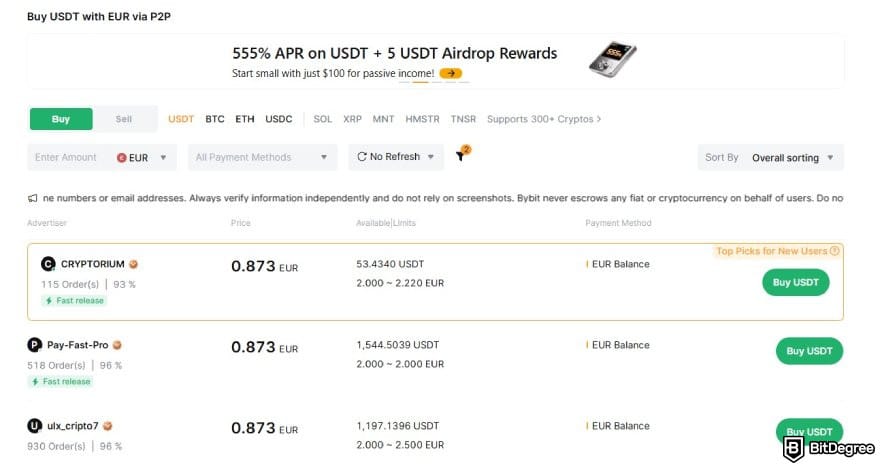
- P2P trading for direct user-to-user transactions;
- Demo trading to practice with simulated funds before committing real capital;
- Pre-market trading for select tokens ahead of official spot listing.
For advanced trading, Bybit supports:
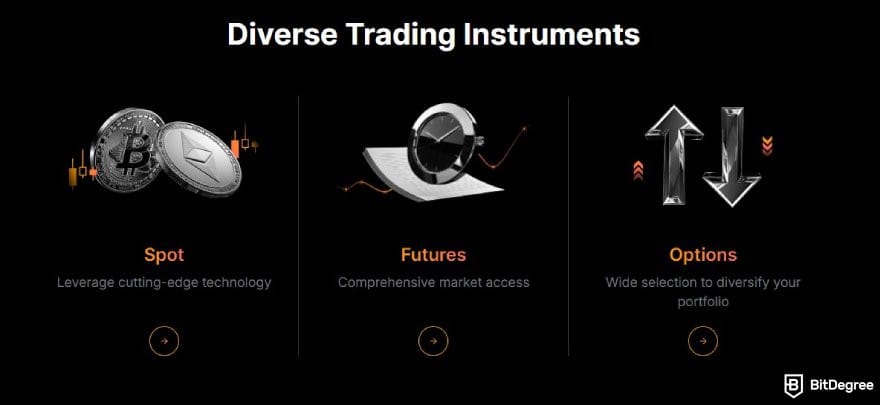
- Perpetual contracts for both USDT-margined and USDC-margined, across hundreds of pairs;
- Inverse contracts, margined in the base coin (e.g. BTC-margined for BTCUSD);
- Dated futures, which are expiry-based contracts alongside perpetuals;
- Options trading with European-style, cash-settled USDC options;
- Leveraged tokens, available within the Unified Trading Account;
- Up to 100x leverage on select perpetual contracts;
- Unified Trading Account (UTA), which consolidates spot, margin, derivatives, and options into a single account with shared collateral.
For automated and strategy-based trading, Bybit offers:
- Copy trading across three modes: Classic (spot and futures), Pro (strategy-style, opaque positions), and TradFi (mirroring traders in traditional market instruments using crypto as margin);
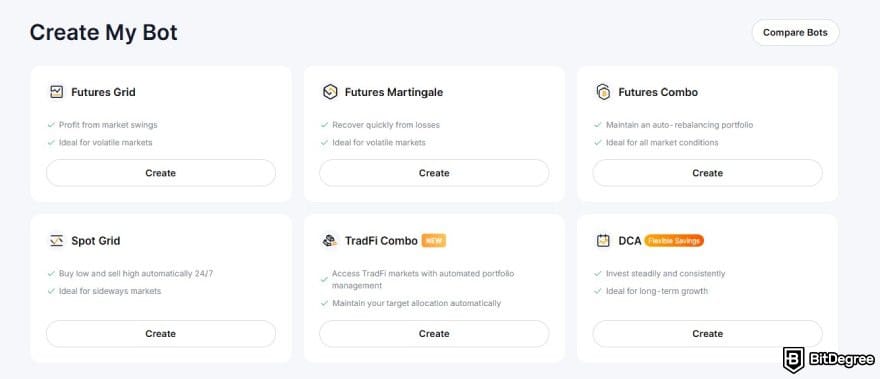
- Six native trading bot types, including Spot Grid, DCA, Futures Grid, Futures Martingale, Futures Combo, and TradFi Combo;
- TradFi access via MT5-style integration for indices, forex, and commodities in eligible regions;
- API trading with a V5 unified endpoint covering spot, derivatives, and options;
- AI Skills platform that allows AI agents, including ChatGPT and Claude, to execute trades through 253 API endpoints.
Bitget Trading Features
For basic trading, Bitget offers:
- Spot trading with TradingView charting integration;
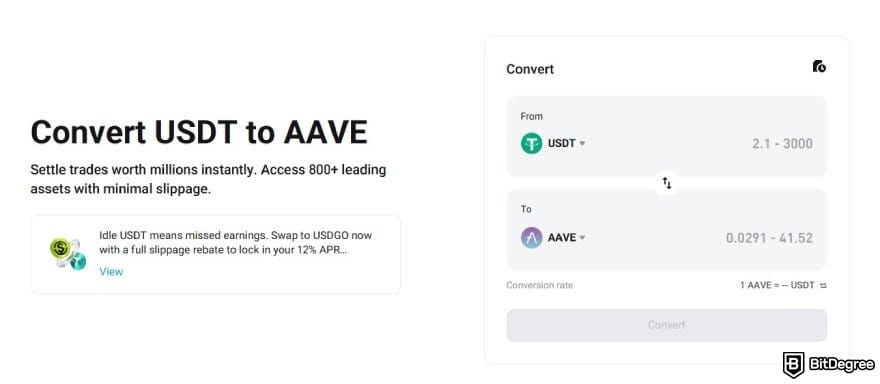
- Convert for quick swaps;
- P2P trading for direct user-to-user crypto purchases;
- Pre-market/OTC trading for tokens not yet listed on the main exchange.
For advanced trading, Bitget supports:
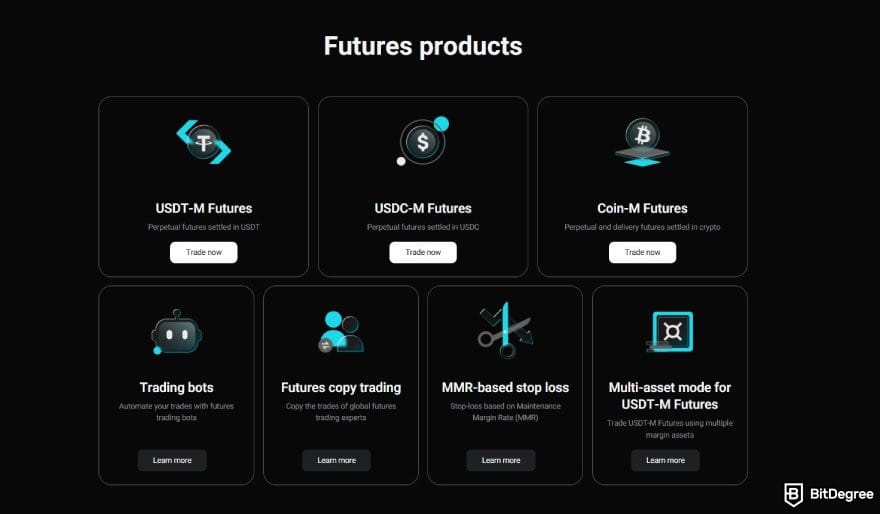
- Perpetual contracts covering USDT-margined, USDC-margined, and Coin-margined, across 660+ futures pairs;
- Delivery futures with expiry-based contracts;
- Margin trading, available across supported pairs;
- Up to 125x leverage on select trading pairs;
- TradFi allows users to trade tokenized stocks, gold CFDs, commodities, forex, and ETFs using USDT from the same account as crypto.
For automated and strategy-based trading, Bitget offers:
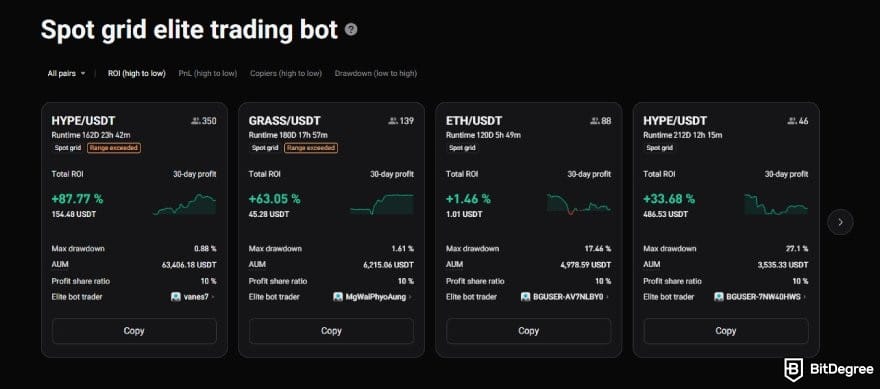
- Copy trading across three types: Spot Copy Trading, Futures Copy Trading, and Bot Copy Trading. The platform's copy trading ecosystem includes over 190,000 lead traders and over 1 million followers as of mid-2025;
- Native trading bots, including Spot Grid, Futures Grid, DCA, Martingale, trend-following bots, and AI bots;
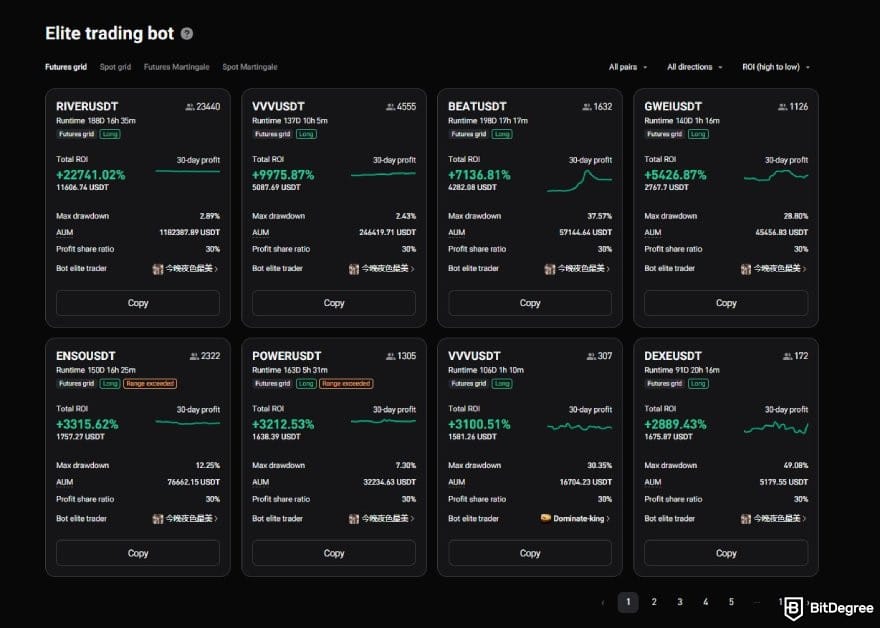
- Bot copy trading, a distinct mode where users copy automated grid or futures bot strategies rather than individual traders;
- Signal trading, where futures orders are triggered automatically via TradingView signals;
- API trading for algorithmic strategies;
- GetAgent, which is an AI-powered trading assistant, launched in mid-2025.
Verdict
Both platforms cover the same core territory. Bybit's clearest structural advantage is the Unified Trading Account, which simplifies margin management across multiple product types, and its demo trading feature for practicing strategies risk-free. Bitget's clearest advantage is the copy trading scale. Its 190,000+ lead trader pool and dedicated Bot Copy Trading mode go deeper than what Bybit offers. Bitget's TradFi product also provides more direct multi-asset access, while Bybit's TradFi integration is available through a more specific copy trading-based pathway. For traders who want derivatives depth and a unified account structure, Bybit has an edge. For traders who prioritize copy trading breadth and multi-asset access, Bitget pulls ahead.
Bybit vs Bitget — Fees
Both platforms use a maker-taker fee model and offer discounts through native tokens and VIP tiers. At the base level, their spot fees are identical, but the differences emerge when you factor in token discounts, futures fees, and how each platform's tier structure scales.
Bybit | Bitget | |
|---|---|---|
Spot trading fees (base) | 0.10% maker/0.10% taker | 0.10% maker/0.10% taker |
Futures trading fees (base) | 0.02% maker/0.055% taker | 0.02% maker/0.06% taker |
Native token discount | MNT (25% off spot and 10% off futures) | BGB (20% discount on spot fees) |
VIP program | Volume + asset balance + MNT holdings based | Volume + asset balance + BGB holdings based |
Table: Bybit vs Bitget base fee comparison
At the base level, spot fees are identical across both platforms. The distinction starts with native token discounts: Bybit's MNT gives 25% off spot fees and 10% off select futures contracts (USDT Perpetuals, USDT Expiry Contracts, and USDC Perpetuals, API trading excluded), while Bitget's BGB gives a flat 20% off spot fees with no equivalent futures discount at the base level.
This means Bybit's MNT discount is more broadly applicable across both spot and futures, while Bitget's BGB discount is spot-only at the standard tier. On futures, Bybit's base taker fee of 0.055% is marginally lower than Bitget's 0.06%. The gap is small but compounds for active futures traders.
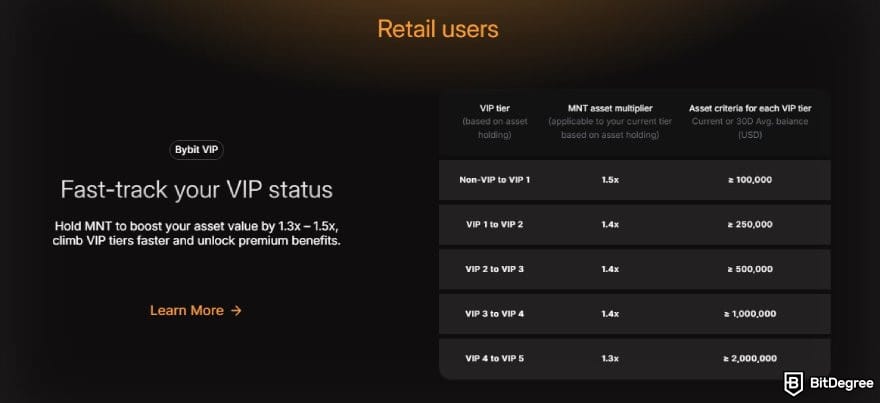
One additional consideration for Bybit users: crypto-fiat trading pairs (such as USDT/EUR) carry a separate, higher fee structure than crypto-crypto pairs. Bybit's own help documentation cites 0.15% maker / 0.20% taker as an example for USDT/EUR. Bitget does not have an equivalent crypto-fiat spot trading market, so this distinction only applies to Bybit users trading fiat-denominated pairs.
$1,000 Spot Trade Fee Comparison
A $1,000 market (taker) order on BTC/USDT, no token discount:
Bybit: $1,000 × 0.10% = $1.00
Bitget: $1,000 × 0.10% = $1.00
With native token discount applied:
Bybit (MNT): $1,000 × 0.075% = $0.75
Bitget (BGB): $1,000 × 0.08% = $0.80
Bybit's MNT discount gives a slight edge on spot when both tokens are held.
$1,000 Futures Trade Fee Comparison
A $1,000 BTCUSDT perpetual, round trip (open + close), taker on both legs, no token discount:
Open | Close | Total | |
|---|---|---|---|
Bybit | $0.55 | $0.55 | $1.10 |
Bitget | $0.60 | $0.60 | $1.20 |
Table: Bybit vs Bitget futures trading fees comparison
With MNT discount on Bybit (10% off):
Bybit: $1.10 × 0.90 = $0.99
Bitget has no equivalent native token discount for futures at the base tier.
Beyond trading fees, also factor in:
- Funding rates on perpetual positions are market-driven, not set by either exchange;
- Withdrawal fees vary by asset and network on both platforms;
- VIP tier thresholds on both platforms reduce fees significantly at higher tiers; check each platform's live fee schedule for current tier breakpoints;
- Bid-ask spread is not a listed fee, but it affects the true execution cost on market orders.
Verdict
Base fees are nearly identical. Bybit has a marginal edge on futures taker fees and offers a stronger native token discount package, 25% on spot and 10% on select futures with MNT, versus Bitget's 20% spot-only BGB discount. The practical difference for most retail traders is small, but Bybit's MNT discount covers more ground. Bybit users trading crypto-fiat pairs should note the higher fee tier that applies to those markets specifically.
Bybit vs Bitget — Liquidity & Execution
Because both platforms are derivatives-focused with similar user bases, liquidity is reasonably competitive across major pairs on both. The differences are in derivatives depth, asset breadth, and how each platform performs outside of top-tier pairs.
Bybit has deeper order books in derivatives, particularly for perpetual contracts. It has been in the derivatives market longer, and its user base is concentrated among active futures traders, which means more counterparty activity on major perpetual pairs. For BTC and ETH perpetuals, Bybit is consistently cited as one of the deepest venues outside of Binance. Bybit also lists over 2,000 tokens across all products, giving it a wider asset pool, though its spot-only selection is narrower at around 500 coins.
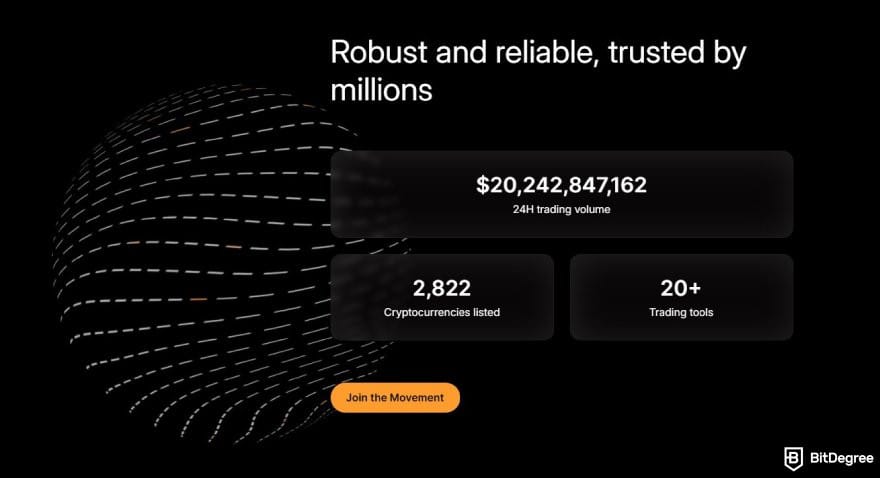
Bitget is more competitive in altcoin spot liquidity. With over 800 tokens on spot and more than 1,000 trading pairs, it lists more assets in the spot market than Bybit and has built liquidity across a wider range of smaller-cap coins. This makes it more useful for traders looking to access altcoins that aren't yet on Bybit's spot market. In derivatives, Bitget is a strong competitor but generally considered a step behind Bybit in raw order book depth on major perpetual pairs.
For most retail traders placing small to medium-sized orders on major pairs like BTC/USDT or ETH/USDT, the practical liquidity difference between the two platforms is unlikely to be noticeable. The gap becomes more relevant for larger position sizes, where Bybit's deeper derivatives order books reduce slippage risk, and for altcoin traders, where Bitget's broader spot listing pool may offer access to assets Bybit doesn't carry.
Verdict
Bybit has the stronger derivatives liquidity profile, particularly for major perpetual pairs, where its order book depth and long-established trader base give it an edge. Bitget is more competitive in altcoin spot liquidity, with a wider coin selection and more spot trading pairs. For standard retail order sizes on major pairs, both platforms execute reliably.
Bybit vs Bitget — Security & Trust
Both platforms offer a similar baseline of account-level security features, but they have meaningfully different track records and approaches to transparency.
Bybit | Bitget | |
|---|---|---|
Two-factor authentication | ✓ | ✓ |
Anti-phishing code | ✓ | ✓ |
Withdrawal address whitelist | ✓ | ✓ |
Cold storage | ✓ | ✓ |
TEE/TSS key management | ✓ | Not publicly confirmed |
Proof of Reserves | Monthly, Merkle tree, attested by Hacken | Monthly, Merkle tree, user-verifiable via MerkleValidator |
Most recent PoR ratio | 100%+ (post-hack, per monthly reports) | 130% (April 2026) |
Protection/insurance fund | Derivatives insurance fund (size not publicly disclosed) | 6,500 BTC Protection Fund (~$451M average, March 2026) |
Table: Bybit vs Bitget security feature comparison
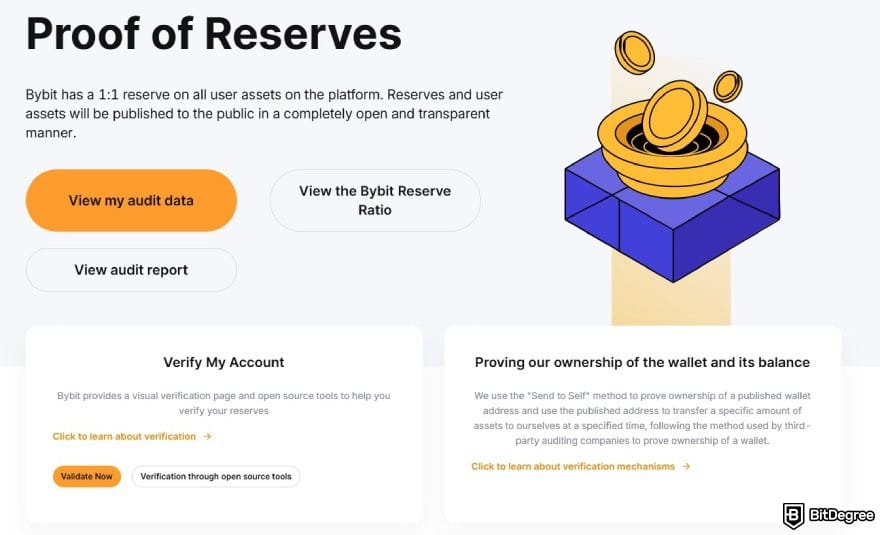
Bybit stores the majority of user assets in multi-signature cold wallets with additional protection through Trusted Execution Environments (TEE) and Threshold Signature Schemes (TSS), which split private key material across multiple parties so no single point of failure can authorize a transfer.
On the user side, Bybit supports TOTP 2FA, passkeys (FIDO), YubiKey hardware keys, biometric authentication, withdrawal address whitelisting, anti-phishing codes, and one-click account freeze. Bybit publishes monthly Proof of Reserves using a Merkle tree structure attested by Hacken, which users can independently verify.
The defining event for Bybit's security profile is the February 2025 breach, in which attackers linked to North Korea's Lazarus Group stole approximately $1.4–1.5 billion in ETH, the largest crypto exchange hack on record. The attack exploited a vulnerability in a third-party wallet provider rather than Bybit's core infrastructure.
Bybit restored reserves to a 1:1 ratio within 72 hours, processed over 350,000 withdrawal requests in the first 12 hours, and reported zero client fund losses. In the aftermath, Bybit conducted over 50 security upgrades following nine audits and has since reinforced its infrastructure and monitoring systems.
Bitget uses a similar custody structure: the majority of assets are held in offline multi-signature cold wallets, with private keys generated in isolated environments and multi-level transaction verification. User-side security includes 2FA, withdrawal address whitelisting, anti-phishing codes, and device management controls.
Bitget publishes monthly Proof of Reserves using a Merkle tree structure, verifiable by users via an open-source tool (MerkleValidator on GitHub). Its most recent published reserve ratio was 123% as of June 2026.
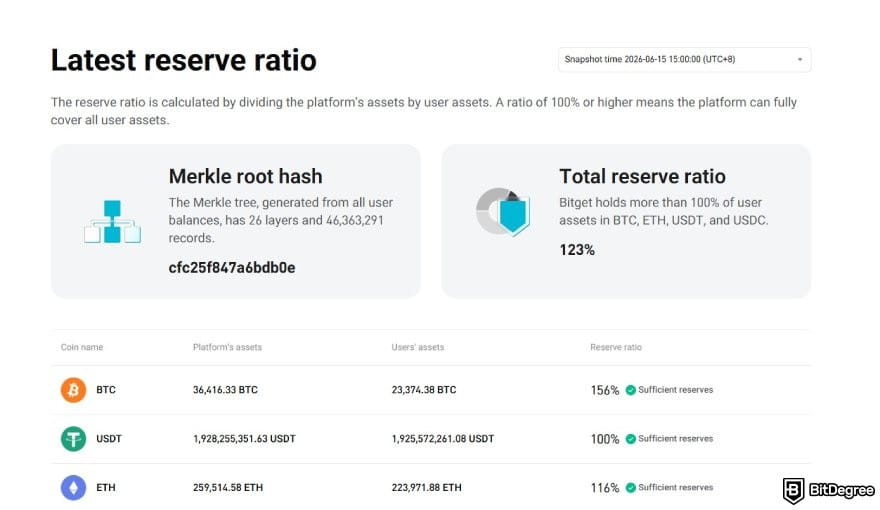
Bitget's clearest structural trust signal relative to Bybit is its Protection Fund, a dedicated reserve of 5,500 BTC, maintained separately from user deposits, with daily public valuation updates. The fund averaged approximately $352 million in June 2026. Bybit maintains a derivatives insurance fund as well, but its size is not disclosed with the same regularity or transparency.
Bitget has not experienced a major platform-wide hack. However, it has had smaller incidents: abnormal BGB token price fluctuations in October 2024 (for which it compensated affected users) and an abnormal trading event in the VOXELUSDT perpetual market in April 2025. Neither resulted in confirmed loss of user funds at scale, but they are part of the platform's track record.
One further consideration: Bybit holds MiCA and UAE SCA licenses, which subject it to external regulatory oversight. Bitget's regulatory footprint is broader in country count but shallower in regulatory depth. It holds a collection of smaller registrations without a comparable tier-one license, which means less external accountability on security and custody standards.
Verdict
Both platforms offer strong account-level security tools and monthly Proof of Reserves. Bitget's clearest advantage is its Protection Fund, publicly reported in BTC with daily valuations, and a clean record with no major platform-wide breach. Bybit's February 2025 hack is a material data point that cannot be ignored, but its crisis response was swift and transparent, and its post-incident security hardening has been substantial. For users who weigh the transparency of reserve backing heavily, Bitget's Protection Fund and higher PoR ratios give it an edge. For users who weigh regulatory accountability, Bybit's MiCA and UAE SCA licensing provides external oversight that Bitget's current license portfolio does not match.
Bybit vs Bitget — Broader Ecosystem
Both platforms have built out ecosystems well beyond spot and derivatives trading, but their approaches differ in scope and emphasis.
Bybit's Other Features
While being one of the exchanges with the strongest derivatives trading features, Bybit also has other non-trading offerings, including:
1
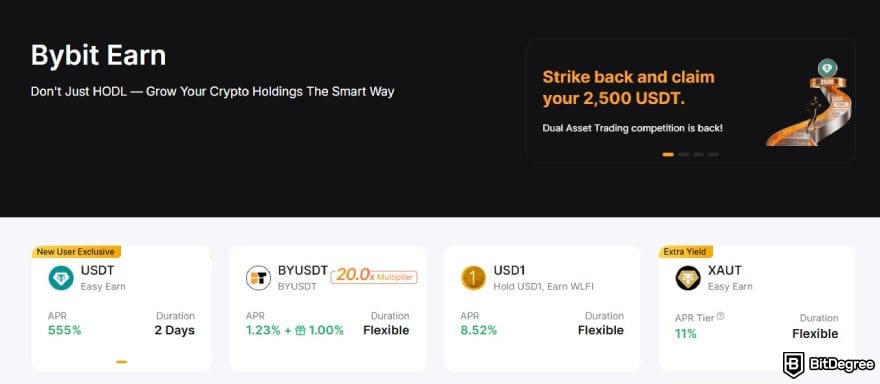
Bybit Earn
Bybit Earn covers multiple yield products: Easy Earn for flexible or fixed-term staking, On-Chain Earn for simplified DeFi staking (with gas fees and node operations handled by the platform), Liquidity Mining via an AMM model, Shark Fin (a structured, principal-protected product that generates returns regardless of market direction), and Launchpool for staking to earn new tokens.
2
Launchpad
Bybit Launchpad has hosted 110 projects and facilitated over $1.817 billion in funds raised as of March 2026. It operates across three formats: Launchpad (token sales via MNT subscription or USDT lottery), Launchpool (staking-based token distribution), and Wednesday Airdrop (a weekly task-based reward campaign). KYC Level 1 is required for all three.
3
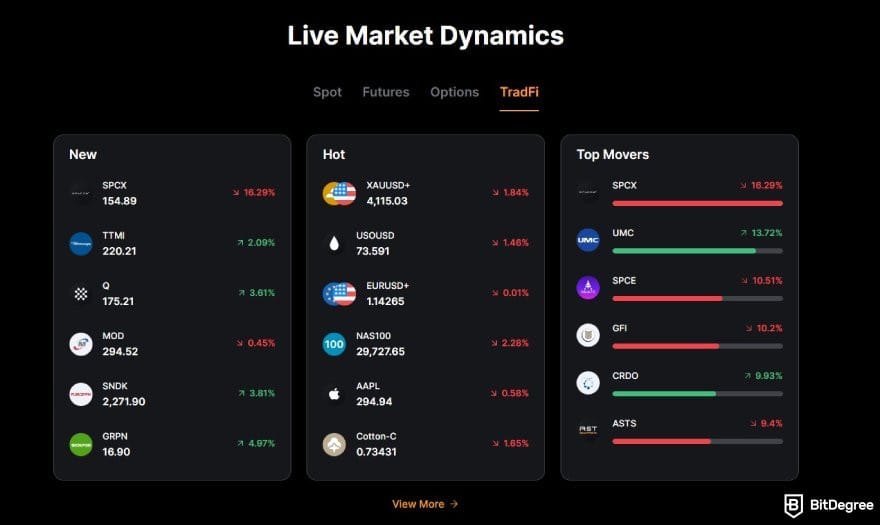
TradFi and IPO Access
Bybit offers access to over 380 global stock CFDs, including major names like Apple, NVIDIA, and Tesla, with zero commissions via its TradFi product. It also launched IPO Express, giving users access to tokenized IPO offerings. Note: TradFi features are not available in the European Economic Area due to regional regulatory requirements.
4
Web3 Wallet
Bybit's Seed Phrase Wallet is a self-custody option integrated within the Bybit ecosystem, supporting multiple EVM and non-EVM networks and dApp connectivity. Bybit streamlined its Web3 suite in 2025, discontinuing its NFT Marketplace and cloud/keyless wallet types; the Seed Phrase Wallet is now the primary self-custody offering.
5
MNT Token
Bybit's native token MNT provides fee discounts (25% on spot, 10% on select futures contracts), Launchpad subscription access, and VIP tier benefits. It is central to the Bybit ecosystem's incentive structure.
Bitget's Other Features
Similarly, Bitget also offers multiple non-trading features to accommodate users who want to do more with their cryptocurrency. Here are some of them:
1
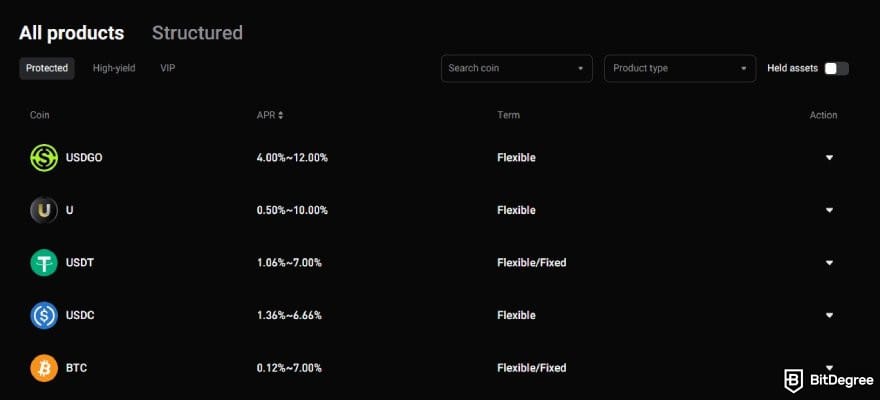
Bitget Earn
Bitget Earn provides flexible and fixed-term savings products, staking, and structured financial products for users looking to generate yield on idle assets.
2
Launchpad and Launchpool
Bitget Launchpad gives users early access to vetted token projects within the exchange. Bitget Launchpool allows users to stake assets to earn new tokens. The platform also runs an Agent Hub, an AI trading framework that was expanded in March 2026 to include five analytical AI skills and 19 integrated data tools, enabling AI agents to access real-time market data and execute trades.
3
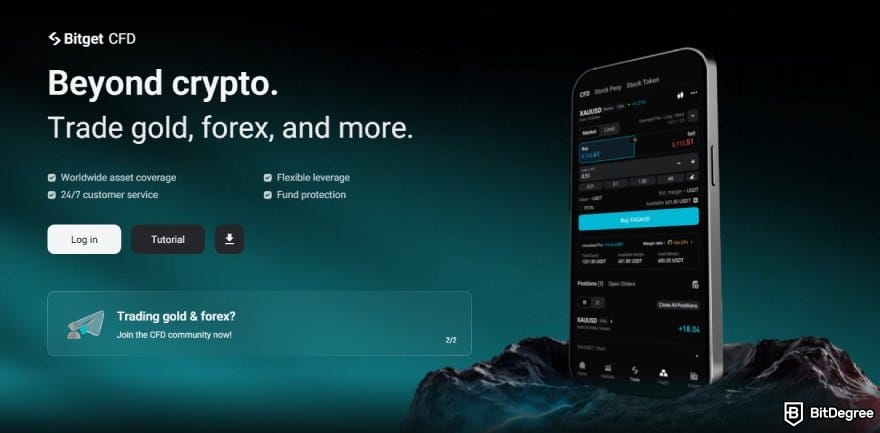
TradFi and Onchain Stocks
Bitget's multi-asset reach goes further than Bybit's in one specific area: tokenized stock spot trading. Users can invest directly in 100+ curated on-chain stocks, including Apple and Tesla, using USDT with zero gas fees. Additionally, 30+ stock perpetuals are available with up to 25x leverage. Bitget Onchain supports six major blockchains (ETH, SOL, BSC, Base, Morph, and Monad) for exchange-native on-chain asset access without wallet switching.
4
Bitget Wallet
Bitget Wallet is a fully standalone non-custodial Web3 wallet with 90 million users, separate from the exchange and usable without a Bitget account. It supports 130+ blockchains, over 1 million tokens, and 20,000+ dApps, and includes its own swap aggregator, launchpad, earn center, and DApp browser. It operates independently of the exchange, meaning its user base and feature set are not tied to Bitget Exchange activity.
5
BGB Token
Bitget's native token BGB, provides a 20% spot fee discount, VIP tier access, and participation rights in Launchpad events. It also functions as the fee and governance token within the broader Bitget ecosystem.
Verdict
Both ecosystems cover Earn, Launchpad, TradFi, Web3 wallet, and native token utilities. The clearest differentiator is Bitget Wallet, a fully independent, large-scale Web3 wallet product that stands on its own outside the exchange. Bybit's Web3 wallet is more tightly exchange-integrated and more limited in scope following its 2025 streamlining. On the TradFi side, Bitget's tokenized stock spot trading goes a step further than Bybit's stock CFD offering, giving users direct on-chain stock exposure rather than derivative-only access. Bybit counters with IPO Express and a more developed structured Earn product suite. Neither platform's ecosystem is clearly dominant overall. The better fit depends on whether you value Web3 breadth (Bitget) or structured trading-adjacent products (Bybit).
Bybit vs Bitget — Fiat Deposits & Withdrawals
Since neither platform is available in the United States and neither has Coinbase-level direct banking infrastructure, fiat access on both exchanges relies on a similar mix of regional bank transfers, P2P trading, and third-party payment providers. The differences are in specific currency coverage and a few practical details.
Bybit supports direct fiat deposits and withdrawals in select regions, with SEPA bank transfers available for EU users. For users outside directly supported regions, P2P trading is the primary fiat on-ramp, with over 80 payment methods supported, including Wise, Revolut, and local bank transfers across markets in Latin America, Southeast Asia, and the CIS region.
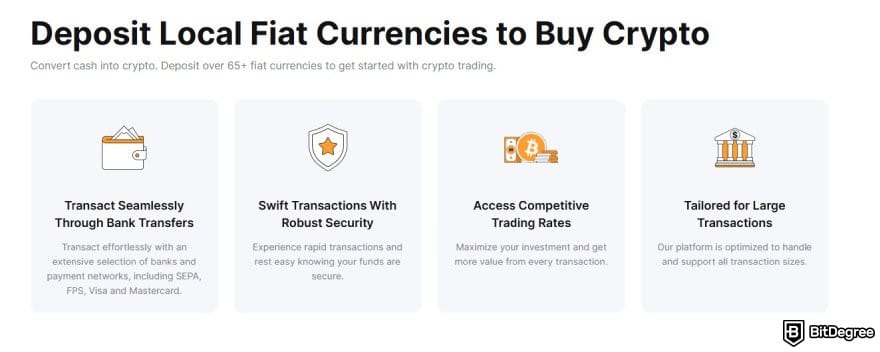
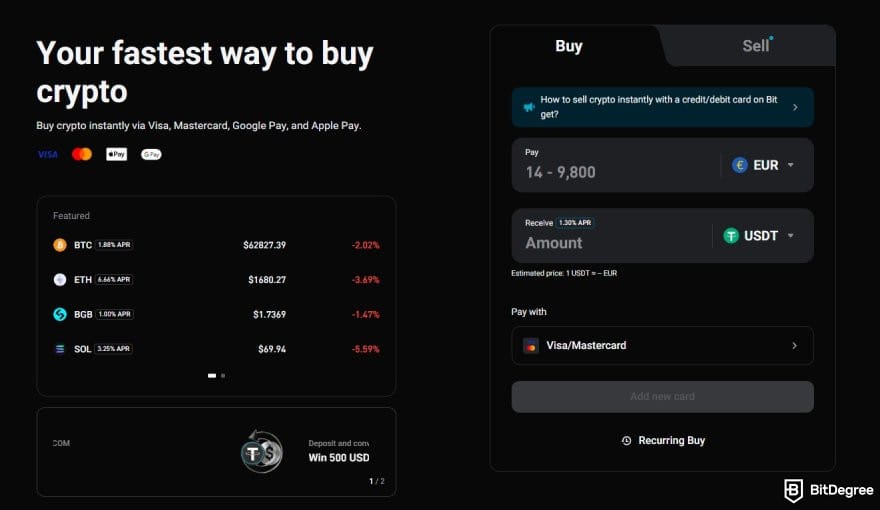
Crypto purchases via card (Visa, Mastercard), Google Pay, and Apple Pay are supported through third-party providers, though these count as crypto purchases rather than direct fiat deposits. Card withdrawals are not supported, and fiat exits are processed via bank transfer or P2P.
Bitget supports direct bank transfers for a wider list of currencies, including EUR, USD, BRL, MXN, PLN, HUF, CZK, DKK, AUD, CAD, NOK, SEK, CHF, VND, and ZAR. EUR and BRL deposits via SEPA or bank transfer incur no platform fees. P2P trading covers nearly 70 fiat currencies, with Bitget acting as escrow to protect both parties.
One-Click Buy supports over 125 fiat currencies through third-party provider MultiX, accepting Visa, Mastercard, Apple Pay, and Google Pay, though card purchases carry third-party fees of around 3–7% depending on region and provider. Card withdrawals are not supported on Bitget either.
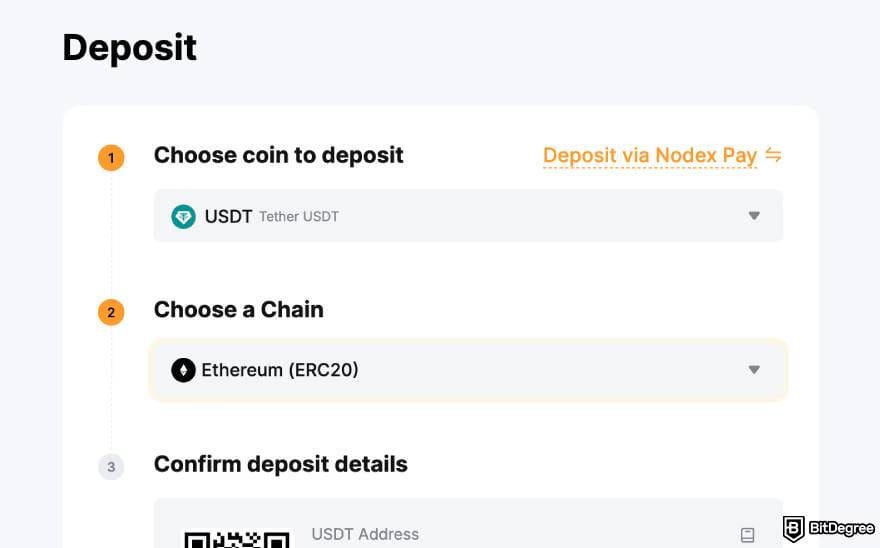
One practical differentiator worth noting: Bitget's USDT withdrawal via the TON chain carries no platform fee, making it one of the more cost-effective options for moving USDT off the exchange for users whose destination supports TON-based transfers.
For both platforms, the actual available methods and supported currencies depend on the user's country and KYC level. Neither platform publishes a single definitive global fiat fee schedule; actual costs vary by currency, method, and third-party provider.
Verdict
Both platforms offer broadly similar fiat infrastructure for non-US users, with direct bank transfers in select regions, SEPA for EU users, P2P as the broadest fiat access channel, and card purchases via third parties. Bitget covers a wider list of directly supported bank transfer currencies, while Bybit's P2P network is slightly larger in terms of supported payment methods. The practical difference for most users is small; what matters more is whether your specific country and preferred payment method are supported, which is best checked directly on each platform's deposit page.
Bybit Trading Walkthrough
One of Bybit’s most popular trading features is perpetual futures, so let’s look at how opening a BTCUSDT perpetual contract works.
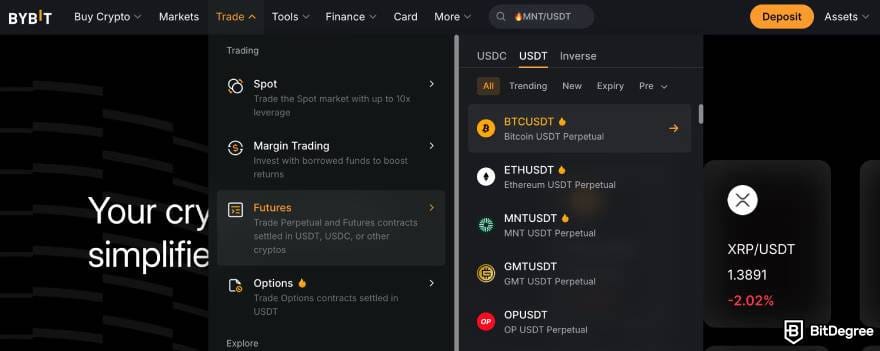
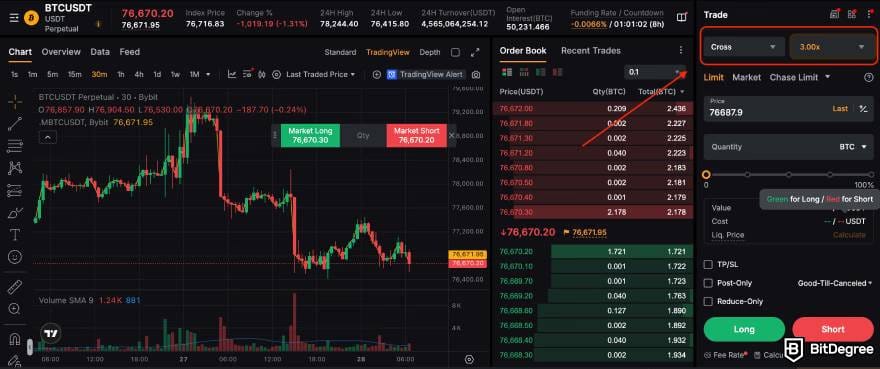
Beginners often misunderstand leverage and assume it simply “boosts profit”. In reality, it also reduces the margin of error.
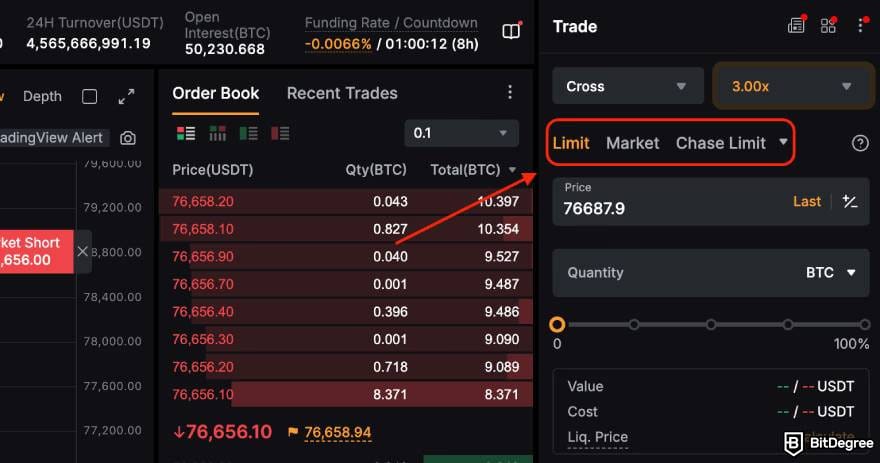
Other order types are available as well, but market and limit orders are the simplest ones to understand first.
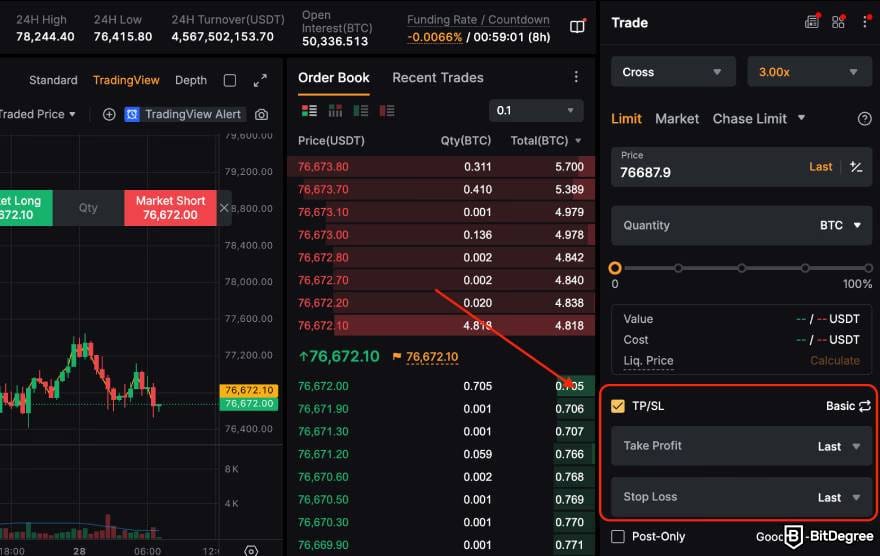
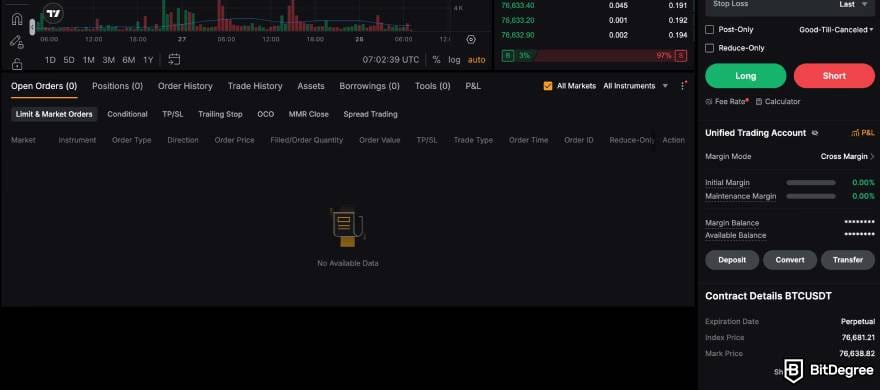
After confirming the trade, you should monitor:
- Entry price;
- Mark price;
- Liquidation price;
- Unrealized P&L;
- Funding fee;
- Margin ratio;
- Stop-loss and take-profit status.
This is where futures trading differs heavily from spot trading. With spot, the value of the asset can fall, but the user still owns the asset unless they sell. With leveraged perpetuals, the position can be liquidated if the market moves too far against them.
If you close with a market order, remember that this usually means paying taker fees again. This is why the round-trip cost matters. You pay when entering and exiting the position, and funding rates may also apply while the position is open.
Bitget Trading Walkthrough
Bitget offers the same level of intuitiveness on its platform, making it easy to access most of its features. Here is how to use the spot trading feature on Bitget:
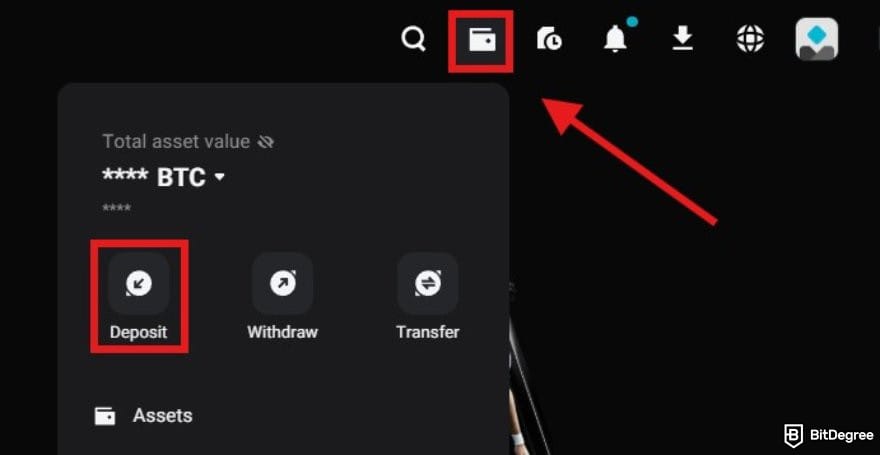
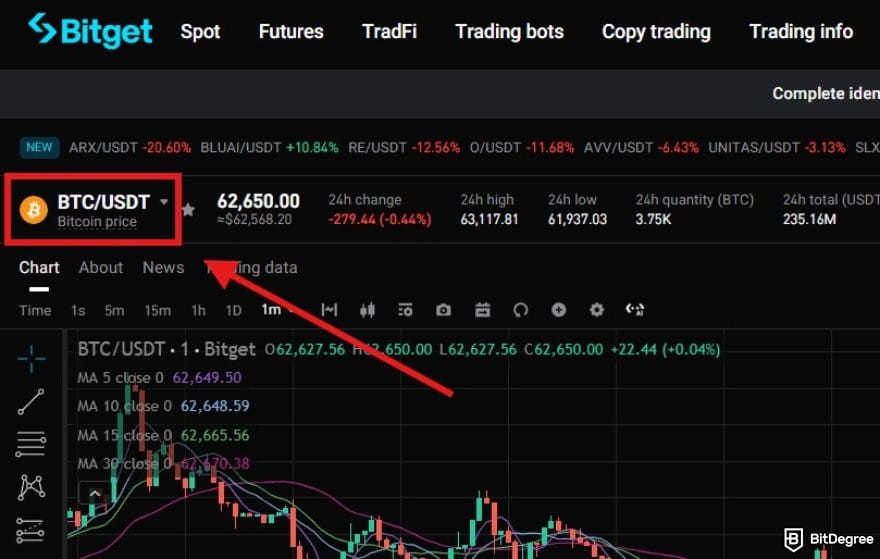
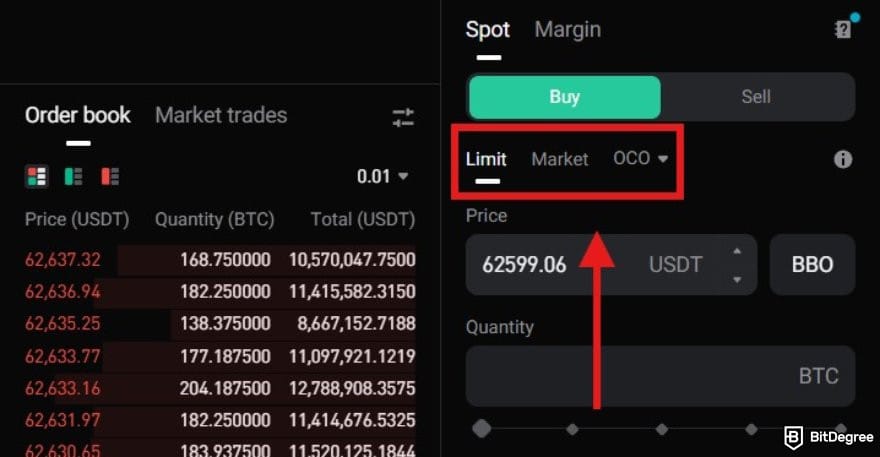
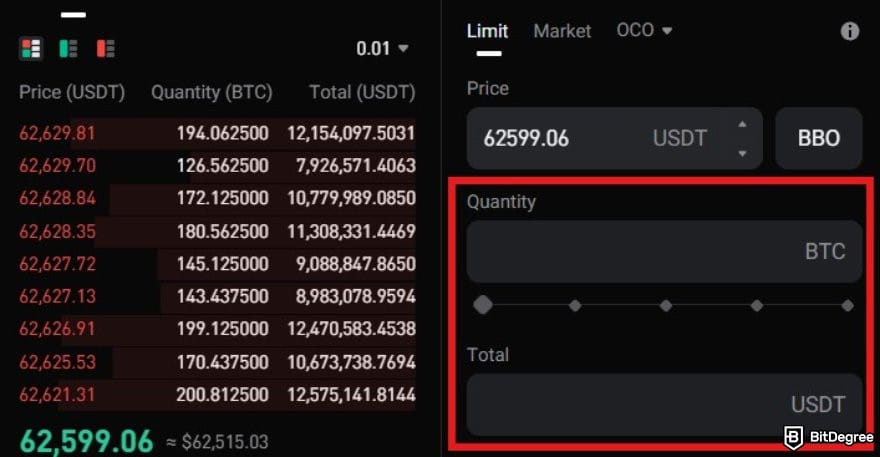
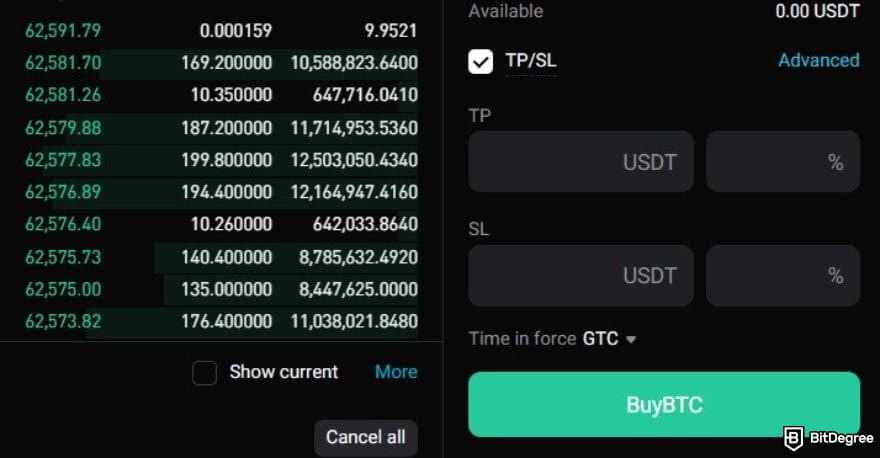
Once filled, your purchased asset will appear immediately in your Spot Account. You can check your holdings anytime under [Assets] > [Spot Account].
Bybit vs Bitget For Beginners
Neither Bybit nor Bitget is designed primarily with beginners in mind. Both platforms are built around active trading, and that shows in their interfaces. A complete newcomer to crypto will find both exchanges more complex than consumer-first platforms. That said, both have invested in features that lower the barrier to entry, and the question for a beginner is really which learning path suits them better.
Bybit is widely regarded as having a slightly smoother and more polished overall interface. The navigation is intuitive for a trading-focused platform, TradingView charting is well-integrated, and the experience across web and mobile is consistent. For beginners specifically, Bybit's demo trading account is one of its most valuable features.

It lets users practice spot and derivatives trading with simulated funds before committing real money, with no time limit or capital at risk. Bybit Learn provides educational content covering trading concepts and platform features.
Bitget takes a different approach to beginner accessibility. Its copy trading system is arguably the most beginner-relevant feature either platform offers. Rather than requiring a new user to learn trading mechanics independently, it allows them to follow and automatically mirror experienced traders from day one.
Bitget's tiered KYC onboarding is also noted as a lower-friction entry point where users can begin with minimal verification and increase limits as they get more comfortable. Bitget also offers demo trading for practice before going live.
A beginner might lean toward Bybit if they:
- Want a cleaner, less cluttered interface to start with;
- Plan to learn trading mechanics actively using demo trading before risking real funds;
- Value a platform with stronger regulatory credentials and licensing depth.
A beginner might lean toward Bitget if they:
- Want to get market exposure quickly without learning to trade independently, via copy trading;
- Prefer a lower-friction onboarding process with tiered KYC;
- Are drawn to a social trading approach where they can learn by following and observing experienced traders.
Verdict
Neither platform is ideal for complete beginners who have never traded before. Both are built for active traders first. Between the two, Bybit has a slight edge in interface polish, while Bitget's copy trading system offers a more accessible entry point for beginners who want market exposure without full trading independence. For anyone starting from scratch, demo trading, available on both platforms, is the recommended first step before trading with real funds.
Bybit vs Bitget For Active Traders
This is where the comparison gets closest, because both platforms are built primarily for this audience. Both cover derivatives, copy trading, and bots, but they emphasize different aspects of active trading, and the right choice depends on what kind of active trader you are.
Bybit is the stronger fit for traders who prioritize execution quality and derivatives depth. Its order books are consistently deeper on major USDT-margined perpetual pairs, its Unified Trading Account removes the friction of managing separate sub-accounts by consolidating spot, margin, derivatives, and options under shared collateral, and its base futures taker fee of 0.055% edges out Bitget's 0.06% at the entry level.
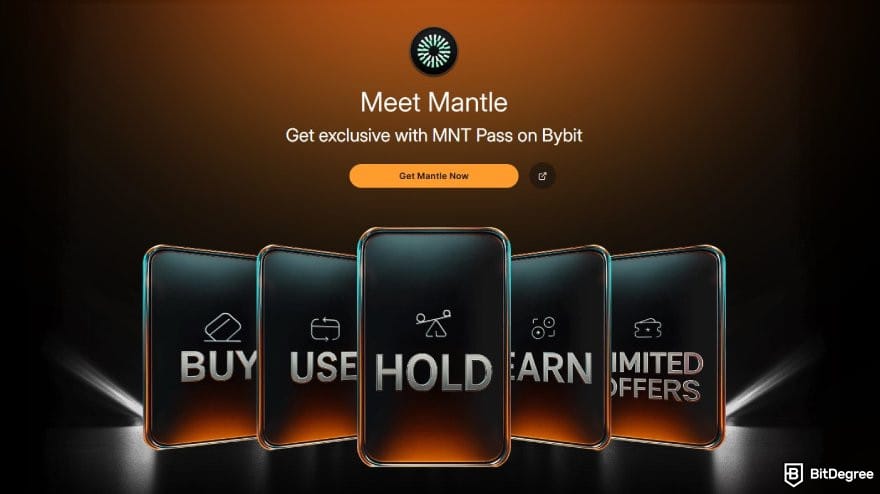
The MNT token discount also applies across both spot and futures, making it the more versatile fee-reduction tool. Traders who work with options alongside perpetuals will also find Bybit's product range more integrated. For algorithmic and high-frequency traders, Bybit's institutional-grade API infrastructure is a further draw, and its MiCA and UAE SCA licenses provide a level of regulatory oversight that Bitget's more fragmented license portfolio does not currently match.
Bitget is the stronger fit for traders whose strategy is built around automation and social trading. Its copy trading ecosystem, with over 190,000 lead traders and more than 1 million followers, is the largest of the two, giving users a wider pool to choose from, whether they are following manual traders or automated bot strategies via Bot Copy Trading. The latter is a mode that Bybit does not have a direct equivalent for.
Bitget also goes further on multi-asset access: its TradFi product offers direct exposure to 100+ tokenized stocks and stock perpetuals with up to 25x leverage, going beyond Bybit's stock CFD offering. Traders who use TradingView for signals will also find Bitget's native signal trading integration useful, enabling futures orders to be triggered automatically from TradingView alerts. At sustained high volume, Bitget's VIP tier structure and BGB discounts may also result in a lower effective fee than Bybit at equivalent tiers.
Verdict
For pure derivatives depth, execution quality, and account structure flexibility, Bybit has the edge. For copy trading scale, bot automation breadth, and multi-asset TradFi access, Bitget pulls ahead. Both are strong choices for active traders. The decision comes down to whether your trading style is more execution-focused or strategy and automation-focused.
Bybit vs Bitget For Passive Users
Bybit and Bitget are both trading-first exchanges, but they have grown their non-trading product suites to the point where someone who wants to hold crypto and earn yield has meaningful options on either platform.
Bybit has the more developed Earn ecosystem of the two. Its product range spans Easy Earn for flexible and fixed-term savings, On-Chain Earn for simplified DeFi staking where the platform handles gas fees and validator operations, Liquidity Mining via an AMM model, and Shark Fin, a structured, principal-protected product designed to generate returns in either market direction.
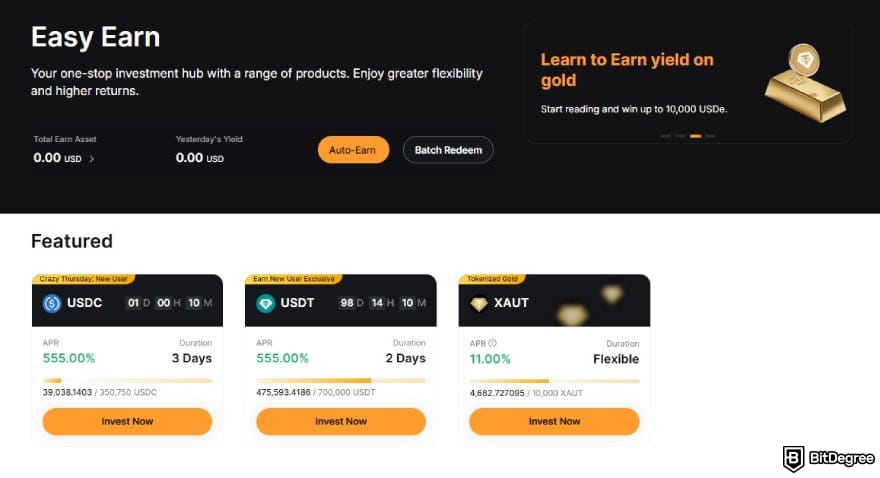
For users who want to participate in new token projects without active trading, Bybit Launchpad offers two participation paths (MNT subscription and USDT lottery), with Launchpool allowing token farming through staking. The range of structured products in Bybit's Earn lineup is broadly considered wider and more varied across risk levels than what Bitget currently offers.
Bitget's Earn suite covers the core needs. These include flexible and fixed-term savings with hourly interest accrual, staking, and structured products. Its on-chain Earn integration gives passive users access to DeFi-based yield without managing wallets or gas fees, and its Launchpad and Launchpool programs provide early token access for users who want to participate beyond simple holding.
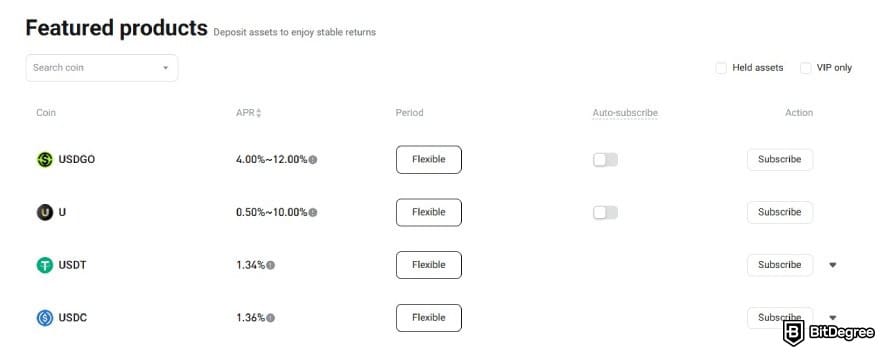
While Bitget's Earn is considered somewhat narrower in product variety than Bybit's, it is competitive on APRs for standard flexible savings and staking products.
For truly passive users, both exchanges are viable, but neither is specifically optimized for that use case. The complexity of each platform's full interface can feel overwhelming for users who have no interest in derivatives or copy trading. In that sense, both platforms serve passive users as a secondary audience rather than a primary one.
Verdict
Bybit has the edge for passive users who want a wider range of Earn products and more structured yield options. Bitget is competitive on core savings and staking but offers a narrower product suite. For users whose primary goal is passive yield rather than active trading, both platforms require navigating a trading-heavy interface. Neither is as purpose-built for passive holding as platforms like Coinbase.
Final Verdict: Is Bybit or Bitget Better?
This is one of the closest comparisons in the crypto exchange space precisely because both platforms are built for the same type of user. There is no wrong answer here, but there is a more accurate answer depending on what you actually need.
Bybit is the stronger choice if execution quality, derivatives depth, and regulatory standing are your priorities. Its order books are deeper on major perpetual pairs, its Unified Trading Account makes multi-product trading genuinely cleaner than managing separate accounts, and its fee structure has a slight edge at the base level for futures trading.
Bybit's MiCA and UAE SCA licenses also give it a more substantive regulatory footprint than Bitget's current portfolio of smaller VASP registrations, which matters for users in jurisdictions where regulatory oversight is a trust signal.
The February 2025 security breach is a material part of Bybit's story, but its crisis response demonstrated organizational resilience that is hard to dismiss. For experienced traders who want the sharpest trading environment and are comfortable with that history, Bybit remains a strong platform.
📚 Read More: Bybit Review
Bitget is the stronger choice if copy trading scale, multi-asset access, and a clean security track record are what matter most to you. Its copy trading ecosystem, with over 190,000 lead traders, more than 1 million followers, and a dedicated Bot Copy Trading mode, is the most developed of the two, and its TradFi product offers direct access to tokenized stocks and gold within the same account as crypto futures, going further than Bybit's equivalent offering.
Bitget's Protection Fund, reported in BTC with daily valuations and a most recently published reserve ratio of 123% as of June 2026, is more transparently disclosed than Bybit's insurance fund. For users who value a clean exchange-level security record and a strong copy trading infrastructure, Bitget makes a compelling case.
📚 Read More: Bitget Review
Choose Bybit if you are an experienced derivatives trader who values execution depth, account structure flexibility, and a platform with advancing tier-one regulatory credentials. Choose Bitget if your priority is copy trading breadth, multi-asset TradFi access, or if you prefer a platform without a major security incident on its record.