
Are you looking for online courses related to Python, ChatGPT, AI, machine learning, SQL, R, and many other IT- and technology-specific fields? If so, look no further - this DataCamp review is for you.
DataCamp is a very popular MOOC (in plain terms, an online learning platform), especially for anyone who’s interested in studying some of the aforementioned subjects. Naturally, popularity attracts opinions, and divides students - is DataCamp worth it, or are there better alternatives?
Things such as features, prices, learning experience, and everything in between work to answer that very question. Those aspects are also what I’ll focus on today, as well.
Verdict at a Glance
DataCamp is a leading data & AI course provider. It offers over 700 courses on a variety of topics surrounding data and AI, with tools to tailor each experience to be unique for the students. While there are no accredited certificates, DataCamp still offers high-quality, fairly priced learning experiences for anyone interested.
Pros
- Easy to use with a learn-by-doing approach
- Offers quality content
- Gamified in-browser coding experience
- The price matches the quality
- Suitable for learners ranging from beginner to advanced
Cons
- No accredited certificates
Table of Contents
- 1. DataCamp Review: Introduction
- 2. Who's DataCamp For?
- 3. DataCamp Alternatives
- 4. Advantages
- 5. Limitations
- 6. Course Catalog and Content Quality
- 7. Learning Formats and Structure
- 8. Certificates and Accreditation
- 9. Gamification and Motivation Features
- 10. Business and University Offerings
- 11. Pricing Plans
- 12. Customer Support
- 13. User Experience
- 14. How to Use DataCamp
- 14.1. How to Create a DataCamp Account
- 14.2. How to Enroll in a Course on DataCamp
- 15. Comparison to Other Popular Learning Platforms
- 15.1. DataCamp VS Udacity
- 15.2. DataCamp VS Udemy
- 15.3. DataCamp VS edX
- 16. Conclusions: Is DataCamp Right for You?
DataCamp Review: Introduction
DataCamp is a MOOC-providing platform established in 2013. In this context, MOOC stands for Massive Open Online Courses - this means that the company specializes in providing online courses to students all over the world. I’ve mentioned this in the introduction of my DataCamp review, but the platform specializes almost solely in courses that revolve around the topics of data and AI.
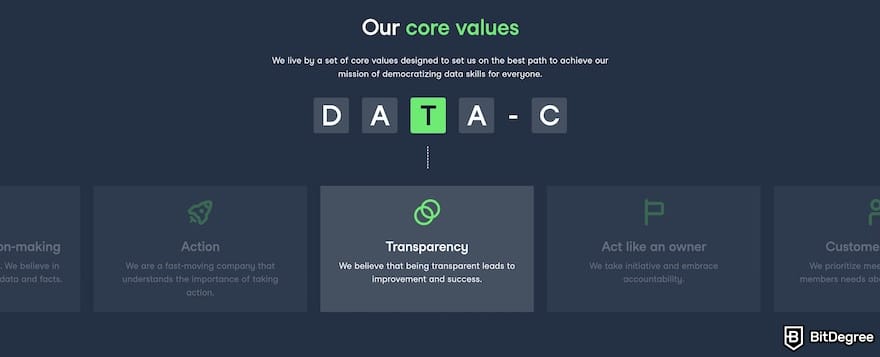
As they themselves state, more than 90% of the world’s data has been created in the past few years[1] - this means that there’s a need for data-savvy specialists now more than ever before.
The platform aims to teach people the essential skills needed to work with data - all in the comfort of their own home (or wherever else they might be; the courses are taught and transmitted through an internet browser, meaning that you can learn them practically anywhere where there’s an internet connection).
Founded | 2013 |
|---|---|
Focus | Data science, AI, analytics, programming |
Course count | 790+ |
Learners | ~19 million |
Pricing | Free Basic plan; Premium from $28/month (billed annually); Business custom packages; free for students and teachers |
Certificates | Statements of Accomplishment (free), Career Track certificates, partner certifications (Azure, Power BI, Alteryx) |
Best for | Self-learners wanting hands-on, structured data/AI skills |
Table: DataCamp overview
DataCamp's core pitch hasn't changed since it launched: learn data skills, in your browser, through short video lessons paired immediately with coding exercises. What has changed is the scope, as it now covers broader topics on data and AI.
Latest DataCamp Coupon Found:Who's DataCamp For?
Is DataCamp worth it? After trying the platform myself, I believe it's worth it for certain kinds of people. It comes with structured tracks, gamification that keeps learning consistent, and a hands-on, interactive format that gets you writing real code from your very first lesson – all at a reasonable price with frequent promotions.
Here are some groups of people that may benefit the most from this platform:
- Beginners looking for AI and data lessons. DataCamp covers various AI and data topics from the ground up, with no prior coding experience required for most introductory courses.
- Career changers targeting a data-focused role. The structured Career Tracks give you an end-to-end path into roles like data analyst, data scientist, or data engineer, without needing to piece together your own curriculum.
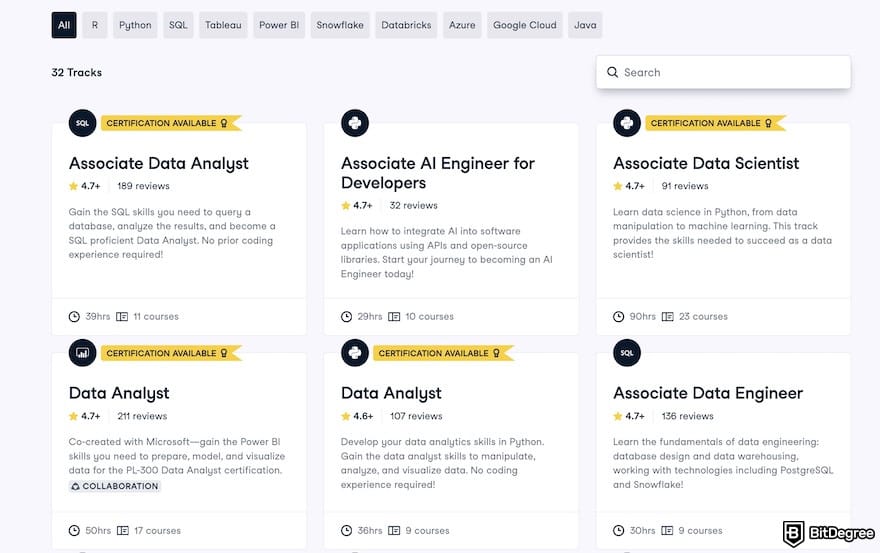
- Working professionals upskilling in a specific tool. If you already have a job and just need to get sharper in Python, SQL, Power BI, or a similar tool, individual courses or Skill Tracks let you target what you need.
- Teams and organizations closing a skills gap. DataCamp for Business gives managers a way to track team progress, assign learning goals, and run engagement challenges at scale, making it a practical fit for companies investing in data literacy.
- Students and educators looking for free access. Through DataCamp Classrooms, students and instructors at eligible institutions get full platform access at no cost, which is hard to beat if you qualify.
If your priority is a personalized, mentor-guided experience, or you need academically accredited credentials, DataCamp isn't built for that. However, for self-directed learners who want structured, hands-on, and reasonably priced education, it's a strong option.

Did you know?
All Online Learning Platforms may look similar to you but they're NOT all the same!
DataCamp Alternatives
If DataCamp doesn't end up being the right fit, here are the platforms most learners compare it against:
- Udacity. It’s suitable for learners who want a mentor-reviewed, bootcamp-style experience. Its Nanodegree programs pair video lessons with real project feedback from a human mentor, though at a higher monthly cost than DataCamp.
- Udemy. This option is best for breadth and one-off courses across virtually any topic, not just data. It's a marketplace, so you buy individual courses instead of following a structured path, and pricing is usually far cheaper on sale.
- edX. This platform is ideal for learners who want university-backed content and credentials. Courses come from partner institutions like MIT and Harvard, with some programs offering real academic credit, though certificates cost more per course than DataCamp's subscription model.
See how these platforms compare against each other:
 |  |  | |
|---|---|---|---|
| Best for Starting Online Learning | Best for Learning New Skills & for Developing a Career | Best for Different Topic Choices | |
| All Udacity Coupons | All edX Coupons | All Udemy Coupons | |
| One of the best online learning platforms with extensive Nanodegree programs. | An online learning platform that works in collaboration with prestige universities and institutions. | A diverse online learning platform for a broad user base. | |
| Visit site We may be compensated if you click on the links in this post and make a purchase. Read review | Visit site Read review | Visit site Read review |
Table: The main features of Udacity, Udemy, and edX compared
These platforms fill in the gaps DataCamp doesn't cover. Udacity, for instance, offers the kind of human accountability DataCamp lacks, while edX brings university-backed credentials. I'll walk through how each of these stacks up against DataCamp in more detail later in this review.
📚 Read More: Best Online Learning Platforms
Advantages
DataCamp brings a lot to the table, but features that stood out the most while I wrote this DataCamp review are:
- Broad, constantly updated catalog;
- Structured learning paths;
- Certifications with real assessment behind;
- Well-designed gamification.
DataCamp's catalog has grown well past its original data-science roots, now spanning Python, R, SQL, and Java programming to AI and machine learning (including LLMs, prompt engineering, and courses built around tools like Claude and ChatGPT). Additionally, every course sits within the same data-and-AI focus, so the catalog stays coherent.
All of the courses are organized into Skill Tracks and Career Tracks, so you don’t need to guess what to learn next to get well-rounded knowledge in a specific topic. Nonetheless, it’s possible to individually complete the course for more freedom.
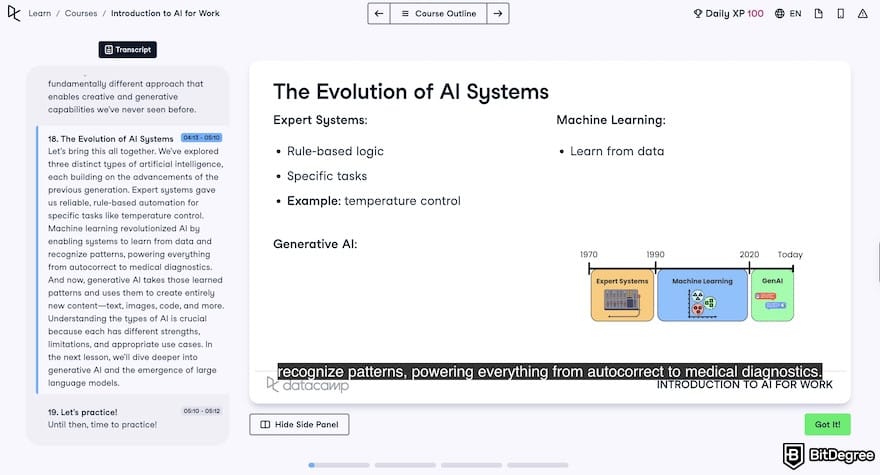
Every course pairs short video lessons with in-browser coding exercises you complete immediately after watching to help you get hands-on experience. There’s also the AI Tutor for getting unstuck without simply being handed the answer.
Another aspect I want to highlight in this DataCamp review is its well-thought-out gamification, from the XP system and daily streaks to a ten-tier weekly leaderboard for extra competitiveness.
Limitations
Every platform comes with trade-offs, and DataCamp is no exception. Below, I've broken down
- No academic accreditation, at any tier;
- Support leans heavily on AI.
Even DataCamp's paid, proctored certifications aren't recognized as academic credit. If your goal requires a credential that counts toward a degree or formal transcript, DataCamp isn’t for you. Platforms like edX, with direct university partnerships and credit-eligible MicroMasters programs, serve that need instead.
Also, if you're on an individual plan, your fastest support option is an AI assistant rather than a live human agent. Yes, an AI assistant can be helpful for common account or billing questions, but potentially frustrating for more nuanced issues.
As far as I can tell from this platform, live human support (via chat with an actual sales rep) is reserved for business inquiries and demos, not day-to-day individual troubleshooting.
Course Catalog and Content Quality
DataCamp is focused on data-driven and -specific courses. “Data”, however, is a pretty broad term. A few years back, I would have said that the correct terminology to use would be “data science”[2]. Indeed - I remember trying DataCamp out back then, and it was very focused on data science and analytics as the main focal points of the platform.
These days, DataCamp's catalog has broadened. It's still data-heavy at its core, but now spans:
1
Programming: Python, R, SQL, Java
2
AI & Machine Learning: LLMs, prompt engineering, Claude, ChatGPT, deep learning, generative AI
3
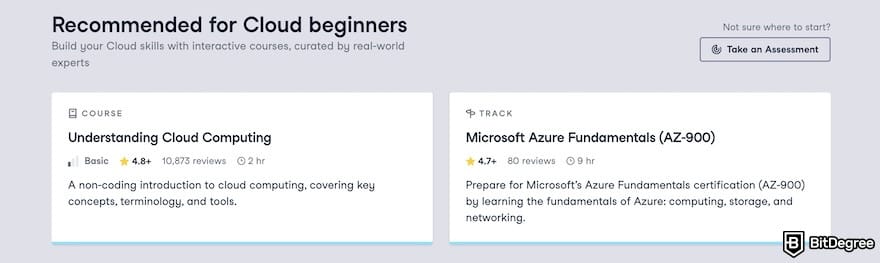
Cloud: AWS, Azure, Google Cloud
4
BI & Visualization: Power BI, Tableau, Excel, Google Sheets
5
Data Engineering: dbt, Airflow, Spark, Databricks, Snowflake
6
Applied Finance & Reporting
On content quality, earlier DataCamp reviews noted complaints about text-heavy assignments and instructors who felt overly hand-holdy.
DataCamp has iterated on this. Most modern courses on the platform now pair short video segments with hands-on exercises, and the platform has since added an AI Tutor feature to help learners get unstuck without being given the answer immediately.
📚 Read More: Top Online AI Courses
Learning Formats and Structure
Everything on DataCamp builds on one unit: a course, made up of video lessons and hands-on exercises. String several courses together and you get a Learning Path, either an individual course, a Skill Track, or a Career Track.
- Individual courses. These can be a go-to option if you want to hone a specific skill in areas like Python programming, data manipulation, or machine learning.
- Skill Tracks. For those looking to dig deeper into a particular domain, these combine related courses into a comprehensive understanding of a subject, covering everything from AI fundamentals to data literacy.
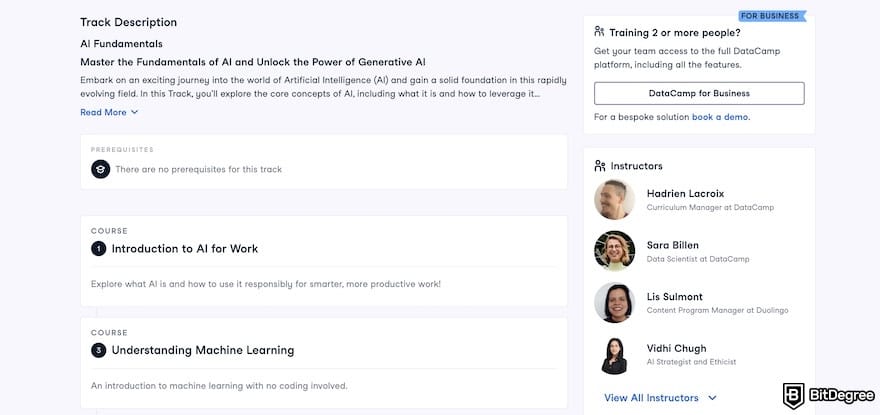
- Career Tracks (typically 60–100 hours). You can navigate to this section for a career transformation, as it chains together the most courses of all, providing an end-to-end path into a role like a data scientist or data engineer.
DataCamp also offers DataLab (a cloud coding/notebook environment), Sandboxes for specific tools (Python, AWS, Azure, Power BI, Tableau), and real-world Projects and Competitions for portfolio-building.
DataLab, specifically, was known as Workspace. It's shifted from a coding environment into something closer to an AI-assisted analyst. You connect a data source, such as a CSV, Google Sheets, or a database/warehouse like Snowflake, BigQuery, or PostgreSQL, then ask questions in plain language.
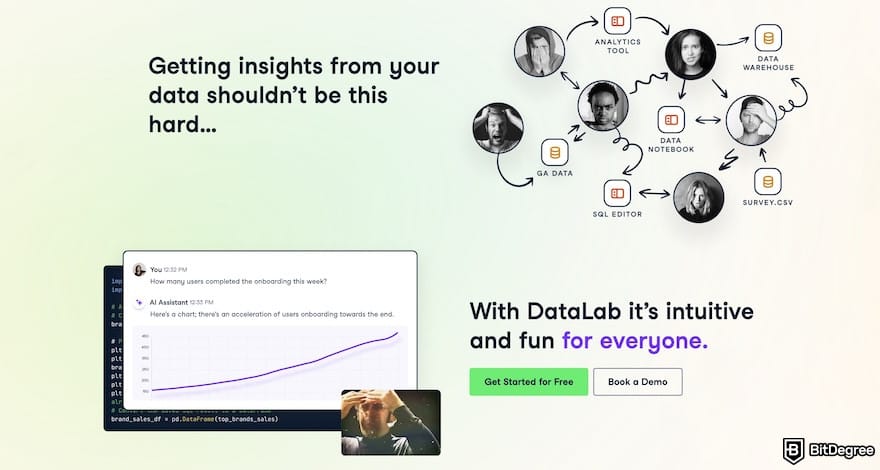
After that, DataLab's AI Assistant writes and runs the underlying Python or SQL for you, while still showing you (and letting you edit) the actual code behind each answer. It's built for both individual practice and team collaboration, and it comes with enterprise-grade security (ISO 27001:2017 certified, encrypted data, SSO/MFA support).
There's a free tier (up to three workbooks and 15 AI Assistant uses), but DataLab Premium lets you access unlimited workbooks, unrestricted AI use, and more processing power, available separately from a regular DataCamp course subscription.
If you go to the [Resources] tab, you can also find educational podcasts, e-books, webinars, tutorials, case studies, blog posts, and cheat sheets.
Additionally, there’s a practice environment with over 65 different practice sessions to test your knowledge independently.
📚 Read More: DataCamp Data Engineer with Python Career Track
Certificates and Accreditation
It's easy to conflate DataCamp's credentials into one thing, but there are actually three distinct tiers, and only one of them is assessed.
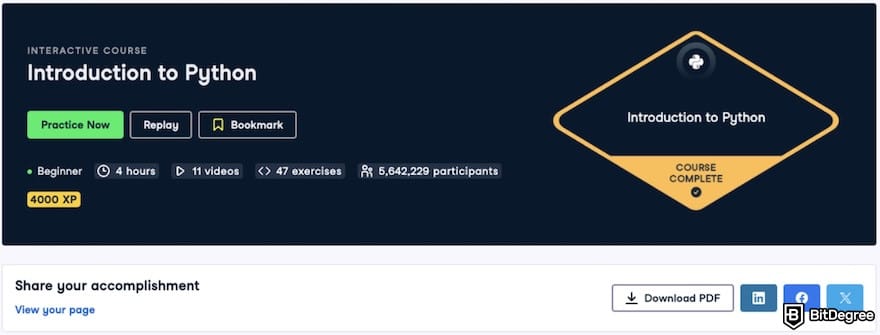
At the base level, every course and Career Track you finish earns you a free Statement of Accomplishment. This is a participation record, awarded automatically the moment you complete the content.
One step up is DataCamp Certification, a separate paid product tied only to Career Tracks that carry the "Certification Available" badge (e.g., Associate Data Analyst, Associate Data Scientist, and Associate Data Engineer).
Earning one requires passing a timed, proctored exam, including a case study plus a practical coding assessment, that actually tests whether you can apply the skill.
At the top are partner certifications, developed with outside companies and tied to specific tracks. Examples are the Microsoft-co-created Data Analyst track, which prepares you for the Power BI PL-300 certification, and similar arrangements exist for Azure (AZ-900) and Alteryx Designer Core.
Note that none of these, including the paid certifications, are academically accredited. If your goal is university credit, DataCamp isn't built for that. It’s the one worth the extra effort for signaling you’re job-ready.
Gamification and Motivation Features
DataCamp leans heavily on game mechanics to keep learners consistent. At the center of it is XP (experience points), earned automatically for completing lessons, practice exercises, and projects.
XP feeds into two habit-forming features: daily streaks and weekly leaderboards. A day only counts toward your streak if you earn at least 250 XP before your local midnight, which encourages learners to show up daily.
Once you cross the same 250 XP threshold in a week, you're automatically placed into a small, randomly grouped bracket and ranked against other learners. DataCamp organizes these brackets into ten leagues, from Bit, Byte, and Deca to finally the Exa League. Each week, the top performers in a bracket get promoted to the next league up, while the lowest performers drop down a tier.
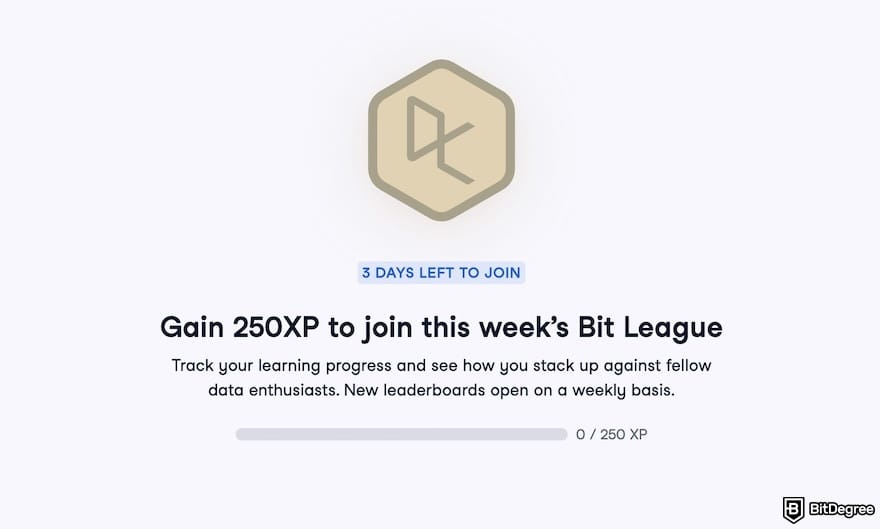
There's a built-in trade-off in how you earn XP: hints and revealed solutions both cost you XP (a partial deduction for a hint, the full amount for the solution). It's a small but effective design choice, since it keeps you solving the problem yourself – the path of least resistance if you want to protect your XP and hold your rank on the weekly leaderboard.
For organizations on DataCamp for Business, the same leaderboard mechanic scales up into a management tool. Team admins get access to a Group Hub dashboard where they can view team-wide leaderboards ranked by XP, courses, or chapters completed, and launch time-boxed "XP challenge" assignments to drive engagement.
Business and University Offerings
One more thing that's often praised in many student DataCamp reviews is that, apart from courses and learning paths for individuals, DataCamp also offers programs for universities, businesses, and a cloud-based, AI-powered data notebook.
DataCamp for Business
DataCamp for Business is designed to build data and AI skills across an entire organization, used by companies like Bank of America, Pfizer, Uber, and 80% of the Fortune 1000. These are suitable for employees looking to build skills and organizations trying to close their data and AI literacy gap.
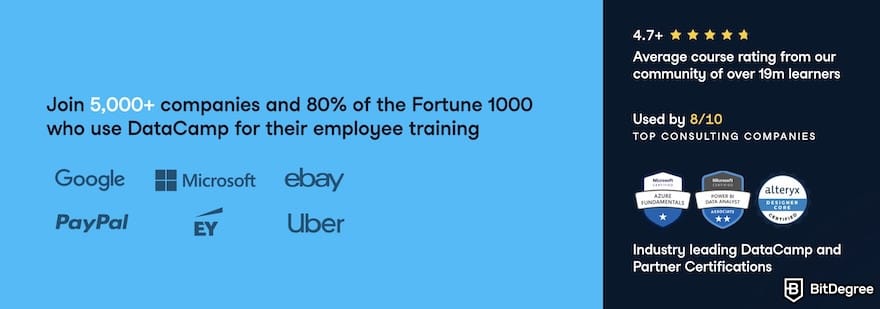
Beyond the same courses, tracks, and certifications individual learners get, users with Business accounts can add admin tools for user management, analytics and reporting, custom curriculum built around a company's own data, and even instructor-led training and implementation support for larger rollouts.
Supervisors get a Group Hub dashboard to track individual and team progress, run team leaderboards, and launch time-boxed learning challenges.
DataCamp for Universities
DataCamp for Universities (now branded DataCamp Classrooms) gives professors, instructors, and (in select countries) high school teachers free access to DataCamp's full course catalog for their students, for a renewable six-month term.
It's used by over 1 million teachers and students across 14,000+ institutions in 180 countries, including Oxford, Imperial College London, and Columbia.
Once approved, educators get an Admin Dashboard to assign courses and projects, track engagement, and monitor student progress, alongside access to DataLab, certifications, and competitions for their class.
Larger institutions that want more control, such as custom reporting, LMS integration, unlimited seats, and a dedicated account manager, can request an institution-wide plan rather than the free Classrooms tier.
Pricing Plans
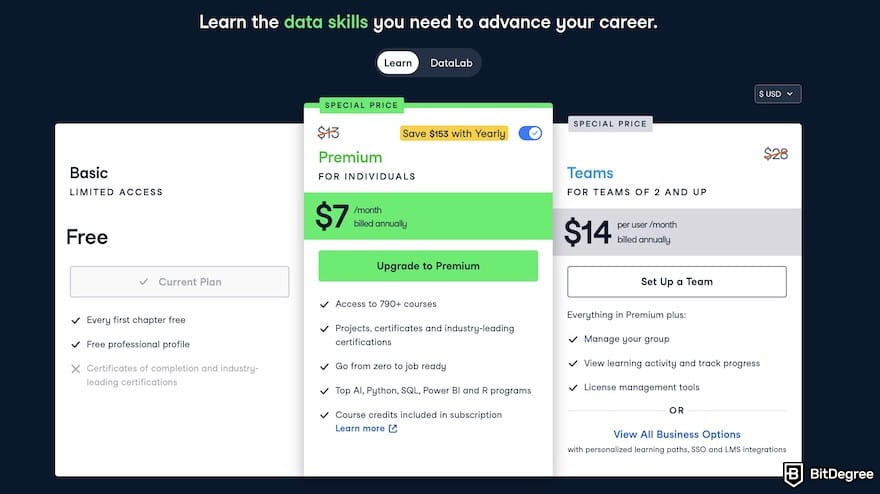
DataCamp splits pricing across four audiences: individuals, students, teams, and enterprise. Generally, the structure is simple:
Price | Best For | Key Features | |
|---|---|---|---|
Basic | Free | Trying out the platform | First chapter of every course, professional profile with no certificates |
Premium | $28/month billed annually ($336/year) | Individuals | Full access to 790+ courses, Career and Skill Tracks, certifications, AI Tutor course credits |
Student | $74/year (50% off $150) or $13/month (30% off $19)* | Verified students | Same full Premium access at a discounted rate |
Teams | $14/user/month (Special Price, down from $27.5) | Small teams | Core learning features plus analytics |
Small Business | Custom, based on company size | Companies up to 500 employees | Everything in Teams, plus SSO, customizable learning pathways, 3 hours of premium services |
Enterprise | Custom (contact sales) | Large organizations | Everything in Small Business, plus LMS/LXP and SSO integrations, advanced analytics and reporting, fully personalized upskilling program |
Table: DataCamp's pricing plan
Student pricing can vary by region or active promotions, but overall, DataCamp's pricing holds up well against the online education platforms. The premium plan gets you the entire catalog and certifications. As long as you don't need the higher tiers' academic accreditation, DataCamp's pricing is one of its strongest selling points.
The free Basic tier means you can test the waters before spending anything.
Customer Support
DataCamp offers several ways for you to get help, depending on who you are and what you need. If you're already logged in as an individual learner, the fastest option is the AI-powered support assistant built right into the platform. It can answer most course-access questions instantly, since DataCamp states its support is available 24/7.
You don't actually need an account to get help, either. Heading to DataCamp's support site and choosing "Get help without an account" opens a chat box that asks which plan best describes how you're using (or planning to use) DataCamp. It then routes you to their AI agent for an answer.
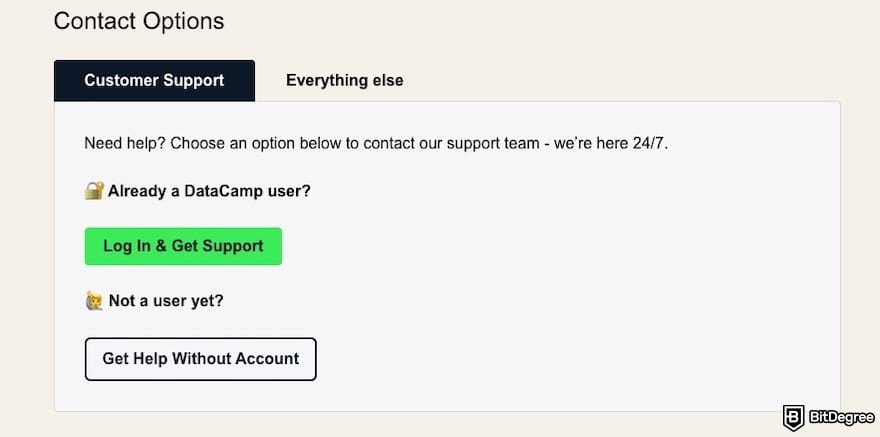
For businesses, support looks a little different, as you get access to live chat with an actual sales representative. You can also request a demo directly.
Beyond that, DataCamp's Help Center covers the bulk of self-serve documentation that is organized by topic (Learn, AI Tutor, DataLab, Certification, Account & Billing).
User Experience
On my first visit to the DataCamp site, I saw there's a lot going on, section- and menu-wise, and it can feel like a lot to take in. But it only took me a couple of minutes to find my footing, and from there, the experience was smooth.
The homepage leads with a simple, contrast-friendly design and a one-line pitch ("Learn data and AI skills"), alongside a sign-up form. From there, I could either search for a course or browse through the "A path for every goal" dropdown, and I found it easiest to filter by skill level when I wasn't sure where to start.
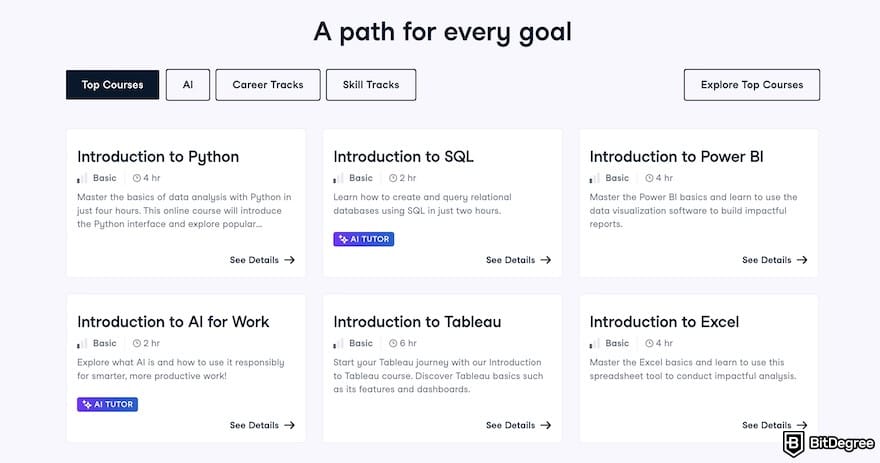
Course pages themselves are minimal, with no pop-ups, no ads, and no "you might also like" clutter pulling my attention elsewhere. Once I landed on a course, that page had my full focus, which I appreciated.
Signing up was just as painless, since I only needed an email and password, or one click via Google, Microsoft, LinkedIn, Facebook, or Apple. I was also prompted to answer a short goals questionnaire, which fed me personalized course and track recommendations, though skipping it and exploring on my own worked just as well.
What actually won me over, though, was the home profile once I got further in. Everything I needed to track my progress was sitting in one place, including the courses and tracks I was working through, my certification progress, my ranking on the weekly leaderboard, and my streak and XP activity. I didn't have to dig through menus to check any of it.
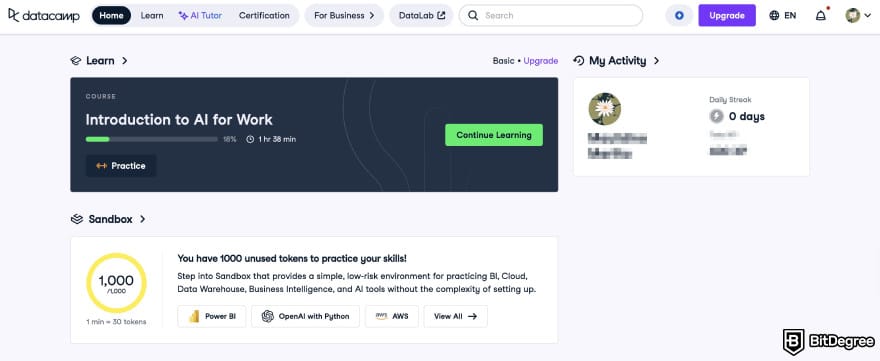
On the language front, I was impressed by how far DataCamp's reach goes. The interface supports English, Bahasa Indonesia, Deutsch, Español, Français (Canada and France), हिंदी, Italiano, 中文 (简体), 日本語, 한국어, Nederlands, Polski, Português (Brasil), Română, Русский, Svenska, ไทย, Tiếng Việt, Türkçe, and Українська, although several of these are still in Beta.
Arabic gets a more limited but interesting treatment, as it's supported through AI Tutor-powered courses, while the rest of the platform stays in English. It's a wide net for a platform this specialized in one subject area, though I'd temper expectations slightly since not every course has fully translated content yet.
DataCamp is still rolling out translations course by course, prioritizing its most popular ones first.
Overall, my experience mirrors what I've seen in user DataCamp reviews: I had no trouble finding what I needed, and the platform felt intuitive from early on.
How to Use DataCamp
After reading this DataCamp review, are you ready to get started? Below, I'll walk you through the two essentials: how to create your DataCamp account and how to enroll in a course once you're in.
How to Create a DataCamp Account
Creating a DataCamp account is quick and straightforward:
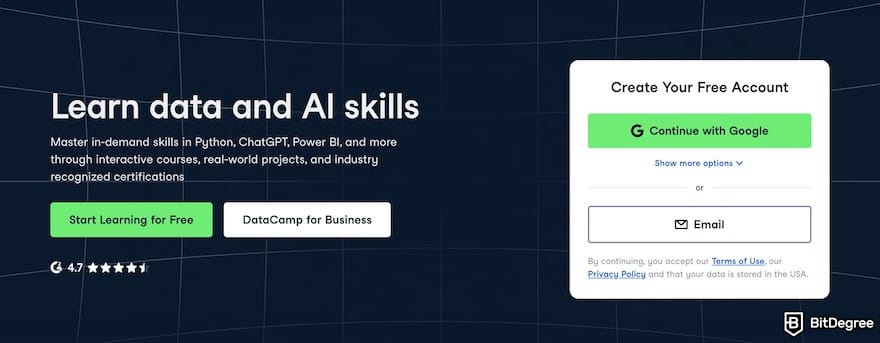
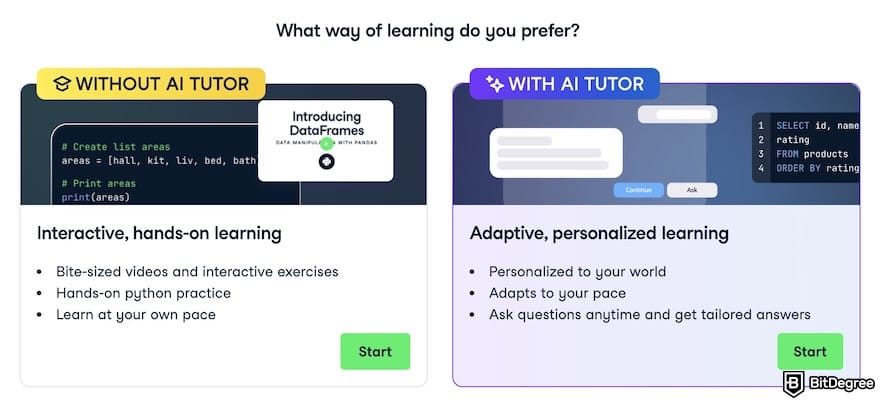
That's it; you're in. You can jump straight into the course the tool signed you up for, or click [Course Outline] at the top, then [Back to Dashboard], to browse the full course description or explore other subjects.
How to Enroll in a Course on DataCamp
The first chapter of every course is free. But to keep going beyond that, you'll need to subscribe to a paid plan, starting at $28/month (billed annually), by following these steps:
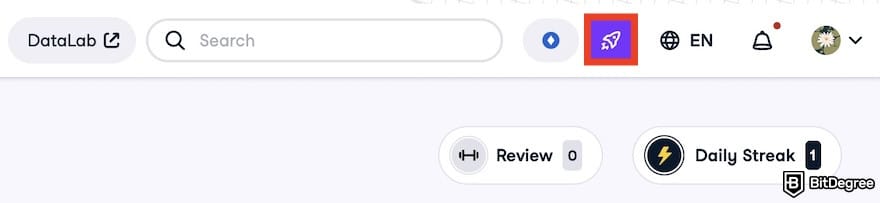
Once your payment goes through, your full course library, tracks, and certification access unlock immediately. You can pick up right where you left off in that first free chapter or browse other options.
Comparison to Other Popular Learning Platforms
DataCamp is a strong option, but it's not the only one worth considering. Here's how it stacks up against other top education platforms, so you can see where each one pulls ahead:
DataCamp VS Udacity
Udacity's flagship product is the Nanodegree, which is a mentor-supported, project-heavy program that usually takes three to six months to complete, built in partnership with companies like Google and Microsoft.
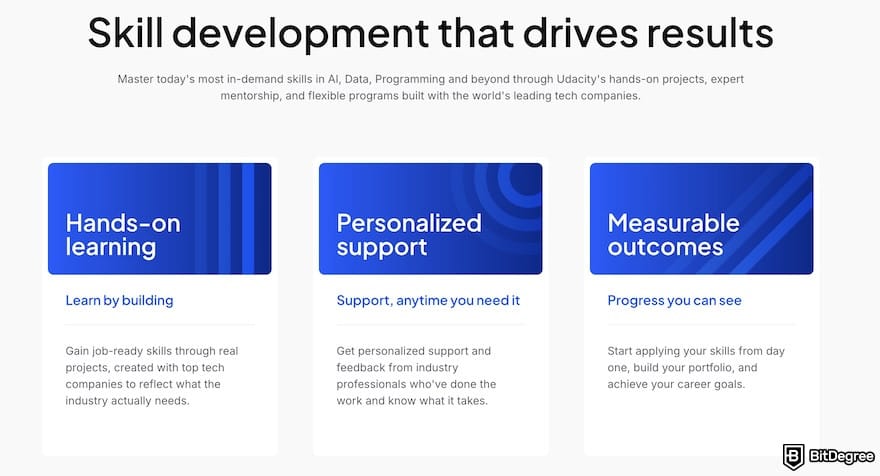
Every Nanodegree pairs video lessons with real-world projects that a human mentor actually reviews and gives feedback on, plus career services like GitHub portfolio reviews and LinkedIn optimization.
That human touch is Udacity's biggest differentiator from DataCamp, where feedback comes from automated exercises and, more recently, an AI Tutor rather than a person.
That mentorship comes at a real cost, though. Udacity runs a subscription model priced around $249-399 per month (with frequent 40–65% promotional discounts), which puts a single Nanodegree well above what a full year of DataCamp Premium costs.
DataCamp, by contrast, is modular and self-paced by design, so you can pick up a single course, a Skill Track, or a full Career Track without ever paying more than its flat monthly or annual rate, and you're never waiting on a mentor's schedule to get unstuck.
📚 Read More: Udacity Review
DataCamp VS Udemy
Udemy's model is fundamentally different from DataCamp's because it's a marketplace, not a curriculum. Anyone can publish a course, which is why the catalog has increased past 250,000 courses covering nearly any subject imaginable; not just data and AI like DataCamp.
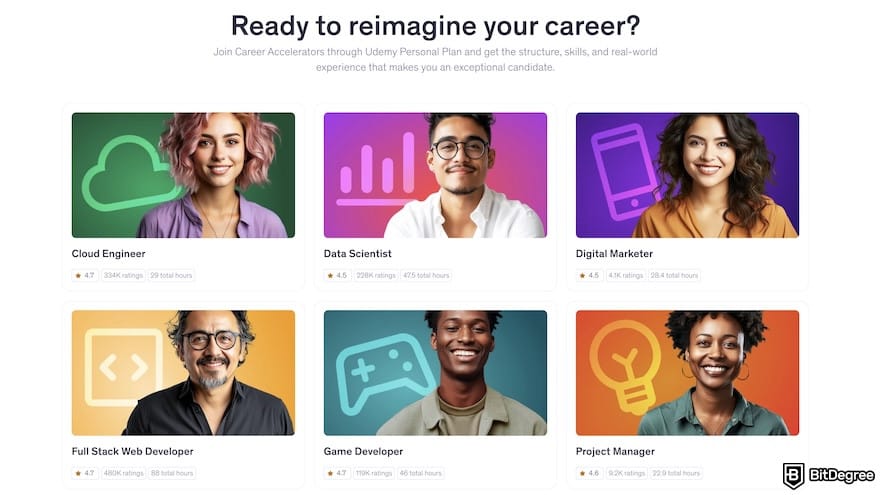
On this platform, you buy individual courses (often on deep, near-constant sales bringing $100+ list prices down to $10-20) and own them for life, or subscribe to Udemy's Personal Plan for a curated slice of the catalog. There's no structured path connecting one course to the next, unless you subscribe to its program called Career Accelerators.
DataCamp takes the opposite approach, with a smaller, curated catalog focused on data, AI, and analytics, organized into Skill Tracks and Career Tracks. Where Udemy gives you flexibility and breadth, DataCamp gives you a guided sequence, so you're never left wondering what to learn next.
It's also worth noting that Udemy's certificates are completion-only and carry little weight with employers, similar to DataCamp's free Statements of Accomplishment, though DataCamp's paid, proctored certifications go a step further than anything Udemy currently offers.
One more thing worth knowing: Udemy is no longer fully independent. Coursera completed its acquisition of Udemy in May 2026.
While the two platforms currently still operate separately, deeper integration is expected over time. That doesn't change the day-to-day comparison much today, but it's a sign Udemy's positioning could change in the near future.
📚 Read More: Udemy Review
DataCamp VS edX
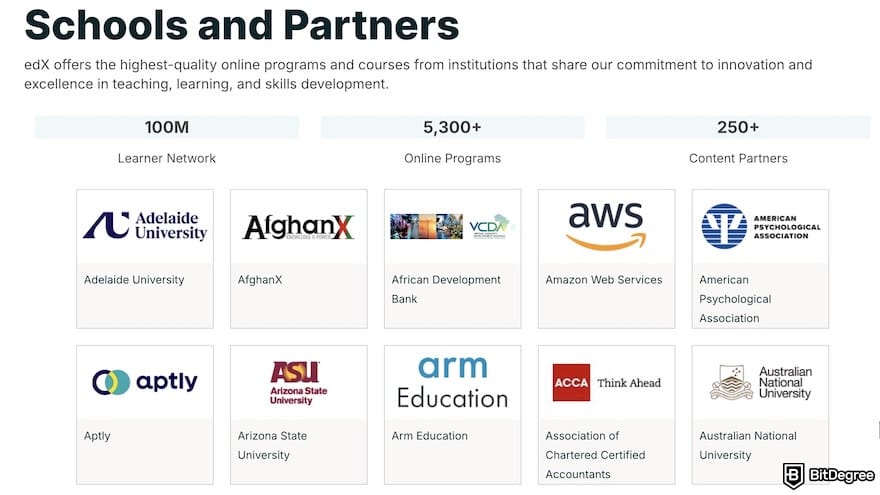
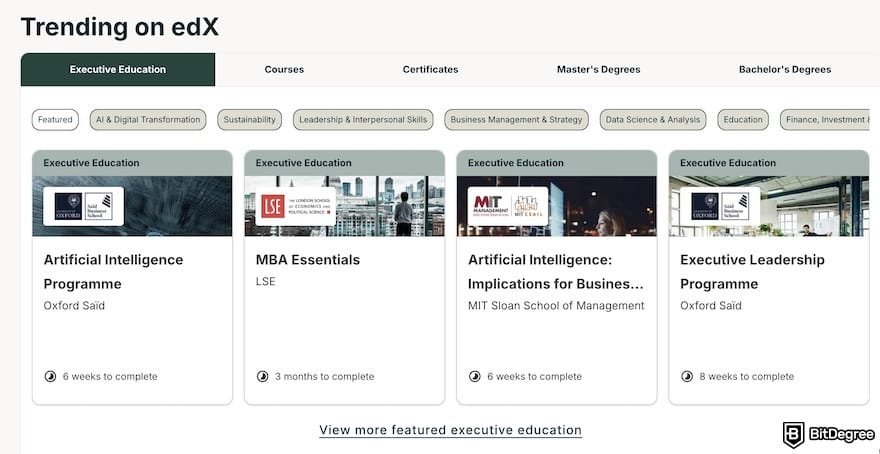
edX's core identity is about partnering with universities, including MIT, Harvard, Berkeley, and 250+ others, to offer real academic content, with most courses free to audit and a paid "verified track" (typically $50-$300 per course) unlocking graded work and a certificate tied to the issuing university's name.
You can find the broad academic topics edX covers, such as humanities, business, hard sciences, tech, and more.
Beyond single courses, edX also offers MicroMasters and Professional Certificate programs that can run $600-$1,500. Some of which count as actual credit toward a partner university's master's degree, which is a level of academic weight DataCamp doesn't attempt to replicate.
It's also worth noting edX's ownership history: the platform was acquired by 2U in 2021, went through a Chapter 11 restructuring in 2024, and has since stabilized with a 2026 recapitalization and new leadership. These changes are worth mentioning only because they explain why pricing and free-access policies on edX have changed somewhat since its nonprofit-era origins.
📚 Read More: edX Review
Conclusions: Is DataCamp Right for You?
After going through DataCamp's catalog, pricing, and gamification firsthand, my final take for this DataCamp review is straightforward: the platform is well worth trying if you're a self-directed learner who wants a structured, interactive way to build real, job-ready data and AI skills.
The structured Career Tracks take the guesswork out of what to learn next, the gamification keeps you coming back, and the pricing stays reasonable compared to more mentor-heavy competitors like Udacity.
That said, it's not a fit for everyone. If you need academically accredited credentials or a more personalized, human-guided learning experience, platforms like edX or Udacity will serve you better.
With a free Basic plan giving you the first chapter of any course, there's nothing stopping you from trying it yourself. Head to DataCamp and see if it clicks for you.
Scientific References
1. J. Namjoshi, M. Rawat: 'Role of Smart Manufacturing in Industry 4.0';
2. M. L. Brodie: 'What is Data Science?'.
About Article's Experts & Analysts


- + Easy to use with a learn-by-doing approach
- + Offers quality content
- + Gamified in-browser coding experience
- + The price matches the quality
- + Suitable for learners ranging from beginner to advanced
- - No accredited certificates
A leading data & AI course-focused online learning platform for beginners and advanced learners.
Disclosure: To keep our site running & free of charge, we may sometimes receive a small commission if a reader decides to purchase services via some links on site, at no extra cost.